How a Smart TV Purchase Notification on Christmas Morning Exposed My Husband’s Three-Year Secret Life

Eighteen hundred and twenty-six days. That is how long I kept my head down, managed our grocery bills to the penny, and told myself that my husband Greg was carrying a heavy burden to keep our family afloat in our Glendale neighborhood. I am a forty-four-year-old part-time accountant, and my natural tendency has always been to keep the peace. I hated confrontation, so whenever Greg sighed over his laptop and showed me spreadsheet columns proving our cash flow was too tight for a new water heater or a family vacation to the coast, I nodded, smiled, and took on extra contract bookkeeping work late at night.
I convinced myself that we were simply enduring a rough patch, that the late hours at his sales job were necessary, and that my quiet sacrifices were what kept our household together.
On Christmas morning, while our sixteen-year-old twins were still asleep upstairs, that entire fragile house of cards came down because of a television setting. Greg had set up our joint credit card account to sync balance notifications directly to our living room screen so we could monitor household spending together. I was sitting on the sofa with a mug of coffee, watching the digital fireplace burn on screen, when the top banner flashed black. It showed a transaction from the previous evening: twelve thousand dollars processed at Tiffany and Co. downtown. My hands went still on my mug. I looked over at Greg, who was standing by the kitchen island in his flannel pajama pants, pouring orange juice into a glass.
He saw me staring at the screen and quickly grabbed the TV remote from the coffee table, clearing the banner with two rapid clicks. He gave me a calm, practiced smile and said it was a software glitch from an old corporate account he used for client gifts at work. He told me not to worry about it and went to wake up the kids.
An hour later, we exchanged our usual practical gifts under the tree. Greg gave me a sturdy leather handbag I had mentioned needing for my bookkeeping office, along with a standard bottle of department store perfume. There was no little blue box under the tree. There was no twelve-thousand-dollar necklace. For eighteen months, Greg had been telling me that we needed to tighten our belts, that every dollar mattered, and that our savings were practically non-existent. I spent Christmas afternoon sitting in our quiet kitchen, staring at the financial spreadsheets Greg had built, trying to quiet the small, nagging voice in the back of my mind that told me something was deeply wrong.
I had noticed small inconsistencies for six months before that morning, but I had deliberately chosen to ignore them. I had convinced myself that pointing out his late hours or his sudden secrecy with his phone would only create unnecessary drama and ruin the stable life we had built.
That evening, while Greg was in the shower, I walked quietly into our home office and logged into our mobile carrier portal on my laptop. I pulled up the detailed usage logs for Greg’s line, my hands feeling strangely numb as the data loaded on the screen. Over the previous ninety days, Greg’s phone had sent and received twelve hundred and forty-seven late-night text messages and calls to a number saved under the contact name Dave from Work. Most of those communications were logged between eleven at night and two in the morning, right during the hours when I was downstairs at the kitchen table finishing up client tax filings and balancing our household accounts.
I reached into the desk drawer, pulled out a yellow notepad, and wrote down the ten-digit number. My hand was trembling so hard that the blue ink smudged across the paper, but I forced my fingers to steady.
The next morning, while Greg was out running errands for a supposed hardware run, I walked two blocks down to the corner strip mall and used the public payphone outside the laundromat. I dialed the number saved as Dave from Work, listening to the monotonous tone pulse through the receiver until a woman answered on the third ring. Her voice was light, relaxed, and entirely unhurried when she spoke into the line. She did not say hello in a professional manner; she answered with a familiar warmth that dropped straight into my chest like cold water. Greg? Did you forget your charger? That was all she asked before the silence stretched between us. I did not say a word back to her. I simply lowered the receiver onto the heavy metal hook, walked out of the booth, and started the long walk back to our house.
For the next six months, I did not throw a glass, I did not scream, and I did not ask Greg a single question about where he went on Thursday nights or why his phone bills showed hundreds of data packets exchanged in the dead of night. My lifelong conflict avoidance had curdled into a cold, protective instinct that I did not even recognize in myself. I knew with absolute certainty that if I confronted him with only a credit card popup and a phone log, he would lie, manipulate the story, and turn our teenagers against me while scrambling to cover his tracks. I needed absolute, undeniable facts before I made a single move. I began tracking the physical locations tied to his phone bill usage during his supposed late nights at the office, comparing the billing timestamps with the cell tower pings that repeatedly centered on a quiet residential development of two-story townhouses on the north side of Glendale, less than fifteen minutes from our front door.
On a warm Tuesday morning in April, after Greg left for his sales job, I drove over to the Glendale complex in my dusty SUV. I parked half a block down under the dense shade of a mesquite tree and waited, watching the front doors of the townhouses with the steady patience of someone waiting out a long accounting audit. At ten o’clock, the front door of the end-corner townhouse opened smoothly. A woman stepped out onto the concrete porch to collect her mail from the metal box. She was wearing a cream-colored silk robe, and hanging around her neck on a delicate platinum chain was a diamond pendant that caught the morning light. When she turned her head toward the sun, my breath caught in my throat and my hands locked onto the steering wheel. She was roughly my age, with dark shoulder-length hair, the same average height, and a nearly identical frame to my own. Looking at her from fifty feet away was like looking at a distorted reflection of myself from ten years ago, a ghost image stepping out of a life I never knew existed.
I recognized her face instantly from an old photograph album Greg kept tucked away in the back of his desk drawer. She was his former college girlfriend, a woman named Andrea whom he occasionally mentioned during our first year of dating as a distant college memory. He had systematically re-engaged with her three years prior, bringing her back into his life in our own suburb while telling me day after day that our household money was too low for a weekend trip with our children. I drove straight home, parked in the driveway, and sat down at my desk to open my personal email inbox. A notification sat unread from our primary bank, alerting me to an administrative update on our joint credit line that I had flagged two weeks earlier. The automated system had finally delivered a full joint audit statement along with a secondary safe deposit box inventory receipt, containing every transaction tied to our primary assets.
I opened the attached PDF files and began scrolling through three years of financial history. The paper trail did not just show an affair or a momentary lapse in judgment; it showed a systematic, deliberate drain on our family’s financial security. Over three years, Greg had opened an unauthorized secondary line of credit tied directly to our primary residential equity without my knowledge or signature. He had diverted a total of forty-eight thousand five hundred dollars in unrecorded marital funds into a separate private bank account that I had never seen. He used those funds to pay the monthly lease on Andrea’s Glendale townhouse, buy her designer jewelry, cover her car payments, and take her on weekend trips to Sedona, all while forcing me to stretch every dollar at the discount grocery store and watch our teenagers drive an eighty-dollar rust-bucket sedan to high school. He had intentionally built a complete secondary life right down the road, choosing a woman who looked like me to play a quiet, secret role while he maintained his respectable public standing as a dedicated family man in our neighborhood.
As a part-time accountant, I understood numbers better than words. Numbers do not lie, and they cannot be charm-talked out of existence by a man who knew how to smile his way through a spreadsheet. Instead of driving back to the Glendale townhouse to cause a public scene that would only disrupt our children, I took a personal day from work and scheduled back-to-back appointments with a top family law attorney downtown and a certified forensic accountant. The forensic accountant spent four grueling days reviewing the credit line history, the bank transfer receipts, and the safe deposit logs. He compiled a seventy-page certified audit proving beyond a shadow of a doubt that Greg had committed marital asset fraud by diverting tens of thousands of shared liquid assets into a non-marital account to support another individual while our household budget was systematically starved.
My attorney drafted an emergency petition for dissolution of marriage, along with an immediate, court-ordered financial freeze on all joint accounts and credit lines to prevent any further movement of money. Under state law, because the funds were illegally diverted from our primary marital estate, we were entitled to seek full reimbursement directly from Greg’s personal asset share. On a Friday afternoon at two o’clock, I took half of our remaining liquid checking balance, exactly fourteen thousand dollars, and legally deposited it into a court-monitored escrow account managed by my attorney to secure my children’s living expenses for the coming months. At three o’clock, a process server walked into Greg’s corporate office downtown and handed him the formal divorce petition, the financial freeze order, and the forensic audit report right in front of his regional manager and executive team.
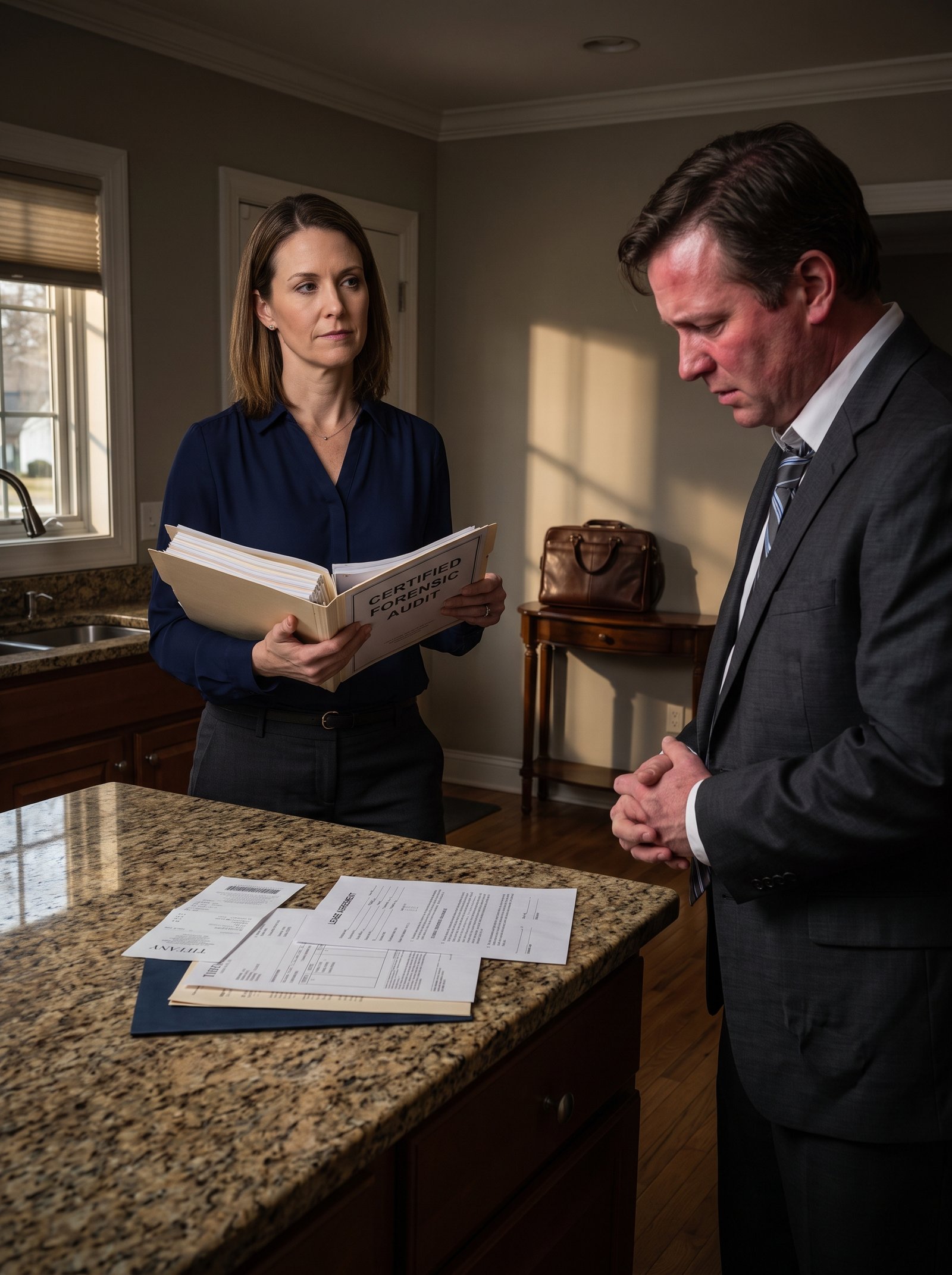
When Greg arrived at our house two hours later, his face was flushed bright red and his hands were shaking so badly he could barely fit his keys in the front door lock. He slammed his briefcase on the foyer table and tried to storm toward me in the kitchen, demanding to know why I had frozen his credit lines and humiliated him in front of his entire office. I stood firmly on the other side of the kitchen island, holding the heavy certified audit folder in my hands like a shield. I set the documents down in front of him, opening the pages directly to the section showing the twelve-thousand-dollar Tiffany receipt, the total diverted transfers, and the Glendale townhouse lease agreement bearing his signature.
You have twenty minutes to pack a bag, I told him, my voice completely steady and cold. Your name is off the primary accounts. The lawyer has the phone logs, the bank statements, and the photo of the necklace. If you say one word about financial struggle or keeping the peace, I will hand this entire folder to your board of directors before five o’clock.
Greg looked down at the paper, his eyes darting across the columns of numbers and dates. For the first time in twenty years of marriage, he had no explanation, no clever spreadsheet, and no smooth words to bridge the gap. He stood there in the quiet kitchen for a long moment, breathing heavily through his nose, before turning around to walk up the stairs. He packed a single suitcase with his clothes and left without looking back at me or the kitchen where we had spent so many years pretending everything was fine.
The court proceedings took seven months to finalize through a series of tense depositions and financial disclosures. Because the forensic evidence proved Greg had systematically committed financial fraud against our marital estate, the judge ordered him to liquidate his personal retirement investments to reimburse the forty-eight thousand five hundred dollars directly back to me. The family home was awarded to me with primary residential occupancy so our children could finish their high school years without the added disruption of a sudden move. Greg was ordered to pay full spousal and child support, and his reputation as the modest, hard-working neighborhood family man was completely dismantled among the friends and extended family members who had once praised his dedication.
I used a portion of the restored funds to finally repair our sagging back porch, install a brand-new water heater that actually heated our water without making a rattling sound, and take my twins on their long-overdue trip to the coast before they left for college. On a quiet Saturday morning in October, the air in Glendale was crisp and clear, carrying the faint scent of dry leaves across the neighborhood. The landscapers had just finished trimming the mesquite trees in the front yard, leaving the lawn looking neat and cared for. I walked down the brick front pathway to the metal mailbox sitting by the curb. I took a small screwdriver out of my sweater pocket, unbolted the brass nameplate that had read Greg and Laura Mercer for nearly two decades, and replaced it with a simple black plate bearing only my name and my children’s name. I dropped his metal nameplate into the recycling bin by the garage, turned back toward my house, and took a deep, clean breath of the autumn air, knowing that the peace in my home was finally real.