How My Stepson’s Demand for $5,500 in Rent Exposed His $86,000 Theft and a Fake Conservatorship Petition

The argument started over a yellow pad of lined paper on our kitchen table in our suburban Lehigh Valley home, right where Frank had eaten his oatmeal every morning for twenty years before the cancer took the use of his legs. My husband Frank had been buried six months, and my personal savings sat at almost zero after three years of paying for his terminal cancer care, home health aides, and specialized prescriptions that the insurance company found every possible loophole to deny.
I set down a clear breakdown of our monthly household bills in front of my eighteen-year-old stepson, Tyler, who was sitting there scrolling through his phone with his sneakers propped up on the edge of the maple wood. The math was plain as day and I had spent two hours double-checking every single line item the night before so he could see I wasn’t making numbers up out of thin air. The property taxes, mortgage balance, utilities, and basic upkeep totaled $5,500 for the upcoming season, an amount I simply could not cover alone while working reduced hours at the clinic after my caregiving duties finally ended. I asked Tyler to contribute his fair share from the full-time job he had held for eight months at a local auto repair shop down on Route 22, or at least help maintain the family home his father had left behind for us both.
Tyler did not even glance at the paper. He leaned back in his chair until the wooden legs groaned against the linoleum, crossed his arms over his chest, and laughed right in my face. He told me that I was nothing more than an unpaid maid his father hired off the street, and that since I was childless and had no real family of my own left in this state, my only purpose was to keep cooking his meals, doing his laundry, and maintaining his house until he decided what to do with it when he turned twenty-one. He called me his personal financial backer and walked out the front door, slamming it so hard the hall mirror rattled against the drywall and dropped a speck of silver backing onto the rug. For six years, ever since I married Frank when Tyler was twelve and still struggling to pass his pre-algebra quizzes, I had poured everything I had into that boy.
When Frank grew too ill to work the lathe at the machine shop, I drained my own $42,000 retirement fund to keep the lights on and buy Tyler’s clothes, baseball gear, insurance, and the reliable sedan he wrecked six months after getting his license. I suffered through Tyler’s coldness and disrespect, telling myself he was just grieving his mother who had left for Florida years ago, or stressed about his father’s declining health, always making excuses because I was not his biological mother and I was constantly trying to earn a place in a home where I was treated like disposable domestic labor.
That night, listening to the echo of the front door dying out in the cold driveway, something broke inside me. The guilt vanished, replaced by a quiet, steady resolve that felt colder than any winter wind I had ever known. I walked to the front door, locked the deadbolt with a firm twist, and flipped the sliding brass latch that Frank had installed back when we first moved in.
The next morning, while Tyler was clocking in at the auto shop on Route 22, I called a locksmith from the yellow pages and had every exterior lock on the house rekeyed to a new set of brass cylinders. Then I walked into Tyler’s bedroom with heavy lawn trash bags and thick cardboard liquor boxes I had begged off the stock boy at the grocery store down the road. I was done being treated like an unpaid servant in my own home while the bills piled up around my ankles like autumn leaves. I cleared his closet, boxing up his designer hoodies, his dozens of sneakers, and the expensive electronics he bought with money I suspected came from somewhere other than his starter wages. When I pulled the heavy wooden bed frame away from the wall to sweep the accumulated dust ruffles and stray bottle caps from the baseboards, my broom handle struck a solid object buried deep underneath the fringe in the back dark corner where the floorboards met the baseboard.
It was a heavy, military-style black duffel bag, double-zipped and secured with a small brass padlock that looked brand new. I stood there in the quiet room for a long minute, listening to the refrigerator hum in the kitchen downstairs, wondering why a nineteen-year-old kid needed a locked military bag hidden beneath a mattress. I brought a pair of heavy wire cutters from Frank’s workbench in the garage and snipped the brass padlock shackle with a single hard squeeze that left my palms stinging. I unzipped the main compartment, expecting to find old high school porn magazines, stashed weed, or stolen auto parts from the repair shop. Instead, the bag was packed to the top with neat, stacked bundles of hundred-dollar bills bound in paper bank bands that smelled faintly of mold and damp basement air. Sitting directly on top of the money was a thick manila folder holding original legal documents, life insurance claim receipts listing my name across the primary beneficiary line in faded blue ink, and a set of drafted legal forms that made my breath catch in my throat.
I sat down hard on the bare floor of Tyler’s cleared bedroom, surrounded by cardboard boxes, and pulled the manila folder into my lap with fingers that felt stiff and useless. My hands were ice cold as I unfolded the top document and squinted at the letterhead in the dim light coming through the small window. It was an official payout confirmation from my late husband’s term life insurance policy through a regional carrier in Philadelphia. When Frank was diagnosed with stage four lung cancer, he assured me repeatedly that he had maintained a $100,000 policy to ensure the house would be paid off and that I would be protected if the worst happened while I was still working part-time. But after his funeral, when I contacted the insurance company from the kitchen landline, a corporate representative told me in a flat, bored voice that the policy had lapsed due to non-payment two years prior during Frank’s second round of chemo. I had believed them at the time, assuming Frank had simply forgotten to pay the premiums while managing his pain medications and his daily medical equipment rentals.
The documents in the bag proved otherwise, down to the exact date and tracking number. The policy had remained active until the day Frank died, paid through an automatic bank draft that I never knew existed because Frank handled the household accounts before he got too sick to balance a checkbook. Two weeks before Frank passed away, while he was heavily medicated and sleeping eighteen hours a day in the hospital bed we rented for the parlor, Tyler had secretly intercepted his father’s mail from the roadside box. He filed a fraudulent change-of-address form that redirected all official insurance correspondence to a private post office box downtown near the bus station. When the $86,000 death benefit check arrived in my name six weeks after Frank’s funeral, Tyler had intercepted the mail carrier at the front gate, forged my signature on the back of the check with a practice run on a scrap envelope, and deposited it into a newly created joint account he had managed to open at a credit union using my stolen personal details from my old tax folders. He had withdrawn the entire $86,000 in physical cash over a period of three frantic weeks, bundling it inside the black duffel bag beneath his bed where he thought nobody would ever look while he was out working on transmissions.
Tucked beneath the insurance receipts was an even more sinister set of papers that turned my stomach inside out. It was a drafted petition for legal conservatorship, completely filled out with my personal details, my social security number, and claims that I was mentally incapacitated and emotionally unfit due to severe, untreated grief. Attached to the printed legal petition were color-printed email exchanges and photos showing Tyler meeting with an unscrupulous real estate buyer who specialized in quick, distressed property cash-outs for pennies on the dollar. Tyler had taken wide-angle photos of our home interior, sent them to the predatory buyer, and agreed to sell the property for cash as soon as he reached legal majority at eighteen and successfully forced me out under the conservatorship filing with the help of a cheap local lawyer he had retained online. He had sat at my dinner table every single night, eating meals I paid for with borrowed grocery money, watching me panic over $5,500 in household expenses, while sitting on $86,000 of my stolen money and plotting to declare me unfit so he could take the deed to my home and leave me with nothing in the middle of a Lehigh Valley winter.
At four o’clock that afternoon, right on schedule, I heard a sharp key scrape against the front door lock in the foyer. When the key didn’t turn because of the new brass cylinders I had installed that morning, heavy fists began pounding against the solid oak door with a rhythmic, furious violence. Brenda! Tyler shouted from the porch, his voice cracking with teenage rage and entitlement. What the hell is this? Open the door right now! My key isn’t turning! I stood in the quiet hallway, holding the manila folder tightly against my chest like a shield against everything I had foolishly believed about our family for six years. I did not open the door, and I did not say a single word through the wood. I walked down the narrow hall to the small home office, picked up the desk phone, and dialed our family probate attorney, Arthur Vance, before calling the local police non-emergency line to report a trespasser attempting to break into my private residence.
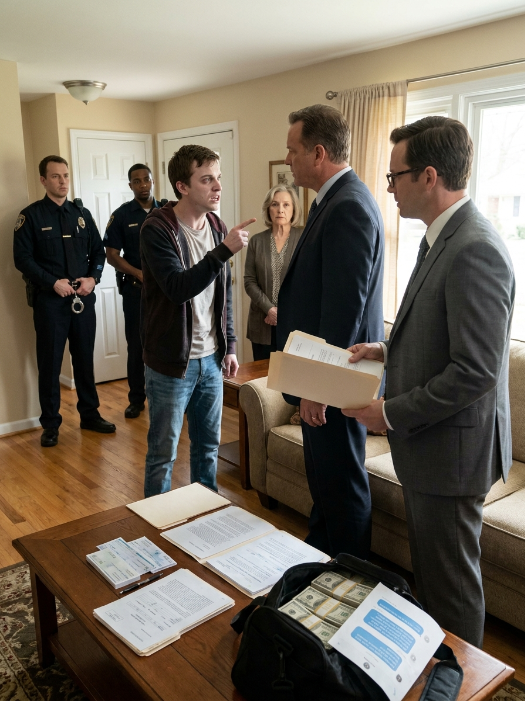
Detective Robert Vance arrived at the house twenty minutes later in an unmarked sedan, pulling up right behind Tyler’s rusted sedan alongside two uniform officers and my probate lawyer, Arthur, who stepped out of his town car with a briefcase in hand. Tyler was still standing on the front porch, kicking the bottom decorative panel of the front door with his heavy work boots and screaming threats about calling the county housing authority to report an illegal eviction by a crazy person. I unlocked the front door and stepped aside, letting the officers and Arthur into the living room where the afternoon light was hitting the faded floral sofa. Tyler marched in right behind them before the officers could stop him, his face flushed dark red with fury, pointing a filthy mechanic’s finger directly at my face. She locked me out of my own house! Tyler yelled at the detective, his voice pitching high and frantic. I live here legally! She’s crazy, officer, she’s been losing her mind since my dad died six months ago and I’m filing papers to have her taken care of by the county court!
Detective Robert Vance did not even look at Tyler. He was a tall, middle-aged man with tired eyes who had seen every ugly family dispute in this county twice over. He looked past Tyler at Arthur, who stepped forward with a calm, deliberate slowness and laid the heavy black duffel bag and the thick manila folder directly on the glass-topped coffee table. Detective, Arthur said quietly, opening the folder to reveal the crisp legal documents and the forged bank slips. My client, Mrs. Brenda Vance, just uncovered evidence of severe financial fraud, mail theft, identity theft, and forgery committed against her estate by an occupant of this residence. Arthur laid out the evidence beat by beat on the coffee table like a dealer putting down a winning hand in a high-stakes game. He showed the original life insurance policy confirmation from the Philadelphia carrier, the forged check endorsement showing my signature written in Tyler’s shaky teenage handwriting, the withdrawal slips from the downtown credit union, and the $86,000 in cash bundles contained inside the opened duffel bag. Then Arthur produced the printed text threads and emails proving Tyler was actively negotiating to sell a property he did not own to a predatory cash buyer in Allentown.
Tyler’s arrogant posture collapsed in seconds, his shoulders rounding as if a heavy physical weight had dropped onto his back. His eyes darted wildly from the stacks of cash on the table to the two uniform officers standing solidly by the hallway door with their hands resting on their duty belts. The color drained completely from his face, leaving him looking pasty and much younger than nineteen. That’s dad’s money, Tyler stammered, his voice suddenly sounding small, pathetic, and cracked like a breaking branch. He meant for that money to come to me! She’s not even my real mother! She didn’t deserve a single dime of his estate after he died! The primary beneficiary named on this policy is Brenda Vance, Detective Vance said evenly, pulling a pair of cold steel handcuffs from his belt loop with a practiced snap. You intercepted federal mail, forged a legal instrument, and stole eighty-six thousand dollars in cash proceeds. You have the right to remain silent and anything you say can and will be used against you in a court of law.
The officers snapped the heavy handcuffs around Tyler’s wrists with a sharp click that echoed off the living room walls and led him out the front door toward the driveway. He did not look at me once as they walked him down the cracked concrete path to the rear door of the patrol car, his head hanging low between his shoulders. Over the next three months, the legal system moved with quiet, relentless precision while I stayed in the house alone with the ghosts of Frank’s illness and the new deadbolts on the doors. Arthur Vance filed emergency motions with the Lehigh Valley circuit court, officially revoking all of Tyler’s residency rights to the property and securing a permanent order of protection that kept him fifty yards away from my front step. Because the cash was recovered intact inside the duffel bag without being laundered or spent, the entire $86,000 was legally deposited into my sole bank account as the rightful, unchallengeable insurance beneficiary under Frank’s original policy terms.
The county prosecutor brought formal criminal charges against Tyler for grand larceny, insurance fraud, and federal mail theft, presenting a mountain of paperwork that left no room for argument or teenage excuses. Facing overwhelming documentary evidence and the prospect of real prison time, Tyler accepted a plea agreement through a public defender that included five years of probation, mandatory restitution for legal fees, and a permanent felony record that would follow him into every job interview for the rest of his natural life.
Six months after that terrible morning when the locks were changed, my house was finally quiet in a way I had not experienced since before Frank got sick. I used a portion of the $86,000 insurance payout to settle the remaining mortgage balance in full with the bank, securing the unencumbered deed to the home Frank and I had shared through every bad year and every hospital bill. I paid off my small credit debts at the hardware store and the pharmacy, repaired the aging slate roof that had been leaking into the attic every time it rained hard, and hired a local paving crew to repave the cracked driveway and repaint the front porch railing a clean, bright white. The living room, once filled with tension, argument, and constant judgment from a boy who viewed me as nothing more than an inconvenient servant, was bright and peaceful in the autumn air. Late afternoon sunlight poured through the clean glass windows onto the polished hardwood floors where I had once sat on the bare boards with my cold hands shaking over a manila folder.
On a small oak side table near the front window sat the cleared, original property deed to the house, stamped with the Lehigh Valley county recorder’s official gold seal. Next to it was a framed photograph of Frank and me from our early years together down by the river, before the illness and the deception had taken over our lives and turned our home into a battlefield. I stood in the center of the room, holding a warm ceramic mug of tea, listening to the soft rustle of the oak trees in the front yard shedding their dry leaves onto the lawn. For six years I had believed that love required me to endure disrespect, financial ruin, and emotional exhaustion until there was nothing left of me to give away. I set my ceramic cup down on the table, took a deep, clean breath of air that smelled of cedar and woodsmoke, and looked out at the quiet street through the glass, knowing that my home was finally mine, my dignity was intact, and the heavy guilt that had held me hostage for so long was gone for good.