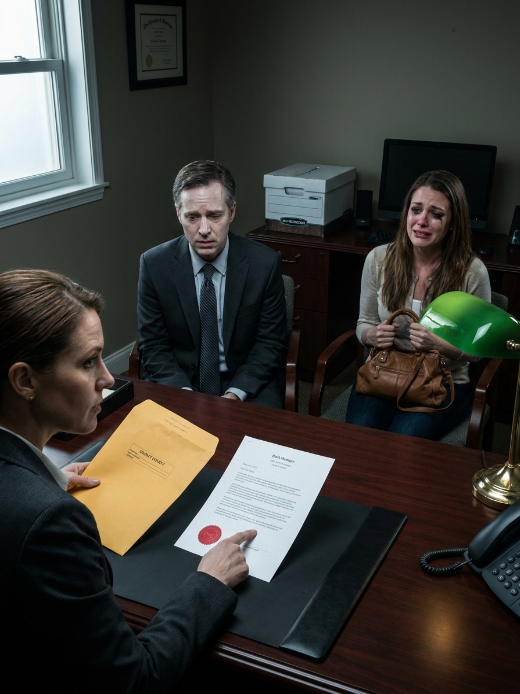
How My Twin Sister’s Forged Mortgage Signature on Our Family Farm Cost Her Everything

The white envelope was sitting right there on the wooden kitchen counter when I came in from feeding the cattle at 7:42 in the morning, dusted with dry snow from the morning blizzard that had blown down off the ridge. It was an official certified tax redirect notice from the county treasurer, addressed to Miller Family Homestead LLC, marked urgent in bright red ink stamped across the top corner. I pulled off my heavy leather work gloves, dropped them into the tin bucket by the back door, and opened the envelope with a dull butter knife because I didn’t want to go looking through the utility drawer for the kitchen shears.
I assumed it was just the annual assessment update for our two-hundred-acre family farm. My twin sister Glenda and I had owned the place jointly since our parents passed away six years ago in that terrible November truck accident on Route 9. I handled the daily labor, the equipment maintenance, the calving seasons, and the fencing, while Glenda handled the office accounting and the paperwork from her rented brick townhouse up near the county seat where she ran her little home staging business.
When I unfolded the stiff paper, my eyes stopped right on the highlighted bold line near the middle of the page where the county assessment breakdown began. It was an official notice of secondary tax assessment based on a newly recorded encumbrance: a $280,000 second mortgage placed on our entirely unencumbered farm property just three weeks prior by Prairie State Lending over on Main Street. My breath hitched in my chest and stayed there, cold and sharp.
Two hundred and eighty thousand dollars was more money than our cattle operation grossed in four solid years of good beef prices. There had to be some kind of clerical error at the courthouse because our farm was completely paid off down to the last cedar post. My father had burned the original mortgage papers in the old iron woodstove forty years ago when Glenda and I were just starting grade school, and we had never taken out a single line of credit against the land through all the lean drought years or the bad winters when the tractor transmissions blew. I grabbed my cell phone off the charger by the microwave and called Glenda immediately, my thumb shaking so badly I hit the wrong speed dial button twice before getting her direct line.
It rang four times with that hollow, echoing tone before going straight to her voicemail greeting where she sounded bright and professional. “Glenda, call me the second you get this,” I said, trying to keep my voice steady against the rising panic in my throat. “I just opened a letter from the county treasurer.
It says there’s a two hundred and eighty thousand dollar second mortgage on the farm. What in God’s name is going on?” She didn’t call back. I waited twenty agonizing minutes, staring out the frosted kitchen window as the north wind drove hard sheets of snow against the weathered red siding of the cattle barn. Then I put my heavy chore coat back on, grabbed my truck keys off the hook, and drove through the blinding whiteout down the unplowed township road, heading straight for the county courthouse because I knew Clara Higgins would still be behind her counter.
The land registry office was dead quiet because of the blizzard, smelling faintly of old paper, radiator heat, and wet wool. County Registrar Clara Higgins was sitting behind the high oak counter, adjusting her half-moon glasses over a stack of yellowed tax ledgers. Clara had known our family since Glenda and I were running around the courthouse lawn in matching smocks while our mother paid the property taxes. “I need to see the physical deed file for the Miller homestead, Clara,” I said, leaning both hands on the smooth wood of the counter. “I just got a tax notice saying there’s a heavy lien on our land out on Creek Road.” Clara looked up at me with deep, grandmotherly concern in her tired eyes, then stood up without a word and walked into the fireproof steel vault in the back room.
She returned two minutes later carrying a thick manila folder stamped with our parcel number, 44-09-12-88. She pulled out the top document and laid it flat between us on the counter. It was a full secondary mortgage agreement for $280,000, filed under a formal Power of Attorney bearing what looked like my own signature.
“Glenda brought this in three weeks ago,” Clara said softly, pointing her pen to the official filing stamp in the bottom right corner. “She had a power of attorney document granting her full authority to sign land encumbrances on your behalf without your physical presence.” A cold weight dropped into my stomach. “I never signed a power of attorney,” I whispered, staring down at the black ink on the page. “We’re equal fifty-fifty co-owners under our parents’ will. I never gave anyone permission to put a single dollar of debt on this farm.” Clara leaned closer, tilting the green metal desk light over the page to show me the finer details. “Look at the physical document, honey,” Clara said. I looked down at my supposed signature at the bottom of the form where the notary block was filled out. The notary stamp date was recorded in faded black ballpoint ink, but my signature over the line was written in dark blue gel ink, thick, heavy, and completely uneven compared to my usual cursive. “That’s not how I sign my name,” I said, my voice dropping an octave. “I haven’t used a gel pen since we bought those office supplies in town four years ago.”
“It’s worse than that,” Clara replied quietly, her expression darkening. “When Glenda brought this in for filing, our new automated land registry system flagged the physical filing for an ink-density audit because the signature layer didn’t match the age or composition of the notary stamp. We ran the document through the registry scanner yesterday morning just to be sure.” Clara reached into the back of the manila file and pulled out a single sheet of heavy bond paper bearing the official red seal of the Registrar of Deeds. “This is the official County Signature Audit Log,” Clara said, sliding it toward me. I took the paper from her hands. The audit log detailed a technical analysis of the physical filing. The notary stamp had been placed on a blank administrative form weeks before, but my signature had been written in dark blue gel ink with completely different density levels, applied long after the notary seal had set into the fiber of the paper. The timestamp on the document filing had also been manually altered to bypass standard verification checks.
“Who was the lender on this?” I asked, my voice dropping into a hard, quiet register that made Clara blink. “Prairie State Lending,” Clara said, pointing to the top line of the printed mortgage contract. “The loan officer listed on the recording sheet is Mark Vance. He’s based at their regional office over on Main Street, right across from the hardware store.” “Was Mark Vance present when this was filed at your window?” I asked. “No,” Clara said, shaking her head. “Glenda brought the paperwork in herself. But Vance signed off on the lender certification, claiming he had verified your identity and witnessed the execution of the power of attorney in his private office. He completely bypassed mandatory identity verification protocols.” The pieces began falling into place with a sickening, heavy clarity. Six months ago, Glenda had started an upscale home staging business in the city fifty miles south, renting a big warehouse and buying expensive furniture.
She had bragged about taking on huge commercial leases and buying high-end inventory, but whenever I asked about her accounting or how the business was doing, she brushed me off with a wave of her hand. She was drowning in speculative business debt, facing catastrophic personal losses, and she had used our thirty-six-year-old family farm as emergency collateral to save her own skin. And Mark Vance, eager to collect a massive commission on a $280,000 loan during a slow quarter, had cut corners and ignored the glaring signs of fraud.
“I need certified copies of this entire file, Clara,” I said, straightening up from the counter. “The audit log, the forged power of attorney, and the lender certification sheet.” “I already have them stamped and ready for you,” Clara said, sliding a heavy yellow manila envelope across the counter. “I also notified the township sheriff’s department this morning when the audit log came off the printer because state land fraud statutes require it. What are you going to do with these?” “I’m going to go see my sister,” I said. I left the courthouse and drove three miles through the swirling snow to the regional office of Prairie State Lending. The blizzard had thinned out the morning traffic, and the asphalt parking lot was mostly empty except for two cars parked near the side entrance. One of them was Glenda’s blue sedan with the snow piled high on the roof. I walked through the heavy glass doors into the warm, carpeted lobby, my boots leaving wet tracks on the industrial rug. Through the glass partition of a corner office, I saw Glenda sitting across a broad oak desk from a man in a tailored grey suit who had to be Mark Vance.
They were looking at a laptop screen together, talking animatedly, their faces lit by the blue glow of the display. On the desk right between them sat a freshly printed file folder marked Disbursement Authorization in bold red lettering. I didn’t bother to knock on the frosted glass. I pushed the door open with the flat of my hand and stepped directly inside the office. Glenda spun around in her executive chair, her face going completely pale the moment she saw me standing in the doorway with the heavy yellow county envelope clutched in my hand. “What are you doing here?” Glenda gasped, her voice tightening into a shrill register. “I thought you were out at the dairy barn feeding the heifers.” “I was,” I said, shutting the heavy door firmly behind me with a loud click. “Until I opened the certified tax redirect notice from the county treasurer that arrived on my kitchen counter.” Mark Vance stood up from his desk, smoothing his silk tie with a practiced, slick smile that didn’t reach his eyes. “Excuse me, ma’am. This is a private commercial consultation.
If you need an appointment with our loan department…” “I don’t need an appointment, Mr. Vance,” I said, stepping directly up to his desk and looking down at him. “I’m the co-owner of the Miller homestead. The land you just attempted to encumber with a two hundred and eighty thousand dollar second mortgage without my knowledge or consent.”
Vance’s smile faltered slightly, but he quickly recovered his professional corporate tone. “Ah. You must be the twin sister. Glenda assured me that you were fully aware of the credit line and that she held full legal power of attorney to execute the documents on your behalf.” “She lied to you,” I said flatly. “And you chose not to check.” “Now wait a minute,” Vance said defensively, his cheeks flushing a mottled red. “We followed standard administrative lending procedures. We have a signed power of attorney on file right here in our portfolio.” “A forged power of attorney,” I corrected him, my voice dangerously low. “It’s not a forgery!” Glenda interjected frantically, standing up from her chair and grabbing her leather purse off the floor. “It was just an administrative consolidation! I was going to pay the entire balance back before the first quarterly assessment hit the books! I was protecting us! My business just needed a temporary bridge loan to clear out my supplier debt!” “You put a two hundred and eighty thousand dollar lien on the land our parents worked their whole lives to keep clear of debt,” I said, looking my twin sister dead in the eye. “You risked everything we have to cover your own failed speculation.”
I opened the yellow envelope, pulled out the certified documents, and slapped them down hard on top of Vance’s open disbursement folder. “That is an official County Signature Audit Log, signed and stamped by Registrar Clara Higgins,” I said, pointing at the red raised seal on the paper. “It proves that my signature was forged in blue gel ink long after the notary stamp was placed on that blank sheet. It also details altered timestamps on the filing that violate state registry laws.” Vance picked up the audit log with trembling fingers, his eyes darting across the technical findings and the official registrar’s seal. As he read the fraud certification, the color completely drained from his face until he looked as gray as his suit. “And here,” I continued, dropping another sheet onto his desk right beside the audit log, “is your signed lender verification sheet, Mr. Vance. You signed under penalty of perjury that you personally verified my photo identification and witnessed my signature on that power of attorney. You bypassed mandatory identity verification checks to push a fraudulent mortgage through for a business associate.” Vance stared at his own signature on the paper, his hands beginning to shake so badly he had to set the page back down on the desk.
“If that loan disbursement goes through today,” I said, keeping my tone razor-sharp and quiet, “I will walk straight back across the street to the prosecutor’s office. This certified audit log and police incident report will result in an immediate felony charge for probate and land registry fraud against Glenda, and a criminal investigation into you and this branch for fraudulent loan origination and falsifying bank records.” “You wouldn’t do that to your own sister,” Glenda cried, tears spilling hot and fast over her mascara. “We’re family! We’ve lived on that farm our whole lives!” “You gave up our family the second you put a price tag on our home,” I replied without a trace of pity in my voice. Vance looked between the certified county audit log and Glenda’s weeping face, calculating the damage in real time. He knew he was facing total professional ruin, the loss of his banking license, and potential criminal prosecution for fraud compliance failure.
He reached out, grabbed the disbursement folder from the desk, and slid the entire file into his heavy-duty office shredder box. Then he pulled up his computer terminal, his fingers flying across the keyboard with frantic speed. “I am executing an immediate emergency cancellation and full discharge of the mortgage contract,” Vance said, his voice trembling as he stared at the screen. “The lien is permanently voided. No funds have been disbursed, and no claim exists against the Miller Family Homestead LLC.” He printed out the official cancellation receipt, stamped it with the bank’s corporate seal, and handed the original directly to me across the desk.
Ten minutes later, I stepped out of the lending office into the quiet winter afternoon. The blizzard had finally stopped, leaving a fresh, pristine layer of white snow over the town streets. Glenda followed me out to the parking lot, sobbing, begging me to listen, asking how she was going to pay off her creditors without the loan money. I turned to face her beside the driver’s side door of my truck. “The loan is gone, Glenda,” I said, my voice steady and cold as the air around us. “And so is your authority on the farm. Tomorrow morning, my lawyer will have the legal papers ready to formally remove you from the farm’s operating LLC. You will sign them, or the county sheriff will proceed with the forgery indictment. You can figure out your own debts without using our parents’ land.” She stood there in the snow, speechless, realizing that her manipulation had finally hit an unyielding wall of reality.
I got into my truck, turned on the heater, and drove the three miles back to the homestead. The afternoon sun was finally breaking through the heavy gray clouds, casting a golden light across the snow-covered fields. I pulled up to the entrance of the property and stopped at the heavy iron gate. I got out, walked through the crisp snow, and pulled the heavy brass chain around the fence post. I snapped the padlock shut, listening to the clean, solid click of the iron locking into place. I looked out across the two hundred acres of quiet, unencumbered land, the barn, the old farmhouse, and the rolling pastures stretching out to the tree line. The $280,000 lien was gone. The farm was safe, secure, and entirely protected. I took a deep breath of the cold, clean winter air, turned my key in the lock, and walked back up the drive toward my home, surrounded by absolute peace.