How Poured Gravy on My Silk Tie Cost My Brother Forty Eight Thousand Five Hundred Dollars

I sat at my younger brother Greg’s dining room table on a Sunday evening while his wife, Sarah, set down a steaming boat of dark gravy right beside the roast beef. Across from me sat my eleven-year-old nephew, Leo, kicking his sneakers against the wooden table leg the way he always did when he was bored by adult talk. I had paid forty-eight thousand five hundred dollars over the past twelve months to cover Leo’s private school tuition at St. Jude Academy, his monthly trust allowance, and the property tax subsidies for the shared lake house Greg’s family lived in half the summer.
I never asked for a thank you, because I figured that was just what older brothers did when they had a pension from thirty-five years of structural engineering and no kids of their own. I was sixty-two, my wife had passed away five years prior, and I believed family looked after family without making a scene or keeping a ledger on the kitchen counter. Then Leo picked up the heavy ceramic gravy boat with both hands, looked me right in the eyes across the white tablecloth, and slowly tipped it forward so the hot brown liquid spilled right over my clean silk tie, my roast beef, and my lap.
I didn’t yell, and I didn’t jump up out of my seat like a startled old dog. I just sat there as the warm grease soaked straight through my trousers and pooled against the fabric of my chair. Sarah gasped and brought both hands up to cover her mouth, but Greg did not scold the boy or even reach for a napkin to help me clean up the mess.
Instead, Greg grinned from ear to ear, leaned back in his oak chair until it creaked, and let out a short, nasal laugh that sounded entirely too pleased with itself. Leo looked over at his father, saw the grin, and mirrored it right back at me before delivering the line they had clearly rehearsed or discussed in private before I walked through their front door. He looked right at my dripping tie and said, Dad told me you deserve it because you think you own us. The dining room went completely still for three seconds, that heavy, suffocating kind of quiet where you can hear the kitchen refrigerator humming down the hall, before Greg laughed again, louder this time, shaking his head as if I were some kind of theatrical prop in a comedy show they were putting on for their own amusement. Sarah bit her lip to hide a smirk and picked up her cloth napkin to dab at an imaginary spot on her own water glass, completely ignoring the fact that I was sitting in a puddle of lukewarm meat drippings.
Nobody handed me a towel. Nobody told Leo to apologize for ruining my clothes or disrespecting an older man who had driven forty minutes across town just to share a Sunday roast. They just sat there waiting for me to lose my temper, to shout across the room, or to play the angry, arrogant older brother they always claimed I was whenever we had family disagreements about money or responsibility.
I looked straight at Greg across the table, watching the way his eyes were bright with a strange, ugly triumph that didn’t belong at a family dinner. For years, I had convinced myself that my money was helping a struggling younger brother get on his feet after his logistics firm downsized back in two thousand eighteen. I told myself that paying for Leo’s private education was an investment in the next generation, a way to keep some pride and stability in a family that had lost our parents too early.
But looking at the way Greg sat there basking in his son’s disrespect, the ugly truth hit me harder than the gravy had. In reality, he hated me for every single dollar I deposited into his accounts. He couldn’t afford the private academy tuition or the lake house taxes on his modest salary as a mid-level coordinator, so he took my checks month after month while secretly teaching his son that I was a tyrant who deserved to be humiliated in public. He thought my sentimental attachment to the boy and my quiet pride in keeping the family together would force me to eat the insult, wipe my lap with a cheap paper napkin, and keep paying the bills just to avoid making a scene at the dinner table. He had miscalculated my tolerance entirely, because thirty-five years of reading blueprints and calculating load limits teaches you a very specific kind of patience. When a structural beam is rotten at the core, you don’t waste time arguing with the wood; you simply measure the failure and prepare to cut it out entirely.
I didn’t give him the satisfaction of a shouting match or a dramatic exit speech. I slowly stood up from the chair, letting my cloth napkin drop right into the mess on the seat. I didn’t say a single word to Leo, to Sarah, or to Greg. I reached behind my chair, picked up my wool jacket where I had draped it over the spindle back, and slid my arms into the sleeves with slow, deliberate movements. I walked out through the dining room and down the short hallway toward the front door without looking back once. The screen door gave its familiar metal squeak as I pushed it open, and the cool night air hit my face as I stepped down onto the concrete porch. I walked out to my sedan, opened the door, and drove the forty minutes back to my house in complete silence, listening only to the hum of the tires against the wet asphalt.
When I got inside my house, I walked straight to the bathroom, peeled off the ruined trousers and the stained silk tie, and dropped them directly into the black trash can under the sink. Then I walked into my home office, switched on the green brass desk lamp, opened my floor-safe with the four-digit combination, and pulled out the thick manila legal binders containing every single family trust agreement, joint account co-sign guarantee, and recurring bank authorization form I had signed over the past decade.
My phone buzzed on the dark wooden desktop at precisely nine-fifteen PM, cutting through the quiet hum of the house. It was a message in our family group chat from Greg, written with that casual cruelty people use when they think they’ve won a game nobody else is playing. Are you still pouting over a kid’s prank? Leo was just joking around, Greg wrote. Don’t be so thin-skinned. You always have to ruin Sunday dinner over nothing. Two minutes later, Sarah chimed in with a laughing emoji and her own little contribution to the evening’s entertainment. He always takes himself way too seriously, she added, as if I were sitting three feet away instead of forty miles across town in a quiet house. They were completely convinced I was sitting alone in the dark, nursing my wounded pride and worrying about whether they would ever invite me back to their Sunday table. They had absolutely no idea that I had already unlocked my safe, located the emergency contact numbers for my financial advisor, and drafted an email canceling every single financial obligation I had held toward their household since two thousand twenty-one.
At seven-thirty sharp on Monday morning, I was sitting in the corner office of my financial advisor, Martin, looking out the large plate-glass window at the morning commuter traffic crawling along Main Street. I had placed the thick manila legal binders right on the center of Martin’s glass desk, neatly organized with yellow sticky notes marking every signature line and guarantee clause. Martin adjusted his wire-rimmed glasses, peered down at the top document, and looked up at me with a slightly raised eyebrow. You realize what happens if you pull these signatures today, Arthur? he asked me, his voice carrying that careful professional caution advisors use when a client is about to make a permanent move. The tuition guarantee for St. Jude Academy drops back onto the primary guardian immediately, meaning the school will demand the balance directly from Greg. The automatic monthly tax transfer for the lakeside property will stop on the first of next month, throwing the whole levy back on his personal ledger. And the discretionary trust allowance for Leo closes today with zero further distributions.
I know, I said. My voice was completely steady, lacking any trace of hesitation or doubt. I had spent thirty-five years reviewing architectural blueprints and calculating weight loads for bridges and commercial complexes where a single miscalculation could bring down tons of concrete. When a structural beam is rotten from the inside out, you don’t reinforce it with more weight; you remove it entirely before the whole roof caves in. I reached into my jacket pocket, pulled out my fountain pen, and signed the formal revocation papers across every designated line Martin pointed to. The tuition co-signature was canceled instantly, leaving Greg with the full twenty-eight thousand dollar bill due for the upcoming fall semester, which had to be settled in full by Friday afternoon to keep Leo enrolled in the private academy. The twelve thousand five hundred dollar annual lake house tax subsidy was terminated, shifting the entire property levy directly to Greg’s personal checking account with no safety net from my portfolio. The eight thousand dollar direct educational trust contribution was frozen and liquidated back into my primary investment accounts. Total discretionary backing revoked: exactly forty-eight thousand five hundred dollars per year, down to the very last penny.
By noon, the formal notices were fully processed by Martin’s office staff. Bank confirmation letters and legal notices of guarantee termination were dispatched via certified courier directly to Greg’s home address and his primary email inbox, ensuring they would have the paperwork in their hands before the lunch hour was over. I spent the rest of Monday afternoon working outside in my backyard garden, clearing away the dead brush and old raspberry canes along the weathered wooden fence line. The physical labor felt good against my shoulders, and my mind was completely clear of any lingering clutter or hesitation. I felt no anger toward Greg, no urge to call him up and yell, and no desire to argue about what happened over the gravy boat. Around five-thirty that afternoon, just as the sun was beginning to dip below the tree line at the back of my property, I heard the familiar sound of heavy truck tires crunching aggressively on the gravel of my long driveway. I dropped my garden shears into the plastic bucket, wiped my calloused hands on an old cotton towel, and walked slowly through the kitchen toward the front porch to see what the afternoon had brought to my doorstep.
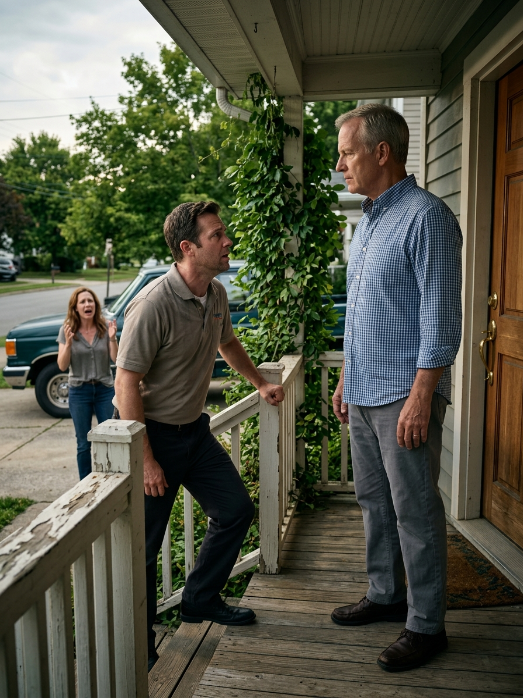
Greg slammed his pickup truck door so hard the side mirror rattled in its housing, and Sarah was right behind him, hurrying down the gravel path with a stack of papers clutched in her shaking hand. Greg’s face was dark red, the skin around his nose mottled and pale with fury, his nostrils flaring as he stomped up the wooden porch steps like a man ready to kick down a door. What the hell is this, Arthur? Greg shouted, waving a bank document right in my face so hard the corners fluttered in the evening breeze. St. Jude’s just called my office ten minutes ago! They said the tuition guarantee was canceled and I owe fourteen thousand dollars by Friday afternoon or Leo loses his spot for the fall term! Have you completely lost your damn mind over a little dinner table joke?
I stood on my porch with my hands resting naturally at my sides, my weight balanced evenly on both boots. I didn’t step back away from him, and I didn’t raise my voice to match his theatrics. You said last night that I always take myself too seriously, I said quietly, looking past his shoulder at the empty driveway. I decided it was time to stop burdening you with my presence and my money.
It was a joke! Sarah screamed from behind him, her voice cracking on the high notes as tears of pure panic welled up in her eyes. He’s an eleven-year-old boy! You’re ruining his entire education over a spilled gravy boat! What kind of monster does that to his own flesh and blood over something so stupid?
It wasn’t about the gravy, Sarah, I said, turning my gaze to look directly at her face so she knew I wasn’t backing down an inch. And it wasn’t a joke, either. Leo told me exactly what Greg taught him to repeat word for word. He said I deserved it because I think I own you. If my financial help feels like ownership and tyranny to your family, then removing it is the only honest act of respect I can offer you. You are now completely free from my control, my money, and my interference.
Greg stepped closer, his chest heaving under his flannel shirt as he tried to tower over me the way he used to do when we were boys. You co-signed those financial guarantee documents three years ago! You gave your solemn word to our father before he died that you would look after this family no matter what happened!
I promised Dad I would help support a family that respected itself and each other, I replied, my voice dropping an octave as the memory of our father’s hospital room drifted through my mind. I did not promise to fund my own public humiliation at Sunday dinner. You wanted to make sure your son knew I wasn’t in charge of your household. Now he knows that you are completely in charge of your own bills, your own tuition deadlines, and your own property taxes.
Greg stared at me for a long, silent moment, his jaw working back and forth without any words coming out. The arrogant, untouchable confidence he had displayed at the dining room table twenty-four hours earlier was completely gone, washed away by the harsh reality of arithmetic. In its place was pure, cold panic, the kind of dread that sets in when a man realizes he has spent money he never actually earned. He knew perfectly well that his salary as a middle-management logistics coordinator could never cover twenty-eight thousand dollars in private tuition alongside his mortgage and the double property taxes on the lake house. Arthur, please, Greg stammered, his shoulders slumping as his posture suddenly collapsed under the weight of his own bluff. We can’t pay this lump sum on such short notice. The fall deadline is four days away, and Leo will be kicked out before he even starts the sixth grade. We’ll lose the lake house to a tax lien by next spring if the subsidy drops off. You have to sign the reinstatement forms for Martin.
I signed the revocations twenty-four hours ago, I said plainly. They are legal, final, and fully executed. The bank and the school board have already received the certified copies by courier. There is nothing left for us to discuss here.
You’re doing this just to spite me because I hurt your fragile pride! Greg yelled, his voice rising again in a desperate, cracked pitch that echoed across the quiet neighborhood.
No, I said, looking him straight in the eye. I am doing this because I am sixty-two years old, and I have finally decided to stop paying people to hate me.
I turned around on the wooden porch, walked inside my house, and closed the heavy front door firmly behind me. I turned the dead bolt until it made a dry, metallic click that signaled the end of the conversation. Greg pounded on the wood three times with his fist, shouting my name into the empty hallway, but I didn’t answer him and I didn’t unlock the latch. After ten minutes of muffled arguing and slamming doors out in the driveway, I heard his truck engine roar to life, spitting gravel as he sped down the road toward town.
An hour later, the house was completely quiet again. The sun had dipped fully below the horizon, casting a soft, golden-red glow across my kitchen counter through the west-facing window. I prepared a simple dinner of seared chicken breast, roasted potatoes with rosemary, and a handful of fresh green beans from the garden. I set the small wooden table for one person, using a crisp white linen napkin and my good silver forks that hadn’t seen a formal setting in months. My phone sat quietly on the living room side table, buzzing occasionally with frantic text messages from Sarah and long, apologetic voice notes from Greg that I had no intention of opening or listening to. I didn’t pick up the phone, and I didn’t read a single word of their late-night explanations. The noise of their entitlement and the weight of their resentment no longer had any place under my roof. I sat down at my clean, quiet table and took my very first bite of food in absolute peace. The house was silent, orderly, and entirely mine. For the first time in over ten years, I ate my meal without holding my breath, knowing that my dignity was no longer for sale to the highest bidder in the family.