How Poured Gravy on My Silk Tie Cost My Ungrateful Brother Forty Eight Thousand Five Hundred Dollars

The notification popped up on my phone screen at 9:15 PM while I was sitting at my wooden desk in my home office, a harsh blue glare cutting across the stack of three thick blue binders that contained every financial agreement I had signed for my brother’s family over the past five years. Greg had sent a message to the family group chat complaining that I was pouting over a kid’s prank and telling me not to be so thin-skinned.
Sarah added a laughing emoji two minutes later, typing that he really thinks he’s immune to a joke. They were completely convinced I was sitting alone in my dark living room, nursing hurt feelings, waiting for them to grant me permission to come back into their good graces after they humiliated me in front of an eleven-year-old boy. They had no idea that I was already drafting an email to my financial advisor and my attorney, booking a 7:30 AM emergency appointment for Monday morning to dismantle every single dollar of support I had been giving them since my retirement from structural engineering.
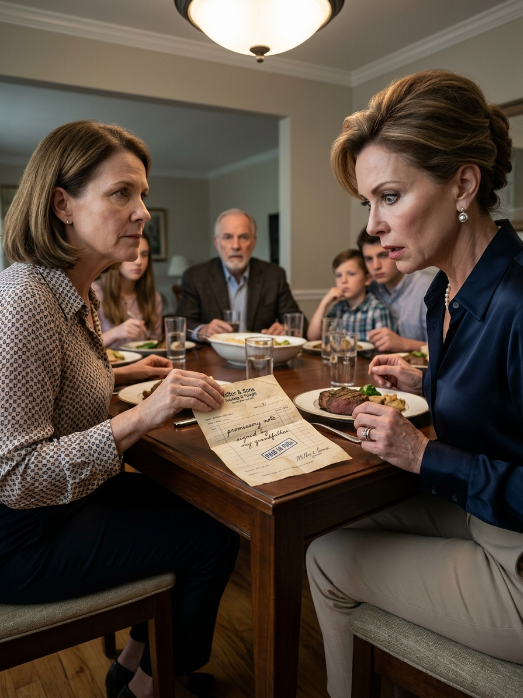
I sat at my younger brother Greg’s dining room table on Sunday evening while his wife, Sarah, set down a warm ceramic boat of dark turkey gravy right beside the roast beef. Across from me sat my eleven-year-old nephew, Leo, who had grown six inches over the past year and spent most of dinner staring at his phone underneath the edge of the mahogany table.
Over the past twelve months, I had paid exactly $48,500 out of my personal retirement portfolio to keep Greg’s household afloat without ever asking for a public speech or a thank-you note. That money was divided clearly and tracked down to the penny: $28,000 for Leo’s annual tuition at St. Jude Academy, $12,500 for my co-signed share of the property tax subsidies on the family lake house, and an $8,000 discretionary trust allowance meant for the boy’s future education. I was sixty-two years old, newly retired after thirty-five years working as a structural engineer on commercial bridge projects, and I believed firmly that family stepped up to support family without making a scene or demanding applause.
Then Leo reached across the table and grabbed the handle of the gravy boat with both hands. He looked me straight in the eyes, raised the heavy dish high, and slowly inverted it directly over my plate, my ironed gray trousers, and my favorite silk tie that my late wife had bought me for our thirtieth anniversary.
Warm, greasy liquid soaked through my clothes in an instant, dripping onto the seat of the hardwood chair and pooling across my lap with a sickening warmth. I did not jump up from my seat. I did not raise my voice or slam my hands on the table to demand an explanation. I simply sat there as the grease cooled against my knees, feeling the heavy fabric stick to my skin while the smell of poultry seasoning and rendered fat filled the air around my chest. Sarah gasped softly and brought a hand to her mouth, but Greg did not scold his son or reach for a napkin. Instead, Greg leaned back in his leather chair, crossed his broad arms over his chest, and let out a short, nasal laugh that sounded like dry gravel shifting under a boot. Leo looked over at his father, took his cue from Greg’s smirk, and looked back at me with a cold, rehearsed little smile that did not reach his eyes.
“Dad told me you deserve it because you think you own us just because you pay for things,” Leo said, his voice carrying clearly across the quiet dining room where the grandfather clock in the hall ticked away the seconds.
A heavy silence fell over the room for three full seconds before Greg laughed again, louder this time, his chest shaking under his blue button-down shirt. Sarah bit her lower lip, wiped her mouth with a linen napkin to hide her smile, and shook her head as if I were a difficult child throwing a tantrum at a birthday party. Nobody offered me a dish towel. Nobody told the eleven-year-old boy that pouring scalding-warm grease onto an adult relative’s lap was unacceptable behavior. They sat around the mahogany table waiting for me to break. They wanted me to yell, bang my fists against the wood, or play the role of the domineering, arrogant older brother they had spent years gossiping about behind my back whenever they needed another check signed. I looked at my younger brother across the dishes of cold corn and mashed potatoes. His eyes were wide and bright with a strange, ugly sense of triumph that reminded me of the way he used to gloat when he broke my balsa wood model airplanes back when we were kids living out in Montgomery County.
In that single moment, the fog cleared completely from my mind. For five long years, I had assumed my financial support was helping a struggling sibling get back on his feet after a series of logistics management career setbacks and bad local investments. In truth, Greg resented every single dollar I earned through decades of sixty-hour workweeks and engineering contracts. He could not afford private school tuition or lake house property taxes on his base salary, so he took my checks with one hand while using the other to teach his son that I was a stingy tyrant who deserved to be put in his place. Greg was convinced he had me completely trapped in a corner. He believed that my deep attachment to my nephew and my pride in keeping our late parents’ family unit together would force me to swallow the insult, wipe the grease off my trousers, and keep writing the checks month after month to avoid a public scene.
I gave him no scene at all, not because I was a saint, but because bridges don’t argue with the load they’re dropping. I slowly stood up from my chair, letting the stained napkin fall unceremoniously onto the cushion. I did not slam my water glass or utter a single word to the boy or his parents. I unbuttoned my soiled jacket, pulled my heavy wool coat off the brass rack near the front foyer, and walked out the front door into the cool evening air. I drove home in complete silence with the heater running against the spring chill, watching the streetlights blur past through the windshield. When I reached my house, I walked straight upstairs, removed my ruined clothes, and tossed them directly into the trash bin behind the garage where nobody would ever have to look at them again. I washed up at the utility sink, put on a clean fleece sweater, and sat down at the wooden desk in my home office where I kept my records.
I unlocked my filing cabinet and pulled out the three thick blue binders containing the joint property account agreements, the co-signed property tax guarantees, and the discretionary educational trust documents for Leo. That was when the group chat notification chimed on my desk, bringing Greg’s message about me pouting over a kid’s prank and Sarah’s laughing emoji. I muted the phone, laid it face down on the blotter, and opened a blank document on my computer to outline every single account number that needed to be frozen before the sun came up.
By seven-thirty on Monday morning, I was sitting across from my financial advisor, Martin, in his corner office downtown overlooking the county courthouse square. On the glass table between us lay the formal trust agreements, the bank co-signature documents, and the automatic transfer authorizations that had been active for years without interruption. Martin put on his reading glasses and scanned the signature lines with a practiced, professional frown. If you sign these revocation forms today, Arthur, the consequences take effect immediately, he explained, pointing his pen at the bottom line of the first document. The tuition guarantee for St. Jude Academy will be formally canceled, shifting full financial obligation back to Greg as the sole legal guardian of record. The monthly property tax subsidy for the lake house will terminate on the first of next month without any further grace periods. And the discretionary allowance trust for your nephew will be frozen and dissolved back into your primary investment portfolio where it belongs.
I understand every word, Martin, I said quietly, my voice entirely steady. Thirty-five years as a structural engineer had taught me a fundamental truth about load-bearing structures that most people forget when things get complicated. When a support beam is rotten from the inside out, you do not reinforce it with extra weight and hope the wood holds. You remove it entirely before the structure collapses on your head and hurts someone innocent. I picked up the heavy metal pen and signed my name cleanly across every revocation document, each stroke firm and deliberate against the paper.
The tuition guarantee cancellation pulled $28,000 in yearly educational funding out from under Greg’s feet, leaving him with an immediate $14,000 balance due for the upcoming fall semester that had to be settled within four business days to prevent Leo from being dropped from the school enrollment ledger. The property tax subsidy revocation removed $12,500 in yearly maintenance funding for the shared family house on the lake that Greg loved to host his coworkers at during the summer months. The trust dissolution closed an $8,000 annual direct allowance account that Leo had been treating like his own personal pocket money for video games and sporting equipment. The exact total of voluntary financial backing I revoked in less than thirty minutes was $48,500 per year, down to the last dollar. By ten o’clock that morning, my attorney had processed the legal notices through the proper channels. Certified copies were dispatched via courier directly to Greg’s home address, while official digital notifications were sent to the business office at St. Jude Academy and Greg’s personal work email address so there could be no confusion about where things stood.
I spent the rest of Monday afternoon out in my backyard garden where the soil was still damp from the weekend rain. I cleared dead branches from the hydrangea bushes and turned over the fresh dark soil along the back fence with a long-handled spade. My mind felt remarkably unburdened, like a rusty gate finally swinging free on well-oiled hinges. I felt no urge to vent to our neighbors, no anger burning in my chest, and no desire to engage in a verbal shouting match when they finally realized what had happened.
At five-thirty that evening, the heavy crunch of gravel signaled a truck pulling into my driveway at high speed, tires spitting small stones against the side of the garage. I laid my garden shears down on the wooden workbench, wiped my callused hands on an old cotton shop towel, and walked through the back kitchen door toward the front porch just as Greg slammed his truck door so hard the side mirror rattled on its bracket. Sarah was right on his heels, clutching a stack of legal papers in her trembling right hand as she hurried up the concrete path. Greg’s face was dark red, his forehead glistening with sweat as he charged up my porch steps and stopped two feet from where I stood leaning against the wooden railing. What the hell is this, Arthur? Greg shouted, thrusting a legal letter within inches of my face so hard the paper fluttered in the evening breeze. St. Jude just called my office and hauled me into a meeting with the principal! They said the tuition guarantee was revoked and I owe fourteen thousand dollars by Friday afternoon or Leo loses his spot for the fall term! Have you completely lost your mind over a silly family joke?
I stood on my porch with my shoulders square and my hands resting comfortably in my sweater pockets, looking down at my younger brother with the same calm detachment I used to bring to site inspections when a subcontractor tried to argue about structural load limits. You told me last night that I take myself too seriously and need to lighten up, I said calmly, letting the words drop into the space between us like stones. I simply decided to take your advice for once in my life. I am no longer burdening you with my presence, my attitude, or my money. Sarah pushed past Greg, her voice rising to a sharp, brittle screech that echoed off the neighboring brick siding. It was a joke! He is an eleven-year-old child who didn’t mean anything by it! You are ruining his entire academic future over a spilled gravy boat because your pride is too fragile to take a laugh!
What kind of bitter, cruel uncle does something like this to his own blood over a dinner table accident? It had nothing to do with gravy, Sarah, I replied, looking her directly in the eyes without flinching. And it was not a joke. Leo stood at your dining table and told me exactly what Greg trained him to say. He told me I deserved to be humiliated because I think I own your family. If my financial backing feels like ownership to you, then taking it back is an act of pure respect. You are now entirely free from my influence and my bank account.
Greg stepped closer, his chest heaving under his work shirt as desperation began to crack through his righteous anger. We signed those joint tax agreements four years ago when the market was down! You gave your word to Mom and Dad before they passed that you would keep this family secure no matter what happened! Our parents raised us to support each other with respect and integrity, I answered softly, my voice refusing to rise to match his shouting. They did not raise me to act as a personal bank for a brother who spends his evenings training his child to spit in my face. You wanted to make sure your son knew I wasn’t the master of your house. Now he can watch you pay the bills yourself. Greg stared at me, his jaw dropping open as the reality of the numbers finally settled into his brain. The arrogant sneer he had worn at the dinner table twenty-four hours earlier vanished entirely, replaced by a look of cold, naked panic that looked pathetic in the fading daylight.
He knew the numbers as well as I did because we had gone over them together when he bought the house. On his base salary as a middle logistics manager, he could not pay $28,000 a year in private school fees alongside his full mortgage and the doubled property tax load on the lake house without sinking into immediate default.
Arthur, stop this right now, Greg stammered, his posture collapsing as his shoulders slumped forward and his hands dropped to his sides. Listen to me for a second, please. We can’t cover this shortfall on my current salary. The fall deadline is four days away and we don’t have liquid savings like that. Leo will be removed from the school and his friends will all find out. We’ll face a tax lien on the lake house by next spring if you don’t co-sign the reinstatement paperwork. You have to sign the forms and put things back the way they were. I executed the revocations nine hours ago, I said plainly, watching a car drive slowly down the quiet street past my yard. They are legal, binding, and final. The bank, the county tax office, and the school board have all received certified copies by courier. There is nothing left for us to discuss or negotiate. You’re doing this out of pure spite and malice! Greg yelled, his voice cracking as total desperation took over his face. No, Greg, I said gently, turning slightly toward the front door. I am doing this because I am sixty-two years old, and I have finally decided to stop paying the bills for people who hate me.
I turned on my heel, stepped back inside my house, and closed the solid oak door behind me before either of them could think of another excuse. I turned the deadbolt with a firm, satisfying click that echoed in the small entryway. Greg pounded on the thick wood three times with his heavy fist, shouting my name into the empty porch, but I did not turn back or open the latch. After ten minutes of heated, hushed arguing out on the gravel driveway between his wife and himself, I heard his truck engine turn over with a loud sputter and roar away down the street, tires crunching into the asphalt as they left my property behind for good. By seven o’clock that evening, the sun had dropped completely behind the tree line, filling my kitchen with a soft, warm amber glow that felt clean and untroubled. The entire house was completely quiet, save for the hum of the refrigerator in the corner.
I prepared a simple dinner for myself without rushing. I seared a thick chicken breast in a cast-iron skillet with a little garlic and olive oil, roasted a handful of small red potatoes until the skins were crisp, and steamed some fresh green beans from the farmers market. I set my dining table for one, using a clean linen napkin and my good silver cutlery that had sat untouched in the sideboard drawer for too long. My mobile phone lay on the living room side table, buzzing periodically as text messages from Sarah and long, emotional voice notes from Greg flooded in with pleas and threats mixed together. I did not pick it up. I did not read a single word of the text messages. The chaotic noise of their endless entitlement no longer held any power over my peace of mind. I took my seat at the clean wooden table and ate my dinner in absolute, undisturbed peace.
The house was silent, orderly, and entirely mine. For the first time in over a decade, I enjoyed a meal without hesitation, knowing that my dignity was no longer up for negotiation with anyone, family or otherwise.