How My Neighbor Stole My Daughter’s Babysitting Money And Met Her HOA Board

My fifteen-year-old daughter Lucy came home with red, puffy eyes on a Friday evening, and I knew something was wrong before she even took off her scuffed sneakers by the front door. The light was fading fast over our quiet suburban cul-de-sac in central Iowa, casting long gray shadows across the floorboards where she stood clutching her canvas tote bag like it was a shield. She had spent the last seven days over at Evelyn Carpenter’s house four doors down, taking care of Evelyn’s two energetic twin grandsons while their parents were away in Kansas City.
Lucy had put in three grueling hours every single afternoon after school and a long six-hour stretch on Saturday morning, missing out on her track practice and her study group just to make sure those boys didn’t burn the kitchen down. She pulled her knees up toward her chest as she sat on the entry bench, swallowing hard against the thick tears that had already stained her cheeks and left white streaks of salt on her dust-covered face. I dropped the dish towel I was holding and walked over to her slowly, feeling that familiar, tight knot start to form right behind my breastbone whenever one of my kids got hurt.
“What happened, honey?” I asked, my voice dropping into that quiet, careful register I always used when I knew a storm was coming.
Lucy stared down at the gray linoleum between her feet, her lower lip trembling so hard she could barely get the words out. “Mrs. Carpenter… she didn’t pay me, Mom,” she whispered, the sound cracking right down the middle under the weight of sheer humiliation.
I blinked once, taking half a step closer while my brain tried to process what she had just said. “What do you mean she didn’t pay you?
You two agreed on eleven dollars an hour before you took the job last Monday.”
“I asked her for the envelope when her daughter pulled into the driveway to pick up the kids,” Lucy said, her voice dropping to a miserable little hum. “And she looked right at me and smiled like I was telling a joke. She said it was a life lesson. She told me I should learn to get things in writing and never trust someone’s word in the real world. Then she said that hard work was payment enough, handed me an old box of stale, store-bought cookies with three of them missing, and slammed her heavy oak door right in my face.”
My fury boiled instantly, a hot, sharp pressure rising behind my ribs that made my ears ring in the quiet hallway. I remembered Evelyn Carpenter strutting down our sidewalk every morning with her chin tilted up at an impossible angle, wearing those pastel cardigans that cost more than my weekly grocery budget and tending her prize-winning rose garden like she owned the municipality itself.
Evelyn was the elected treasurer for our local homeowners association, a woman who treated every weed in the common areas like a personal insult and walked around with an air of effortless moral superiority that drove half the street crazy. She thought she could pull rank on a fifteen-year-old girl because she figured kids don’t have teeth.
“She said I was being entitled for asking,” Lucy sobbed, finally letting the dam break completely as the tears spilled over her lashes. “I worked twenty hours this week, Mom. I washed her dishes, I folded their laundry, and I didn’t even touch my phone once while the boys were napping. I spent the whole week thinking I had finally earned my own money for school clothes, and she made me feel like I was begging for scraps.”
Seeing my daughter, a girl who set her alarm every morning without being asked and checked every single food allergy label twice, so thoroughly crushed by an arrogant neighbor made my teeth grind until my jaw ached.
I didn’t hesitate for another second. I turned on my heel, walked straight over to my roll-top desk in the corner of the living room, pulled out my leather wallet, and counted out eleven crisp twenty-dollar bills and two tens from the cash envelope I kept for grocery emergencies. I walked back to the entryway, took Lucy’s trembling hand in mine, and pressed the two hundred and twenty dollars firmly into her palm until her fingers curled around the paper.
“Take this,” I said quietly, keeping my voice level and warm so she knew the anger wasn’t directed at her. “This is what you earned. Every single cent of it.”
Lucy looked down at the cash in her hand, her eyes wide and startled through her tears. “Mom, no… I can’t take your grocery money, we need this.”
“This isn’t charity, Lucy. It’s your wage,” I told her, looking her dead in the eye so she understood every word. “Your work has real value. You fulfilled your side of the contract with honor, care, and diligence, and you do not suffer just because some miserable adult decided to act like a thief. I am paying you what you are owed right now because your effort matters.”
Lucy wiped her face with the back of her sleeve, a massive wave of physical relief visibly washing over her thin shoulders as she let out a long, shuddering breath. She stood up and wrapped her arms around my waist, burying her face in my sweater. “Thank you,” she whispered against the wool.
“Go wash your face and get something to eat,” I said, gently squeezing her arm and giving her a reassuring pat. “Mrs. Carpenter thought she’d get away with this because you’re fifteen and she figured you wouldn’t tell anyone who could do anything about it. She thinks she can hide behind a high-minded speech about life lessons to pocket two hundred and twenty dollars of a child’s hard work. But she made a massive mistake.”
“What are you going to do, Mom?” Lucy asked nervously, pulling back and looking up at me with wide, frightened eyes.
“I’m going to make sure she learns a lesson of her own,” I said.
That night, after Lucy had finally gone upstairs to bed and the house settled into that heavy, midnight quiet, I sat down at the kitchen table with my reading lamp and got to work. Evelyn Carpenter had told my daughter that she should have gotten everything in writing, secure in her belief that because there wasn’t a formal paper contract signed in blood, she was legally and morally untouchable. She was about to find out how wrong she was about the digital age.
I had Lucy hand over her smartphone before she turned in, and I spent the next hour scrolling through the text message thread between Lucy and Evelyn spanning the entire past month of babysitting arrangements. It was an absolute goldmine of clear, unambiguous documentation that left zero room for interpretation.
“Hi Lucy, can you watch the kids next week? Mon-Fri 3:30-6:30 and Sat 10-4? We can do the $11/hr we talked about,” Evelyn’s number had pinged on October 4th at 4:12 PM.
“Yes Mrs. Carpenter! That works for me,” Lucy had replied.
“Great, see you Monday at 3:30!”
There were daily texts from Evelyn acknowledging Lucy’s arrival time, texts asking her to stay an extra thirty minutes because traffic was bad on Interstate 80, texts thanking her for sweeping the kitchen floor after the boys dropped a box of crackers, and a text from that very afternoon asking Lucy to come over at three o’clock sharp to wait for her daughter’s arrival. I took screenshots of every single message on the screen, making sure the timestamps, phone numbers, and dates were crystal clear in every frame. Then I hooked up our old inkjet printer in the den and printed out every page until the black cartridge started to streak.
After that, I opened a blank document on my laptop and drafted a formal, itemized invoice detailing the exact dates, hours worked, the agreed eleven-dollar hourly rate, and the total balance due of two hundred and twenty dollars. Beneath the invoice, I drafted a formal demand letter citing local small-claims parameters in our county, highlighting the explicit written confirmation provided in her text messages, and outlining a strict seventy-two-hour deadline before official legal filing fees and service costs would be added to the principal balance.
To cap it all off, I remembered Evelyn’s prominent role in our community. As the HOA treasurer, she was responsible for managing thousands of dollars in neighborhood dues, paying landscaping contractors, and approving pool maintenance vendor contracts every single month. Integrity and trust were the absolute prerequisites of her position, and she ran that committee like she was the queen of England.
I drafted a short, precise email to Arthur Henderson, the HOA board president, attaching the itemized invoice and the printed text message logs as PDF files. I read it over twice to make sure my tone was cold, professional, and entirely unassailable.
Dear Mr. Henderson,
I am bringing an urgent matter of ethics and conduct to your attention regarding Board Treasurer Evelyn Carpenter. Attached you will find documented evidence of deliberate wage theft concerning twenty hours of labor contracted with a minor in our neighborhood. Mrs. Carpenter has publicly refused to honor her financial obligations, citing that verbal agreements and unpaid labor serve as life lessons. As a community, we entrust Mrs. Carpenter with our collective treasury. Her willingness to violate written financial commitments and exploit neighborhood teenagers raises severe questions regarding her fitness to manage community funds. I request an emergency board review if this matter is not immediately rectified.
I left the email sitting right there in my drafts folder, set the printed invoice and text documentation inside a crisp white mailing envelope, and finally went to bed at midnight, my mind racing too fast for sleep.
The next morning at eight-fifteen, the autumn sun was bright and crisp over the neighborhood, glinting off the frost on the grass and turning the maple leaves a brilliant amber. I walked down the sidewalk with absolute purpose, holding the white envelope flat and steady in my right hand like a summons.
I walked up Evelyn’s manicured stone walkway, stepped onto her wide porch, and pressed the polished brass doorbell button.
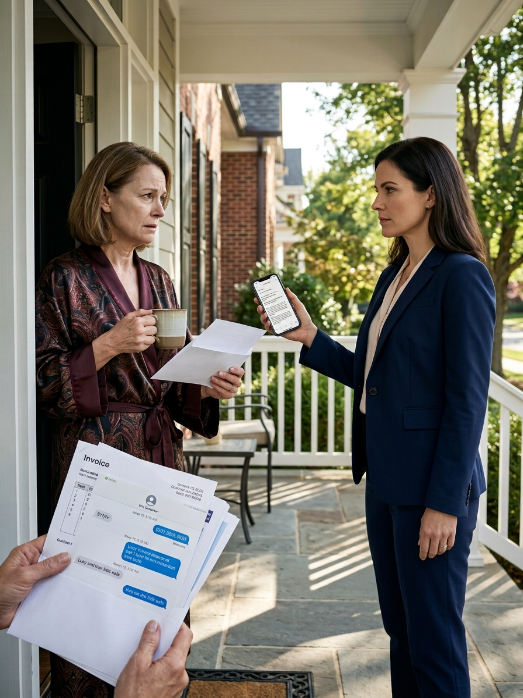
A moment later, the front door clicked and swung open. Evelyn stood there holding a heavy ceramic mug of dark coffee, wearing a thick silk robe over her pajamas with her silver hair pinned back into a neat twist. When she saw me standing on her welcome mat, her expression shifted instantly from polite morning curiosity to a tight, guarded smile that didn’t reach her eyes at all.
“Oh, good morning, Martha,” she said, leaning lazily against the wooden doorframe and taking a slow sip from her mug. “If this is about Lucy, I already explained the situation to her yesterday afternoon. I gave her some very valuable real-world advice. Young people today are far too coddled by their parents. They think money just falls into their hands without understanding how legal contracts work in the real world.”
I didn’t smile back. I didn’t break eye contact for even a fraction of a second. I let her finish talking, standing entirely still on her porch until the silence between us grew heavy and uncomfortable.
“Lucy came home in tears yesterday, Evelyn,” I said, my voice steady, sharp, and cold enough to freeze water. “You took twenty hours of dedicated labor from a fifteen-year-old girl, used her services to keep your grandchildren safe while you ran your errands, and then used your position as an adult to intimidate her and steal her wages.”
Evelyn chuckled softly, taking another slow sip of her coffee like she was amused by my tone. “Steal? Don’t be dramatic, Martha. It was a verbal agreement between neighbors. There’s no formal contract signed by a lawyer. I taught her a lesson about getting things in writing before she starts working for people. She’ll thank me when she’s older and wiser.”
“You told her to get things in writing,” I said smoothly, letting my lips part in a humorless line. “I agree with you completely. In fact, that was the best piece of advice you could have possibly given her.”
I stepped forward and handed her the white envelope without breaking my stare.
Evelyn frowned, her smug smile faltering slightly as she pulled her hand away from her coffee mug, opened the flap, and pulled out the contents. She looked down at the top sheet: an itemized, professional invoice for two hundred and twenty dollars, accompanied by a Notice of Intent to File in Small Claims Court at the county courthouse. Beneath it were five full-color printed pages of her own text messages, complete with her phone number, the exact dates, the exact times, and her explicit written confirmations of the eleven-dollar hourly rate.
Her face drained of color as she flipped through the pages, her fingers suddenly clumsy against the paper.
“This… this is completely ridiculous,” she stammered, her voice losing its polished, suburban-queen edge and dropping into a defensive panic. “You can’t sue someone over two hundred dollars! That’s absurd!”
“I absolutely can, and I will by Monday morning,” I replied evenly, not blinking. “Small-claims filing fees are seventy-five dollars, which will be added directly to your total debt once you are officially served by the sheriff. Furthermore, under state contract law, a continuous text thread constitutes a legally binding agreement. You explicitly stated the rate, you requested her presence, you acknowledged her labor every single day, and you confirmed the hours in writing.”
“You’re making a massive scene out of nothing!” she snapped, her posture stiffening as she tried to regain her footing. “I’m not paying this extortion!”
“That is entirely your choice,” I said, my voice dropping an octave. “Which brings me to my second point.”
I pulled my smartphone out of my coat pocket, tapped the screen to wake it up, and turned it around so she could see the drafted email addressed to Arthur Henderson and the entire HOA board of directors.
“Evelyn, you are the treasurer of our neighborhood association,” I said, holding the screen right in front of her face. “You oversee thousands of dollars in neighborhood dues every year. You handle our accounts and pay our vendors. I have drafted a formal complaint to the entire board, complete with these exact text printouts, detailing how you routinely use young neighborhood teenagers for labor and then refuse to pay them under the guise of life lessons.”
Evelyn gasped, her eyes widening in genuine horror as she read the glowing text on my phone screen. “You wouldn’t dare send that. That has nothing to do with the board or my position!”
“It has everything to do with the board,” I countered, leaning in slightly so she couldn’t look away. “A person who commits wage theft against a child and brags about breaking agreements has no business managing communal money or sitting on an ethics committee. The moment I hit send on this screen, Arthur Henderson will call an emergency meeting to review your conduct and assess whether you should be stripped of the treasury position immediately. Word gets around fast in this neighborhood, Evelyn. How do you think your neighbors will view you when they find out you cheat local teenagers out of their hard-earned money?”
She stood frozen on her porch, her hand trembling so hard against her coffee mug that the dark liquid sloshed over the rim and hit the wooden floorboards. The high-and-mighty facade she had maintained for years was crumbling right in front of me into nothing. She looked down at the printed text messages in her hand, then back up at the email draft on my phone screen, realizing in one blinding second that her reputation, her social standing, and her precious board position were all on the line over a petty two-hundred-and-twenty-dollar dispute.
“Wait,” she whispered, her voice dropping to an urgent, ragged gasp. “Don’t send that email. Please.”
“My daughter worked twenty hours,” I said firmly, not giving an inch. “Her rate was eleven dollars an hour. She did an exceptional job, and she deserves every single penny she earned.”
Evelyn swallowed hard, her throat working visibly under her silk collar. “Just… wait here for a second.”
She turned around abruptly and retreated into the dark interior of her house, leaving her front door wide open to the morning chill. I stood on the porch with my hands folded calmly in front of me, watching the quiet, peaceful street where the other houses sat unaware of the storm that had just blown through.
Two minutes later, Evelyn returned to the doorway. She was holding a thick stack of folded bills in her hand, her knuckles white. She didn’t look me in the eye as she thrust the cash forward across the threshold.
I took the money from her hand and counted it deliberately right in front of her face: eleven crisp twenties. Two hundred and twenty dollars, down to the last cent.
“Thank you, Evelyn,” I said, reaching down to pick up the printed invoice and text logs from her porch table where she had dropped them. “Here is your paid receipt. And as a final life lesson for you: never mistake a mother’s patience for weakness, and never exploit a child who has someone standing behind her.”
She slammed her front door shut in my face without saying another single word.
I walked back down her stone pathway and crossed the street under the warm morning sun, feeling a profound, quiet strength settle into my bones with every single step I took.
When I pushed open our front door and walked into the kitchen, Lucy was sitting at the table eating a bowl of oatmeal and looking nervously toward the front entryway, her shoulders tense.
I walked right over, took the crisp two hundred and twenty dollars out of my coat pocket, and laid it flat on the wooden table right beside her cereal bowl.
Lucy’s eyes went wide as saucers, staring down at the money. “Mom… she actually paid you?”
“She paid every single cent,” I said, pulling out a chair and sitting down across from her. “The money I gave you last night was from my own wallet for your hard work. This money goes right back into our household funds where it belongs. Your earnings are officially accounted for, fair and square.”
Lucy stared at the cash, and a slow, genuine smile spread across her face, not just of relief, but of deep, undeniable pride and validation.
“Now,” I said, pulling a fresh notepad and a black ballpoint pen from the kitchen drawer. “Mrs. Carpenter gave you one good piece of advice amidst all her nonsense: always get things in writing. So, before you take your next babysitting job, you and I are going to draft a standard, professional babysitting agreement template together. It will list your hourly rate, cancellation policies, payment terms, and require a signature from the parents before you ever step foot in their house again.”
Lucy looked up at me, her eyes shining with confidence fully restored. “Can we really do that, Mom?”
“We sure can,” I smiled, sliding the pen across the table toward her. “You are a professional, Lucy. It’s time the whole neighborhood treats you like one.”