How Taking My Sick Daughter to the Clinic Behind My Husband’s Back Exposed a Two-Pound Nightmare in Her Stomach

The coffee pot on the counter had finished its wet sputter about ten minutes before Vernon came down the stairs, his boots clicking hard against the linoleum while I stood there wiping down the laminate with a damp rag. He never looked at the sky or the weather outside, just marched straight to the coffee maker like he owned the seconds on the clock, pouring himself a mug before grunting something about the truck needing new spark plugs before the freeze set in.
I didn’t answer him right away because my mind was stuck on the way Maya had looked at breakfast, pushing a single piece of dry toast around her ceramic plate without taking one bite of it. She looked smaller in her oversized gray hoodie than she had the week before, her shoulders tucked in tight like she was trying to shrink herself down until she disappeared entirely from our kitchen. Vernon tossed his keys onto the counter with a sharp clatter that made me jump, shaking his head as he checked his watch for the third time in forty seconds. I reckon I should have said something right then about how gray her skin looked under the fluorescent overhead light, but I knew how the argument would go before I even opened my mouth. He would tell me I was borrowing trouble, that teenagers were lazy by nature and needed a little backbone instead of a mother hovering over them with a thermometer every five minutes.
For weeks, Maya had been fading right out from under our roof while Vernon sat at the head of the table complaining about the cost of city water and the price of diesel fuel. It started small with a little skipped breakfast here and a cup of black tea there, but by March she looked like a shadow of the girl who used to stay out until dark kicking a dented soccer ball against the garage door until I yelled at her to come inside for supper. She stopped taking those blurry sunset pictures over our rusty mailbox with her old hand-me-down phone. She stopped laughing on FaceTime with the girls from her ninth-grade geometry class, retreating instead to her bedroom with the door shut tight against the hallway. At suppertime, she would push chicken around her plate with her fork until the grease went white and cold, her eyes fixed on her lap like she was waiting for someone to excuse her from a trial she hadn’t signed up for.
One Thursday night, the kitchen smelled like reheated beef stew and bleach while the metal porch flag tapped a steady, irritating rhythm against the cedar post outside. Vernon never looked up from his glowing phone screen, his thumb scrolling through farm equipment listings while the stew sat untouched in front of our daughter. She’s putting on an act, he had told me, his voice flat and dismissive as he reached for the salt shaker without glancing her way. Teenagers make everything dramatic because they want attention, and we are not wasting three hundred dollars of our grocery money on urgent care copays just so some doctor can tell us she stayed up too late playing on her phone.
I told him he needed to look at her face, whispering so Maya wouldn’t hear from the living room couch where she lay curled under a heavy fleece blanket despite the furnace running full blast.
I reminded him that she had lost twenty pounds in two months and that her skin had taken on that dry, papery look that usually meant something was rotting inside. Vernon just snapped his phone screen off and set it face-down on the table with enough force to rattle the sugar bowl, his jaw working behind his tight, stubbled cheeks. She’s fifteen, Ellen, he told me, his voice rising just enough to carry into the hallway where she was sitting. She’s trying to get out of her algebra midterms, and if you rush her to the clinic every time she gets a bellyache, our insurance deductible is going to wipe out my whole overtime bonus. Stop coddling her before she learns she can manipulate every man in this house with a few crocodile tears. He picked his phone right back up, closing the conversation the way he always did by turning his shoulder toward the refrigerator and pretending I wasn’t even standing in the room. I didn’t argue with him because arguing with Vernon was like talking to a limestone cliff in the middle of our pasture. I just picked up the heavy iron skillet from the stove, washed it in dead silence, and carried a glass of ice water up the wooden stairs to Maya’s bedroom.
When I pushed her door open, she was lying on her side with her knees pulled up so high they almost touched her chin in the dim light of her desk lamp. Her long brown hair was tangled into hard knots, falling across her hollow cheeks like dry straw that hadn’t seen a brush in days. Her hands were jammed deep inside the cuffs of that same faded gray hoodie she had worn every single day for three weeks, refusing to take it off even when the house got stuffy in the afternoons. I sat down softly on the edge of the mattress and laid my palm against her forehead, feeling the cool, clammy sweat that didn’t make any sense given how cold her room felt. Sweetie, I murmured, brushing a strand of matted hair away from her closed eyes, you’ve got to tell me where the hurt is coming from so I can help fix it.
Everywhere, Mom, she whispered back, her voice sounding thin and dry like paper rubbing against paper. It feels like there’s a big, heavy stone stuck right under my ribs, and every time I try to swallow a little water, it feels like it has nowhere to go down. We are going to see Dr. Kincaid tomorrow morning, I told her, my mind made up despite what Vernon had laid down as law at the supper table. But Dad said we don’t have the money for that, she whispered, her lower lip trembling against her teeth. I don’t give a hoot what your father said, I told her, my heart hardening into something cold and steady in my chest. I have my own savings from selling my mother’s cedar chest last fall, and you are my only daughter, so we are going to that clinic whether he likes it or not.
The next morning, Friday, I waited until Vernon’s Ford pickup rumbled out of the gravel driveway at seven-thirty sharp for his shift down at the grain elevator. The moment the red taillights disappeared around the stand of cottonwoods by the old well, I went upstairs and helped Maya pull her sneakers on over her thin, bird-like ankles. She was so dizzy she had to sit on the bottom step of the staircase for a full minute with her head between her knees just to keep the room from spinning around her. I drove our old sedan straight through town toward the suburban pediatric clinic six miles away, watching the low, gray spring clouds hang heavy over the cattle pastures on either side of the highway. Maya sat in the passenger seat with her forehead pressed flat against the cold glass of the window, her hands knotted tightly over her lower stomach through the thick fleece of her sweater.
We waited in a small examination room that smelled of rubbing alcohol and fresh paper rolls for less than twenty minutes before Dr. Kincaid pushed the door open with his chart tucked under his arm. He was a silver-haired man who had treated Maya for croup when she was six years old, a doctor whose calm, slow way of speaking had always managed to settle my nerves during farm accidents and childhood fevers. He greeted Maya with a warm smile, but I watched his eyes narrow slightly as he sat down on his little round stool and took in the dark, bruised circles under her eyes and the way she shielded her belly with her forearm.
Alright, Maya, let’s see what’s going on in here today, Dr. Kincaid said gently, leaning forward with his stethoscope dangling from his neck. Your mom tells me you’ve been having some pretty sharp pains and trouble keeping anything down since the winter cold set in. It hurts right about here when I press down, Maya murmured, pointing a shaky finger to the center of her upper belly just below her breastbone. Dr. Kincaid pressed his thumb against the spot with practiced care, and Maya let out a sharp, breathless gasp, her whole body pulling away from his touch like she’d been burned with a hot iron. Let’s take a look underneath the surface, Dr. Kincaid said, standing up and wheeling the portable ultrasound machine closer to the exam table. We’ll do a quick scan right here before we talk about drawing blood or sending you across town to the main lab.
He squirted the cold blue gel onto her flat stomach, and Maya shivered hard, her fingers reaching out to grab my hand with a grip that felt surprisingly strong for someone so weak. I squeezed her cold knuckles back, keeping my eyes fixed on her face while the doctor picked up the plastic transducer and smoothed it across her skin. The little monitor in the corner flickered to life, showing grayish swirls of tissue and muscle that didn’t mean much to my untrained eyes, while the machine let out a low, steady hum that filled the tiny room.
Then Dr. Kincaid’s hand stopped moving altogether on her skin. His shoulders stiffened up inside his white coat, and he reached out with his left hand to twist the contrast knob on the monitor, zooming in on a large, dense shadow that seemed to fill up the whole screen. It wasn’t gray like normal organs or dark like fluid; it was a solid, mottled mass that cast a hard black shadow right behind it, blocking out the view of everything underneath. The doctor didn’t say anything for five long seconds, and the silence in that small room felt heavier than anything I’d ever experienced on our farm. Then he turned his head slowly, looking from the screen to me with an expression that made the blood drain right out of my face. There’s something inside her stomach, Dr. Kincaid said, his voice dropping down to a quiet, flat whisper that made the room seem to tilt sideways under my boots. My breath caught in my throat like I’d swallowed a dry bone, and I stared at him while my hands shook around Maya’s fingers. What do you mean something inside her? I asked, my voice sounding like it belonged to a stranger standing across the room. Is it a growth? Is it cancer, Dr. Kincaid? Tell me what I’m looking at on that screen.
He didn’t answer right away, just moved the probe in a slow circle around her upper abdomen, tracing the hard, defined edges of the obstruction that took up nearly the entire space of her gastric cavity. It’s not a tumor, Ellen, Dr. Kincaid said, his voice steady and grave as he looked back down at the frightened girl on the table. It’s a dense, solid foreign mass that has completely filled her stomach and extended down into the beginning of her small intestine. That is why she hasn’t been able to keep food or water down for months, because her stomach physically cannot hold anything else, and the pressure is causing severe tissue damage along the lining. I stared at the screen while my mind tried to catch up with words that didn’t make any sense in a doctor’s office. Foreign material? What on earth could she have swallowed that wouldn’t pass through her system? Dr. Kincaid dimmed the light over the sink and looked across the table at Maya with a gentleness that almost broke my heart right then and there. Maya, honey, I need you to look at me and be completely honest with the two of us, he said softly. Have you been chewing on things when you get nervous? Like threads, or pieces of cotton, or even your own hair?
Maya’s hand began to shake violently inside mine, and she pulled her gaze away from the monitor, staring down at the crinkly white paper lining the exam table while a single hot tear cut a clean path through the pale dust on her cheek. I couldn’t stop, she sobbed, her small shoulders shaking under the weight of that gray hoodie as the grief finally broke out of her. Ever since school got so hard last fall and Dad started yelling about the mortgage and the grocery bills every single night at the table, I felt like I couldn’t get enough air into my lungs. At night in my room when the house was dark, I started pulling little threads out of the hems of my blankets and chewing on them to keep from screaming. And my hair, too, I guess. I would chew on the ends while I tried to do my homework, and sometimes I would swallow them without even thinking about it.
I didn’t mean to make you and Dad mad, Mom, I swear I didn’t. The realization hit me like a kick from a spooked heifer in the dark, knocking the wind right out of my lungs. It was a trichobezoar, a massive, matted knot of hair and fabric fibers that her stomach had no way of breaking down or passing through, growing larger month by month while Vernon sat downstairs complaining about the price of chicken feed and calling her lazy.
We need an ambulance right this second, Dr. Kincaid said, his tone shifting instantly from gentle to urgent as he stepped across the room to grab the wall telephone. I’m calling the pediatric surgical unit at Children’s Memorial in town. Her stomach is distended to the point of perforation, and if we don’t get that mass out of her today, her stomach wall is going to burst open and cause a massive internal infection. Within forty-five minutes, the red and white ambulance was parked right outside the clinic doors, its diesel engine rumbling while the paramedics loaded Maya onto the folding cot with practiced efficiency. I climbed into the narrow back bay beside her, holding her cold hand while the young paramedic hooked up an IV line and placed an oxygen cannula under her nose. As the vehicle bounced over the pot-holes on the highway toward the regional hospital, I pulled my phone out of my coat pocket and dialed Vernon’s number at the grain elevator.
He answered on the fourth ring, his voice sharp and impatient over the background noise of heavy machinery and grain augers. Ellen, what is it now? I’m in the middle of weighing three semi-truckloads of yellow corn, and you know how the boss gets when the scales back up. You need to leave right now and drive to Children’s Memorial Hospital in the city, I told him, my voice flat and cold as ice water. Maya is being admitted for emergency abdominal surgery because her stomach is full of a two-pound ball of hair and thread she’s been swallowing for months.
There was a long, heavy silence on the line before Vernon let out an exasperated sigh that sounded like he was dealing with a broken tractor belt. Emergency surgery? Ellen, are you out of your mind? I told you last night she was just trying to get out of her tests, and now you’ve let some quack doctor talk you into an expensive hospital trip over nothing. Listen to me very carefully, Vernon, I said, every single word dropping like a lead weight into the phone speaker. If you are not standing inside that hospital lobby in thirty minutes to support your daughter while they cut her open to save her life, don’t bother coming back to our house ever again, because I will change the locks before you finish your shift. I hung up before he could sputter another excuse, slipping the phone back into my pocket as the ambulance turned into the emergency bay with its lights flashing against the brick wall.
When we rolled through the double doors, a team of nurses and a tall, sharp-eyed pediatric surgeon named Dr. Thorne were already waiting for us with a rolling bed and a stack of charts. They moved Maya into a sterile prep room with monitors beeping against the walls, drawing blood and checking her pulse while I stood by her head and stroked her matted hair.
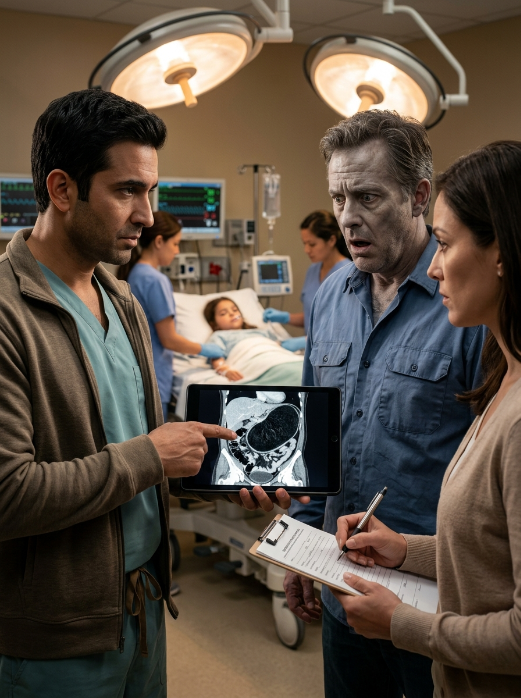
Around one o’clock in the afternoon, the door swung open and Vernon walked into the room, looking rumpled and sweaty in his work shirt with grease smudged across his forehead. He looked around at the IV poles and the digital heart monitors like a man who had walked into the wrong house by mistake, his mouth half-open to start complaining about the gas money he’d spent driving across the county. Before he could get a word out, Dr. Thorne walked through the door holding a digital tablet with the contrast CT scans glowing brightly against the dark screen. Mr. and Mrs. Vance? the surgeon asked, looking between the two of us with eyes that didn’t miss a single detail of Vernon’s panicked expression. I’m Dr. Thorne, and I’ve just finished reviewing the scans of your daughter’s abdomen. He turned the tablet around so the glowing image was right in front of us, showing a massive, dark shape that completely blocked out the interior of Maya’s stomach and curled down into her intestines like a thick black tail.
This is a gastric trichobezoar weighing at least two pounds, Dr. Thorne explained, pointing his pen right at the dense center of the mass. It has completely choked off her digestive tract, and if her mother hadn’t brought her in this morning, the pressure would have cut off the blood supply to her stomach lining within twenty-four hours, leading to necrosis and death.
Vernon stared at the screen, his jaw dropping slack while his face turned the color of wet cement under the fluorescent lights. I… I thought she was just being difficult about school, Vernon stammered, his voice cracking on the vowels as he looked from the doctor to his pale, frightened daughter on the bed. I didn’t know she was actually sick. I thought she was just putting on an act for attention. Children don’t hide their suffering like that unless they’ve learned there’s no safe place for them to land when things get hard, Dr. Thorne said coldly, turning away from Vernon like he was something unpleasant he’d stepped in on the sidewalk. We are taking her into Operating Room 3 right now to perform a gastrotomy. I need one of you to sign these consent forms immediately. I stepped forward, took the clipboard and the pen from the nurse’s hand, and signed my name across the dotted line in a firm, clear script without looking at Vernon once. I didn’t hand him the pen. I didn’t ask what he thought we should do next. The authority in our home had shifted permanently during that twenty-minute drive, and we both knew it as well as we knew our own names.
Mom? Maya whispered from the pillow as the nurses began to wheel her bed toward the double doors of the surgical suite. Will it hurt when they wake me up? They’re going to give you all the medicine you need so you won’t feel a thing, my sweet girl, I told her, leaning down to press my lips against her cold forehead while my own tears finally fell onto her blanket. And when you wake up, that heavy stone in your stomach will be gone for good, I promise you. Everything is going to be different from today on. They pushed her bed through the swinging doors, and Vernon and I were left standing alone in the quiet hallway with the smell of floor wax and antiseptic hanging heavy in the air. For three hours, we sat on plastic chairs in the surgical waiting room while the clock on the wall ticked off the seconds in a steady, maddening rhythm.
Vernon tried to clear his throat twice to say something to me, once to offer to buy me a vending machine coffee and once to start an apology about how he’d handled things at the supper table over the winter. I didn’t raise my voice or start a fight because I was all out of anger; I just looked straight ahead at the green carpet and told him his opinion didn’t matter to me anymore and that we would talk about our marriage after our daughter was safe. He swallowed hard, slumped down in his chair, and stared at his heavy work boots for the rest of the afternoon without saying another word.
At four-twenty, Dr. Thorne pushed through the double doors wearing his green scrubs with his surgical cap tucked under his arm, looking tired but carrying a small, unmistakable air of relief. The surgery was a complete success, the doctor said, a tired smile breaking across his face as he walked over to where we were sitting. We performed an open gastrotomy and pulled out a solid mass of hair and fibers measuring nearly seven inches long without causing any tears or leaks in her digestive tract. Her stomach wall is inflamed, but it’s healthy enough to heal completely with a few weeks of proper nutrition and rest. She’s resting in the recovery ward right now, and you can see her as soon as the nurses get her settled into her room. A wave of relief washed over me so hard and fast that my knees turned to water, and I had to grab the arm of the plastic chair to keep from sliding down onto the floor. I closed my eyes and let out a long, shaky breath, feeling the cold knot of terror that had lived in my chest for months finally loosen its grip and drift away.
Maya stayed in the pediatric recovery ward for two full weeks while I took an unpaid leave of absence from my grocery store job to sit beside her bed from morning until night, bringing her fresh clothes and reading to her from old paperbacks. I arranged for a clinical social worker and a specialized adolescent counselor to visit her room every afternoon, setting up a long-term plan to help her manage the anxiety that had driven her to chew on those fibers in the dark. Vernon paid every single hospital bill without a single word of complaint about his savings or his overtime, taking on extra weekend shifts down at the elevator to cover the copays that kept rolling in through the mail slot. But he didn’t make decisions about our household anymore, and he didn’t tell me how to raise our daughter when things got difficult or expensive. I took full control of her medical care, her diet, her bedroom setup, and the way our home ran from that day forward, making sure she knew every single minute of the day that she had a safe place to land.
Three months later, on a warm, clear Saturday afternoon in late June, the sky over our farm was a brilliant, endless blue that stretched out over the wheat fields as far as the eye could see. I sat by the open kitchen window with a mug of black coffee in my hand, the screen letting in the sweet, green smell of freshly cut clover and warm earth from the backyard. Out on the lawn, the afternoon sun caught the bright red fabric of Maya’s new fitted soccer jersey as she stretched her legs out on the grass. Her long brown hair was tied back in a neat, shining ponytail that bounced against her shoulders as she moved with a lightness I hadn’t seen in years. She balanced herself on her left foot, drew back her right leg, and kicked the old soccer ball hard against the wooden side of the garage door with a loud, satisfying thud.
She caught it neatly on her sneaker as it bounced back toward her, spinning around with a bright, loud, breathless laugh that carried all the way across the yard and through the kitchen window. I smiled down at the rim of my coffee cup, set it gently on the counter, and watched my daughter kick the ball again, whole and healthy and finally free from the heavy stone she had carried in secret for so long.