How a Wealthy Heir Assaulted Me at a Charity Gala to Steal My Audit and Met the Master AV Override

I got it wrong right from the start because I trusted the ink on the page instead of the way Graham Weller kept tapping his gold signet ring against the edge of his coffee cup during our third intake meeting. I should have known that a man who wears handmade Italian shoes to a dusty basement municipal records room is not there to look at eighteen-twenty-eight masonry reports. He was there to make sure the historical preservation covenants vanished before the city council’s zoning vote next Tuesday morning.
I spent six months pulling microfiche records from twenty-eight, cross-referencing soil-sample tests from three different independent engineering firms, and documenting every altered stress report on the municipal library’s foundation. Graham’s firm had systematically manipulated the structural integrity ratings to claim the historic limestone building was crumbling beyond repair. That lie allowed them to condemn the landmark, void the public preservation covenants, and claim the fourteen million five hundred thousand dollar municipal grant to clear the ground for a private commercial tower. I had thought showing the facts to the foundation trustees tonight would shock them into action. I had thought they simply did not know. Seeing Councilman Harris turn away, and seeing the police chief laughing at Arthur Weller’s table, shattered my blind spot completely. They did not need to be informed. They were protecting their own interests, and they expected me to back down out of fear and shame.
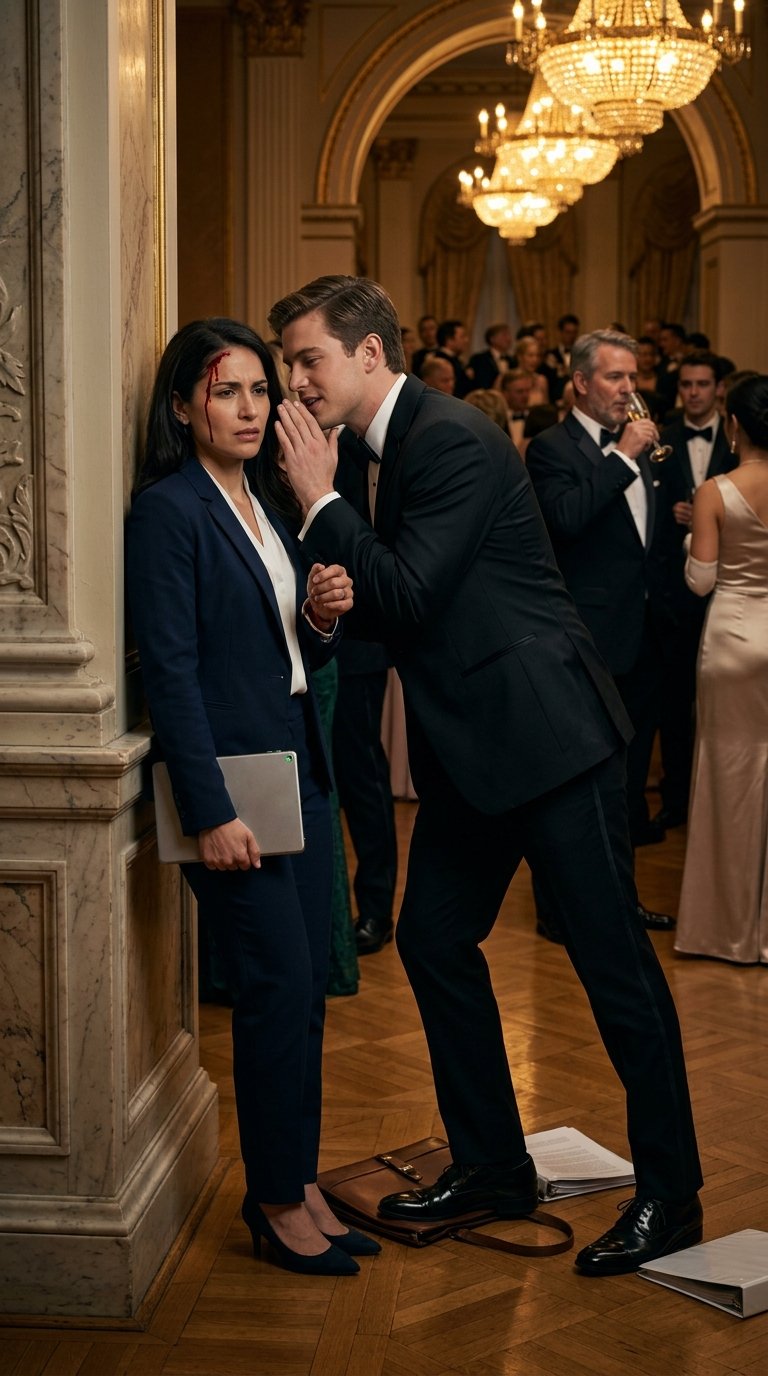
The back of my head hit the carved marble wainscoting with a dull, wet crack that seemed to echo through the entire south colonnade of the Grand Heritage Foundation Gala. The pain came fast, sharp and hot, shooting straight down into my shoulder blades like a needle dipped in boiling oil. My leather portfolio dropped onto the polished parquet floor with a heavy slap. Graham Weller stepped into my space immediately, his polished dress shoe pinning the strap of the case so I could not pull it back. You are done, Elena, he whispered, leaning down so close I could feel the heat of his skin. His breath smelled like expensive scotch and peppermint. Give me the digital drive and the hard copy, or I will have security carry you out into the alley as a trespasser. We were standing less than thirty feet from three hundred people in black tie and satin evening gowns.
A string quartet was playing a sleepy arrangement near the grand staircase. Caterers carried silver trays of champagne flutes past the archway, their white gloves gleaming under the gold leaf trim of the ceiling molding. At least a dozen city leaders and foundation trustees saw him push me. Councilman Harris looked directly at us, paused with a drink halfway to his mouth, and then deliberately turned his back to rejoin a conversation about county zoning. Mrs. Dupont, who had known my family for twenty years and used to bring lemon bars to our porch when I was ten, caught my eye through the gilded arch and took two steps backward behind a floral pillar. Nobody moved. Nobody said a word. Graham’s family held the fourteen million five hundred thousand dollar civic redevelopment contract for the historic municipal library district. His father was the foundation’s primary donor and sat on the executive allocations committee.
In that room, money did not just talk; it bought total, obedient silence.
I touched the side of my forehead where the marble had caught me. My fingers came away slick with dark red blood, warm and sticky against my palm. That report is city property, Graham, I said, keeping my voice as level as my lungs would allow, though my ribs felt tight and bruised. The foundation board hired me as an independent compliance auditor six weeks ago. You cannot bury four years of falsified foundation inspections just because your dad bought the flowers for this party. I just did, Graham said. He smiled, a thin, crooked line that showed his small, even teeth. You think these people care about nineteenth-century load-bearing arches and old plaster ceilings? They care about the twenty-story glass tower we are building over it, and they want their investment returns by next spring. My father signed the check for the orchestra, the wine, and the municipal grant matching funds.
You are a thirty-four-year-old girl with a clipboard and an expired contract. Hand over the tablet before I make this really unpleasant for you. I kept my hand pressed flat against the slim metal case inside my blazer pocket. A small green sync light on the top edge of the casing blinked once every three seconds, steady and quiet, like a pulse in the dark. Graham reached out, grabbed my wrist, and twisted it hard against the stone wall. The pain flared in my wrist joint, sharp enough to make my vision grey at the edges, but I did not drop the device. He ripped my paper binder from under my arm with his free hand, tossed the heavy folder onto the floor, and kicked it under a velvet-skirted banquet table where it vanished into the shadows. Look at them, Elena, Graham sneered, nodding toward the crowded ballroom where silver spoons clinked against crystal stemware.
Not one person is coming over here. You can hold that phone all night. Go ahead. Dial whoever you want. Call the police chief. He is sitting at Table Two next to my father, eating prime rib.
Arthur Weller himself appeared in the colonnade archway a moment later, moving with the unhurried grace of a man who owned the real estate beneath everyone’s feet. The elder Weller was seventy, with silver hair brushed straight back and tailored posture that made him look ten years younger than his age. He walked over slowly, glancing at the blood on my temple and then down at his son with mild irritation. That is enough, Graham, the old man said quietly. He did not sound angry at his son’s violence. He sounded annoyed by the mess, the way a homeowner might look at muddy bootprints on a clean foyer rug. Arthur turned to me, pulling a crisp linen handkerchief from his pocket and extending it toward my face. I did not take it. I let the blood run down toward my eyebrow. Miss Vance, Arthur said, keeping his voice low and soothing, pitching it for my ears alone.
You have done thorough work, and your documentation is impressive, but you lack the broader perspective. This city needs modernization. The library has served its time, and a pile of old brick is not worth holding back municipal progress. My firm will compensate you for your consulting time, three times your standard fee, if you simply certify the standard clearance papers and leave quietly through the staff entrance tonight. Your son forged geotechnical load ratings, Mr. Weller, I said, wiping the blood from my brow with the back of my own sleeve to keep it out of my eye. He swapped the soil tests from the west wing with tests from a different parcel five miles away where the ground is solid clay. If you build that tower, the entire eastern gallery will collapse into the subway tunnel within five years of excavation. No one is going to read your private notes, Elena, Arthur replied smoothly, his expression never changing.
The vote to approve the demolition and release the fourteen million five hundred thousand dollar contract happens in ten minutes on that stage. Take the settlement and protect your career. Because if you cause a scene, my attorneys will ensure you never inspect a single square foot of public property in this state again, and you know how small this town is when the county blackballs an auditor.
Graham stood beside his father, adjusting his gold cufflinks with his free hand, his expression dripping with smug confidence. He thought I was trapped against the wainscoting. He thought my hand inside my pocket was clutching a cell phone, desperately trying to dial a emergency dispatcher who would never arrive in time to stop the vote. He did not understand what he was looking at because he had never bothered to read the technical rider on the municipal audit contract he had signed off on behalf of the development syndicate. When the city appointment board named me master compliance auditor six weeks ago, the city IT department had paired my diagnostic tablet directly with the municipal public record archive and the venue’s staging network as part of the mandatory transparency protocol. The ballroom’s automated overhead tracking cameras, designed to follow speakers for the foundation’s live stream and record every transaction for public transparency, were calibrated to follow my auditor ID tag wherever I walked in the building.
The green light blinking against my palm was not a phone searching for cell service. It was the active master override for the ballroom AV system and the city council’s public transparency feed, waiting for a single trigger to dump every byte of cache data onto the main screens. I am not taking your money, Mr. Weller, I said clearly, looking past Arthur straight into his son’s panicked eyes. Graham laughed out loud, a sharp, barking sound that turned a few heads at the nearest table. Then get thrown out, you idiot.
I pressed the tactile execution button on the side of the device three times, holding it on the third tap until the green indicator turned solid blue. Above our heads, the ceiling audio cut out with a sharp electronic ping that made the string quartet stop playing mid-measure. The two twenty-foot high-definition staging screens on the main stage, which had been displaying the foundation’s gold logo against a cream background, flickered once and went bright white. A split second later, the ballroom speakers boomed with Graham’s voice, captured crystal-clear by my lapel microphone and amplified through twenty thousand watts of concert-grade line arrays: Give me the digital drive and the hard copy, or I will have security carry you out into the alley as a trespasser. A collective gasp swept through the three hundred guests like a sudden gust of wind through dry leaves. Heads snapped toward the front of the room all at once.
On the giant screens, the automated tracking camera high in the colonnade ceiling showed everything in high definition. The entire room saw Graham Weller slamming my head into the marble wainscoting. They saw him rip the paper binder from my hands and kick it under the table. They heard Arthur Weller offering to pay me three times my fee to falsify safety clearance papers so they could pour concrete over a municipal hazard. Arthur Weller went completely rigid, his smooth composure cracking like old plaster. Graham took a wild step toward me, reaching for my hands with his fingers clawed, but the screens were already cycling to the next file in the audit cache without my having to touch a button.
Side-by-side engineering schematics filled the twenty-foot displays above the silent orchestra. On the left was the real structural core sample showing solid limestone bedrock beneath the library’s west gallery. On the right was Graham’s forged submission, complete with the timestamp and his personal digital signature altering the safety score from stable to condemned to justify immediate demolition. Beneath it, in bold red text, the municipal compliance header displayed the exact financial stake: Fourteen Million Five Hundred Thousand Dollar Municipal Redevelopment Fraud Alert, logged directly into the secretary of state’s public portal. The ballroom descended into utter chaos in less than three seconds. Guests pulled out their phones, filming the screens, gasping and pointing at the figures scrolling past. At Table Two, the police chief stood up immediately, his face dark as he realized the stream was broadcasting live to the municipal public access channel and the state attorney general’s open records portal where anyone with an internet connection could watch it happen in real time.
Graham lunged at me again, his face twisted in panic, losing all the polish that fourteen million dollars had bought him. Turn it off! Shut it down! he screamed, grabbing for the metal case in my pocket. Two uniformed patrol officers who were stationed at the grand entrance to keep out protestors did not wait for orders from the chief or anyone else. They moved swiftly down the colonnade corridor, pushed past Arthur Weller as if he were a stranger on the street, and forced Graham’s arms behind his back with practiced efficiency. The sharp click of metal handcuffs echoed against the stone floor, loud and final.
Let go of me! Graham shouted, twisting against the officers as his expensive tuxedo jacket pulled tight across his shoulder blades. Do you know who my father is? My father built half the commercial strip in this county! Graham Weller, you are under arrest for assault and felony tampering with public records, the larger officer said loudly, leading him straight through the center aisle of the stunned crowd while guests flattened themselves against the tables to avoid touching the handcuffs. Arthur Weller reached out a trembling hand toward the podium where the microphone was still live, but no one looked at him. The foundation board members were already backing away from his table like ghosts, frantically pulling out their phones to call their legal counsels before their own names appeared on the scrolling feed.
The formal cancellation of the redevelopment contract came seventy-two hours later after an emergency session of the city council called for Monday morning at eight o’clock. With the livestream footage and the uncorrupted structural records entered into public evidence without a single objection, the council voted unanimously to terminate the Weller firm’s contract, revoke their commercial license, and permanently reassign the fourteen million five hundred thousand dollar grant to the historic library’s permanent restoration trust. Graham Weller was formally indicted on four counts of felony fraud and one count of aggravated assault, his bail set high enough that his father’s accounts could not clear it before the weekend deposition. Arthur Weller resigned from every civic board in the county before the week was out, his name quietly scrubbed from the brass plaques in the lobby of the municipal building where he had held court for decades. Six months later, on a bright Tuesday morning in October, I walked up the broad granite steps of the municipal library with my leather portfolio tucked securely under my arm.
The yellow demolition warning tape was completely gone, replaced by fresh white trim and window boxes filled with late-season mums. The heavy bronze double doors, cast in eighteen-ninety-four and restored to a rich, warm shine by local artisans, were propped wide open to the crisp autumn air. Inside the central rotunda, the morning sun poured through the high clerestory windows, lighting up the grand limestone arches that Graham Weller had tried to destroy for profit. An elderly man sat at a solid oak reading table with a morning paper spread wide, and a young mother helped her daughter carry a stack of picture books toward the front desk. My head had healed months ago, leaving only a tiny, faint line near the hairline that nobody noticed unless I pointed it out in a harsh light. I stood on the top step for a moment, listening to the quiet murmur of voices coming from the reading room and the distant chime of the library’s clock tower striking ten.
I adjusted my shoulder bag, walked through the open bronze doors, and went in to start the final preservation inspection.