How My Stepmother Handed Me an Eight-Dollar Watch and Met My Father’s Rose Gold Observatory Chronometer

Eighty-four thousand six hundred and fifty dollars is a very tidy sum of money to realize you are holding in the palm of your hand when the person who gave it to you thought she was handing you literal garbage.
The morning after Daddy passed away, Evelyn didn’t even wait for the coffee pot to finish its wet, sputtering cough before she came down the stairs with a battered cardboard box in her arms. She set it down right on the edge of the stone porch where the gravel meets the pavement, pushing it toward me with the toe of her sensible loafer like she was clearing away a stray dog.
“You can take his junk,” she said, her voice carrying that sharp, practiced indifference she always used whenever she wanted to remind me I didn’t belong in the house my daddy built with his own two hands. “The boys and I are handling the actual estate. We don’t have time to catalog sentimental scrap.”
Behind her in the driveway, her two grown boys, Todd and Greg, were already loading a rented box truck that smelled faintly of old cardboard and stale exhaust. They had backed it right up to the front steps so the rubber bumper was almost touching the screen door, treating the place like a moving sale before the body was even cold in the ground.
I watched Greg carry out Daddy’s leather wingback chair, his brass floor lamps, the silver tea set his mother had brought down from Ohio back when Eisenhower was in office, and the heavy walnut gun cabinet that always smelled of gun oil and cedar.
Greg was sweating right through an expensive golf polo he must have bought just for the funeral trip, barking at Todd not to scratch the cherry wood console table as they hoisted it into the dark maw of the truck.
I stood there on the gravel with the cardboard box in my arms, my shoulders heavy with a tiredness that sleep wasn’t going to fix. Inside that box, there was no silver, no cash, and none of the precision hand tools my daddy had spent forty years collecting as an industrial machinist down at the water works. There was only a faded shop rag, a couple of brass keys to padlocks nobody used anymore, and Daddy’s everyday wristwatch resting right in the middle like an old bottle cap.
The watch looked awful, honestly. The acrylic crystal was deeply scored across the center with a long, jagged scratch that looked like it had taken a direct hit from a grinding wheel, and the stainless steel bezel had a rough, lumpy solder joint near the two o’clock position where Daddy had clearly repaired it himself with a torch in his basement shop.
The lugs had been filed down flat by hand, and the leather strap was dark and stiff with decades of motor oil, sweat, and cutting fluid.
“Evelyn,” I said, trying to keep my voice steady because I didn’t have the stomach for a shouting match on the porch where my mother used to hang her ferns. “Daddy promised me his drafting desk. The one with the brass drawer pulls he made by hand during the strike back in seventy-eight.”
Evelyn didn’t even turn around from checking her clipboard with a gold-plated pen she must have fished out of Daddy’s study drawer. “The appraiser is coming Tuesday for the furniture and the vehicles, Chris. Everything in the main house is marital property. If it isn’t listed in the memorandum, it stays right here. Be grateful I didn’t throw that box in the dumpster with the old newspapers.”
She walked inside and let the heavy oak front door slam shut with a dry, hollow thud that rattled the glass in the sidelights.
I was thirty-eight years old, standing in the driveway where my daddy used to teach me how to check spark plugs and set the gap on a distributor point, feeling entirely like a trespassing child who had overstayed his welcome.
I didn’t hire a lawyer that morning. I didn’t scream or block their rented truck, and I certainly didn’t make a scene on the front lawn. My daddy, Thomas Vance, had been a quiet, deliberate man who hated public arguments more than almost anything else in this world, and I was simply too exhausted by grief to fight three people who had spent the last five years treating his slow decline like an estate sale countdown.
I took the box home to my small two-bedroom rental across town, a place with cheap linoleum floors and a radiator that banged like a hammer every time the furnace kicked on in the basement.
That night, after the sun had gone down behind the telephone poles and the neighborhood had grown quiet, I threw away the cardboard box because it smelled like musty attic dust, washed the shop rag in the kitchen sink until the water ran clear, and picked up the watch to see if it was completely dead. I wound the small ridged crown until it resisted with a firm, oily click, half-expecting nothing to happen at all. To my surprise, the second hand gave a slight, stuttering jump and began sweeping around the dial with a steady, purring rhythm. It didn’t tick with the loud, tinny snap of a cheap five-dollar quartz movement you buy at the hardware store counter. It had a strange, dense hum, almost like a miniature turbine, and the case felt unexpectedly heavy in my palm, like a piece of solid lead pipe disguised as a timepiece.
I buckled the stiff, oil-stained strap around my left wrist, and it settled there like it had grown from the bone. It smelled faintly of cutting fluid, cedar shavings, and Daddy’s pipe tobacco, that cherry-blend stuff he used to order in bulk from a catalog up in Michigan.
Over the next four months, I wore that battered watch every single day without fail. I wore it to my shift down at the water treatment plant while I checked the chlorine pumps, I wore it while doing my grocery runs at the Piggly Wiggly, and I wore it when I sat alone on my back porch in the evenings watching the fireflies come up through the weeds. Whenever Evelyn or her sons posted updates online boasting about their new leased European SUVs or the weekend trips they were taking down to the coast after clearing out Daddy’s house, I didn’t comment or pick a fight; I just touched the scratched crystal with my thumb and thought about the way Daddy used to whistle through his teeth when he was working a difficult radius on the lathe.
It was the only piece of my father I had left in this world, and for a long time, I figured that was simply the end of the story.
Then came the second Saturday in October, when the morning air had that sharp, dry smell of frost coming off the creek and the leaves down on Maple Street were turning the color of old copper pennies.
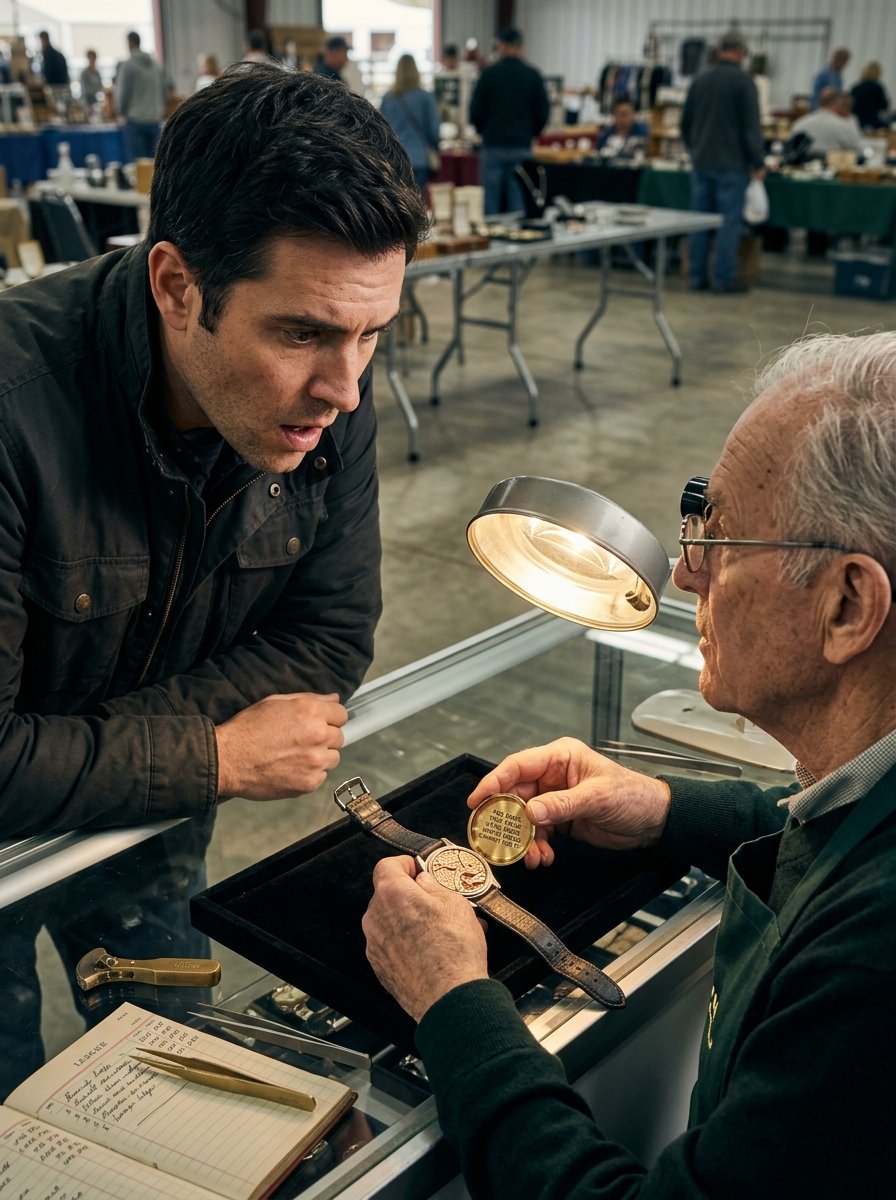
I went down to the regional agricultural fairgrounds for the monthly flea market, hoping to find an old bench vise to set up on my workbench in the garage so I could stop holding things between my knees when I filed them. Near the back of the second pavilion, tucked away behind a row of rusted tractor parts and old kerosene lanterns, an elderly man in a dark green shop apron was sitting behind a glass case filled with vintage mantle clocks and pocket watches that all ticked at slightly different speeds. A hand-painted sign beside him read: Campbell Horology, Repairs & Restorations Since 1974.
I stopped to look at a small brass barometer hanging on a wooden board by his table, wondering if the glass face was still airtight after all these years. As I reached out to touch the brass casing with my fingertips, the sleeve of my canvas jacket pulled back just enough to expose the wrist of my left arm.
The old man behind the counter didn’t look at the barometer at all. His eyes locked onto my wrist with the kind of laser-focused intensity you only see in people who spent sixty years working with watch jewels and hairsprings under a magnifying glass. He pushed his wire-rimmed glasses up his nose, stood up so quickly his folding chair scraped the concrete floor with a harsh screech, and stared directly at my arm.
“Excuse me,” the old man said, his voice quiet but sharp enough to make a woman three tables down turn her head. “Where did you get that watch?”
I pulled my hand back instinctively, shoving my fist into my jacket pocket with a sudden flare of defensiveness that caught me completely off guard. “It was my father’s,” I said, my voice dropping an octave.
“Thomas Vance,” the man said immediately, before I could even draw another breath to explain.
The air seemed to leave my chest all at once, like someone had pressed a hand against my ribs and leaned their weight into it. I looked down at the small brass nameplate sitting on his display case, reading the block letters etched into the surface: Arthur Campbell.
“You knew my dad?” I asked, and the words felt small and thin in the drafty concrete pavilion.
Arthur didn’t answer right away. He reached under the counter and pulled out a clean velvet jeweler’s pad, the dark blue kind that didn’t show the lint, and placed it right on the glass between us. “Take it off, son. Please. Let me look at the lugs.”
My fingers were stiff and clumsy as I unbuckled the worn leather strap, the old oil-stained hide resisting the buckle like it didn’t want to leave my skin. I handed the watch over across the glass case. Arthur didn’t handle it like an old piece of garage junk or a cheap drugstore find. He picked it up with two fingers by the extreme edges of the case, holding it up toward the bright halogen work lamp he had clamped to the edge of his table. He slipped a black jeweler’s loupe into his right eye socket with a practiced squint and turned the heavy steel case slowly in the light, his thumb resting lightly on the rough solder mark.
“Forty-two years,” Arthur murmured, running a blunt, clean fingernail over the ugly silver solder blob near the two o’clock lug where Daddy had burnt his thumb back when I was just starting grade school. “He brought this case into my shop on Elm Street back in nineteen eighty-two. A cheap, mass-produced utility casing he bought out of a catalog for eight dollars. He spent two full weeks in his machine shop hand-filing the interior cavity just to make enough clearance.”
“Clearance for what?” I asked, leaning over the glass so my breath fogged the surface. “It’s just an old mechanical watch. He wore it under trucks and around the lathe while he cut steel pipe.”
Arthur lowered the loupe and looked at me over the top of his glasses, his pale blue eyes watery behind the wire frames. His expression was dead serious, the kind of look my daddy used to give me when I was about to touch a spinning belt on the drill press. “Thomas was a master machinist, Chris. He understood tolerances down to the ten-thousandth of an inch. Do you honestly think a man who built custom hydraulic valves for aerospace contracts would wear an eight-dollar department store movement for forty years without losing his mind over the drift?”
“I thought he was just practical,” I said, feeling like a fool. “He never cared about flashy things or brand names. When he died, my stepmother Evelyn took everything with any shine on it. She handed me this out of a trash pile because she said it was worthless junk.”
A dry, bitter smile crossed Arthur’s face, the kind that had seen a lot of family greed over forty years in a small town. “Evelyn. Yes. Thomas came to see me four years ago, shortly after his second stroke made his hands shake too much to hold a micrometer. He brought this watch in for a complete oiling and timing regulation. He told me what was happening at that house on Maple Drive. He said his new wife and her boys were already walking through the rooms with yellow sticky notes, claiming furniture and talking about trade-in values on his truck while he was sitting in his wheelchair on the porch waiting for the sun to move.”
Arthur reached behind his stool into a heavy leather doctor’s bag that looked like it belonged to a country doctor from the nineteen-fifties, pulling out a specialized brass case-opener wrench with multiple adjustable prongs and a pair of anti-magnetic steel tweezers.
“I kept the old commission ledger,” Arthur said, tapping the corner of his wooden table with a thick finger. “Thomas told me that if his instincts were right, you would end up with this watch because nobody else in that family would bother to look twice at a scratched crystal and a solder blob. He made me promise on his grave that if you ever walked into my shop wearing it on your wrist, I would open the back right in front of your eyes.”
My heart pounded hard against my ribs, thumping like a loose piston in a worn cylinder. “Open it, then.”
Arthur set the watch face-down on the blue velvet pad, treating it like a loaded gun. He fitted the brass prongs of the wrench into the subtle, fine notches along the steel perimeter of the back plate. He applied steady, practiced pressure with both hands, his knuckles whitening under the skin. There was a faint, clean metallic click as the threads finally yielded after decades of being sealed tight against the weather.
Arthur carefully lifted away the outer steel shell, setting it aside on the counter. Beneath it was not a standard rubber gasket or a cheap dust cover, but a custom-machined brass plate, polished bright and sealed tight with two tiny blued-steel screws that looked like they belonged in a fine rifle mechanism. He removed the screws with a micro-screwdriver, lifted the inner plate away, and laid the inner movement completely bare under the harsh glare of the halogen lamp.
Even with my untrained eyes, I could tell this was nothing like the outside.
Inside that beat-up, scratched iron shell was a movement of breathtaking, almost painful beauty. The plates were plated in pure rose gold, decorated with microscopic concentric waves that caught the light like spun silk when you tilted it even a fraction of an inch. Tiny ruby pivot jewels glowed deep red against polished steel levers that looked like they had been shaped by a jeweler in Geneva rather than a toolmaker in Kansas. A balance wheel made of some pale gold-alloy glided back and forth in total, silent perfection, its hairspring breathing in and out like a living thing.
“What is that?” I whispered, and the sound of my own voice felt small in the big, noisy pavilion.
“A nineteen-fifty-four prototype observatory chronometer movement,” Arthur said softly, his voice dropping almost to a whisper. “Thomas’s uncle brought it back from Switzerland after the war in a grease-paper parcel. Only twelve were ever produced by the manufacturer before the factory burned down in fifty-six. In nineteen eighty-two, Thomas brought the bare movement to me because he didn’t have a housing for it. He wanted it protected from the grit and the iron filings in his shop. He built that ugly, indestructible steel sleeve himself on his manual lathe so it could survive a machine shop floor without anyone ever knowing what lived inside.”
Arthur reached under his display case again, pulled out an old cloth-bound ledger from the Reagan administration with grease stains on the corners, and turned to a yellowed page filled with his own tight, fountain-pen handwriting. On the ledger line, right next to my father’s signature in faded blue ink, was a serial number that matched the tiny digits engraved on the rose-gold plate of the movement.
Below the movement, etched directly into the inner face of the custom brass dust cover in Dad’s own unmistakable block lettering from his shop days, was an inscription that made my throat tighten up until I couldn’t swallow:
FOR CHRIS. TRUE VALUE LIVES INSIDE WHERE GREED CANNOT SEE IT.
“What is something like this actually worth?” I asked, my voice barely audible above the hum of the electric fans and the chatter of the flea market around us.
“Last November, an identical movement in its original presentation box went at an auction house in New York for eighty-four thousand dollars,” Arthur said calmly, as if he were quoting the price of a gallon of milk. “With your father’s provenance, the custom machinist housing, and my original commission ledger from eighty-two, I would insure this piece today at exactly eighty-four thousand six hundred and fifty dollars.”
I sat on the wooden stool beside Arthur’s table for a long time, unable to take my eyes off that glowing rose-gold engine that Daddy had carried around in his pocket and on his wrist through every shift he ever worked.
Eighty-four thousand six hundred and fifty dollars.
My mind raced back across town to that chilly morning in the driveway when the trees were dropping their first dead leaves. I remembered Evelyn’s smirk, the dismissive wave of her clipboard, and the way Greg and Todd had nearly broken their backs hauling away heavy oak buffets and used lawn tractors that wouldn’t start without ether. They had fought over every silver spoon, every old television set, and the keys to Daddy’s four-year-old pickup, absolutely convinced they were taking every cent he had ever earned in this life.
“I need to give you a certified appraisal and an insurance binder,” Arthur said, breaking my silence while he reached for a pad of green paper. “If you want, I can transfer the movement into an authentic vintage gold case. I have three in my safe that would fit the caliber right down to the millimeter. We can polish out the scratches, replace the crystal, and put it on genuine alligator leather so it looks like what it is.”
I looked down at the scarred steel casing sitting quietly on the blue velvet pad. I saw the rough solder bead near the lug where Daddy had burned himself, the microscopic tool marks where he had shaped the inner brass plate on his manual lathe while the radio played old country songs, and the deep scratch across the acrylic from when he had caught it on a boat trailer winch while helping me fix the brakes on my first car.
“No,” I said firmly, shaking my head before he could pull another tool from his bag. “Leave it in this case. Just clean the movement, replace the rubber gaskets, and keep it exactly the way my dad built it.”
Arthur looked at me for a long moment over his wire-rimmed glasses, and then he gave a slow, approving nod that made me feel like I had finally passed some test Daddy had set for me thirty years ago. “A wise choice, son. A thief would walk right past it on a sidewalk table without a second glance. But you will always know what is inside.”
Over the next three weeks, Arthur completed a full mechanical overhaul in his back room. He photographed every single component with a macro lens, verified the serial numbers against his nineteen-eighty-two shop ledger, and had the provenance officially notarized down at the county courthouse. When I finally went back to pick up the watch and the heavy leather-bound appraisal portfolio, I paid Arthur his standard service fee and immediately took the paperwork straight to my insurance agent across from the courthouse, adding a specific scheduled personal property rider under my name alone so nobody could ever claim it was part of any probate mess.
The title and legal ownership were completely airtight. Daddy had personally gifted the watch to me right through Evelyn’s own hands on the morning after the funeral, documented by her signed receipt of non-probate personal effects that she had clumsily filed with the county clerk to close out the small estate in record time so she wouldn’t have to pay lawyer fees.
Two weeks after that, right when the first hard freeze was turning the grass white in the mornings, my phone rang while I was sitting at my kitchen table drinking instant coffee. It was Todd.
He didn’t bother with small talk or pleasantries. His voice was stressed, tight, and loud enough that I had to hold the receiver an inch away from my ear.
“Chris, we have a massive problem,” Todd said, and I could hear the sound of traffic in the background like he was standing outside a bank in a stiff wind. “The bank is putting a lien on the house. Did Dad have another safe deposit box somewhere downtown? Did he leave any cash stashed away in the garage behind the workbench?”
“What are you talking about, Todd?” I asked, keeping my voice level.
“Evelyn is losing her absolute mind,” he snapped, his voice cracking with panic. “The pickup was still financed under a balloon note Dad took out before his stroke to pay for her new kitchen counters. The credit union is repossessing it this Friday morning. And the estate lawyer just called to tell us Dad had a private line of credit secured against the house equity that we didn’t know existed. We sold all the furniture and the heavy tools, but after the auctioneer took his thirty percent cut, we barely cleared eleven thousand dollars total. It doesn’t even cover the back property taxes she owes the county.”
I leaned back in my old wooden desk chair, looking out my kitchen window at the afternoon sun hitting the rusted gutters of the house next door.
“He didn’t leave any cash, Todd,” I said quietly, watching a blue jay land on the fence post.
“He had to have had something!” Todd yelled into the phone, his anger slipping over the edge into bitter, desperate laughter. “He worked forty years at the plant! He was a master toolmaker! Where did all the money go? Did he give you anything special before he died?”
“You saw what Evelyn gave me on the porch,” I replied, keeping every syllable flat and even. “A box of scrap metal. You guys loaded everything else into your truck yourselves.”
“That junk watch?” Todd scoffed, his voice dripping with disgust. “Yeah, right. Look, if you find any bank books or old savings bonds in Dad’s old paperwork in your garage, you better let us know right now. Evelyn is facing a thirty-thousand-dollar deficit just to settle the estate debts before the end of the year, and the house is going to a short sale by December.”
“Good luck with the bank, Todd,” I said, and without waiting for him to yell another question, I pressed the red button and hung the phone up on the kitchen counter.
The house where I grew up went to a public foreclosure auction three months later on a raw Tuesday morning when the wind was howling off the plains. Evelyn moved into a small, cramped rented townhouse down near the railroad tracks outside the county line, and her sons quickly scattered back to their own lives in different states once there were no more assets to divide, argue over, or sell off for quick cash. They had spent all their energy chasing things that looked expensive from the road, only to inherit a mountain of debt, unpaid maintenance fees, and liens that followed them like a dark cloud.
I never told them about the eighty-four-thousand-dollar chronometer ticking steadily inside the steel case on my arm.
There was no reason to fight with them, no reason to gloat over a cup of coffee, and no reason to open a door that my daddy had so carefully closed with his own hands. Daddy knew exactly who Evelyn was from the first day she moved into that house with her expensive luggage and her two entitled boys. He knew that if he had left me a bank account or a shiny gold watch in his written will, she would have hired high-priced lawyers to contest it, dragging me through months of ugly probate litigation until every last cent was swallowed up by court costs and legal fees.
Instead, he used his own two hands, his machinist’s skill, and forty years of quiet patience to hide his life’s true treasure inside the one thing human greed was 100 percent guaranteed to throw away without a second thought.
Now, every single morning before I leave the house for my shift at the water plant, I pick up the watch from the nightstand and wind the crown twelve slow times until I feel the mainspring take hold.
I don’t look at the watch as an eighty-thousand-dollar investment asset to be sold off to strangers or locked away in some dark bank vault where nobody can see it. I wear it right on my wrist every day, with its oil-stained leather strap and its deep, jagged scratch catching the early morning light through the truck windshield. When I press the scarred steel casing against my ear for just a second before I turn the key in the ignition, I can hear the quiet, rapid, unbreakable pulse of the movement Daddy built for me, running perfectly, right on time, exactly where it was always meant to be.