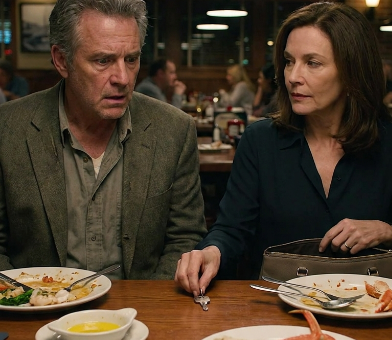
The heavy crystal of the wine glass felt cold in my hand, but the air in the dining room was stifling. We were in McLean, Virginia, for the annual Vance holiday dinner, a sprawling, over-produced event that felt more like a political campaign than a family reunion. My mother, Victoria, sat at the head of the long mahogany table, her silver hair perfectly coiffed, watching every movement with the intensity of a hawk. Beside her, Vanessa, my sister-in-law, kept glancing toward my wife, Emily, with a look of practiced, thin-lipped disdain.
I had spent six years trying to navigate these waters, constantly playing the role of the quiet asset manager while Emily, a guidance counselor from a working-class town, did her best to fit into a world that wanted nothing to do with her. I knew the tension was there, but I had always managed to keep the peace by keeping my head down. I was wrong to think it would last forever.
We were onto the dessert course when it happened. Emily had set a small, velvet-lined box next to her plate, a modest silver cameo brooch she inherited from her late mother. It wasn’t worth much in money, but it was everything to her. Vanessa reached out, her rings clinking against the china, and snatched the box with a smirk. She didn’t just move it, she tossed it with a sharp, dismissive flick into the brass trash bin under the sideboard. “That thing is an eyesore, Emily,” she said, not even bothering to look up. “It ruins the aesthetic of the table.” Emily went still, her face flushing, and she stood up to reach for the bin.
She looked at Victoria, hoping for a shred of decency. She didn’t find any. My mother lunged from her seat, her movements sudden and violent. She struck Emily across the face with a hard, ringing slap that sounded like a gunshot in the silent room. Emily reeled back, stumbling hard into the glass bar cart. The cart shattered into a thousand shards, and she went down in a heap, her arm catching a jagged piece of glass as she fell.
The room stayed frozen. Vanessa just sat there, picking at her dessert, while her husband, a local dentist who usually played the role of the polite, wealthy peer, merely sipped his wine and looked away. Victoria stood over Emily, her eyes hard, empty, and cruel. “You’ll always be trailer trash, Emily,” she spat out, her voice dripping with a systemic, elitist venom. “Get out of my house.” I didn’t yell.
I didn’t start a fight. I felt something inside me lock into place, a cold, clinical precision I had spent my entire career cultivating in the trust office. I didn’t say a word to any of them. I knelt down, gathered Emily into my arms, and walked past the shocked, silent dinner guests and out the front door. I put her in the passenger seat of our car, her arm wrapped in a makeshift bandage, and drove to the emergency room, my mind already running through the bylaws of the 2018 Vance Generational Trust Codicil.
The emergency room was quiet for a holiday, the nurses moving with a slow, tired grace that felt a million miles away from the theater of the Vance household. Emily sat on the edge of the exam table, the stitches pulling tight against her skin, her eyes red but dry. I spent those hours in the chair next to her, not talking, but documenting.
I used my phone to record every detail of her injury, the time, the context, and the names of the attending doctors. By 2:00 AM, I was pulling up the secure portal for our family estate. I had the keys to the entire infrastructure, a reality my mother had spent years pretending didn’t exist. She thought she was the queen of the hill, but she was only ever a tenant of a document she never bothered to read. I wasn’t just angry; I was finished. I saw the bank statements, the automated distributions, and the property titles, and I realized that with a few keystrokes, I could turn their entire world into a memory by breakfast.
I didn’t sleep that night. I sat in our apartment, the silence of our home a welcome contrast to the chaos of the night before. I had the medical reports, the security footage from our cloud, and the original deed of the trust sitting in front of me. The trust had been created by my maternal grandfather, a man who saw exactly what Victoria was long before the rest of us did. He knew that if he left her the keys to the kingdom, she would burn it down for the sake of appearances. So, he built a fail-safe. He put the control in my hands, and he made sure that the rules were ironclad. There was a clause, Section 14, that specifically prohibited any act of physical violence or gross misconduct against a spouse of a beneficiary. It was clear as day: if you commit violence, you forfeit your right to the estate and your right to live in the home. It wasn’t a warning. It was an automated, administrative certainty.
By 5:00 AM, the work was finished. I had prepared the eviction notices, the asset forfeiture orders, and the banking instructions that would freeze every corporate card, line of credit, and investment dividend linked to the estate. Vanessa’s husband had spent a fortune in anticipation of a new clinic expansion, and he had relied entirely on the trust to secure his financing. He was going to wake up to a catastrophe. I felt no hesitation, no guilt, and no desire to argue. They had treated Emily like garbage because they thought they held all the power. They were about to learn that their power was just an illusion I had been allowing them to sustain. I hit the final confirmation button on the compliance portal, and the digital locks slammed shut.
The sun started to climb over the horizon at 8:00 AM, a cold, pale light that hit the snow on our patio. My phone began to buzz before I had even put the coffee on. It was Victoria. She was calling again, and again, and again. When I finally answered, her voice was a high, frantic register of pure, unadulterated terror. She wasn’t the queen of McLean anymore. “David, what have you done?” she gasped, her composure shattered. “My cards were declined at the airport! Vanessa’s husband just got a call from the bank saying his clinic assets are being seized! You have to fix this now!” I listened to her, my hand resting on the counter. I didn’t feel the need to raise my voice. I didn’t need to be cruel. I just needed to be precise. “It isn’t an error, Mother,” I told her, my voice sounding flat and alien even to my own ears. “You told Emily to get out of your house last night. But the house belongs to the grandfather who built the trust, and your occupancy permit was permanently dissolved at eight o’clock this morning.”
The silence on the other end of the line was the loudest thing I have ever heard. She started to scream, then she started to plead, but the reality was already setting in. Her entire lifestyle, her social standing, her sense of entitlement, all of it had been tied to a ledger that I had just closed. I told her the eviction notice would be on her doorstep by noon. I told her the lockouts were final. Then, I hung up. I didn’t care about the family name. I didn’t care about the dinner or the holiday or the years of history. I only cared about the woman sitting in our kitchen, finally safe, finally home, and finally free from the reach of people who never understood that blood is nothing compared to dignity.
By noon, the estate was locked down. I had hired a firm to handle the physical security, ensuring that no one could force their way back into the property or make a scene. The eviction process was brutal, cold, and entirely lawful. Watching the news reports later that week, I saw them scramble, trying to find lawyers who could challenge a trust they hadn’t even read. They couldn’t. The terms were absolute, and the violation was documented in high definition. It was over. Vanessa and her husband lost the clinic, and Victoria was forced into a lifestyle she had spent thirty years mocking. It was a complete and total collapse of their status.
The final morning was the quietest. I stood on the driveway of the McLean mansion for one last time, watching the security team finalize the property transfer. The air was biting and sharp, a cold wind coming off the valley, but I felt nothing but a profound sense of clarity. I handed the final folder to the firm manager, his face blank and professional, and watched him turn toward the front door to bolt it for the last time. Inside, I knew the house was silent. All the expensive trinkets, the designer furniture, the curated aesthetic they cared about so much, it was all just furniture now, waiting for the liquidation team to come and empty it out.
I walked back to my car, the gravel crunching under my boots like dry bones. I thought about the brooch, resting safely on our kitchen table at home, a tiny bit of silver that had cost them everything. People often say you can’t choose your family, but they’re wrong. You choose who you protect, and you choose when the cycle ends. I got in, started the engine, and drove away without looking back at the house, the empty rooms, or the life that had finally, mercifully, been dismantled. The silence in the car was beautiful. It was the sound of everything being exactly as it should have been all along.