I wanted the silence. That is the only reason I ended up on the edge of a dying town in Nebraska. My life in the city had turned into a series of loud, ugly arguments and legal bills that ate through everything I had left. The Benson farm was 160 acres of flat, dry earth that nobody else wanted. The bank listed it for $318,000, which was basically the cost of my pride and my remaining savings. When I signed the papers, the realtor told me the previous owner, Harold Benson, had just walked away during the 2018 harvest.
He said it like it was a local legend. People around here think farmers just vanish sometimes. They think they get tired of the wind and the debt and they just keep walking until they find a horizon that looks better than the one they left.
I didn’t care why Harold left. I just needed to fix the place up. I spent the first two months just dragging junk out of the machine shed and trying to get the irrigation lines to hold pressure. It was quiet, just like I wanted. The only thing that loomed over the property was that massive, rusting 60-grain steel silo. It sat there like a tombstone, casting a long, jagged shadow over the house every evening. It was filled with decades of compressed grain dust that tasted like copper whenever the wind kicked up.
I decided to tackle the silo on a Tuesday. I wanted to turn the base into a workspace.
I dragged in an industrial vacuum, but the floor was covered in a layer of petrified, mouse-chewed corn that felt like walking on gravel. I started shoveling, and that was when the sound changed. My spade hit something that didn’t ring like steel plate. It sounded dead. Solid. I spent an hour scraping away the rust and the rotted grain until a perfect, rectangular seam appeared in the center of the floor. Someone had welded a hatch into the steel, and then they had gone through the trouble of grinding the beads down so they were flush with the floor. You would have had to know it was there to find it.
My first thought was that this was some kind of old bootlegging setup or maybe an underground fuel tank that hadn’t been reported. I’ve seen enough bad contracting jobs in my life to know that people hide all sorts of disasters under their floorboards.
I was worried about the EPA. If there was a leak, I was the one holding the bag. I went to the shed, grabbed my angle grinder and a fresh pack of cutting wheels, and headed back in. The heat inside the silo was brutal. It was like breathing inside a radiator. I started the cut, and the sparks flew in a chaotic, bright arc, dying as they hit the dust. It took me three hours to work my way around the perimeter of the hatch.
When the last bit of metal gave way, the floor dropped a fraction of an inch with a hollow metallic thud. I put my crowbar into the seam and shoved. The hatch groaned, protesting twenty years of rust, and then it flipped back. I expected a blast of stagnant, sewer-gas air. Instead, the air that hit my face was clean. It was cool. It smelled like cedar chips and old, pressed paper.
It smelled like a library that hadn’t been opened in a lifetime.
I shone my flashlight down. There was a steel ladder bolted into the concrete, leading down about twelve feet into a room that looked like it had been carved out of the earth. My brain tried to process what I was looking at. It wasn’t a tank. It was a home. I started down the ladder, my boots clanging against the rungs. When I hit the bottom, I swept the light around the perimeter. There was a bed with a wool blanket pulled tight. A small propane stove sat on a clean counter. A bookshelf held rows of well-worn paperbacks. And then I saw the chair.
Harold Benson was sitting in a high-backed leather armchair, facing a desk. He was still wearing his flannel shirt, though it hung loosely on him now. He looked like he was just taking a nap, except for the way his hands rested on his knees. I didn’t scream. I didn’t even run. I just stood there because my brain kind of stopped working for a second. That was when I saw the cardboard sign on the desk. It was written in thick, black marker. DO NOT CALL THE SHERIFF. LAURA, LOOK IN THE LOCKBOX.
I felt a cold shiver crawl up my spine. Sheriff Wayne Miller had been the first person to stop by my place when I bought the farm. He had walked the property line with me, smiling, talking about how he remembered the old Benson place and how it was a shame about Harold. He had been so helpful. And here was a man who had clearly spent his final days under the earth, welding himself into a cage to avoid that very same man. I didn’t know what to do. My heart was thumping so hard I thought it would crack a rib.
I knew if I called the sheriff, the evidence wouldn’t just disappear. It would be erased. I reached out and took the heavy iron lockbox sitting on the desk. It felt like it weighed fifty pounds. I didn’t look at anything else. I didn’t want to see what was in the room. I climbed back up that ladder, my hands shaking so bad I could barely grip the metal, and I closed the hatch. I didn’t weld it back. I just covered it with the grain and the rust.
I drove to Lincoln the next day. I didn’t tell a soul where I was going. I found Laura Benson-Giles working at the university library. She looked like her father. She had the same sharp, tired eyes. I took her to a diner near the campus. I didn’t lead with the body. I just put the lockbox on the table between us. I told her I bought the farm and I found something that belonged to her. When she opened it, she didn’t say anything for a long time. She just stared at the medical records.
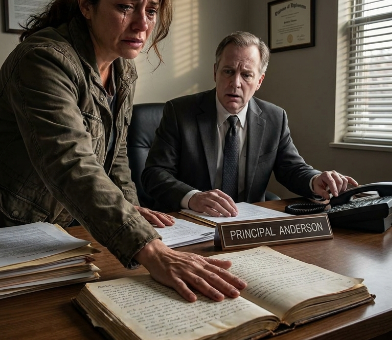
She read the diagnosis. August 2018. Terminal. Then she found the water reports. They were all there, the records showing the illegal dumping of chemical barrels by the Sheriff’s office on the far end of the property. The runoff had been poisoning the wells for years. I watched her face as she realized her father hadn’t abandoned her. He had been fighting a war he knew he couldn’t win, and he had chosen to disappear to keep the sheriff from hurting her. She put the headphones on, the ones from the tape recorder in the box, and she listened to her father’s voice. I didn’t hear what he said, but I saw her shoulders shake. She didn’t cry. She just leaned over the table, her hands trembling, and she whispered, “He knew everything, and he did it anyway.”
I took her back to the farm the next day. We didn’t go to the local precinct. We drove straight to the state patrol office. I didn’t care about the trespassing charges or the fact that I had tampered with a scene. I just wanted those barrels in the ground to be someone else’s problem. We handed over the box and the tape. The state troopers were at the farm by noon. Sheriff Miller showed up twenty minutes later, his cruiser kicking up a massive cloud of dust as he pulled into the lane. He looked confused at first, seeing the state cars, but then he saw Laura.
He stopped right in the middle of the driveway. He didn’t even get out of the car. I saw his face shift. It went from that practiced, small-town-hero smile to something hollow and panicked. He looked at Laura, and he looked at the state troopers, and he knew. He didn’t even try to reach for his radio. He just sat there, staring, while the federal agents moved in to take his badge. It was the fastest thing I have ever seen. One minute he was the king of the county, and the next he was just another man in handcuffs.
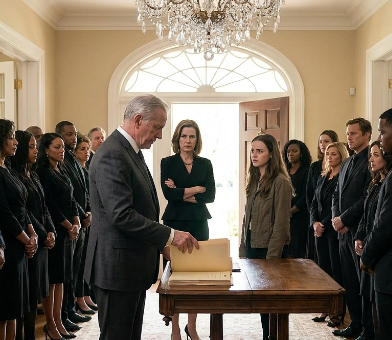
The cleanup took weeks. They pulled forty-two barrels out of the ravine. The state put up fences, brought in trucks, and dug until the soil was clean again. It was a mess, but it was a necessary one. They gave Harold a proper burial next to his wife. I stood there with Laura at the funeral. She didn’t say much. She just looked at me and said, “He would have wanted you to have the land.”
I stayed. I still live on the 160 acres. It’s quiet now. The silo is just a building, not a tomb. I took the hatch off the floor entirely and filled the bunker with concrete so no one else would ever have to go down there. Sometimes, in the evening, I walk out to the fence line where the ravine used to be. I think about Harold, sitting in that chair, listening to the silence of the earth, waiting for someone to finally do the right thing. I guess I was that someone. I’m not a hero. I was just the guy who bought the farm and happened to look under the floor. But every time I see Laura’s car pull up the long gravel lane, I know it was worth every penny of that $318,000. I kept my part of the bargain. I kept the silence, and I made sure it finally meant something.