The fluorescent lights over the checkout counter at CVS always hummed at a frequency that seemed to vibrate right behind my eyes. I was ringing up a gallon of milk and some cough syrup for a regular when the store phone started its shrill, insistent chirping. It was 1:15 PM on a humid Tuesday. I picked up, expecting a call about a shift change or a supply delivery. Instead, I heard Mrs. Gable, Lily’s kindergarten teacher, her voice shaking so hard it sounded like she was standing in a windstorm.
“Elena, I need you to come to the school,” she said. She didn’t wait for me to ask why. “Lily was doing circle time today. She started talking about her bedtime routines. She told the class her stepdad counts her bones in the dark. She said he turns off the lights and presses really hard. She told them, ‘Good girls don’t cry.'”
The world inside that CVS didn’t just stop. It tilted on its axis. I felt the blood drain out of my face so fast I had to grab the edge of the counter to keep from sliding to the floor. Mark. My Mark, who had been the anchor of our home for four years, who had held me when my ex-husband left, who had kissed Lily’s scraped knees with such gentle care. I looked at the customer, a lady I had known for years, and just dropped the phone.
I didn’t clock out. I didn’t tell my manager where I was going. I just ran.
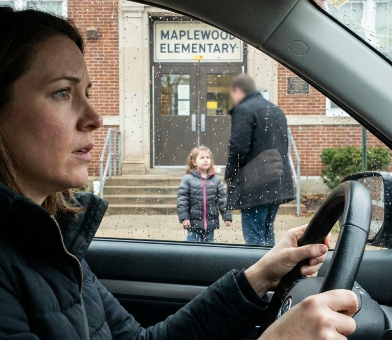
The drive to Oakridge Elementary took twelve minutes. I broke three traffic laws and I didn’t care if I got pulled over. Every time I hit a red light, my brain replayed the last three months. Mark had lost his job at the physical therapy clinic in May. Since then, he had been quiet. Withdrawn. He started taking over the bedtime routine every single night, insisting that I take the late shifts to make up for the lost income. He said it was bonding time. I had thought he was just trying to be a good dad while he looked for work. Now, the memory of him closing that bedroom door and turning the lock felt like a serrated knife in my gut.
When I burst into the counselor’s office, Lily was sitting on a low vinyl couch.
She was clutching a plastic teddy bear, a small smudge of chocolate milk on her chin. She looked so small. So innocent. The counselor, a woman named Ms. Thorne, looked terrified. She told me exactly what the teacher had reported. Lily had described a ritual. The locked door. The darkness. The way Mark would press his fingers deep into her sides and back, counting things she didn’t understand.
I didn’t wait. I stepped out into the hallway and dialed 911. My hands were shaking so bad I almost dropped my phone twice. When Officer Miller arrived, he didn’t look like a hero. He looked tired and grim. He knelt down in front of Lily, his voice low and soft. He asked her about the game. Lily just nodded, her eyes wide. She told him that Daddy Mark used a little plastic ruler that made a clicking sound, and that he had to do it in the dark because, according to him, the bones would hide if the lights were too bright.
“He says if I cry, the bones get scared and go back into hiding,” Lily whispered.
Officer Miller stood up, and his face had gone hard as stone. He didn’t even look at me. He just pulled his radio off his shoulder. “Dispatch, I need an immediate pickup on a male suspect for suspected child abuse. I’m heading to the residence now.” He turned to me then, and his eyes were full of pity. “Ma’am, based on what your daughter described, your husband has been performing predatory physical acts under the guise of a game. We’re picking him up.”
I didn’t want to go to the station. I didn’t want to go to a shelter. I wanted to see him. I wanted to know how he could have looked me in the eye every morning and kissed me goodbye while harboring such a vile secret. I followed the police cruiser back to our house, my knuckles white on the steering wheel. When we pulled into the driveway, Mark was there. He was carrying a bag of groceries, walking toward the porch. When he saw the cruisers, he froze. The bag hit the pavement, spilling a loaf of bread and some apples.
Officer Miller and his partner were out of their car in a flash, guns drawn, shouting for him to get on the ground. Mark didn’t fight. He just stood there, looking completely lost. When they slammed him against the hood of the cruiser, his eyes found mine. He didn’t look like a predator. He looked like a man who had been hit by a truck.
“Elena?” he gasped, his voice cracking. “Did the specialist call back? Is that why they’re here? Did you get the authorization?”
I walked up to him, and for the first time in my life, I felt a physical, burning rage. “Don’t you dare talk about the specialist, you monster! How could you? How could you touch her like that?”
Mark’s face went slack. He looked at me, then at the officers, and then he started to sob. Not a cry of guilt, but a cry of pure, unadulterated terror. “Elena, no! No! Check the garage! The red toolbox! The black binder! Look at the logs!”
Officer Miller glanced at me, then gestured for his partner to keep Mark pinned. “I’m going to take a look, ma’am. Stay here.”
I followed him into the garage. It was messy, cluttered with the remnants of Mark’s job search and old projects. The officer found the heavy steel toolbox and pried it open. Inside, tucked beneath some wrenches and a torque wrench, was a black leather binder. I grabbed it. My heart was hammering against my ribs so hard I thought I might faint. I flipped it open.
It wasn’t what I expected. There were no photos. No dark secrets. It was a technical journal. Page after page of hand-drawn sketches of Lily’s torso, labeled with precise measurements of scapular asymmetry and spinal rotation. There were charts for breathing rates and chest expansion metrics, dated every single night for the last two months. Tucked into the back pocket was a termination notice from our insurance company, dated to expire at midnight.
I read his notes in the margins, his handwriting hurried and frantic. *Spinal curvature accelerating. 14 degrees last month, now 22. Rib cage compressing right lung dome. Pediatrician dismissed it as a postural growth spurt in June. If I can’t present definitive orthopedic mapping to the pediatric chief at the university hospital before the 29th, the insurance will deny the surgical authorization. Cost of VEPTR rod surgery: $180,000. We have $400.*
The room went cold. I looked at the sketches again. He wasn’t hurting her. He was mapping her. He was trying to catch the signs of something called Thoracic Insufficiency Syndrome before the insurance cut us off. He knew that if he told me, I would panic. He knew that if he took her to the doctor, they would put us on a six-month waitlist. He was trying to force an emergency referral by documenting the daily progression of the bone deformity while her muscles were relaxed in sleep.
I ran back out to the driveway. Mark was still pinned against the car, his face pressed into the cold metal. “He’s not a monster,” I screamed at the officers, my voice tearing through the quiet neighborhood. “Uncuff him! Now!”
Officer Miller looked at me like I had lost my mind. “Ma’am, your daughter said, “
“My daughter doesn’t understand what he was doing!” I shoved the binder into his hands. “Look at the dates. Look at the measurements. He was trying to save her life because we couldn’t afford the surgery if we waited! He was doing this because he’s a physical therapist and he knew what was happening to her spine!”
The officer opened the binder. He looked at the medical printouts, the professional charts, and the letter from the pediatric orthopedic surgeon, an appointment scheduled for 8:00 AM the next day. The silence that followed was heavy, suffocating. Officer Miller looked at me, then at Mark. He slowly reached out and clicked the handcuffs open.
Mark didn’t get up right away. He slumped to the concrete, his hands shaking, his forehead resting on the bumper of the car. I knelt down next to him, and for a long time, neither of us said a word. The police officers eventually retreated, leaving us alone in the driveway. The shame hit me then, washing over me like a tide. I had accused him of the worst thing a man could do. I had called the police on the man who had been spending his nights in the dark, measuring our daughter’s bones, terrified that if he stopped, she would suffocate under the weight of her own rib cage.
“I didn’t want you to know,” Mark whispered, his voice barely audible. “I didn’t want you to carry the fear. You were working so hard at CVS. I just needed to get the data to the surgeon. I needed to be sure.”
We went inside. The house felt different. The air was thin, charged with the wreckage of what had almost happened. We didn’t talk about the police. We didn’t talk about the betrayal. We just sat on the kitchen floor, surrounded by the bills we couldn’t pay and the medical documents that were our only hope. We were bankrupt, we were terrified, and we were broken. But we were still a team.
That night, after the house finally went quiet, I went into Lily’s room. She was sleeping, her small chest rising and falling in that shallow, uneven rhythm that I had ignored for so long, thinking it was just a cold or a bad dream. I sat on the edge of her bed in the dark. The house was so still I could hear the wind brushing against the siding. Mark stood in the doorway, his silhouette barely visible against the light from the hall. He looked like a ghost of the man I had married.
I reached out and pulled the blanket back, just a little. I placed my palm flat against her back. I could feel it now, the slight, jagged curve of her spine, the way her ribs were shifting in ways they shouldn’t. I felt the physical reality of the war he had been fighting alone in the dark. I didn’t cry. I didn’t have the strength for it. I just sat there, listening to her breathe, knowing that tomorrow morning, we would walk into that hospital and face the end of our old life together. My hand moved, tracing the line of her back, a silent promise to the man standing in the doorway that I would never stop looking beneath the surface again.