I spent my entire career as a municipal archivist making sure that every single record was accurate, filed in its proper place, and transparently accounted for. My life was built on that same principle of total clarity. After my first marriage ended in a total financial collapse because of my ex-husband’s hidden debts, I swore that the next time I signed a document, I would know exactly what was on the other side of it. For twelve years, Julian seemed to be the man who shared that commitment.
He was a high school guidance counselor, steady and quiet, and our home in the suburbs was our sanctuary. We lived within our means, we kept our books open, and I truly believed that there were no surprises left in my life.
The order broke on a Tuesday night while I was sorting through Julian’s laundry. It was a mundane chore, the kind of thing you do on autopilot while your mind wanders toward the upcoming weekend. At the bottom of his heavy canvas gym bag, nestled beneath a pair of worn-out running shoes, my fingers brushed against cold metal. I pulled it out. It was a new, bright brass Kwikset deadbolt key. It felt heavy in my palm, and I knew right away that it didn’t belong to our house. I walked through every room, testing it in the front door, the back door, and the garage entry. It didn’t turn in any of them.
I spent the rest of the night staring at the ceiling, wondering why my husband would have a key to a place he hadn’t told me about.
The next day at lunch, I took the key to a locksmith in the industrial part of town. I paid him fifteen dollars just to be sure. He looked at it under his magnifying lens and told me it was a standard cut, fresh out of the machine. He said, “This key was made yesterday, ma’am.” I thanked him and walked out into the bright afternoon sun, feeling the first sharp tug of dread in my chest. My mind didn’t jump to anything medical or complicated. It jumped to the classic, miserable story. I convinced myself that Julian had bought a secret apartment for an affair. The memory of my first husband’s betrayal felt like it was sitting right there in my throat, hot and sharp.
On Saturday, Julian told me he was going to the community center for a long workout. I waited until I heard his sedan pull out of the driveway, then I grabbed my keys and followed him. My pulse was drumming in my ears, but my head felt strangely clear, like I was back at work in the archives. He didn’t turn toward the recreation center. Instead, he drove fourteen miles out of our quiet county and into a neighborhood where the streets were grey and the houses looked tired. He pulled up to a small, weathered duplex on Crane Avenue. I parked half a block away and watched. He got out, pulled that same brass key from his pocket, and let himself in.
Ten minutes later, a woman in a floral bathrobe opened the door just wide enough to take a bag of groceries Julian handed to her. She looked tired, her hair thin and messy.
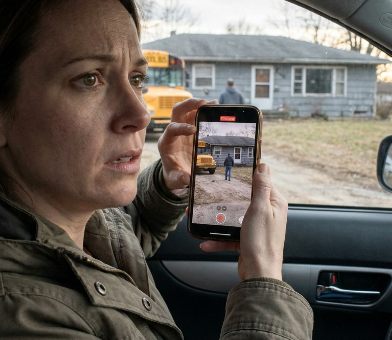
I sat in my car for forty minutes, snapping photos through the windshield with my phone. I captured the house, the woman’s face, and Julian’s car. I took eleven photos in total. By the time I drove home, I wasn’t just mad. I was cold. I felt like I was already preparing for a fight I knew I could win because I had the documentation.
On Monday morning, I went to see Sarah Lin. She was the best family law attorney in the county, and she didn’t have patience for games. I laid the photos out on her mahogany desk. I told her, “I want the deed and the title history for this property.” I wanted to know who he was buying this for and how he had paid for it. Sarah looked at the photos, then looked at me, her face unreadable. She told me to wait in the conference room. It felt like I was waiting for a verdict on my own life.
She came back two hours later with a stack of county clerk documents. Her eyes were sharp, even more than usual. She tossed the papers onto the table and said, “Clara, this isn’t just an affair.” The duplex on Crane Avenue had been purchased in 2023 for $167,000. Julian was the sole owner. I felt a confusing mix of relief and fresh betrayal. If it was his money, it was a secret, but it wasn’t necessarily a life-destroyer. But then Sarah pointed to the financial trail. He had taken out a massive Home Equity Line of Credit against our primary home to fund the purchase.
I looked down at the bank’s certified copy of the loan application. There, written in a handwriting that looked exactly like my own, was my signature. I had never seen that paper before. I had never discussed a loan. I touched the ink with my fingertip, feeling the indentation of the pen. It was a perfect forgery. Sarah leaned across the desk, her voice dropping into a dangerous, low tone. She looked at me with severe gravity and said, “The fraud charges alone carry up to fifteen years in federal prison.”
The room seemed to shrink. Everything I had built, every wall of that house I’d worked so hard to pay off, was now tied to a criminal act I hadn’t committed but was now legally entangled in. I realized then that my house wasn’t a sanctuary anymore. It was a liability. If Julian defaulted, the bank would take it all. I walked out of her office with the copies of the forged documents clutched to my chest, my hands shaking so hard I could barely steer. I didn’t want a divorce anymore. I wanted an explanation that made this make sense, even if it didn’t make it better.
I drove straight to Crane Avenue, my keys digging into my palm. I didn’t knock. I used the spare set I had taken from the house and walked right in, prepared to find a mistress and scream until the walls shook. Instead, I walked into a room that felt like a prison cell for a child. There were no sharp corners anywhere. The windows were reinforced with heavy-duty locks. The air smelled of industrial cleaner and stale sweat. And then I saw him.
Julian was on his knees, his forehead pressed against the floor, trying to hold the hands of a 71-year-old woman who was screaming at the wallpaper. She was small, frail, and her eyes were darting around the room with a terrifying, hollow light. The woman in the bathrobe was standing to the side, looking scared. She was a professional memory care nurse, not a mistress. Julian looked up when he heard the door, and the look on his face wasn’t one of a man who had been caught cheating. It was the look of a man who had been drowning for years.
He didn’t try to hide it. He started talking, his voice breaking every few seconds. The woman was Maeve Vance, his biological mother. She had abandoned him when he was twelve, leaving him to grow up in the system. She had returned three years ago, destitute, suffering from advanced vascular dementia, and completely undocumented. No hospital would touch her without a fortune in upfront psychiatric evaluations, and the state waitlists were years long. She was violent, she was lost, and he was the only thing she had left. He knew I would never agree to put our home at risk for a woman who had treated him like trash, so he had made the choice for me.
I stood there in the middle of that sterile, sad room, holding the forged papers. I looked at the old woman, who didn’t even know who Julian was, and then I looked at my husband, who had ruined our life to give her a roof. I realized he had been working those extra hours, pulling those extra shifts, just to pay for the care she needed in secret. I had suspected an affair, and instead, I had found a tragedy. I felt the anger drain out of me, replaced by a hollow, aching weight. I said, “You turned our marriage into a crime scene to do this.” He just wept. He told me he would go to prison if I wanted, but he couldn’t put her back on the street.
I didn’t call the police. I didn’t call the bank. I looked at the woman who had abandoned him, and I realized that I couldn’t be the one to kill the only mercy he had ever shown himself. But I couldn’t stay. The trust was gone, and the financial foundation he had built for her was a hole that would eventually pull us both under. I went back to Sarah the next day and we drafted the papers. I made it clear: I was keeping the house, and he was keeping the debt. He quit-claimed his interest in the home to me, making it solely mine. He signed every document necessary to take on the $167,000 burden of that loan alone, using his salary to cover it while he lived in that tiny, converted basement apartment on Crane Avenue.
We stayed married, technically, so he could keep his medical benefits, but we weren’t a couple anymore. I went back to my archive work, back to my records, but the quiet of my house didn’t feel the same. Two weeks later, I was standing in my basement, staring at the main support beam of the foundation. I took a black marker and drew a sharp, precise line across the wood where it met the concrete. It was a marker, a way to see if the structure ever started to shift again. I realized then that while I had saved the building, the foundation would never be the same. I turned off the light and walked upstairs, feeling the weight of the silence in every room.