The smell of industrial bleach is a permanent shadow. It lives in the pores of my skin, in the fibers of my uniforms, and in the back of my throat. For three years, that scent was the only thing that kept us fed. My husband, Daniel, was the soul of our world, a man who saw the beauty in small things, but his sudden aneurysm three years ago left us with nothing but debt and a cold, silent house. His parents, Richard and Eleanor Vance, treated his death like a bad business transaction that needed to be cleaned up.
They didn’t see a grieving widow or a fatherless granddaughter. They saw a janitor and a liability.
I took the night shift at St. Jude’s Preparatory Academy because it was the only way to keep Audrey in a school where her mind could actually be challenged. I spent my nights buffing the floors of classrooms where the heirs of the state’s elite learned to run the world. I’d see my daughter’s name on honor roll lists and feel a sharp, stabbing pride, even while I was emptying the trash cans beneath those very lists. We lived in the margins of their lives, and for three years, that was enough. I just needed to keep her safe and keep her smart.
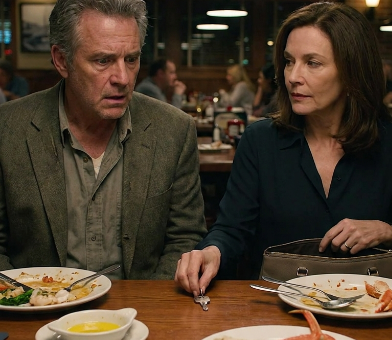
Easter dinner was a mandatory performance. Every year, Richard demanded our presence to keep up the facade of a unified, wealthy dynasty for their tax foundation records. The Vance estate is a sprawl of white stone and cold, polished marble overlooking the Gulf.
Walking through those front doors felt like walking into a cage. Eleanor sat at the head of the table in a dress that cost more than my car, her eyes flicking over my simple, mended black dress like she was checking for stains.
“You look tired, Claire,” Eleanor said, her voice dripping with a fake, honeyed sweetness. She didn’t look at me when she said it. She looked at her crystal water glass. “The work at the school must be so physically taxing. I suppose someone has to scrub the messes.”
A few of the cousins laughed, their eyes bright with the kind of cruelty that only comes from people who have never had to work a day in their lives. Richard didn’t even look up from his lamb. He was a man who measured people by their net worth, and he had decided long ago that I was a zero.
“Daniel had such a bright, measured future,” Richard muttered, cutting a piece of meat with surgical precision. “It is a pity that his legacy was diluted by such a desperate, downward trajectory.”
I felt the heat rise into my neck. I looked down at my hands. They were raw and dry from the week’s cleaning, the skin around my fingernails perpetually chapped. I thought about the three dozen times I had skipped dinner so Audrey could have a full plate. I thought about the nights I sat in the supply closet at St. Jude’s, reading her homework assignments by the light of a flickering hallway bulb. I was ready to take the hit. I was ready to sit there, eat the food, and leave the moment the dessert was cleared.
But Audrey didn’t wait.
She stood up at the far end of the table. She was only eleven, but she moved with a quiet, terrifying grace that reminded me so much of Daniel.
She didn’t look like a child being scolded. She looked like a judge waiting for the room to quiet down. She reached into her small canvas bag and pulled out a cream-colored envelope. She laid it flat on the mahogany table with the kind of deliberate, slow movement that made the entire room freeze.
“No,” Audrey said. Her voice wasn’t loud, but it cut through the room like a razor. “Listen carefully, Grandma and Grandpa. You aren’t looking at what was left behind. You are looking at who is taking everything back.”
The silence that followed was heavy and suffocating. Eleanor’s fork clattered against her plate, a small, sharp sound that echoed in the high ceilings. Richard looked up, his face reddening as he caught sight of the St. Jude’s gold-leaf crest on the envelope. I stood up, my heart hammering against my ribs, and walked toward my daughter. I didn’t pull her back. I stood beside her, my hand resting on her shoulder, feeling the steady, calm vibration of her nerves.
Audrey opened the envelope. She had the document, a digital log from the St. Jude’s registrar, and she read it with a clarity that made my blood run cold. She detailed the scholarship, the Daniel Vance Memorial Endowment, a $120,000 award that was supposed to go to the student with the highest marks in the state. She had won it. She had scored 99.8 percent on the placement exams, a record-breaking performance that should have been celebrated.
“This is a certified digital override,” Audrey said, her voice steady. “It was submitted at 4:15 p.m. last Thursday. It’s a rejection of my scholarship application, signed by the Executive Finance Chair. That is you, Grandpa Richard.”
Richard’s face shifted from a dark, mottled purple to a sickly, pale gray. He started to stammer, but Audrey didn’t let him speak. She turned to the rest of the table, her eyes scanning the faces of the aunts and cousins who had spent the last hour mocking me. She told them how Richard had tried to divert the money to his brother’s son, a boy who had scored significantly lower than her. He had tried to steal the money that Daniel had set aside for his own child, all because he couldn’t stand the idea of a janitor’s daughter being the smartest person in the family.
“You tried to erase me,” Audrey said, her voice dropping to a whisper. “You tried to use the family legal team to threaten my mother’s job if I accepted any other aid. You wanted to make sure we had nothing.”
I moved forward, my heels clicking like gunshots on the parquet floor. I snatched the document from the table and held it up. My eyes were locked on Richard, who looked like he was about to faint. I had spent three years cleaning up after these people, and I knew how their world worked. I knew that their reputation was the only currency that actually mattered to them.
“I have the digital audit trail, Richard,” I said, my voice steady and cold. I placed my phone on the table beside his wine glass. “The registrar’s office logs every single override code. You didn’t just break the rules of a private school. You committed wire fraud. You violated a non-profit educational trust. Do you have any idea what happens to real estate directors who get flagged by the federal education oversight committee?”
Eleanor started to cry, her hands shaking, but I didn’t spare her a glance. I didn’t care about their excuses or their family pride. I only cared about the fact that they had tried to steal my child’s future. Richard tried to stand, his hands gripping the arms of his chair, but his legs seemed to fail him. He looked at the document, then at me, and he saw that I wasn’t the broken, desperate woman he had played with for the last three years. I was a mother who held all the cards.
“You have three minutes,” I said, my voice quiet. “Log into the board portal. Submit your resignation. Resign from the finance chair, the board of trustees, and every committee that handles scholarship funds. If you do it now, I will consider the matter handled. If you don’t, I will walk out of this house and go directly to the local press and the state attorney general.”
The room was so quiet I could hear the hum of the cooling system. Richard looked around the table, hoping for an ally, but everyone was staring at their plates. They knew the truth. They knew he had been caught, and they didn’t want to be anywhere near the fallout. With a hand that wouldn’t stop shaking, he pulled his tablet from his briefcase, logged in, and started tapping.
I stood there for three minutes, watching him. I watched the man who had spent years making me feel small shrink into nothingness. When he finished, he pushed the tablet toward me. “It is done,” he whispered, his face twisted in a mixture of hatred and defeat. “Are you satisfied?”
“I am finished,” I said.
I didn’t take the food. I didn’t take the apology that Eleanor tried to stammer out. I took Audrey’s hand, turned around, and walked out of that house. The double mahogany doors swung shut behind us, closing off that life for good. We didn’t talk until we reached the car. The air outside was cool, smelling of salt and damp earth. I felt a strange, hollow space in my chest, a void where the weight of the last three years used to sit.
We drove for a long time, heading toward the coast where the wind usually cleared the head. When we reached the high, rocky overlook above the valley, I pulled the car into the gravel turnout. The sun was dipping low, painting the sky in shades of bruised purple and gold. I stepped out of the car, the gravel crunching beneath my feet. I looked down at my feet. The formal, uncomfortable shoes I had worn to try and fit in with them looked ridiculous in the dirt.
I reached down, pulled them off, and hurled them as hard as I could into the iron trash bin by the guardrail. They hit the metal with a satisfying, hollow clang. I climbed back into the driver’s seat, my bare feet feeling the cool rubber of the floor mat. Audrey was already deep into her physics textbook, her brow furrowed in concentration. She wasn’t looking at the mansion. She wasn’t looking at the life we had left behind. She was already looking at the future she had fought for.
I started the engine. The sound of it was steady and rhythmic, a heartbeat of my own making. I didn’t feel happy. I didn’t feel triumphant. I just felt clean, in a way that no amount of bleach could ever provide. I drove us back toward home, toward the quiet life I had built for us, knowing that for the first time in three years, the Vances couldn’t touch a single thing we owned. The road ahead was dark, but for the first time, I was the one holding the steering wheel, and I wasn’t planning on stopping for anyone. I thought about the document, the fraud, and the resignation, but those things were just paper. The real victory was the silence in the car, the weightless, perfect quiet of a life that finally belonged to us. I looked at Audrey, then back at the road, and I kept driving.