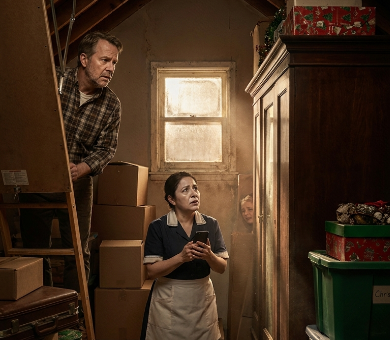
“Just a post-stroke tremor, Martha. An involuntary muscle spasm.”
Nurse Elena said it with that maddening, professional kindness she reserved for patients she had already mentally filed away as lost causes. She stood by the window of our living room, checking her watch, looking everywhere but at the man who had been my husband for fifty-one years. Wilbur sat in his wheelchair, his body rigid in that way that always made me want to scream, his functional left hand resting on my forearm.
It was exactly 7:00 PM. As it had been every evening since March, his index finger lifted and struck the back of my hand three times. Tap. Tap. Tap.
I looked at his face. He was looking at me, his eyes dark and heavy, trapped behind the curtain of his own brain. I wanted to believe Elena. I wanted to believe it was just a side effect of the damage the stroke had done to his motor pathways. But when I looked at him, I felt a heavy, cold weight settle in the pit of my stomach that had nothing to do with medicine.
The silence in our house wasn’t just quiet. It was heavy. It was a suffocating layer of dust that had been settling over our books, our furniture, and our memories since the afternoon in March when Wilbur’s world collapsed. He had been a railway logistics coordinator.
He was a man who lived for schedules, for clear communication, for the certainty of a freight manifest delivered on time. He was a man who talked, always, filling our modest colonial house with the noise of a life lived out loud. Then the stroke hit, and the volume was turned down to zero.
I spent four months filling that silence. I read him the obituaries, the local weather, and the long-winded editorials about the town council. I told him about the garden. I told him about the cat. I told him he was the best man I’d ever known, even when he couldn’t tell me he heard me. I did it because I was terrified that if I stopped, the silence would win.
“He’s tired, Martha,” Elena said, moving toward the door. “He needs his rest. Don’t go digging for things that aren’t there.”
She left, and the house sighed. I looked down at my hand where he had tapped.
My fingers were trembling. It was a habit I’d picked up since the hospital, watching his hands for signs of life. I thought about the church we used to attend back in 1971. We were just teenagers, kids with nothing but secrets and a desperate need to say something we weren’t allowed to say out loud. We had invented a code then. It was a simple, stupid thing, built on logistics and church pews, a way to pass messages beneath the noses of our strict parents.
I don’t know why I did it. Maybe it was the way his eyes were burning into mine, or maybe it was just the sheer exhaustion of not knowing. I reached out and tapped his hand four times.
Our old code for *I’m listening*.
Wilbur went perfectly still. His hand stopped trembling. His breathing hitched, then leveled out into a sharp, focused rhythm. He didn’t just look at me; he bore into me.
He lifted his hand again, and this time, there was no twitch. There was no tremor. He struck my hand three times, each one distinct and rhythmic. Tap. Tap. Tap.
He didn’t stop. He tapped again. Three more. Then he paused, his eyes darting toward the desk in the corner of the room.
My heart started thumping against my ribs. I knew that rhythm. It wasn’t a spasm. It was a message.
“Three?” I whispered. My voice sounded thin, like dry leaves. “You want me to look at something?”
He didn’t blink. He just tapped again. Three times.
I stood up, my knees feeling like water. I walked over to the mahogany roll-top desk that had been his grandfather’s. It was a relic of a different time, filled with old tax forms, railway manuals, and the detritus of a career spent tracking freight. I looked at the drawers. I pulled the third one open.
It was packed with the usual junk, receipts, pens, old paperclips. I pushed them aside. Tucked in the very back was a small, handheld micro-cassette recorder. I had forgotten he even owned it. He used to keep it for field logs when he was working the night shifts at the rail yard.
I pressed the play button.
The tape hissed, a harsh, static-filled sound that made me jump. Then, a voice cut through the hiss. It was Gregory, Wilbur’s nephew. The man I had trusted with the power of attorney. The man who had been “helping” us organize our medical expenses for months.
“Uncle Wilbur,” Gregory’s voice was too smooth, too practiced. It sounded like he was reading from a script. “The investments are completely gone. If you don’t sign the secondary power-of-attorney allocation over to my firm by Friday, the creditors are going to take the warehouse line. Aunt Martha doesn’t need to know the details. Just sign it. It’s for the best.”
I felt the room tilt. I stared at the recorder, the plastic cool against my palm. Wilbur had recorded this two days before the stroke. He had known. He had been trying to tell me, trying to warn me, and then the stroke had taken his voice, and Gregory had used that silence like a weapon.
I realized then that the “medical” help Gregory had been offering wasn’t for Wilbur at all. It was for his own failing real estate firm. He had been bleeding our accounts dry, and when Wilbur tried to stop him, the stroke had happened, a cruel, perfectly timed catastrophe that Gregory had managed to exploit. He hadn’t just watched us suffer. He had accelerated it.
I spent the next six hours in a daze of terrifying clarity. I went through the bank statements I had been ignoring because they were too painful to look at. I compared the signatures. The “authorized” signatures on the transfer documents were beautiful. They were perfect. They were also lies. Gregory hadn’t forced Wilbur to sign; he had stolen the digital stamp from the office safe while we were in the hospital. He had forged our entire life, right under my nose, and he had done it while I was sitting in the ICU waiting room praying for Wilbur to open his eyes.
I didn’t sleep. I didn’t cry. I felt a cold, hard resolve building in me that I didn’t know I possessed. I was a retired teacher. I knew how to grade a paper. I knew how to find the errors in a student’s logic, and I knew how to bring down the hammer when I found them.
Thursday morning, 10:00 AM. Gregory walked into our living room with that same practiced, slimy smile. He brought a real estate agent with him, a man who looked like he’d been scrubbed clean of any morality.
“Aunt Martha,” Gregory said, stepping into the room as if he owned the carpet, the walls, and the life inside them. “I know this is hard. But the new facility is going to be so much better for Uncle Wilbur. This house is just too much. It’s time to let go.”
He started to reach for his briefcase, pulling out a thick stack of papers. The closing documents. The final act of the play he had been writing for us.
I didn’t offer him coffee. I didn’t offer him a seat. I stood by the side table where I had placed the micro-cassette recorder. I looked at Gregory, and for the first time in my life, I truly saw him, not as the boy I’d bought birthday presents for, but as a predator who had mistaken my grief for weakness.
“The house isn’t for sale, Gregory,” I said. My voice was steady. It was the voice I used to use when I caught a student cheating on a final exam.
He paused, a flicker of confusion crossing his face. “Martha, don’t be difficult. We discussed this. The funds are already, “
“The funds are frozen,” I interrupted. I picked up the recorder and pressed play.
Gregory’s own voice filled the room, cold and demanding. It echoed off the bookshelves, bouncing around the living room until he looked like he wanted to vanish into the floorboards. I let it play for thirty seconds, just long enough for the real estate agent to turn a pale, sickly shade of gray.
I didn’t wait for him to respond. I dropped the forensic signature audit and the deputy’s report onto his briefcase.
“The probate judge revoked your power of attorney two hours ago,” I said. “And the sheriff is outside in the driveway. I think he’d like to have a chat about the office safe you broke into while my husband was lying in a coma.”
Gregory’s face went waxy. He looked at the window. The blue and red lights of the cruiser were flashing against our front porch, a silent, rhythmic pulse that matched the beating of my own heart. He tried to speak, to bluster, to pull that same smooth charm he’d used for months, but the words died in his throat.
The real estate agent didn’t even pack his briefcase. He just turned and walked out the front door, leaving Gregory alone in the middle of our living room.
When the deputy walked in, he didn’t even look at me. He went straight for Gregory. The handcuffs made a sharp, metallic sound that was the loudest thing I’d ever heard. I didn’t feel triumph. I felt an incredible, hollow relief. The threat was gone. The noise was gone.
By the time the sun started to dip low in the afternoon, the house was silent again. But this time, it was a good silence. It was the silence of a room that was finally, truly ours again.
I sat down on the sofa next to Wilbur’s wheelchair. He was watching me, his eyes bright and alert. I reached out and took his hand. I didn’t use the code. I didn’t use the rhythm. I just closed my fingers over his, feeling the warmth of his skin, the steady, familiar pulse of a man who had fought a war for us without saying a single word.
He didn’t tap. He didn’t have to. He just squeezed my hand. Once. Twice. And then, he let out a long, slow breath, and leaned his head back against the cushion.
I sat there until the room went dark, watching the shadows stretch across the floor, wondering if we had really won or if we had just survived. I don’t know if he was happy. I don’t know if he was angry. I just knew that for the first time in months, the air in the house didn’t feel like it was running out.
I looked at the hymnal on the shelf. The code was still there, tucked between the pages of a hymn we hadn’t sung in forty years. I thought about the boy who had invented it, and the man who had used it to save us. I squeezed his hand back, and the silence stayed, heavy and deep, until I couldn’t tell where my skin ended and his began.