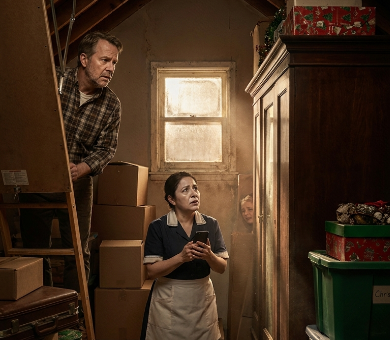
The brass key felt heavy in my palm, heavier than it had any right to be. It was just a piece of metal, stamped with the number 114. Twelve years ago, that room was a supply closet for industrial bleach and spare mattresses. I used to drag my three kids inside whenever the night manager took his smoke breaks, huddling under a thin wool blanket so we wouldn’t freeze while I finished my shift. I had been rejected forty-one times for office work before a motel manager finally looked at my ragged coat and gave me a mop. That was my life. That was my floor.
Now, the floor was reclaimed oak, and the smell of industrial bleach had been replaced by a faint, expensive hint of lavender and bergamot. I was the owner. I was the architect of this quiet, high-end sanctuary. I stood behind the walnut desk, watching the glass doors of the lobby slide open, and there he was.
Richard.
He looked exactly the same and entirely different. He was forty-four, his hair a little thinner, wearing a jacket that cost more than my first month’s rent in our old apartment. He was complaining about the rain, his voice carrying that familiar, thin whine that used to grate on my nerves before he packed his single duffel bag and vanished, leaving me with a mountain of debt and three children under six. He wasn’t alone. A woman in her thirties, dripping in designer athleisure and looking like she was doing the world a favor by breathing our air, trailed behind him.
I didn’t move. I didn’t let my breath hitch. I just waited for the world to turn.
“We need a suite,” Richard said, not even looking at me. He was too busy checking his phone, his posture that of a man who assumed everyone in the room was there to serve him. “The one with the fireplace. And don’t tell me you’re booked. We’ve had a long drive.”
I felt the old, cold ghost of my twenty-nine-year-old self whispering in my ear. She wanted to scream. She wanted to throw the credit card back at him and tell him to get out of my sight. But the ghost was a stranger now. I looked at the screen, typed in his name, and felt a strange, detached calm settle over me.
“We have one suite left, sir,” I said. My voice was level, smooth as glass. “Room 114.”
He didn’t even look up to see who was speaking. He just slapped his credit card on the counter. “Fine. Whatever. Just get us checked in.”
I looked at the card. Richard E. Vance. I swiped it. The transaction authorized in three seconds. I could see the balance, and honestly, it was a miracle it went through at all. I turned the registration book around, watching his hand move as he signed it. He didn’t recognize my handwriting. He didn’t recognize the lobby. To him, I was just a nameless face in a uniform, a tool to facilitate his comfort.
I slid the key across the polished walnut.
“Checkout is at eleven,” I said, looking him dead in the eye. “Enjoy your stay.”
He didn’t notice the weight of the words. He didn’t notice the way my grip tightened on the counter. He just grabbed the key, muttered something about the Wi-Fi speed, and hauled his wife toward the courtyard. I watched them walk away, their footsteps echoing on the tile where I used to scrub until my knuckles bled.
My son, Leo, stepped out from the back office. He was seventeen, tall, and carried the weight of a man who had seen his mother cry too many times in the dark. He looked at the registration log, and I saw the exact moment the blood drained from his face.
“Mom,” he whispered. “That’s him.”
“I know,” I said. I didn’t take my eyes off the courtyard door.
“Do you want me to kick him out?” Leo asked. His voice was hard, protective, the way it had been since he was five years old and knew how to quiet his siblings so I wouldn’t get fired.
“No,” I said. “He’s a paying guest. Let him have his night.”
The afternoon passed with a strange, humming tension. I kept busy. I did the books. I checked the inventory. I acted like a CEO because I was one. But underneath, my brain was running a different kind of audit. I thought about the four thousand days since he left. I thought about the three years I spent writing the business plan that turned this motel into a boutique inn. I thought about every rejection, every late-night shift, every time I had to tell my kids we couldn’t afford new shoes.
At 8:00 p.m., the peace died.
The lobby door slammed open. Richard was back, his face a mask of purple fury. He was holding his phone like a weapon. “The Wi-Fi in 114 is garbage,” he shouted, his voice echoing off the vaulted ceilings. “I’m on a call, and the signal drops every thirty seconds. Do you have any idea who I am? I’ll have this place buried in bad reviews before the sun comes up.”
He was looking for a victim. He was looking for someone to shrink back and apologize.
I walked out from the back office, slow and steady. I didn’t hurry. I stopped ten feet from him and let the silence fill the room.
“Mr. Vance,” I said.
He stopped, his mouth still open for the next insult. He looked at me, really looked at me, for the first time in twelve years. His eyes darted over my face, searching, calculating, and then, the color left his cheeks. The arrogance didn’t vanish, but it cracked.
“Clara?” he stammered. The room seemed to shrink. “What are you… how are you?”
“I’m the owner,” I said. I didn’t smile. I just let the fact hang in the air between us. “And this is a place of business. If you have a problem with the Wi-Fi, you can discuss it in my office. Quietly.”
He followed me because he didn’t know what else to do. His wife trailed behind, looking confused and slightly embarrassed. I gestured for him to sit in the leather chair across from my desk. I sat down behind the computer, the screen light reflecting in my eyes.
“This is a joke, right?” he tried, his voice dropping into that wheedling, manipulative tone he used to use when he was behind on the rent. “You’re running the place for someone? Where’s the real owner? I’ll talk to them.”
“I am the owner, Richard,” I said. “I bought the property three years ago. I did the renovations. I hired the staff. Every brick you walked past today belongs to me.”
He leaned back, his legs twitching. He looked around the office, his eyes landing on the framed documents on the wall, the licenses, the business awards. He was searching for a way to win. He was searching for a way to make me small again.
“You must have found some guy to back you,” he said, his voice sharpening. “You always were good at finding someone to bail you out. We were married when you worked here, Clara. That makes this marital property. You think you can just hide this behind a corporate veil? I’m entitled to a share of this.”
I didn’t lose my temper. I didn’t raise my voice. I just opened the desk drawer and pulled out the file I had been keeping for years. It wasn’t full of anger. It was full of math.
I slid the papers across the desk. The first one was the certified court judgment from 2012, the one where he had fled the state to avoid child support. The next was a printout of his current federal tax liens, which I had pulled from public records the moment he checked in.
“You aren’t entitled to a dime, Richard,” I said. “You walked out on three children. You abandoned your legal obligations. These judgments were ruled non-collectible because you didn’t exist for twelve years. But they’re still on the books. And these tax liens? They show me exactly how desperate you are.”
He stared at the papers. His hands began to tremble.
“I’m not here to argue,” I said. “I’m here to tell you that you are staying in the most expensive room in this house. You are paying full price. And if you cause one more scene, or if you ever mention my business or my family to anyone again, I will have the county sheriff serve these warrants before your breakfast is served. I have the direct line to the court clerk. Do you want to see me use it?”
He was shaking now. The facade of the successful man, the man who had traded his family for a shiny new life, had melted away. He looked like a man standing on the edge of a cliff, realizing there was no ground beneath his feet.
“Please,” he whispered. The word sounded thin and pathetic. “Don’t say anything to Evelyn.”
“Your Wi-Fi has been restored,” I said, closing the folder. “Go back to your room, Mr. Vance. Checkout is at eleven.”
He stood up, his movements stiff and awkward. He looked at me, and for a second, I saw his fear. He wasn’t afraid of me. He was afraid of the reality he had created. He turned and walked out of the office, his shoulders slumped. I didn’t watch him go. I just turned back to my monitor and started a new spreadsheet.
The next morning, the sky was a flat, bruised gray. I stood at the lobby window, my hands wrapped around a porcelain mug of coffee. It was 10:55 a.m.
I watched them emerge from the courtyard. Richard looked like he hadn’t slept a wink. He was dragging a heavy designer suitcase toward the car, his face tight and pale. Evelyn was walking ahead of him, her heels clicking sharply on the pavement. She was already complaining about something, her voice rising in the morning air, but Richard didn’t even argue. He just kept moving.
He looked toward the office windows as he reached the car. I didn’t wave. I didn’t look away. I just watched him. He saw me, and for a heartbeat, our eyes locked. There was no apology in his. There was no recognition of what he had cost us. There was only the hollow, exhausted look of a man who finally realized he had lost the only thing that had ever been real.
He tossed the suitcase into the trunk, slammed the lid, and got into the driver’s seat. The engine sputtered, the car an old model with an expired tag that clattered as it started. He didn’t look back. He pulled out of the driveway, the tires crunching over the gravel, and disappeared into the gray wash of the highway.
Leo walked up beside me. He didn’t say anything. He just rested his hand on my shoulder, his grip firm. We stood there until the car was nothing but a speck on the horizon.
I looked down at the counter. The brass key for Room 114 was sitting there, catching the morning light. It was clean. It was cold. It was just a key.
I realized then that I didn’t feel the surge of victory I had expected. I didn’t feel like I had won a battle. I just felt… clear. The weight that had been sitting in my chest for twelve years, the doubt, the fear that he would come back and destroy what I had built, was gone. It hadn’t been a mountain after all. It had been a shadow.
I picked up the key and dropped it into the return box. The past had checked out.
I turned to Leo and smiled. “Let’s get the lobby ready for the afternoon rush.”
He nodded, already moving toward the back to help the staff. I took a sip of my coffee. It was still hot. It was a good day to be in business.
I knew he would keep running. He would find another town, another woman, another set of lies to build his life upon. He was a man who lived in the cracks of other people’s foundations, and he would never stop looking for a place to hide. But he wouldn’t hide here. Not ever again.
I walked over to the desk and opened the guest ledger. I crossed out his name with a single, clean line. The space was empty. The room was ready for the next guest.
It was almost noon. The sun was breaking through the clouds, hitting the floor-to-ceiling windows and filling the room with a sharp, honest light. I stood in the middle of the lobby, looking at the life I had built with my own two hands. It was quiet. It was steady. It was mine.
I realized then that I wasn’t the woman who used to hide in the supply closet anymore. I was the person who owned the building. I was the person who set the terms. And that, in the end, was the only revenge that actually mattered.
I didn’t need to be right. I didn’t need to be vindicated. I just needed to be sure of who I was. And looking out at the road, at the empty space where his car had been, I finally was.
The world outside kept moving, the cars on the highway blurring into a streak of color and noise, but inside the inn, everything was still. I had everything I needed. I had my son. I had my work. I had the truth.
I finished my coffee and set the mug down on the counter. There were guests to greet. There were rooms to manage. There was a future to build.
I looked at the clock. It was 12:04. The checkout was finished.
The silence in the lobby wasn’t empty anymore. It was solid. It was the sound of a life that had finally, after twelve long years, arrived at its destination.
I walked toward the back office, the light catching the gold trim on the door. I didn’t look back at the parking lot. I didn’t think about where he was going. I just thought about the next booking.
I was finally home.