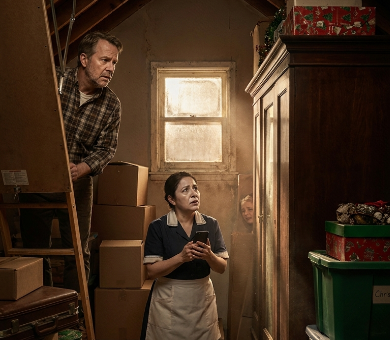
The hallway of the duplex smelled like dust and something sharper, something like copper and old sweat that I couldn’t quite name until the deputy kicked the door open. It wasn’t a house. It was a holding pen. The floorboards were scuffed in the exact same pattern a caged animal makes when it paces, and when the light hit the back corner, I didn’t just see a child. I saw the end of the world as I knew it.
My life, until that Tuesday, was measured in the quiet, steady rhythm of dental cleanings and my son Toby’s school schedule.
Toby was seven, a boy who moved through the world with a soft, quiet grace that I often worried would get him hurt. Every morning, I made him a turkey sandwich on whole wheat, added a crisp apple, and tucked it into his blue insulated bag. It cost me exactly $42.50 a week, a line item in my budget that I never once questioned. He was a growing boy. He needed the fuel.
The call came at 1:47 PM. Mrs. Gable, the lunch lady at Ocala Elementary, didn’t sound like herself. She sounded like she had been holding back tears for a very long time.
“Sarah,” she said, her voice shaking. “You need to come here. Now.”
I left my patient in the chair and didn’t even apologize to the doctor. I drove to the school in twenty minutes, my pulse hitting a frantic, uneven rhythm that I could feel in my teeth.
When I arrived, Mrs. Gable was waiting at the front office with her hands clasped so tight her knuckles were white. She told me about the five months of empty lunch bags. She told me about Lily Vance.
“She’s tiny, Sarah,” Mrs. Gable whispered. “And she’s hungry. Today, I saw the bruises on her wrist. They looked like fingers.”
I found Toby sitting on a concrete bench in the shade. He looked small and terrified. Sitting right next to him was a girl who looked like a ghost draped in skin. Her sleeves were pulled down over her hands, but I saw the dark, angry purple marks around her wrist when she reached for the apple Toby was holding out. I knelt on the grass, my hands hovering in the air, trying not to spook her.
“I’m not going to hurt you,” I said, but she didn’t look at me. She looked at the sandwich.
Toby grabbed my arm. His voice was a thin, desperate whisper. “Mom, don’t be mad. She has to have it. Her dad puts a chain on the fridge. He says if she eats, he’ll take her away.”
The world turned cold. I didn’t wait for the principal. I didn’t wait for a meeting. I stood up, walked to my SUV, and dialed the number for Child Protective Services that I had memorized from a community flyer years ago. When the operator told me they had a standard protocol for home visits, I told her exactly where I was and exactly what my son had seen.
“If there isn’t a caseworker at this address in forty minutes,” I said, my voice sounding like someone else’s, “I am driving to the police station and I am not leaving until someone listens.”
I didn’t go home. I followed the CPS car to the duplex on the edge of the pinewoods.
It was a lonely, gray structure that looked like it had been dropped into the middle of nowhere. Marcus Vance met us at the door. He was handsome in a polished, oily way, the kind of man who practiced his smiles in the mirror.
“This is a misunderstanding,” he said, his voice smooth and controlled. “Lily is a difficult child. She has a selective eating disorder. It’s a medical issue.”
He looked at me then, his eyes cold and devoid of anything resembling a father’s love. I felt a chill run down my spine that had nothing to do with the wind. The deputy, a man named Miller who looked tired of everything, wasn’t buying the act. He stepped past Vance, his hand resting on his belt.
“We’re doing a welfare check, Mr. Vance,” Miller said. “Step aside.”
The house was empty. It was so clean it felt like a hospital. There were no toys, no books, no stray socks in the laundry. It was as if no one lived there at all. We moved to the second floor, the floorboards creaking under our boots. At the end of the hall was a door that didn’t belong in a house. It was reinforced with steel, and mounted on the outside, backward, was a heavy, commercial digital deadbolt that glowed with a sickly blue light.
Vance’s face went completely blank. He stepped forward, his posture changing from a grieving widower to something predatory. “That is corporate property,” he spat. “You touch that door and I will bury you in lawsuits.”
Miller didn’t hesitate. He swung his shoulder into the frame. The wood groaned, then splintered with a sound like a gunshot. The door swung open into a room that had no windows and no furniture, save for three metal cots bolted to the floor.
My breath hitched. In the dim light of Miller’s flashlight, I saw two other children huddled on the floor. They were small, pale, and terrified. Lily was huddled in the corner, her eyes wide and glassy. She looked like she hadn’t seen the sun in years.
Vance didn’t stay to argue. He turned and bolted for the back stairs. I didn’t think. I didn’t plan. I just ran to my SUV, slammed it into reverse, and drove it hard into the side of his sedan, pinning his escape route against the foundation of the garage. He screamed, a high, thin sound of rage, as Miller tackled him into the dirt.
The house wasn’t just a place of neglect. It was a depot. Vance was moving children across state lines like cargo, using Lily as a silent, starving sentry to watch over the others while he was out managing his properties. He had forged the documents. He had built the cage. He had used my son’s kindness to keep his victim just alive enough to be useful.
The next few hours were a blur of flashing lights and federal agents. They took the children. They took Vance. I sat in the back of an ambulance, watching them wrap Lily in a warm blanket, and for the first time in my life, I felt the sheer, crushing weight of how much evil can hide in plain sight.
I had to give a statement, then another, and then one more for the federal prosecutor. I told them about the lunches. I told them about the $42.50 a week that had kept a prisoner fed. They said it was the key to the whole indictment, the proof that the starvation was a calculated, long-term choice, not an accident.
By 11:30 PM, the hospital was quiet. I sat in the hallway of the pediatric wing, watching through the glass of Room 302. Toby was sitting by the bed. He had a fresh apple in his hand, and he was sliding it across the tray to Lily. She took it with a hand that was finally, finally shaking with life instead of fear.
I realized then that I couldn’t fix the world. I couldn’t stop the monsters from hiding in the shadows. But I could watch. I could be the person who looked, who asked, and who refused to be told it was none of my business. I sat there in the dark, watching my son feed his friend, and I knew that for tonight, at least, the hunger was gone.
I didn’t move for an hour. I just watched them. I watched the way Toby reached out and touched her arm, not the bruised one, but the other one, a small gesture of belonging. I think I finally understood that kindness isn’t just a feeling. It’s an act of war against the people who want to see the world grow small and cold.
When the nurse came by to check on them, I stood up and walked to the window. I didn’t say a word. I just leaned my forehead against the cool glass and let myself breathe. The case would go on for months. There would be lawyers, and depositions, and the nightmare of the trial. I knew that. But as I watched Lily take a bite of that apple, I felt a strange, quiet peace settle into my chest.
I stayed until the nurse told me I had to go. I kissed Toby on the forehead and told him he was the bravest boy in the world. He didn’t ask about the house. He didn’t ask about the chains. He just looked at me and said he was going to bring a sandwich tomorrow, too.
I drove home through the empty streets of Ocala, the silence of the night feeling heavy and thick. I pulled into my driveway, turned off the engine, and just sat there for a long time. The house was quiet, but it didn’t feel empty anymore. It felt like a home. I thought about the room in the duplex, the blue light of that lock, and the way the air had smelled in the hallway. I knew I would dream about it. I knew the images would stay with me, tucked into the back of my mind like a scar that never quite fades.
But as I walked to my front door, I realized that for the first time in my life, I wasn’t afraid of the quiet. I had reached into the darkness, I had pulled a child out of the cage, and I had stayed until the light came back on. That was enough. It had to be enough.
I went to bed, but I didn’t sleep. I just lay there, listening to the house settle, thinking about the apple, the bruised wrist, and the look on Lily’s face when she realized she didn’t have to be hungry anymore. The world was still broken, and I was still just a dental hygienist who packed sandwiches, but the monster was in a cage of his own now. And for tonight, that was the only truth that mattered.