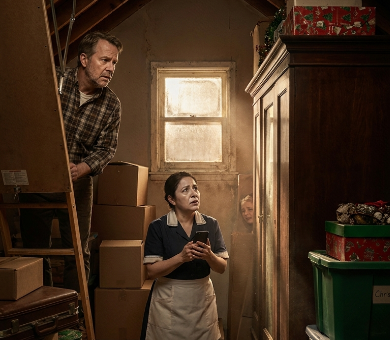
The house on Pembrooke Lane was always too quiet. Even when the television was on, the air felt heavy, like it was pressing down on your shoulders. My mother, Margaret, died three weeks ago on a Tuesday afternoon. The medical examiner said it was a stroke, quick and painless, but looking around at the life she left behind, I wondered if it was just the only way she knew how to finally stop holding her breath.
Robert, the man I called Dad for thirty-eight years, was already going through her things before the funeral home had even cleared the house.
He was a retired accountant who treated our family like a failing ledger. He was standing in the kitchen, tapping his pen against a legal pad.
“Emily, you need to focus,” he said, not even looking up from his calculations. “The estate taxes are going to be a nightmare if we don’t itemize everything before the appraiser gets here.”
I didn’t answer him. I was in the sewing room, the only place in that house where I ever felt like I could breathe. It was filled with old patterns and spools of thread. My mother had spent her life there, stitching together a facade of a happy family while Robert sat in his office, tallying up our worth. I opened the bottom drawer of her heavy oak desk. It was jammed. I pulled harder, and the wood gave way, revealing a hidden compartment tucked against the floor of the desk.
Inside was a small, dusty 1974 high school yearbook. The cover was worn, the edges soft. I opened it to the center, and a slip of paper fell out. It was a note, written in cramped, elegant handwriting. “To Margaret. I will find you again. I promise. Love, James.”
I looked up the name. James Fuller. Class president. Most likely to succeed. A quick search on my phone showed me a picture of a man who looked nothing like the accountant who raised me. James was a retired judge in Savannah, seventy-one years old. I felt a weird, hollow ache in my chest. I called the number I found on his office website.
The phone rang four times. When he picked up, I could hear the background noise of a quiet house, maybe a radio playing jazz.
“Hello?” he asked, his voice steady.
“My name is Emily Vance,” I said, my heart hammering against my ribs. “I’m Margaret Vance’s daughter.”
There was silence. Not a pause, but a heavy, absolute silence that stretched out for what felt like forever.
I could hear him breathing. Then, his voice changed. It became thin, almost fragile.
“Margaret’s daughter.”
“I found a note in her yearbook,” I said. “I just wanted to know if you knew her.”
He let out a shaky breath. “Six hundred dollars a month. For thirty-eight years. To a PO box in your mother’s name. I never missed a payment. Because you’re my…”
“Because I’m your what?” I demanded, my hands shaking so hard I dropped my car keys.
“Biological daughter,” he whispered.
I didn’t scream. I didn’t cry. I just stood there because my brain kind of stopped working for a second. Robert wasn’t my father. All those years of being told I was “the investment,” all the lectures about how I owed him for my tuition and my housing, it was all based on a lie. I hung up the phone before he could say anything else.
I didn’t want to hear about the past. I wanted to hear about the money.
I turned back to the yearbook. I started pulling at the spine, digging my nails into the glue. Inside the cardboard, I found a slit. Taped there was a rusted silver key and a small card with a box number from a post office in the next town over.
Suddenly, the door creaked open. Robert was standing there, his face tight with annoyance.
“What are you doing in here?” he asked, his eyes darting to the destroyed book on the desk. “I told you to finish the inventory in the living room.”
“I’m just clearing out the desk,” I lied, my heart racing. I palmed the key, sliding it deep into my pocket.
“You’re making a mess,” he snapped. “Everything in this house belongs to the estate. Stop playing around.”
I nodded, keeping my face blank. “I’m sorry. I’ll get to the living room.”
I left the house and drove forty minutes to the neighboring town. My hands were sweating on the steering wheel. I found the post office, walked to the back, and inserted the key into the lock. It turned with a heavy, satisfying click. Inside was a single envelope from a local credit union. It was dated three days ago.
I ripped it open in the car. It was a quarterly bank statement. My mother’s name, Margaret, was at the top. The balance made me gasp. Two hundred and seventy-three thousand, six hundred dollars. It was a Totten Trust, Payable on Death. It was meant for me.
I realized then that she had been planning this for decades. She had taken every check James sent and tucked it away, never spending a cent, so that when she was gone, I would have the leverage to leave. She had outplayed Robert at his own game.
But there was a catch. The bank needed an original, certified death certificate. Robert had every important document in a biometric safe in his office. If I asked him for it, he would know. He would freeze the account and lock me in a legal battle that would last until the money was gone.
I drove back home, the statement burning a hole in my passenger seat. I walked past Robert in the kitchen. He was still calculating numbers, his face lit by the harsh glow of his laptop. I went to my room and waited until 2:00 AM.
I knew the code. I had seen him type it in a dozen times over the years. I crept into his office, the floorboards groaning under my feet. The safe was a heavy, industrial thing, but it hummed when I entered the sequence. It swung open. I grabbed the death certificate and the folder labeled “Vance Assets.” I didn’t take anything else. I didn’t want to be a thief. I wanted to be free.
The next morning, I was at the credit union when the doors opened. I walked up to the counter and handed the teller the death certificate.
“I need to claim this trust,” I said, my voice steady. “My mother passed away.”
The teller was typing, her eyes flicking across the screen, when the front door swung open. Robert strode in, his face purple. He had tracked my car. He must have checked the GPS while I was sleeping.
“Stop!” he shouted, storming toward the desk. The security guard stood up, but I waved him off. “She’s trying to commit fraud! I’m the executor of the estate. You are not to release those funds to her!”
The manager stepped forward, looking at the documents I had provided. He looked at Robert, then back at me.
“Mr. Vance,” the manager said, his voice cold. “This is a Totten Trust. By law, it bypasses the probate process entirely. It belongs to the beneficiary named on the account.”
Robert’s face turned gray. He looked at the screen, then at the signature on the form. He realized then that he hadn’t been in control of my mother’s life. He had been a spectator to a secret she had kept for thirty-eight years.
“You,” he spat, looking at me. “You didn’t earn any of this.”
“I earned every minute of living under your thumb,” I said. “And now I’m done.”
I walked out of the bank with a cashier’s check in my pocket and a life I had never even dared to imagine. I didn’t look back to see him standing there, alone in the lobby of a building that suddenly meant nothing to him.
Two months later, the air in Savannah felt different. It was warm and heavy with the scent of jasmine. I sat on the balcony of a small office space overlooking the square. I had just signed the lease for my own firm. It was mine. Every wall, every window, every blueprint.
My phone buzzed in my hand. It was an unknown number, but I knew who it was. I swiped right, blocked the caller, and deleted the history. I didn’t need to hear his voice ever again.
I stood up and walked toward the small table on the patio. James was there, reading a law journal. He looked up, his eyes meeting mine. I held out a cup of coffee. He took it, his hands shaking slightly, a soft, prideful smile crinkling the corners of his eyes. We didn’t need to talk about the thirty-eight years of silence. We just sat there, two strangers who shared a bloodline and a promise, watching the sun rise over a city that finally felt like home.