The heavy tweed coat had hung in our hallway closet for four months, a stiff, dark ghost of the man Wilbur used to be. Every time I walked past it, the wool seemed to hold the scent of that freezing March morning, a mix of damp cedar and cold, metallic pavement. Wilbur hadn’t worn it since the day the world went quiet.
He sat in his recliner now, his good hand resting on the velvet armrest, his eyes tracing the patterns on the wallpaper.
The stroke had taken his speech, and with it, the vibrant, argumentative, loving man who had narrated our lives for fifty-one years. The doctors told me his brain was a locked vault. Everything was in there, they said, but the door wouldn’t open. So I talked for both of us. I read the morning paper until my throat burned. I told him about the garden. I told him about the neighbors. I kept the silence at bay with the sound of my own voice, terrified that if I stopped, he would simply drift away.
Then came the tapping. It started three weeks after we brought him home. Every single evening, just as the sun began to dip behind the pines at 7:00 PM, Wilbur would reach over with his right hand. He would tap the back of my hand exactly three times.
I asked the home nurse, a sturdy woman named Brenda, if it was a tremor.
She watched him for a week, nodding as his fingers drummed against my skin. “It is just a neurological tic, Martha,” she told me with a clinical lack of concern. “Common after a major event like this. Try not to focus on it.”
I focused on it anyway. I focused on it until my own hands started shaking. I spent our savings on tests. I dragged him to the university clinic three towns over. They ran the wires, they scanned the lobes, and they told me the same thing: no seizures, no internal activity of concern. It was just a meaningless, repetitive motor reflex. A broken loop in a brilliant mind.
I stopped trying to interpret it. I treated the taps like a sad, rhythmic reminder that he was fading. When the clock hit seven and his hand landed on mine, I would just pat him back, a small, weary gesture of comfort.
I was so tired. I was grieving a man who was still sitting right in front of me.
One evening in late July, the humidity was so thick it felt like we were underwater. I was sitting on the ottoman by his feet, my head resting against the frame of his chair, half-asleep. The grandfather clock in the hall hummed, then struck seven. I felt the familiar weight of his hand on mine. One. Two. Three.
I didn’t even think. My body just moved. Decades of muscle memory bypassed my brain entirely. I tapped his hand back. Once. Twice. Three times. Four.
The reaction was instantaneous. Wilbur’s entire body went rigid. His eyes, usually clouded with a dull, distant melancholy, flared open. They were bright, terrified, and screaming. He didn’t blink. He just stared at me, his mouth working silently, before he raised his good arm. He pointed a trembling, desperate finger toward the hallway closet.
I stood up so fast I knocked over my tea. “What is it, Wilbur?” I asked, my voice cracking. “What are you trying to tell me?”
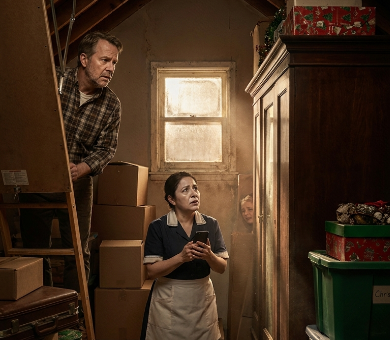
He didn’t look at me. He just kept pointing, his finger stabbing the air in the direction of the closet. I ran into the hallway, my heart hammering against my ribs like a trapped bird. I pushed aside my summer linens and the boxes of old school supplies I hadn’t touched in years. There, pushed into the dark corner, was the heavy tweed coat.
I grabbed it. It felt heavier than it had in March. I shoved my hand into the deep side pocket, the one he always insisted was for his keys, and my fingers hit paper. I pulled out a crumpled, stained envelope. The handwriting was unmistakable. It was from Mark.
Our son. Mark, who hadn’t spoken to us in ten years. Mark, who had left our house after a blowout argument over his career, the kind of fight that leaves scars you can’t see but never stop feeling.
I tore the envelope open. The letter was a gut punch. Mark didn’t want a conversation. He was begging. His wife, Sarah, was sick. The insurance had stopped covering the treatments months ago. They were drowning in debt. They were facing an eviction notice dated April 1st. He was asking for a loan, just enough to keep a roof over their heads, a final, pride-swallowing plea from a man who had burned every other bridge.
I looked at the date on the letter. It was mid-March. I looked at the calendar on the wall. It was late July. My blood went cold. He had been asking for help for four months, and he must have thought we had just ignored him. He must have thought his father had chosen his pride over his son’s survival.
I felt like the floor was falling away. “Oh, Wilbur,” I whispered, running back into the living room. “He thinks we abandoned him.”
Wilbur was crying. Not the quiet, leaking tears of the last few months, but deep, racking sobs that shook his entire frame. He looked at me, his face a mask of pure agony, and he tapped the back of my hand again. Four times. I’m looking. I’m looking.
I spent the next two hours trying to find him. I called the number on the letter, but a bored, mechanical voice told me the line had been disconnected. I took the car and drove to his old duplex, but the windows were boarded up. A neighbor, a young woman with a tired face and a toddler on her hip, told me the people who lived there had moved out in a hurry back in April. She didn’t know where. She thought maybe they went to the motels down by the interstate.
I came home empty-handed. The silence in the house was no longer just sad; it was suffocating. I went to the closet to put the coat back, feeling like a failure. As I gripped the fabric to hang it up, I felt something hard near the inner breast lining.
It was a pocket Wilbur had sewn shut years ago, right after we got robbed at a market in Chicago. He never trusted banks to keep his travel cash safe. I ran to the kitchen, grabbed my sewing scissors, and ripped the stitches out.
Inside was a receipt from the bank, dated March 14th. The day he had his stroke. And behind it, a cashier’s check for forty-five thousand dollars.
I stared at the paper. It was his entire retirement fund. He hadn’t ignored Mark. He had gone to the bank, drained everything we had to save his son, and was walking out the door to deliver it when his body failed him. He had been lying there for four months, trapped in a silent cage, watching me, screaming at me through the only medium he had left.
I didn’t sleep. I didn’t eat. At 6:00 AM, I was back in the car. I hit every motel within twenty miles of the highway. By noon, I was exhausted. I was about to turn back when I saw it. A beat-up gray sedan with a missing hubcap, parked in front of a place called The Sunset Inn. It was Mark’s car.
I knocked on the door of unit twelve. It took a long time, but eventually, the door creaked open. Mark looked like a stranger. He was gaunt, his skin had a gray, papery quality, and he looked at me with eyes that were harder than stone.
“If he sent you to finish the job,” Mark said, his voice a low, jagged rasp, “you can tell him I don’t care anymore.”
I didn’t say a word. I just reached into my purse and pulled out the letter and the check. I held them out toward him. Mark looked at the paper, then back at me, his forehead furrowing.
“What is this?” he asked.
“He didn’t know,” I said, my voice barely audible. “He had a stroke on the way to your house.”
I told him everything. I told him about the taps. I told him about the secret church code from 1971. I told him how Wilbur had spent every night for four months trying to tell me where the money was, trying to save him even while his own life was slipping away.
Mark didn’t move. He kept looking at the check, at the date, at the handwriting on the letter. His hand began to shake. Then, he crumpled. He leaned his head against the doorframe and let out a sound I will never forget, a raw, strangled sob that pulled the air right out of the room. He didn’t ask me to come in. He just slid down the wall until he was sitting on the threshold, clutching the check against his chest like it was a living thing.
“He tried,” Mark whispered, his voice broken. “He really tried.”
We brought them home that afternoon. Sarah was frail, but she was alive. The debt was wiped out by nightfall. The house, which had been a tomb for months, suddenly felt alive again.
That evening, we sat in the living room. The air felt different. Wilbur was in his recliner, his eyes tracking Mark as he moved around the room. Mark walked over, knelt down on the carpet beside his father’s chair, and put his head on Wilbur’s chest. He didn’t speak. He just held on.
I watched them, the father and the son, finally finding the bridge they had been missing for a decade. I walked over and sat on the ottoman, the same spot where I had been sitting when the realization hit me. I reached out and took Wilbur’s good hand. I felt his skin, warm and familiar.
I smiled at him. I squeezed his fingers, and then, very slowly, I tapped the back of his hand four times.
He didn’t tap back. He didn’t need to. He just let out a long, shuddering breath, and for the first time since March, the light in his eyes didn’t look like fear. It looked like peace. I held his hand, but the ache in my chest didn’t leave. It stayed there, sharp and heavy, a permanent reminder of how close we had come to losing everything. I was glad, yes. But I was also terrified, because now that I knew what he was capable of, I couldn’t stop wondering how much else I had missed in all the years we thought we were listening.