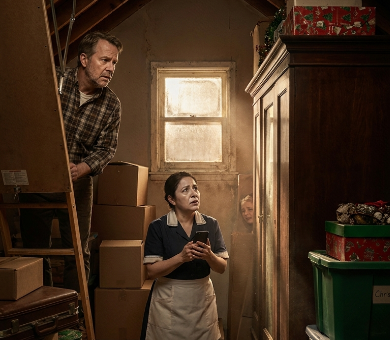
The folding table in my front yard looked like a graveyard for a life that nobody wanted anymore. I sat in a lawn chair, watching people sift through my chipped teacups and stacks of yellowing paperbacks as if they were picking over the bones of a stranger. My joints ached from the damp Alabama air. I was eighty-two, and my entire existence had been boiled down to the four thousand dollars I needed for the deposit on a state-run facility I called the Waiting Room.
I watched a woman haggle over a silver-plated serving spoon for three minutes. She offered me forty cents. I took it because my pride had dried up months ago. My pension had been swallowed by property taxes and medical bills years back, leaving me with nothing but this desperate, degrading yard sale. I just wanted to leave with enough cash to buy a dignified end, but the neighborhood vultures were picking me clean.
The crowd thinned around 11:30 AM. That was when I saw him. He was standing near the edge of my driveway, tucked into the shadow of an old oak tree. He wore a charcoal-colored overcoat that looked far too expensive for a Saturday morning in this neighborhood. He didn’t look at the boxes of junk. He just looked at me.
He walked over slowly, his gait measured, and stopped at my table. He didn’t ask about prices.
He looked down at the table, his eyes tracing the wood grain, before he reached into his pocket. He pulled out a leather wallet and took out a single, folded dollar bill. He laid it flat on the table, his fingers lingering on the paper. It was worn so thin it looked like silk.
“Do you remember the 6th grade at Lincoln, Eleanor?” His voice was gravelly, quiet, and carried the weight of a long time gone.
I looked at his face. The gray hair was different, and the suit was definitely new, but the eyes, those hungry, watchful eyes, were the same. It was Marcus. My boy from 1974. The one who never had a lunch box, the one whose shirt was always a little too thin for the winter.
“I remember,” I whispered, my heart doing a strange, fluttering dance against my ribs.
He didn’t smile. He just pressed his hand down on that dollar. “I did what you taught me, Eleanor.” He looked me right in the eye then and told me what he has done every school year since 1989.
I felt the tears prick my eyes. It was a beautiful thing to hear. I assumed he had found success, maybe started a small scholarship or dropped a few hundred into a charity fund in my name. I felt a fleeting, warm sense of grace. I reached out and patted his hand, feeling the callouses there.
“That is the kindest thing anyone has ever said to me, Marcus,” I said, my voice trembling. “But I’m afraid I’m in a hurry. I need to sell these curtains before two o’clock.”
He didn’t move. He didn’t look at the curtains. He reached into his coat and pulled out a heavy, black leather folder. He set it on the table with a soft, heavy thud that sounded like a gavel.
“I didn’t come to reminisce,” he said. His voice was cold now, business-like. “The city is tearing down Lincoln on Monday. Mayor Higgins signed the order. He’s putting up luxury condos by the end of the year.”
I blinked, the world spinning for a second. “But that’s a school. It’s part of the neighborhood.”
“It’s a payday for the Mayor,” Marcus corrected. He opened the folder. “And you’re the only person on earth who can stop it. You’re the owner of the charity that holds the deed.”
I laughed, a thin, dry sound. “I’m a retired teacher, Marcus. I don’t own a charity. I barely own this chair.”
“You do,” he said. He pushed a stack of papers toward me. “And you have to see it for yourself.”
The trip to the city archives felt like a fever dream. Marcus drove a car that smelled like leather and rain. He didn’t talk much, just navigated the grid of our dying town with a terrifying focus. When we got to the basement of the archives, we spent three hours pulling up deeds and tax filings from the 1920s.
My head was swimming. The original deed for Lincoln Middle School had a clause, written by a long-dead philanthropist, stating the property had to be used for charitable educational purposes. If the school closed, the land reverted to a trust. But there was a catch. The city had declared the building empty in 2015. They claimed it had been vacant for a decade.
“If it’s empty, the clause is voided,” I said, pointing to the fine print. “Higgins is right. He can sell the land.”
Marcus leaned over, his shadow long against the wall of the archive room. “It hasn’t been empty.”
He pulled out the next document. It was a series of tax filings, thirty-seven years of them. Every single one was registered in my name. Eleanor Vance. The Lincoln Foundation.
“I started it in 1989,” Marcus said. “I used the money you left in the locker. I invested it. I kept the school basement running as a weekend clinic for kids who had nowhere else to go. I kept it quiet. I kept it legal. And I kept it in your name because you were the one who started it.”
I leaned back, my breath hitching. “You’ve been running a school in the basement for thirty-seven years?”
“Every weekend,” he said. “The city didn’t know. The Mayor didn’t know. But the IRS did. And because we were active, that deed is still bulletproof.”
We were walking out of the building when Mayor Higgins found us. He was a man who moved like he owned the pavement, all smiles and sharp suits. When he saw me, the old, broken teacher, he didn’t even bother to hide his disdain. He blocked our path, his security guard hovering a few feet back.
“Eleanor,” he said, his voice dripping with false warmth. “I heard you were poking around the archives. Retirement must be boring.”
“It’s a public building, Mayor,” I said, holding the folder tight.
He stepped closer, his face hardening. “Listen to me. That school is coming down Monday. If you try to file an injunction, I will bury you. I’ll tie you up in court until you’re evicted from that house. And I will make sure your little friend here goes away for a long, long time for trespassing on city property for three decades.”
He walked away, leaving the threat hanging in the humid afternoon air. I was shaking. I looked at Marcus. He looked tired.
“He can do it, Eleanor,” he said. “He has the power.”
“Does he?” I looked down at the documents in my hands. The fear was there, clawing at my throat, but then I remembered the locker. I remembered the feeling of that dollar bill hitting the metal vent, the secret, silent promise of a meal. I remembered the dignity of a hungry boy who never once asked for more.
That night, in my empty living room, the silence was heavy. I asked him the question that had been burning in my mind since the archives. “Why 1989, Marcus? Why wait so long?”
He sat on my floor, surrounded by half-packed boxes. “My father died that year,” he said, his voice thick. “He was a proud man. He hated that I was hungry. I found his journal after he passed. He knew. He knew about the dollars you put in my locker. He knew and he never said a word because he knew you were protecting his dignity.”
He looked up at me, his eyes wet. “I realized then that the most important thing you ever gave me wasn’t the food. It was the silence. You never made me feel like a charity case. You just let me be a boy. I started the foundation in your name to honor that. I wanted to protect the dignity of every kid who walked into that basement.”
Something inside me shifted. The fear didn’t leave, but it changed. It turned into something colder. Something harder. I wasn’t an old woman at a yard sale anymore. I was a teacher. And I had a lesson to teach.
Monday morning was gray and overcast. The demolition crew was already there, their machines idling with a low, guttural growl that shook the ground. Mayor Higgins was there, too, smiling for the cameras as he held a golden shovel.
I didn’t call the police. I didn’t call the city council. I walked right past the police barricades. The officer reached for my arm, but I kept walking. I stood directly in front of the lead bulldozer. I stood tall, my Sunday coat buttoned to the chin.
Higgins came over, his face purple with rage. “You’re done, Eleanor! Get off this site or you’re going to jail!”
I reached into my bag and pulled out the folder. I didn’t hand it to him. I held it up for the cameras.
“Mayor Higgins,” I said, my voice carrying over the idle machines. “If you want to move this bulldozer, you’ll have to run me over. And then, you’ll have to explain to the national press why you’re bulldozing a federally registered, active charity that has fed and educated this city’s children for thirty-seven years.”
I handed a copy of the federal tax filings to a reporter who was standing close by. The air in the playground went dead silent. The Mayor looked at the documents, his face draining of all its color. He looked at the cameras, then back at me. He knew. He knew the jig was up. He knew that if he pushed this, he wouldn’t just lose the condos. He’d lose his career.
He looked at the bulldozer, then at the press, and then he turned around and walked away without saying a word.
The demolition was canceled by noon. By the end of the week, the Mayor had quietly retreated, his ego bruised and his plans shredded. The city council held an emergency meeting, and within a month, the property was formally ceded to the Lincoln Foundation.
I didn’t move into the Waiting Room. Marcus and the board saw to that. They renovated the top floor of the school, turning it into a small, sun-drenched apartment for me. I’m the chairwoman now. It’s not much of a title, but it means I get to sit in the office and watch the world go by through windows that have seen more history than any living person in this town.
It’s a Saturday morning a year later. The school is bustling with the sound of kids running through the halls. It’s a good sound. It smells like floor wax and fresh paint, just like it did in 1974.
I’m standing in the hallway, watching the life flow through the building. I see Marcus down the hall. He’s walking slowly, his hand brushing against the row of lockers. He stops at one, his movements quiet and practiced. He slides a brand-new math workbook through the vent.
He looks up and sees me. He doesn’t say anything. He just smiles, a small, knowing look that connects the boy I once knew to the man who saved us both. I smile back, leaning against the wall, and for the first time in my life, I don’t feel like I’m waiting for anything at all. I’m exactly where I’m supposed to be.