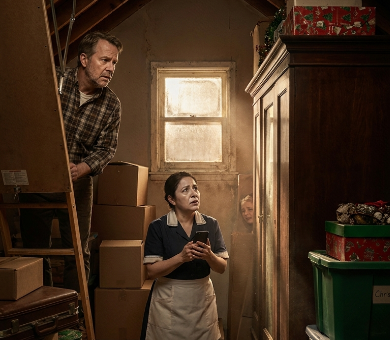
The silence in my kitchen usually feels like a gift. After twenty-three years, I still catch myself waiting for the sound of a baby screaming. It lasted ninety days. Twenty hours a day of pure, jagged noise that carved a hole right through my sanity. My mother came over on day three, listened to it for ten minutes, and walked out the door. She said something was wrong with that baby and I needed to get my head straight. Then Gordon left at the one-month mark.
He told me he couldn’t take the noise anymore. He told me he was moving into a hotel for his own mental health. I spent sixty more days alone, hallucinating in the shower and wondering why God would give a child to a woman as broken as me.
Then day ninety-one happened. The screaming stopped. Leo just looked at me, smiled, and finally slept. I raised him in the quiet that followed. I became a ghost in my own house, doing everything for him, making sure he never felt the shadow of those first three months. He’s twenty-three now. A brilliant pediatric neurologist. He came over last Tuesday to celebrate his first big research paper. We were sitting at my small wooden table, the one with the scratch on the side from when I fell while holding him. He handed me a bound copy of his work. The dedication page hit me so hard I had to put it down.
It said, To my mother, who walked through the fire so I could live.
I was crying, just a little bit, feeling like maybe I had finally earned some peace. Then I looked up and saw his face. He wasn’t smiling. He looked heavy. He reached out and took my hand, his grip firm and clinical. He said he had been digging into his own medical history for his research. He said he found something about his own case, about the crying, that no one had told me at the time. My stomach turned over. I felt that old, familiar coldness creeping up my spine. I figured he found a genetic defect I had passed down. I thought he was about to tell me the three months of hell were my fault, that I had failed him before he even started.
I told him it was okay. I told him I knew I wasn’t a perfect mother.
He shook his head, looking at me like he was trying to shield me from something. He pulled his tablet out and swiped through a digital file. It wasn’t my records. It was a file from a top-tier pediatric specialist in the city, dated week three of his life. I looked at the date and frowned. I never took him to that clinic. We couldn’t afford it. I didn’t even know that clinic existed back then. Leo pointed at the bottom of the intake form. “Look at the signature, Mom.”
It was Gordon’s handwriting. Big, looping, arrogant. My brain felt like it was stalling, like an engine running out of gas. Gordon had taken him there behind my back. I asked him what the file said. Leo hesitated, then tapped the screen. The diagnosis was Transient Neonatal Neuralgia. It was a rare, temporary nerve condition. The notes were clear as day.
It caused agonizing pain, but it was guaranteed to stop at exactly ninety days when the infant’s blood-brain barrier sealed. The specialist had given Gordon the prognosis. He had told him it would end in two months. He had even prescribed a palliative nursing plan to manage the pain.
Gordon didn’t tell me. He didn’t bring home the medication. He didn’t tell me the crying had an expiration date. He looked at the specialist and said the cost was too high. He signed a refusal of care form and walked out. I read the notes over and over. “Father states cost is too high.” I was living in a nightmare, believing I was failing, while Gordon was sitting on a secret that would have saved my life. He didn’t just leave because of the noise. He left because he was a coward who couldn’t be bothered to pay for a fix.
But then Leo swiped to the next page, and the room got even colder. It was an insurance payout form. Gordon had filed a claim for the diagnosis, claiming he was providing full-time medical care. He had forged my name on the check. He took forty-five thousand dollars from the insurance company, used it to start his real estate firm, and then left me to handle the mess while he played the part of the suffering husband who just couldn’t take it anymore. He didn’t just abandon us. He monetized our agony.
The next few days were a blur. Gordon is running for State Senate now. He’s everywhere. Big posters with his face, talking about family values and the importance of supporting our children. He’s got a new life, a new wife, and two daughters who have never heard the sound of a starving, hurting infant screaming for three months straight. I felt sick every time I saw his face on the news. I told Leo I wanted to move on, to just be proud of the man he became. But Leo wouldn’t let it go. He told me he didn’t want his father’s money or his father’s name near his research. He told me he was tired of being the secret that Gordon hid in his closet.
I put on my best suit. I made copies of every single page Leo had found. I didn’t sleep that night, but for the first time, it wasn’t because of a baby screaming. It was because I was finally going to get some air. I drove to the country club where Gordon was holding his big fundraiser. The parking lot was full of expensive cars, the kind Gordon always thought he deserved. I walked through the front doors, my hands shaking just a little, but my head held high. I found him in the VIP lounge, surrounded by people who thought he was a hero.
I didn’t try to be polite. I walked right up to him and tapped him on the shoulder. He turned around, ready to give me his practiced, oily smile, but his expression dropped the second he saw who it was. I told him we were going to talk in private. He tried to brush me off, but I held up the folder. I didn’t say a word. I just walked toward the private office at the end of the hall. He followed me, his face turning an ashen shade of gray that I hadn’t seen in twenty-three years.
I locked the door behind us. He tried to act tough. He told me I was making a mistake, that he had a reputation to protect. I didn’t yell. I didn’t cry. I just laid the documents on his desk. The intake form with his signature. The refusal of care. The forged insurance check. I let him see it all. He started to stammer, trying to tell me it wasn’t what it looked like. I told him he had until midnight to drop out of the race. I told him to cite personal health reasons. I told him he was going to wire every cent of his campaign funds into a grant at Leo’s hospital.
He looked at the papers like they were a snake. He offered me money to keep it quiet. That was the moment I realized he was exactly the same man he was in 1999. He thought everything had a price. I told him the price was his career and his silence. I told him if he didn’t do it, I would walk out of this office and give the files to every reporter in Pennsylvania. He looked at the door, then back at me, and he finally slumped into his chair. He looked small. For the first time, he looked like the coward I had spent two decades grieving.
It’s been six months now. The State Senate race went on without him. He withdrew quietly, just like I told him to. The money is sitting in a trust that helps infants who are suffering from the same thing Leo had. I don’t think about Gordon much anymore. The ghost in my house is finally gone. Today, I’m sitting in the front row of a big medical symposium. The lights are bright, and I’m surrounded by people who respect the work my son has done. Leo is up on the stage. He’s talking about pain, about how to listen to the people who can’t speak for themselves. Above him, on the big screen, it says: Funded by The Sarah Endowed Grant for Infant Distress. I’m crying, but this time, it’s just because I’m proud. I finally got to be the mother I always wanted to be. And for the first time in twenty-three years, the silence is actually perfect.