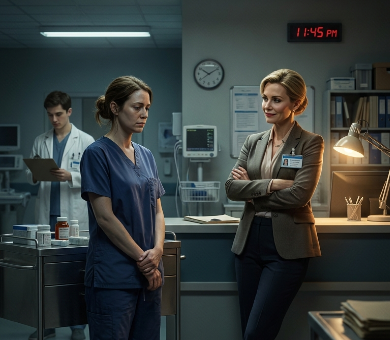
The hospital room at St. Jude’s smelled like sharp, sterile chemicals and the faint, underlying scent of lemon-scented floor wax. I remember the way the fluorescent light hummed above my head, a low, steady drone that seemed to vibrate through my own aching abdomen. I was thirty-four, and I was lying in a bed that felt like it had been designed to make me feel small. My IV line tugged at the back of my hand every time I shifted.
I had been there for two days, recovering from an appendix surgery that had caught me entirely by surprise.
My husband, Garrett, walked in without knocking. He didn’t look worried. He didn’t look like a man whose wife was recovering from a major procedure. He looked like a man who had finally finished a race he had been running for four years. He walked to the side of the bed and dropped a thick, heavy manila envelope right on top of my surgical site. The weight of it made me gasp.
“Consider this your discharge papers from the marriage,” he said. His voice was too smooth, too practiced. He had been rehearsing that line in his head for weeks, I was sure of it. He started listing off the things he was taking. The house. The SUV. The savings account. He talked about me like I was a bad investment he was finally cutting loose.
He stood there smirking, looking down at me in my faded blue gown, convinced he was the smartest person in the room. He thought I was broken. He thought I was broke.
The truth was, I had been working from that hospital bed for hours. My laptop was perched on the plastic tray table, the screen still glowing with the blue light of a secure corporate portal. Three hours before Garrett walked through that door, I had finished signing the final acquisition mandate for Obsidian Logistics. I was the sole owner. I was the one who had been quietly buying up the mid-tier regional distribution firms that Garrett’s company, Apex Supply Solutions, was desperate to merge with.
Garrett didn’t know about Obsidian. He thought I was a freelance archivist who made barely enough to cover my half of the groceries. He thought I was a liability. He had no idea that I was the one pulling the strings of his entire professional world.
As he walked out of that room, laughing to himself about how he had finally gotten the upper hand, I didn’t say a word. I just watched him go. I kept my mouth shut because I knew exactly what he had done to secure that promotion. I had seen his signature on the internal declaration sheets during my review of the due diligence. He had falsified the inventory valuations. He had committed fraud to make the merger look profitable.
I called Julian Vance, my attorney, about twenty minutes after Garrett left. Julian had been my shield since I started the firm. He didn’t ask questions. He just told me to stay quiet and let the process play out. “Let him think he’s winning, Valerie,” he said. “It makes the fall so much harder.”
The next two weeks were a strange, quiet blur. Garrett moved out, cleared the house of anything he thought had value, and changed the locks.
He sent me emails through his lawyer that were full of venom and threats, demanding I sign away the deed to the house. He was living in a downtown luxury apartment on credit, waiting for the merger payout to hit his accounts. He treated me like a ghost. He acted like I didn’t exist anymore.
Then, the evening of the second Thursday arrived. The rain was drumming against the window of the quiet, private apartment I used for my office work. It was 11:23 p.m. I was sitting at my desk, reviewing the final audit reports that had landed on my server earlier that afternoon. My phone vibrated on the desk. The caller ID said *Garrett*.
I stared at it for a long second, listening to the hum of the air conditioner. When I finally hit the answer button, I didn’t speak. I just listened.
“Valerie? Please,” his voice came through the speaker. It was shaking. It sounded thin, like he was standing in a windstorm. “Please don’t hang up. They told me to call you. I didn’t know. Oh God, Valerie, I didn’t know.”
There was no arrogance left. There was no smirking. There was just a man who had looked into the abyss and realized he was falling. I stayed silent. I wanted to hear the rest of it.
“The board,” he choked out, his breath hitching. “They found the inventory numbers. They found everything. They told me I’m personally liable for the shortfall. They said if I don’t get the owner of Obsidian to drop the indemnity claim, they’re handing it all over to the prosecutor’s office by morning. Please. You have to help me. I didn’t know you were the owner.”
I leaned back in my chair and looked at the rain on the glass. “You served me divorce papers in the hospital, Garrett,” I said. My voice sounded flat, even to me. “You told me I was nothing. You told me I was taking your future.”
“I was wrong,” he sobbed. He was actually crying now. It was a pathetic, gasping sound. “I was just stressed. I was just trying to get ahead. Please, just talk to the board. Tell them it was a mistake.”
“It wasn’t a mistake,” I said. “It was a choice. You chose to try and destroy me when you thought I was weak. Now, you have to deal with what you built.”
I told him I would see him at Julian’s office at 8:00 a.m. the next morning. I didn’t promise him anything. I just told him to be there.
The next morning, the office of Vance & Associates felt like a tomb. Julian was sitting there with a stack of papers that looked like a stack of bricks. Garrett walked in, and I barely recognized him. He looked like he hadn’t slept in a week. His clothes were rumpled, his hair was messy, and his eyes were bloodshot. He looked like a man who had lost everything, because he had. He had lost his career, his status, and his arrogance.
He didn’t even look at me when he sat down. He kept his eyes on the floor. I reached into my bag and pulled out the plastic hospital wristband I had cut off two weeks ago. I placed it on the glass table. It was a small, white thing, but it seemed to pull all the light in the room toward it. Garrett stared at it, his face turning a sickly, pale shade of gray.
“You served me these papers while I couldn’t stand up,” I said. I pushed the divorce settlement across the table. It was simple. It was final. It stripped him of every claim to the house, the cars, and any asset I owned. “You wanted to take everything worth keeping. Well, it turns out, I own everything worth keeping.”
Garrett looked at the papers. He looked at the indemnity waiver that would keep him out of prison. He looked at me, and for a moment, I saw the man I had married four years ago. I saw the fear, the desperation, and the realization that he had played a game he didn’t understand.
“If I sign this,” he whispered, his voice barely audible. “I lose everything.”
“You already lost everything, Garrett,” I said. “This just makes it official.”
He picked up the pen. His hand was shaking so hard the tip of the pen rattled against the paper. He signed his name three times. He didn’t say another word. He just stood up, turned around, and walked out of the office. He didn’t look back. He didn’t ask for a final word. He just disappeared into the hallway, leaving nothing behind but the scent of stale coffee and the sound of his own heavy footsteps.
I sat there for a while after he left. Julian didn’t say anything either. He just poured me a glass of water and pushed it toward me. I drank it, and for the first time in two weeks, the weight in my chest started to lift.
Three days later, the house felt different. It was mine again. It was quiet, but it was a good kind of quiet. I stood on the porch and watched the moving crew pack the last of Garrett’s things into the back of a truck. They were efficient. They were fast. They didn’t leave anything behind.
The sun was warm on my skin, and the air smelled like the coming spring. I looked down at my wrist, where the red mark from the hospital band had finally faded away. I reached into my pocket and pulled out the plastic band one last time. I walked over to the small metal bin where I had been burning the shredded remnants of his indemnity contract.
I dropped the band into the bin. It made a small, hollow sound as it hit the bottom. I lit a match and watched the fire catch. The plastic curled and blackened, and the paper turned to gray ash. The wind picked up and carried the ashes away, out over the garden and into the trees beyond the property line.
I stayed on the porch until the moving truck pulled away, turning the corner and vanishing into the afternoon light. The house felt steady under my feet. It felt like it had always been mine. I looked out at the road, and for the first time in four years, I didn’t feel like I was holding my breath. I felt like I was finally breathing again. I turned around and walked back inside, closing the door behind me. I didn’t look back. There was nothing left to look back at. The silence in the hallway was perfect. It was exactly what I had been working for all along. It was my life, and finally, it was mine alone. The last of the boxes were gone, and the last of the fear went with them. I sat down in the living room and realized I didn’t have to be anyone else anymore.
I didn’t have to hide who I was, or what I had built. I could just be. And that was enough. It was more than enough. I poured myself a cup of coffee and walked to the kitchen window, watching the shadows grow long across the lawn. The world felt huge, and I was finally standing in the middle of it. I had survived the hospital, the betrayal, and the greed. I had come out the other side with everything I had worked for, and nothing else mattered. I was home.