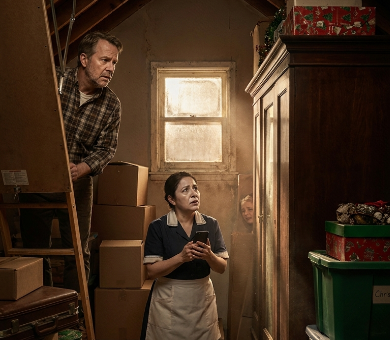
“You should get at least three quotes before you let anyone put stickers on Arthur’s things,” my sister Jean told me over cold tea on a Monday morning. That was the last normal bit of advice I got before the whole circus started. My husband Arthur had been buried six months, and the four-story Victorian on the edge of Boston was simply too big for one person. Every floor creaked at night, and the radiator in the high hallway sounded like someone knocking on wood every time the heat kicked in.
For thirty-one years I sat as first-chair violinist for the city symphony orchestra, living a life measured in rehearsal schedules, rosin dust, and strict discipline. Now I was sixty-eight years old, looking at boxes of English china, mid-century sideboards, and leather-bound books that needed a new home because I was moving down to a clean two-bedroom flat near the public garden.
I hired Vance Estate Liquidators because his business card had embossed gold foil and three different local business awards printed on the back. Marcus Vance was forty-two years old, dressed in a sharp navy suit with sharp leather shoes that clicked on my hardwood entry floor like little hammer strikes. He walked through my home with a smooth corporate charm that lasted about four minutes before turning into something soft and condescending. He looked at Arthur’s cherrywood desk and tapped the corner with his thumb ring like he was inspecting wet paint.
He picked up my grandmother’s hand-painted porcelain plates and turned them over so fast I thought he was going to drop them on the rug. He kept sighing every few feet, making a low clicking sound in his teeth that was meant to tell me everything I owned was a heavy burden he was doing me a favor by taking off my hands.
When we reached the small study near the back stairs, he stopped in front of the narrow oak cabinet where my instrument case sat on the velvet cushion. He reached inside without asking me first, unbuckling the brass latches with his thumb, and picked up my instrument right by the delicate wooden neck like it was a greasy frying pan from a diner kitchen. He held it up to the yellow window light, turned it twice, and slapped the varnish back down against his palm. “Standard student instrument,” Marcus said with a short smirk that barely showed his teeth. “Sentimental value mostly.
I can do fifty dollars for it, sweetheart, and honestly I’m being quite generous.”
I stood by the window sill with my hands resting flat against my linen skirt. I did not raise my voice, and I did not let my fingers shake, because forty years on a stage teaches you how to keep your face completely still when someone misses a note. What Marcus saw was a small widow with silver hair in a house that was too quiet, sitting on sixty years of dust like a target waiting to be picked clean. He did not ask what I did for a living before my hair went grey, because men like him never think an old woman in a high collar ever did anything hard or precision-made in her life. He thought that instrument was something bought from a catalog in 1950 for a school girl who quit after three months. “Leave your paper on the counter, Mr. Vance,” I told him, keeping my tone as light as dry tea leaves. “I will give your offer the attention it deserves.”
The second his car pulled out of my gravel drive, I picked up the telephone and called the senior appraiser at the fine arts auction gallery downtown. By three o’clock that afternoon, a tall gentleman named Mr. Albright had my violin resting on a white velvet cloth on my dining room table under a magnifying lamp. He didn’t touch the neck with bare fingers; he put on white cotton gloves and used a small lighted scope to check the luthier label pressed inside the sound hole. When he looked up at me, his face was very quiet and his eyes were wide. The instrument was an authentic 1888 hand-crafted Italian masterpiece with the original luthier mark intact, worth at least eighty-five thousand dollars on any serious collector market. He filled out the formal intake sheet right there on my table, set a conservative starting bid of sixty thousand dollars for their premier Saturday catalog, and had two uniformed couriers pack it into a hard-shell thermal case for transport.
While I was putting away the tea cups after the appraiser left, I noticed the carbon-copy ledger sheet Marcus Vance had accidentally dropped on the floor behind my kitchen trash bin. I picked it up, smoothed out the yellow paper, and sat down at the kitchen counter with my reading glasses to look over his line items. My eyes went over the neat blue ballpoint script where he had marked down Arthur’s original oil paintings as commercial reproductions worth forty dollars each, and my mother’s solid sterling silver tea set as plated copper worth thirty bucks for the lot. It was the exact same word repeated beside every single high-value item in my home: student, replica, plated, worn, commercial, zero market demand.
I picked up my phone and called my nephew David, who has been practicing estate and probate law in the city for twelve years. David came over within twenty minutes, took one look at that yellow ledger page, and opened his laptop right there on my kitchen table. “Aunt Clara,” David said after ten minutes of clicking through state corporate registries, “Marcus Vance isn’t just a rude guy who gives bad estimates.” David showed me how Vance Estate Liquidators worked alongside three different private holding companies registered under his younger brother’s name in Delaware. The trick was simple and wicked: Marcus would walk into houses owned by recent widows or grieving children, give them a low lump-sum cash offer for the entire household, and claim the market was flooded. Once the contract was signed, he would buy the whole house out for pocket change, transfer the actual treasures to his brother’s private company, and list them six weeks later at major auction houses for eighty times what he paid.
For three days Marcus sent me text messages every morning at eight fifteen on the dot, calling my cell phone twice an afternoon with a voice that got sharper and meaner every time I let it go to voicemail, telling me the real estate market was collapsing and saying the city was going to fine me for trash storage if I didn’t clear the Victorian by the end of the month while dropping subtle hints about how hard it must be for a lonely woman my age to manage winter heating bills without a husband to handle the boilers. I sat at my writing desk reading every text out loud to David while he typed them into his affidavit, my stomach turning over every time I thought about the three other widows on my street who had used Vance Estate Liquidators last autumn and walked away with four thousand dollars for homes that contained fifty years of real family wealth. I realized then that I wasn’t just dealing with a bad salesman who tried to take my violin for fifty bucks, I was looking at a man who made his living by watching elderly women cry into paper napkins in their kitchens while he loaded their dead husbands’ legacies into the back of an unmarked box truck and drove away grinning.
I didn’t answer his texts, and I didn’t take his calls. Instead, I picked up an official VIP gallery card from the auction house downtown, wrotehis name on the parchment envelope, and mailed it to his main office without a return address.
When Saturday afternoon arrived, the gallery was filled with soft light and two hundred people in dark coats holding numbered paddles. I sat in the second row next to David, wearing my best charcoal coat. Marcus Vance walked in ten minutes before the opening gavel, wearing his expensive suit and a smirk that faded the second he spotted me sitting so comfortably near the front. He leaned down with that same patronizing tilt of his head. “Clara, what are you doing here?” he whispered, glancing at the catalog in my lap. “You’re going to embarrass yourself.”
The auctioneer cleared his throat, tapped his gavel, and brought up Lot 42 on the massive digital screens hanging over the stage. There was my instrument, lit like a museum centerpiece, with its certified 1888 provenance documents displayed in clear high-definition right beside it. “We open bidding for this rare Italian masterpiece at sixty thousand dollars,” the auctioneer announced.
I turned slightly to look at Marcus. His mouth fell open and his thumb ring scraped hard against the wooden back of the row chair as he froze. The room erupted into rapid bids, paddles going up across every section, seventy thousand, eighty, eighty-five, until the gavel finally slammed down at ninety-two thousand dollars.
Before Marcus could even step out into the marble foyer, David stepped into his path and handed him a thick stack of legal documents. “Marcus Vance,” David said, his voice flat and perfectly audible to every dealer in the room. “You are being served with a formal civil suit for systemic commercial fraud, along with an emergency state licensing board injunction.” David held up the original yellow carbon copy Marcus had left on my counter, matched side-by-side with court subpoenas for his brother’s shell companies in Delaware.
Marcus looked at the papers, then looked at me, sweating through his shirt collar as he tried to find his voice. “Clara, please,” he whispered, his corporate confidence completely gone. “It was a clerical error. We can fix this.”
“I played for forty years in front of thousands of people, Mr. Vance,” I told him, keeping my hands folded over my purse. “I know the difference between a bad note and a cheat.”
His firm collapsed within three months under state investigations, and the court forced him to pay back over one hundred thousand dollars to six local widows he had swindled. As for me, I moved into my bright downtown flat three weeks later. The rooms are smaller now, warm and easy to keep clean. Yesterday my ten-year-old grandson sat on my new rug, holding a brand-new student violin I bought him with the sale proceeds. As he drew the bow awkwardly across the strings, making a scratchy little sound that echoed off the high glass windows, I drank my tea and knew that no matter how hard men like Marcus try to scrape away a life, real value stays right where you built it.