The house on Whispering Pines Drive was designed to be an absolute fortress. It had custom-built windows made of impact-resistant glass, automated thermal sensors that could detect a stray cat on the perimeter, and a security system that cost more than my first car. Richard, my husband, was the one who pushed for the move. He said we needed to look the part of a successful executive family, and he said our old house, the one where we’d raised our girls, was just a liability waiting to happen. To him, everything was a liability. Even Maria.
Maria Santos had been with us for fifteen years. She was the one who taught our girls how to tie their shoes and how to tell the truth. She was the steady, quiet heartbeat of our home. But Richard decided she didn’t fit the new, sleek image of our lives. He said we needed a “tech-savvy, modern nanny” who could interface with the smart-home hub. I remember the day he fired her. He didn’t even look her in the eye. He just stood there, checking his watch, waiting for her to clear out so he could bring in Chloe.
Chloe Bennet was twenty-three, polished, and always had her phone in her hand. She seemed to know the house better than I did within a week of starting. When Maria left, she didn’t make a scene. She just kissed the girls, hugged me once, and pressed a heavy, plain white envelope into my hand.
She didn’t look back as she walked to her car. She just whispered, “Open it only when the new house feels too quiet.” I tucked the envelope into my dresser, feeling a strange, heavy lump of guilt in my chest that I pushed down deep.
The quiet came on a Tuesday. It wasn’t the peaceful kind of quiet; it was the suffocating, heavy kind that makes you want to hold your breath. By then, the break-ins had become a weekly ritual in Whispering Pines. Neighbors whispered about a “ghost thief” who could bypass the most advanced security systems on the planet. I thought we were safe because we had the best. That changed at 4:12 in the morning when I walked into the study to find my jewelry box open and empty.
My grandmother’s diamond rings were gone. My mother’s gold locket, gone. The smart-home logs showed absolutely nothing. No doors opened, no lasers tripped.
Richard was already up, sitting at the kitchen island, looking at his tablet. He barely looked up when I told him. “It’s just insurance, Elena,” he said, his voice flat. “That’s why we have it. Don’t go spiraling.” He sounded so calm. He sounded like a man who already knew what was missing.
That was the thing that started to eat at me. The thieves didn’t take the expensive flat-screen TVs or the high-end laptops sitting right in the open. They took things that were harder to trace but had deep personal value, things that were perfectly documented in our comprehensive insurance policy. I spent three weeks walking around the house feeling like a stranger in my own life. The cameras were everywhere, yet I felt like I was being watched by the house itself.
I remembered the envelope. I went to the bedroom and pulled it from the back of my dresser.
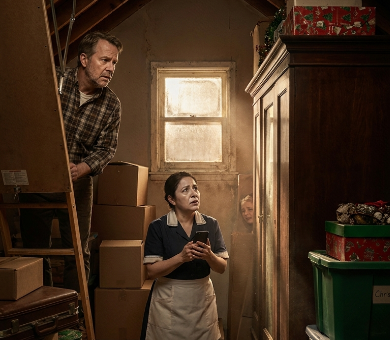
It felt heavy, like it held a physical weight. I sat on the floor, my hands shaking. I didn’t know what I expected to see, but it wasn’t a blueprint. It was a formal architectural schematic of the house, the kind the builder provides before the walls go up. I stared at the paper. There were three heavy, red X marks drawn right over the utility room wall in the basement. And at the bottom, written in Maria’s precise, shaky hand, were the words: “They were already inside…”
I didn’t think. I just moved. I grabbed a flashlight from the kitchen drawer and headed for the basement. The air down there was cold and smelled like damp concrete. I walked past the furnace and the water filtration units, my heart thumping against my ribs like a trapped bird. I stopped in front of the utility wall. I ran my hand over the paneling, looking for a seam. I pushed, and the wood panel clicked, swinging inward.
Behind it was a dark, narrow crawlspace. It wasn’t on any of the smart-home maps. It was a hidden tunnel that bypassed the entire security grid, leading straight out to an unmonitored storm drain at the edge of the gated community wall. I crawled in, the dust choking me. In the back, tucked behind a pillar, was a black duffel bag. I pulled it open. Inside weren’t just my rings; there were gold coins, high-end watches, and a timestamped USB drive wrapped in a silk hair tie. It was Chloe’s.
I didn’t scream. I didn’t cry. I sat there in the dark, the reality of it settling into my bones. Richard didn’t want a modern nanny. He wanted an accomplice. I plugged the USB drive into my laptop later that night, while Richard was out “checking on neighborhood security” with Chloe. The files were devastating. Maria had been recording everything for weeks before she was fired. She had caught them talking about their debt, about the insurance payouts, and about how I was just a “liability” that needed to be managed.
They weren’t just robbing the house. They were staging a life. They were building a record of me being “unstable” and “paranoid,” using the stress of the break-ins to justify a forced divorce that would leave me with nothing. The anger that flooded me wasn’t a hot, blinding rage. It was cold. It was the sharpest thing I had ever felt. I knew I had one chance to fix this before Richard realized I knew.
I didn’t confront him. I didn’t even change my tone of voice. I acted like the same, nervous wife he expected to see. Two days later, he told me he was taking the girls and Chloe to a country club gala. “You should stay home and rest, Elena,” he said, touching my shoulder. “You look exhausted.” I nodded and watched them leave. The second their car cleared the gate, I made my move. I didn’t call the local guards, who I now knew were just as bought as everything else in this place. I called the state insurance fraud office.
I sat in my SUV outside the gate, watching the clock. It was 8:45 PM when I got the notification on my phone. The motion sensor I’d hidden in the crawlspace had been tripped. They were back. They were doing a final sweep, going to pull everything out of the crawlspace and report it as a “theft” to the insurance company. I hit the send button on my phone, alerting the sheriff’s office.
I waited in the dark, my hands gripping the steering wheel. I heard the sirens before I saw them. Blue and red lights cut through the pristine, manicured hedges of Whispering Pines, turning the quiet, perfect night into something chaotic. I watched from the end of the driveway as the deputies swarmed the house. I watched them pull Richard out in handcuffs, his face twisted in a mask of shock and fury. I watched them drag Chloe out, her hair tie loose and her phone clattering to the driveway.
The arrest was the end of the life I thought I wanted. The prenuptial agreement was nullified before the sun came up the next morning. The lifestyle clause was gone, and with it, the leverage Richard had used to keep me small, quiet, and dependent. The legal process took months, but for the first time in fifteen years, I wasn’t waiting for permission to do what was right. I wasn’t worried about what Richard thought or if the house was quiet enough.
Six months later, I stood in the driveway of a house in the suburbs. It wasn’t a fortress. It had creaky floors, a drafty front door, and a garden that needed a lot of work. But it had soul. It had trees that grew the way they wanted to, not the way a landscaping service dictated. I watched the moving truck pull away, taking the last of the expensive, cold furniture I’d bought just to please Richard.
I looked back at the house. The girls were playing in the yard, their laughter bright and clear, echoing off the old maple trees. I reached into my pocket and pulled out my phone. My thumb hovered over a contact. I had been waiting for this moment. I took a deep breath, listening to the sound of the wind in the trees, and pressed call. “Maria?” I said, my voice steady. “I have a house that needs a real home. Are you ready to come back?” I didn’t need to hear her answer to know it was yes. I just stood there, watching the sun hit the porch, finally able to breathe.