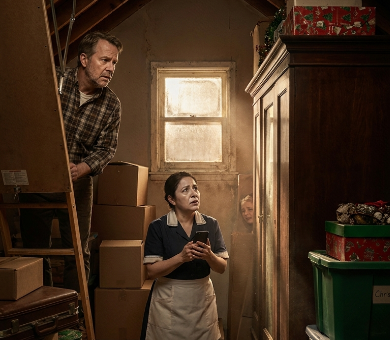
The smell of raw, untreated pine and metallic dust has been the baseline of my existence for over thirty years. My shop, Miller Hardware Supplies, sits on the edge of a dying strip in Grand Rapids where the wind always sounds like it is trying to find a way inside. For fifteen years, the shop was my church. It was where I went to hide from the hollow, echoing silence of the house I shared with Martha.
Back in 2011, a roof collapse at our secondary warehouse took Barry, our only boy.
He was eleven. He was supposed to be at home, but he’d snuck out to play in the rafters like he always did. The coroner called it an industrial tragedy. The insurance company called it an act of God. I just called it the end of my life. Martha didn’t cry at the funeral. She just tightened her grip on everything, from the checkbooks to the locks on our doors, and then she locked the rest of us away with her.
I thought I was just doing a good deed on a rainy Tuesday in May. A stack of job applications sat on my scarred oak desk. I was looking for a night janitor, someone who wouldn’t mind the solitude. I reached the bottom of the pile and stopped. The name on the sheet was Barry Vance. Age twenty-six. A short, uneven list of jobs and a three-year sentence for a non-violent commercial burglary.
I looked at his mugshot. My heart didn’t stop. It just started beating in a rhythm I hadn’t felt since 2011. The jawline, the set of the mouth, the slate-grey color of the eyes. It was like looking at a ghost. Without calling for a reference, I hired him. I didn’t care about the burglary. I didn’t care about the gaps in his work history. I just wanted to see that face every day, even if it was just sweeping the linoleum aisles.
Martha didn’t like it. When she found out his name was Barry, she threw our dinner plates against the kitchen wall so hard the porcelain shattered into jagged teeth. She called me a senile, grieving fool. She said I was trying to replace a dead boy with a convict. I ignored her. I told myself it was just her grief talking. Grief makes people mean, and Martha had been mean for a long, long time.
Barry Vance was the best employee I’d ever had. He was quiet, efficient, and he had a way of handling a framing hammer that made me feel like I was watching my own father work. But Martha couldn’t stay away. She started showing up at the store at 2:00 AM, her eyes darting between the monitors, watching him stack paint cans as if he were planting bombs.
One afternoon, I found her in the administrative office. She was sweating, her fingers dancing over the keyboard, deleting files from the 2011 fiscal year. When she saw me in the doorway, she didn’t jump. She just froze.
“The server is outdated, Thomas,” she said. Her voice was like thin, cracked ice. “I’m just clearing space.”
I didn’t argue. I just went to the basement.
The basement was a labyrinth of plumbing and shadows. I hadn’t been back there since the warehouse collapse, but something told me to look behind the main furnace.
I pried off a piece of foam insulation that didn’t belong. Behind it was a cavity, and in that cavity sat a leather-bound ledger. It wasn’t the kind I used for taxes. It was private.
I opened the first page and the floor seemed to tilt. The insurance payout schedule for the warehouse accident was there, but the dates were wrong. It had been filed two weeks *before* the roof came down.
I invited Barry to dinner that Sunday. I wanted to see them in the same room. I wanted to see if the weight of the truth would finally force Martha to break. We sat at the mahogany table, the kind we bought when we thought we had a future to fill. Barry was polite. He kept his head down, hands folded on his lap. He looked like a man waiting for the world to turn on him.
Martha was shaking. She stared at the silver watch on Barry’s wrist, a piece that had belonged to my own father. She didn’t blink. Then, she stood up. She grabbed her wine glass and hurled it into the fireplace.
“Tell him what you did to his real son!” she screamed.
The silence that followed was heavy, wet, and suffocating. Barry looked at me, his eyes wide and vacant. I didn’t say a word. I stood up, walked to the study, and retrieved the ledger. I walked back and dropped it on the table. The thud was the loudest sound I’d ever heard.
“He isn’t a stranger, Martha,” I said. My voice was steady, like I was reciting a bill of sale. “He’s my boy from before we met. And you knew it. You didn’t just know it. You tried to burn him out of my life.”
The truth came out in jagged, ugly pieces. Martha hadn’t just been angry about the money I’d put into a secret trust for Barry Vance. She had been terrified. She had hired a logistics contractor to stage a theft to bankrupt the trust and swipe the insurance money for herself. She didn’t account for our son, the first Barry, sneaking into the warehouse to play. She didn’t account for the forklift operator panicking when the police sirens started. She didn’t account for the collapse.
She hadn’t just covered it up. She had spent fifteen years using her connections to ensure that my biological son, the one she saw as a threat to her inheritance, stayed in the system. She had manipulated his records to keep him from ever getting a job, to keep him from ever finding his way back to me. She had been paying the contractor to stay gone for over a decade.
Barry Vance sat there as the story unfolded. He wasn’t crying. He was just looking at the ledger, his fingers tracing the signatures. He looked at Martha, then at me. He didn’t say a word, but the look he gave her was more devastating than any scream. It was pity.
“Get out,” I told her.
She tried to laugh. She tried to tell me I was crazy, that no one would believe me. She didn’t realize that the ledger wasn’t just a record. It was a confession. It had the contractor’s flight address. It had the deposit slips from the insurance company. It had everything.
I didn’t call the police that night. I didn’t need to. I gave her one hour to pack whatever she could fit into her car, and I gave her the keys to the house as a final gesture of goodbye. I told her if she ever came back to Grand Rapids, the prosecutor would have the ledger before she reached the county line. She left without looking at me. She didn’t even look at the boy she had spent fifteen years trying to erase.
The days that followed were a blur of lawyers and signatures. I signed 50% of the property deed over to Barry. I didn’t call it an inheritance. I called it a restitution. I filed the papers for an adult adoption, a formality that made me feel like I was finally closing a wound that had been festering for half a lifetime. We didn’t talk much about the past. We just worked.
The store felt different now. The air didn’t smell like pine and dust anymore. It smelled like work. It smelled like starting over.
Three months later, I stood in the loading bay. The sun was hitting the pavement, turning the oil stains into rainbows. I watched Barry step out of the office. He looked different than he had the day he applied. His shoulders were set, his gaze clear. He walked over to the back doors, the heavy brass key in his hand.
He moved with a purpose that belonged to a man who finally knew where he came from. He fit the key into the lock and turned it. The sound of the deadbolt sliding home was sharp and clean. It echoed against the brick walls, a final, definitive sound. He looked up at the new sign, *Miller & Son Hardware*, and he didn’t look like a ghost anymore. He looked like my son. And for the first time in fifteen years, I didn’t feel the need to look behind me.