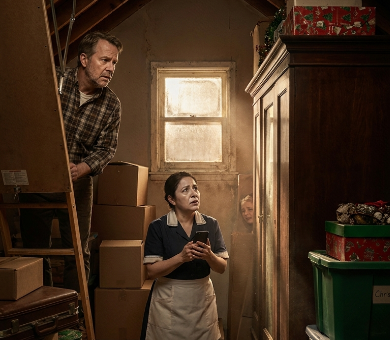
The hallway of the colonial home on Elm Street always smelled like lemon wax and dried cloves. It was a good smell. It was the smell of safety. For six years, that house had been the only place on earth where I didn’t feel like a number in a municipal file. I grew up in the system, moving from one foster placement to another, until the day I dialed the wrong number and got Wanda Dench. She didn’t care that I was a stranger.
She just said to get there by two o’clock if I wanted a hot meal. That house was my anchor.
Wanda passed away three weeks ago. The silence she left behind was heavy. It sat in the corners of the living room and hung over the dining table. David, her biological grandson, was barely holding it together. He was a good kid, quiet and kind, the kind of person who spent his life trying to take care of everyone else. I wanted to make this first Thanksgiving without her feel like it always had. We followed her tradition to the letter. We set the table for six, even though there were only two of us. We put out a plate for Wanda. And because she always told us that a home isn’t a home unless there’s space for someone else, we set an extra empty plate by the window.
At 2:03 PM, the house was perfectly still. The turkey was carved.
The mashed potatoes were steaming. David was staring at the empty chair where his grandmother used to sit, his shoulders shaking, but he wasn’t making a sound. I was watching him, feeling that familiar, cold knot of helplessness I hadn’t felt since I was twelve.
Then the knocking started.
It wasn’t a tentative tap. It was a series of hard, aggressive raps that shook the stained glass in the front door. My heart jumped. For a split second, I actually thought maybe it was a neighbor, or someone who had seen our lights and needed a place to sit. I stood up, smoothing out my shirt, and walked to the door with a ghost of a smile on my face. I thought we were about to fulfill the mission. I thought someone needed us.
I opened the door and the smile died on my face.
It wasn’t a stranger. It was Arthur Vance. He was wearing an overcoat that probably cost more than my first car, and his face looked like it had been carved out of cold, gray granite.
Behind him stood a deputy sheriff with a heavy utility belt and a look of complete boredom. Arthur didn’t even acknowledge me. He stepped onto the threshold, his eyes scanning the hallway like he was counting the square footage.
“Playtime is over,” Arthur said. His voice was thin and sharp. He reached into his coat and shoved a thick, stapled packet against my chest. I caught it, but I didn’t open it. I didn’t have to. I knew what it was. “Wanda is gone,” he continued. “This property is under corporate foreclosure. I’m the primary lien-holder of the estate. You have forty-eight hours to clear out before the demolition crew arrives.”
David came into the hall then. He looked like he was about to collapse. He took the papers from me, his hands trembling so hard the pages rattled. He didn’t even look at me. He just looked at the red text at the top of the page. “She said this was mine,” David whispered.
It was a small, broken sound. “She told me she paid it off. She promised.”
Arthur just sneered. “People say a lot of things when they’re getting old and confused. The law doesn’t care about promises. The law cares about liens.”
My brain started firing, the files in my head clicking into place. I’ve worked at the county land registry for four years. I know how people like Arthur operate. They look for the gaps. They wait for the holidays when the clerks are gone and the computers are off and there’s nobody to verify a date. He had timed this perfectly. He had waited until Thanksgiving afternoon, knowing there was zero chance we could get into the courthouse to pull the original deed. He wanted us out before the offices opened on Monday.
I looked at the deputy. “Officer, I’m a senior archivist for the registry. This notice is procedurally defective.”
The deputy frowned, looking from me to Arthur. “I’m just serving the order, son.”
“Check the filing date on the probate lien,” I said, my voice steady despite the adrenaline spiking in my veins. “It was processed on a holiday weekend. That’s a violation of the civil code. I’m requesting a twenty-four-hour stay for a formal administrative review.”
Arthur laughed, but it sounded like a bark. “You’re a clerk. You don’t have the authority to block a corporate foreclosure.”
“I have the authority to trigger a mandatory verification audit,” I said, keeping my eyes locked on the deputy. “If you execute this now, and the audit proves the lien is fraudulent, the department is going to be liable for a wrongful eviction suit that will make your redevelopment project look like a rounding error. You want to take that risk?”
The deputy sighed. He didn’t want the paperwork. He looked at Arthur, then back at me. “I’ll give you twenty-four hours for a review. But if you don’t have a stay by Monday morning, I’m coming back with the crew.”
Arthur’s face went dark, but he knew he’d lost this round. “You’re just delaying the inevitable,” he spat. He turned and walked down the steps.
I closed the door and leaned my forehead against the cool wood. “David, go to the table. Just breathe. I have to make a call.”
I didn’t call the police. I didn’t call a lawyer. I called my supervisor, a man who owed me a few favors from back when I saved his department from a massive database audit. It took an hour of pleading, but I managed to get him to unlock the remote access portal for the county’s secure archive vault. I had my digital credentials, but I needed the physical root records.
I walked into the entry hall. I looked at the coat rack. It was an old thing, heavy mahogany with brass hooks. Wanda used to tell me that her husband had bought it at an estate sale in the seventies, right after they secured the house. She told me once, while she was showing me how to polish the brass, that it was a good place to hide things because nobody ever thought to check under the base.
I got down on my knees. I took a flathead screwdriver from the junk drawer in the kitchen and began to pry at the felt lining in the bottom drawer. My heart was hammering against my ribs like a trapped bird. I didn’t know what I was looking for, only that Wanda never said anything without a reason.
The felt came up in strips. Beneath the wood, there was a small, hollow cavity. I reached in, my fingers brushing against something cool and stiff. I pulled it out. It was a thick, hand-inked ledger page, folded into a tight square. I unrolled it under the chandelier. It was the 1974 Homestead Protection Covenant. It was signed, stamped, and sealed with the original gold seal of the county clerk.
I spent the rest of the night cross-referencing that document with the digital records I pulled from the vault. By 4:00 AM, the picture was clear. Arthur Vance had been playing a long game. Back in 1998, he had manipulated Wanda’s father into signing a secondary commercial indemnity deed to cover his own failing business debts. He’d kept it off the books, hoping to wait until Wanda was gone to claim the property. He had manufactured a debt that didn’t exist and used it to bypass the legal protections Wanda had spent her life building.
But he had made a mistake. He hadn’t accounted for the 1974 covenant. That document was the original root deed. It explicitly prohibited any secondary liens on the property. It wasn’t just a record; it was an absolute, non-lienable shield.
At 8:00 AM, we walked into Vance Development. I didn’t care about their security guards. I walked right into the executive suite. Arthur was sitting at his desk, looking at blueprints. He looked up, his eyes widening.
“You’re done, Arthur,” I said. I laid the ledger page and the formal invalidation decree on his desk. “The county registrar has verified the root covenant. Your indemnity deed is a legal nullity. The notary who stamped your filing has already retracted it to avoid a forgery indictment. It’s over.”
Arthur stared at the paper. His mouth opened, but no words came out. The smugness was gone. He looked smaller, suddenly, like a man who had built a skyscraper out of wet sand.
“If you ever step foot on that property again,” I said, my voice cold, “I will personally see to it that the state attorney reviews your entire portfolio. Every lien, every deal, every signature. Do you understand?”
He didn’t answer. He just looked down at the desk.
We left the building and didn’t look back. By noon, we were back at the house. We established the Wanda Dench Open Door Foundation, putting the house into a land trust that made it legally untouchable. It belonged to the community now. It belonged to everyone, and therefore, it belonged to no one who would ever try to steal it.
Six weeks later, I stood in the entry hall and looked at the coat rack. The sun was streaming through the window, catching the dust motes. David was in the kitchen, carving a new turkey for the friends who were coming over. The table was set. The empty plate was there, waiting for the next stranger who needed a place to sit.
I reached out and touched the wood of the coat rack. It felt solid. It felt like a promise kept.
I hung my jacket on the brass hook and walked into the dining room. David looked up and smiled. It was the first time I’d seen him smile like that since the funeral. It cost us a lot of sleep, and it cost us the peace we thought we had, but we were still here.
“Ready?” David asked.
“Yeah,” I said. “I’m ready.”
We sat down together, the house filled with the smell of cloves and lemon wax, safe once again in the home that had taught us everything we needed to know about belonging.