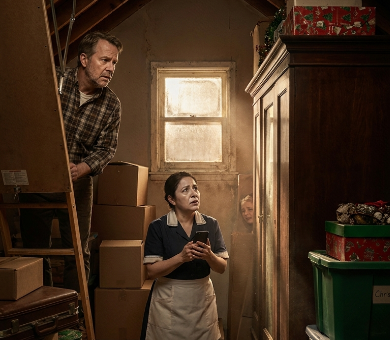
The air in my farmhouse has always been thin in February. It smells of old wood and the kind of damp wool that never quite dries out. At seventy-three, my joints don’t handle the chill the way they used to, but I keep the thermostat pinned at sixty-two degrees. Every cent counts now. Arthur has been gone since October, and the house feels like a giant, hollow shell without his heavy boots in the mudroom or the sound of his humming at the kitchen table.
On my counter, there is a stack of envelopes from the Buckeye Regional Bank. They aren’t friendly letters. They are stiff, white, and marked with red-inked stamps that scream about arrears and final notices. I am nine thousand dollars behind on the mortgage. My checking account shows a balance of one hundred and fourteen dollars, which is just enough to keep the lights on for another month, provided I don’t buy anything else. The bank doesn’t care that Arthur died. They don’t care that I drove that school bus for thirty years, hauling the county’s children through ice and mud while my own life slowly wore down to the nub.
It was a Tuesday morning, the kind where the sky looks like wet slate and the wind bites right through your coat. I was staring out the living room window, watching the frost patterns creep across the glass, when I saw the car.
It was a black sedan, heavy and polished, looking entirely out of place on my gravel drive. It crunched through the unplowed snow, tires spinning slightly before coming to a stop near the rusted, leaning mailbox.
My stomach did that familiar, sickening flip. I figured it was a lawyer or a collector come to stick a sign in my front yard. I wiped my hands on my apron and walked to the door, my heart hammering against my ribs like a trapped bird.
When I opened the heavy oak door, the man standing there didn’t look like a collector. He was tall, wearing a charcoal wool coat that looked expensive and warm. He had silver in his hair, but his face was young, strong, and deeply serious. He didn’t speak. He just stood there, letting the wind whip around us. Then, he slowly opened his hands.
Sitting in his palms were two small, faded knit gloves. They were red and blue, the yarn pulled thin at the fingertips, stiffened by forty years of storage.
I felt the floor drop out from under me. The silence was heavy, filled only by the sound of the wind rattling the siding. I looked at the gloves, then up at his eyes. They were a piercing, specific blue. I knew those eyes. I had watched them in my rearview mirror for an entire winter back in 1986.
“I found them,” he said softly. His voice was steady, but there was a tremor of old, buried hurt behind the words.
I didn’t know what to say. My brain felt like it had stalled out. “You’re the boy,” I whispered. I didn’t even know his name. Back then, he was just a kid on the temporary roster, listed as J. Miller.
“I am,” he said. He didn’t smile, but his expression softened. “You kept me warm when no one else did.”
I stepped back, letting him inside, but my legs felt like lead.
I was terrified. I was terrified of being seen like this, in a house that was falling apart, with the bank notices sitting right there on the counter like a stain. I felt like a failure, and here was a ghost from the best part of my life, seeing the wreckage of my end.
Then he turned toward the car, and out stepped a woman. She was elegant, wrapped in a heavy camel-hair coat, with silver hair pulled back neatly. She walked up the porch steps with a purposeful, graceful stride. She wasn’t just a visitor. She was someone who knew exactly what she was doing.
“I am Evangeline Cross,” she said, her voice warm but professional. She held a thick, leather-bound binder. “Julian has told me so much about you, Clara. We’ve been looking for you for a very long time.”
I looked from her to Julian. “I don’t understand.”
Julian stepped further into the kitchen, his gaze sweeping over the peeling wallpaper and the stack of bank notices. He didn’t look at them with pity. He looked at them with a kind of quiet, burning intensity. “I never forgot the crackers, Clara. I never forgot the seat by the heater.”
I felt the heat rise to my face. “It was just a seat on a bus. It was nothing.”
“It was everything,” Julian said. “You have no idea what it was like back then.”
He gestured to the leather binder. Evangeline opened it on the kitchen table. My breath hitched. It wasn’t a bank notice. It was a legal document, heavy with seals and signatures. It was a deed of release, fully executed.
“I didn’t come here to offer you money,” Julian said, his voice dropping to a gravelly, intense tone. “I came here to settle a debt.”
I reached out, my fingers brushing the pages. “You can’t do this. I didn’t do anything worth this.”
“You did,” he insisted. He reached into his coat pocket and pulled out a small, crinkled piece of wax paper. It was the original wrapper from the saltine crackers I used to slide across the engine housing to him every single morning in 1986. “You kept me alive until the state could step in. You were the only person who noticed I was freezing. You were the only person who treated me like I was worth the effort.”
I started to cry then, not because I was sad, but because the weight of the last few months, the loneliness of Arthur’s death, and the crushing fear of losing my home just shattered. I felt the shame of my poverty, the pride I had clung to like a life raft, and the overwhelming, terrifying grace of this moment.
“I am not a charity case,” I said, my voice shaking. “I just did my job.”
Julian stepped closer, his blue eyes searching mine. “This isn’t charity, Clara. This is a harvest. You planted seeds of kindness forty years ago in a winter that almost killed me. You don’t get to tell me it doesn’t matter anymore.”
He explained it all then. He had spent years searching for me. He had used his resources not to track down old friends, but to monitor the public records for the woman who had once saved him. He had seen the foreclosure notices. He hadn’t just paid the nine thousand dollars in arrears. He had purchased the entire mortgage note from the bank, buying out the debt completely. He had dissolved it. The house was mine. It was truly, legally, and permanently mine.
I looked at the deed on the table. It felt surreal, like a dream I would wake up from in an hour. “You bought the house?”
“I bought the debt,” Julian corrected. “I wiped it out. The house is yours. No bank can touch it. There’s a trust, too, managed through my firm. It will handle the heating oil, the roof, the taxes. You will never have to look at another red-inked letter again.”
I sat down at the table, my legs giving out. I felt small, and old, and suddenly, profoundly, at peace. I looked at the little, faded gloves on the table. I realized then that while I had spent my life thinking my work as a bus driver was just a routine, a way to pay the bills and get through the day, it had been something else entirely. I had been a witness to a child’s life. I had been a shield.
“Why now?” I asked.
Julian looked at his mother, then back at me. “Because I finally could.”
We sat in the kitchen for a long time. They told me about his life, about how he had fought his way through foster care, how Evangeline had saved him, and how he had built a life on the foundation of the safety he had felt on those short, twenty-minute rides in my bus. He hadn’t just survived. He had flourished.
As the sun began to dip behind the tree line, casting long, purple shadows across the snow, Julian stood up to leave. The weight of his presence seemed to fill the room, grounding it in a way I hadn’t felt since Arthur passed.
“I’ll be back on Sunday,” he said. “If you’ll have us for dinner.”
I nodded, unable to find the words. I watched them walk out to the black sedan. I watched the car pull away, leaving deep, tire-tread scars in the fresh, untouched snow of my driveway.
I stayed there for a long time, listening to the silence of the house. It didn’t feel hollow anymore. It felt heavy with history. I stood up and walked to the mantlepiece, placing the certified deed next to the photograph of Arthur. He would have loved this. He would have been so proud that a kid from a bus route had turned into a man who understood the value of a home.
I picked up the little gloves. They were stiff, smelling faintly of age and old yarn, but they felt warm against my skin. I pulled them over my own weathered hands, the fingers reaching all the way to the tips. I stood by the window, looking out at Route 6, watching the snow begin to fall again in soft, thick flakes. I wasn’t cold. For the first time since October, the cold wasn’t getting in at all.
I looked at the deed on the mantle, the bold letters standing out like a promise: PAID IN FULL. It was a strange, uncomfortable kind of peace, the kind that demands you stop fighting and just exist. I had spent my whole life worrying about the next mile, the next payment, the next winter. Now, there was just the quiet, and the gloves, and the knowledge that I hadn’t been invisible after all.
The house was still, save for the ticking of the clock, a sound that finally felt like it was counting time I was meant to have, rather than time running out. I turned away from the window, pulling the gloves tight against my knuckles. I was ready for Sunday. I was ready for whatever came after. I was finally, truly, home.