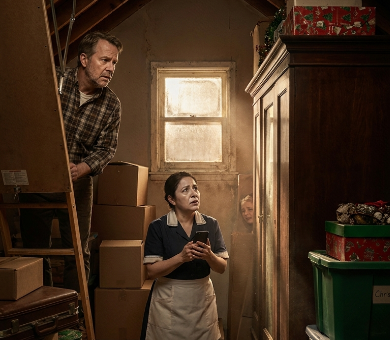
I spent twenty years believing that the only way to survive my family was to run as far as I could. I left Blackwood County when I was eighteen, and for two decades, I stayed away. My brother, Garrett, and my sister, Meredith, stayed behind to build their lives on the foundation of Sterling Timber. They had the mill, the house, and the narrative. They told everyone that I was the selfish daughter who traded our history for a desk job in Seattle. Maybe I was. I don’t know anymore.
When the call finally came about Dad’s health, I didn’t hesitate. It wasn’t about the money or the mill. It was just the right thing to do. The vascular dementia had taken most of his mind, and the house was falling apart. Garrett was too busy with his real estate ventures in Portland to care, and Meredith wouldn’t even step foot in the mudroom. So, I packed my life into a storage unit and went back to the house that smelled of pine sap and stale regret.
I spent fourteen months in that house. I learned how to lift a man who couldn’t remember his own name. I learned the rhythm of his breathing during the long, terrifying nights when the wind whipped through the Oregon pines. I watched his hands, those thick, scarred hands that had built an empire, tremble as he tried to hold a glass of water.
I was the one there. I was the one who buried him when the first freeze of December hit the valley.
The reading of the will was a performance. It took place in a sterile office in town, the kind that smells of cheap industrial floor wax and disappointment. Garrett was wearing a suit that cost more than my car, and Meredith was busy checking her watch every two minutes. They had the lawyer, a man named Mr. Henderson, read the document while they sat there like they were waiting for a winning lottery ticket.
Garrett got the farmhouse. Meredith got the four hundred thousand in liquid assets. They didn’t even look at me. When the lawyer finally reached the last line, he cleared his throat and looked over his spectacles. “To my daughter, Evelyn, I leave my old work coat, which has carried me through every storm.”
Meredith laughed. It was a sharp, ugly sound that echoed off the walls.
She leaned across the table and shoved the heavy, dust-covered canvas jacket toward me. It smelled like gasoline and Douglas fir. “You walked out on him, Evie,” she sneered. “You can have his old coat and the guilt that comes with it. Maybe it’ll keep you warm while you’re out looking for a new life.”
I didn’t argue. I didn’t cry. I just took the coat. I felt the weight of it in my arms, and for a second, I thought Dad had finally turned on me. I walked out of that office into the biting cold, feeling like a fool. I had given up fourteen months of my life, my job, and my savings to care for a man who left me nothing but a reminder of my failure.
For almost a year, that coat hung in the back of my closet in my tiny apartment. I couldn’t bring myself to throw it away, but I couldn’t look at it, either.
It sat there, gathering dust and smelling of a life I had tried to escape. My finances were a disaster. I was staring down an eviction notice because I had spent every cent I had on hospice care and back taxes for the house I didn’t even own.
One Tuesday in November, the sky was a bruised purple color and the rain was relentless. I was packing. I had to get out. I pulled the coat off the hanger, intending to drop it into a donation bin on my way out of town. That was when I noticed it. As I lifted the jacket, it tilted sharply to the right. The hem didn’t hang straight. I stopped, my hands hovering over the canvas.
I had worn this coat a thousand times as a kid, riding in the truck with Dad. It was balanced. It was always balanced. I put my fingers along the inside hem, feeling for the weight. There was something hard, something tucked deep into the fabric. I traced the line of the stitching and felt my breath hitch. The seam wasn’t factory-stitched. It had been repaired with thick, black nylon twine, the same heavy-duty stuff Dad used to patch his logging tarps in the shop.
I didn’t think. I just grabbed my sewing kit. I sat on the floor, the rain drumming against the window like a warning. I picked at the thread, my hands shaking. I didn’t know what I was looking for, but part of me knew that nothing about my father was ever an accident. I worked the seam open, inch by inch, until the lining gave way.
My fingers brushed against something cool and waterproof. I pulled out an oilskin packet, bound tight with a rubber band that snapped as soon as I touched it. Inside was a ledger and three thick pieces of paper with golden seals that caught the dim light of the bedroom. I opened the first one. It was the original 2004 Sterling Timber founding partnership certificate.
I sat there for a long time, staring at the words. The capital hadn’t come from Dad’s accounts. It came from a trust my mother had left me, something I had been told as a kid was long gone, spent on the mill’s start-up costs. But Dad hadn’t spent it. He had used it to buy the shares. And according to these documents, he had assigned 51% of the voting power to me. He had made me the majority owner of the company before the mill even officially opened.
The ledger was worse. It showed years of deposits and withdrawals, but the last ten pages were a forensic map of theft. Garrett had been bleeding the company dry, moving money into personal shell accounts and covering it up with fake invoices. He had been planning to sell the mill to a conglomerate, a deal that would have effectively erased the Sterling name from the valley forever.
I felt a cold, hard clarity settle in my chest. Garrett thought he was the king of Blackwood County, but he was nothing but a thief living on his sister’s money. I spent the next forty-eight hours in a blur of activity. I called an attorney I knew in Seattle, a woman who specialized in corporate fraud. When she saw the certificates, she didn’t even wait for a court order. She told me to get to the mill.
Two days later, the board meeting was in full swing. I could hear Garrett’s voice through the heavy oak doors of the main office. He was laughing, talking about the “final transition” of the assets. I took a deep breath, adjusted the collar of the old, oil-stained coat, and pushed the doors open. The room went silent.
Garrett stood at the head of the table, a fountain pen in his hand. He looked at me, his face twisting into a mask of pure annoyance. “This is a private transaction, Evie,” he said, his voice dripping with condescension. “Go cry over your rags somewhere else.”
Meredith was sitting beside him, a glass of champagne in her hand. She didn’t even bother to look up. “We’re busy, Evie. Don’t be pathetic.”
I didn’t say a word. I walked to the table, the heavy canvas of the coat making a rough sound against the polished wood. I didn’t look at them. I just laid the oilskin packet down and spread the certificates out over their merger contracts. Garrett glanced down, his eyes scanning the documents. I watched the color drain from his face. It started at his neck and moved up until he looked like a ghost.
“Where did you get these?” he whispered.
“Dad gave them to me,” I said, my voice steady for the first time in years. “He wanted me to wear the coat when I took it back.”
The lawyers at the table were already moving. They had seen the seal. They knew what it meant. One of them, a man in a gray suit, picked up the certificates and looked at Garrett. “Mr. Sterling, if these documents are verified, you have no legal standing to sign this agreement.”
Garrett reached for the papers, but I stepped in front of him. “Don’t,” I said. It wasn’t a request. It was the sound of a woman who had spent fourteen months watching her father die while her brother counted his stolen money. “You’re done, Garrett. You’re all done.”
The next hour was a complete collapse of their world. I presented the audit. I showed them the shell accounts. I watched as the corporate executives gathered their things and walked out of the room, leaving Garrett and Meredith sitting there in the silence of their own greed. I saw the moment they realized the house, the money, and the power were gone. It wasn’t an explosion. It was just a quiet, hollow realization that they had lost everything.
I fired Garrett on the spot. I froze Meredith’s accounts. I took my seat at the head of the table, the place where Dad had sat for thirty years. I didn’t feel happy, exactly. I felt heavy, like the coat I was wearing. It was a weight I hadn’t expected to carry, but it was mine now.
A month later, the snow had covered the valley in a blanket of white. I stood on the loading dock at the mill, watching the trucks move out into the morning. The air was crisp and smelled of raw timber and diesel. I pulled the collar of the coat up against the wind. It was still soft at the elbows, still smelled like Dad.
I looked out over the property line, toward the farmhouse where Garrett used to live. It was empty now, waiting for a new owner. I had reclaimed the mill, but the house didn’t matter. The money didn’t matter. What mattered was that I had finally fulfilled the last promise I made to a man who had loved me enough to hide the truth in the only thing I had ever valued from him.
I wasn’t the girl who ran away anymore. I was the one who stayed. I walked back into the office and sat down at the heavy oak desk. The silence in the room was absolute, but for the first time in my life, it didn’t feel like loneliness. It felt like peace. I opened the ledger, picked up a pen, and started to work.