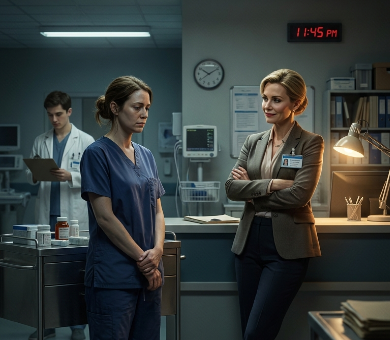
The fluorescent lights of the nurse station at Oakridge Memorial always hummed at a frequency that seemed to vibrate right behind my eyes. I was checking a patient’s chart at 3:12 AM when the silence of the hospital finally felt heavy enough to breathe in. My shift was over, but my mind was stuck back in my kitchen, replaying the way Nathan had looked when he walked out the door. He had been wearing a charcoal suit that cost me three weeks of extra shifts.
He looked taller than he was. He looked like a man, even if he still moved with the hesitant, careful grace of the boy who spent his Friday nights reading about the fall of the Roman Empire.
Nathan had never been the popular one. He was the one the other kids tolerated, or worse, ignored. When he told me Madison Vance had asked him to prom, I didn’t feel joy. I felt a cold, sharp spike of dread. Madison was the queen of Oakridge High. She drove a car that cost more than my annual salary, and she was attached at the hip to Blake Sterling, the kind of boy whose father owned half the town and whose ego took up even more space. I spent those two weeks waiting for the other shoe to drop. I scoured the local forums and checked every tagged photo on Instagram, convinced that any moment, a video would surface of Nathan being poured with pig’s blood or being laughed at by a crowd of varsity athletes.
I was wrong. I was so incredibly wrong.
The call came in at 10:48 PM. My phone vibrated against the bedside table, the sound jarring enough to wake me from a shallow, anxious sleep. I saw her name on the screen and my blood went cold. I assumed Nathan had finally been humiliated, that he was sitting in some bathroom stall while the whole school recorded his breakdown. I swiped the green icon with a trembling hand, ready to unleash the kind of protective rage that only a mother who has been through hell can summon.
“Nathan?” I said, my voice sharp. “Put him on.”
There was no laughter on the other end. There was no background music. There was only the sound of ragged, wet breathing and the distant, metallic scrape of something heavy being dragged across gravel.
“Mrs. Miller,” Madison whispered. Her voice wasn’t the polished, confident tone she used in the halls at school.
It was thin, breaking, and utterly shattered. “Please don’t let him leave the parking lot.”
I sat bolt upright, the sheets tangling around my legs. “Madison? Where are you? Where is Nathan?”
“Blake is here,” she gasped. “He has a crowbar. He’s blocking Nathan’s car. He said he’s going to break his hands.”
The world tilted. I didn’t ask questions. I didn’t ask why she was with him or how this had happened. I just stood up, my brain hitting a wall of pure, white-hot adrenaline.
“Stay in the car,” I commanded, my voice dropping into my nurse tone, the one I used when a patient was coding. “Lock the doors. Do not look at him. Do not talk to him. I am on my way.”
I threw on my work scrubs, grabbed my keys, and didn’t even bother to put on shoes. I drove the station wagon like a getaway car, my hands white-knuckled on the steering wheel.
The drive to the Oakridge Country Club felt like an eternity. Every red light was an insult. Every slow driver was a barrier between me and my son. I kept seeing Nathan’s face in my mind, the way he had practiced his dancing in our living room, pivoting around the kitchen chair with such hopeful, clumsy sincerity.
I pulled into the country club lot at 11:05 PM. The valet area was empty, but I saw the glow of taillights near the secondary exit. A massive pickup truck was parked sideways, effectively pinning a smaller sedan against a concrete planter. I didn’t brake. I swerved my station wagon directly onto the manicured grass of the golf course, cutting a path through the dark until I was inches away from the truck’s bumper.
I killed the lights. I didn’t turn off the engine. I stepped out, my heart hammering against my ribs like a trapped bird.
Nathan was standing in front of the sedan, his charcoal jacket torn at the shoulder. He was holding his arm, but he wasn’t backing down. Madison was behind him, pressed against the driver’s side door, her eyes wide and staring at the man who stood in front of them. Blake Sterling looked like a caricature of a high school hero, his face twisted in a sneer, a rusted iron crowbar dangling from his right hand.
“Get out of the way, Nathan,” Blake shouted. His voice was thick with beer and something much darker. “She’s mine. She’s always been mine.”
“She’s not yours,” Nathan said. His voice was steady. It was the voice of a boy who had finally decided that some things were worth getting hurt for. “She’s leaving with me.”
Blake raised the crowbar. “You want to be a hero? I’ll show you what happens to heroes.”
I didn’t think. I just walked. I didn’t run, and I didn’t scream. I walked with the cold, measured pace of someone who spends their life around trauma, around death, and around people who have lost their minds. I reached into my pocket, pulled out my phone, and started recording.
“Blake,” I said. My voice wasn’t loud, but it cut through the night air like a razor.
He spun around, his eyes wild. He looked at me, then at the station wagon, then back to the iron tool in his hand. He looked like he was about to swing it at me, but I didn’t flinch. I just walked closer, holding the phone out so he could see the recording icon blinking red.
“My daughter-in-law, my son, and I are currently on a call with the sheriff’s deputy,” I lied. It was a good lie. It was a necessary lie. “The dashcam in my car is recording every single motion you make. If you touch that metal to either of them, you are spending the next ten years in a cage.”
Blake’s face went through a rapid series of shifts. Rage, confusion, and then, finally, the realization that he was losing his hold on his own reality. He looked at the crowbar. He looked at the security guard who was finally jogging toward us from the main clubhouse.
“You’re crazy,” he spat.
“I’m a nurse,” I said. “I see people like you every single night. You’re not a hero, Blake. You’re just a bully who’s about to find out that money doesn’t buy you out of a felony assault charge.”
He threw the crowbar. It clattered against the asphalt, skidding toward my feet. He scrambled back into his truck, the tires spitting gravel as he floored it, tearing across the fairway and disappearing into the dark.
I didn’t move until his taillights were gone. Then, I turned to Madison. She was shaking so violently that her teeth were chattering. She reached into her clutch and pulled out a small, cheap burner phone, the kind you buy at a gas station with cash.
“He’s been tracking me,” she whispered. Her voice was barely audible. “He’s been following me for months. He said if I ever left him, he’d make sure no one would ever want to look at me again.”
I looked at the phone. It was full of messages. Hundreds of them. Threats, locations, pictures of her house, pictures of her bedroom window. It was a digital map of a nightmare. I looked at Nathan. He was standing there, his face bruised, his breathing heavy, but he was holding Madison’s hand. He wasn’t looking at me, or the car, or the police lights that were finally appearing on the horizon. He was looking at her.
“You’re safe,” Nathan said. “It’s over.”
We didn’t go home for hours. We went to the sheriff’s station. We sat in a hard, plastic-chaired room while I watched my son, my quiet, introverted boy, stand up to a detective and describe the way Blake had cornered them. I watched Madison, the girl I had judged so harshly, tell her story with a terrifying, clinical precision. She wasn’t the popular girl anymore. She was a survivor.
By the time the sun started to bleed gray light over the horizon, we were back in my kitchen. The house was cold, but I turned the oven on and shoved a box of frozen pizza inside. We sat at the small, scratched table. Nathan had taken off his ruined suit jacket. Madison was wearing one of his old, oversized track sweatshirts, the sleeves covering her hands.
They didn’t talk much. They just sat there, eating the pizza, the silence between them no longer heavy, but soft. Nathan kept glancing at her, and she kept looking down at her hands, but there was a rhythm to it. It was a rhythm of two people who had seen something too big to carry alone.
I stood by the counter, nursing a cup of chamomile tea that had gone lukewarm. I thought about the two weeks I had spent worrying about a prank. I thought about the bitterness I had carried, the way I had projected my own high school ghosts onto a girl who was actually just trying to breathe. I had been so busy looking for a monster that I had missed the person who was actually dying for help.
Nathan looked up at me. “Mom?”
“Yeah, honey?”
“She’s going to stay here for a while,” he said. It wasn’t a question. It was a statement of fact.
“I know,” I said. “I already cleared the guest room.”
Madison looked at me then. Her eyes were red, her face was pale, but for the first time since she had walked into my house weeks ago, she looked like she was actually here. She wasn’t glancing at the windows anymore. She wasn’t checking the time.
“Thank you,” she said.
I didn’t know what to say to that. I didn’t know how to apologize for the thoughts I had held against her. I just walked over and put a hand on her shoulder. It felt thin. It felt fragile. But it was there.
The house was quiet. The world outside was starting to wake up, the birds beginning their morning chorus, but in the kitchen, time felt like it had stopped. I looked at the burner phone sitting on the table, a small, black plastic object that had almost cost me everything. I knew that in a few hours, the lawyers would start calling. I knew the school administration would try to protect Blake’s family. I knew there would be hearings and depositions and a long, jagged road ahead.
But for now, there was just the hum of the refrigerator, the smell of burnt pizza crust, and the sight of my son sitting next to a girl who had finally found a place where she didn’t have to be afraid. I leaned against the counter and took a sip of my tea. I didn’t know if this was a happy ending. I didn’t know if any of us would ever feel truly safe again. But I knew that for the first time in eighteen years, Nathan wasn’t eating alone.
He was sitting in the light, and for tonight, that was enough.