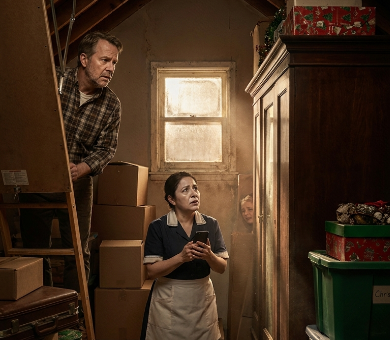
The smell of the house in Toledo always hits me the same way. It is a thick mixture of boiled cabbage, lemon-scented floor wax, and the kind of stale, trapped heat that comes from a furnace that hasn’t been serviced since the late nineties. I spent my whole childhood trying to scrub that scent out of my clothes. I thought I had left it behind when I moved to Chicago and built a life that didn’t require me to count pennies at the grocery store checkout.
But on Christmas Eve, I was back in the thick of it. My husband Julian sat on the worn floral sofa, trying to look comfortable despite being six-foot-two and cramped in a room meant for half his size. Our kids, Chloe and Leo, were sitting on the rug near the tree. They were six and four, and they had been perfectly behaved for the entire four-hour drive. They were excited. They had been talking about their cousins and the tree and the magic of the holiday for weeks.
My mother, Grace, stood by the mantelpiece. She was holding a mug of cider, watching the room with a look of intense, predatory satisfaction. Her house was packed with my siblings, Sarah, Danny, and Jessica, and their various children. The air was loud with the sound of tearing paper and the high-pitched squeals of kids discovering new plastic toys. It felt like a war zone of discarded ribbons and cardboard.
Grace clapped her hands, and the sound echoed like a gunshot. “Look at all these wonderful things,” she announced, her voice booming over the chaos. “You kids were all so good this year, and that is why Santa rewarded you.”
I sat on a wooden kitchen stool near the doorway, watching my own children. Chloe and Leo were waiting patiently. They had been raised to wait for their turn. They were watching their cousins rip into large, colorful boxes, scooters, tablet games, expensive sneakers. I smiled, feeling a little bit of guilt. I had always worried that my success, that the life Julian and I provided, would somehow distance my kids from their roots. I had sent checks, wire transfers, and boxes of extras for months leading up to December. I wanted everything to be level. I wanted them to be a part of this.
But as the paper-shredding frenzy began to die down, I noticed the silence.
It wasn’t the quiet of a finished event. It was the heavy, suffocating kind of silence that happens right before a storm. My cousins were surrounded by mountains of toys. Chloe and Leo were sitting in the exact same spot on the rug, their hands resting in their laps.
Leo looked up at me. His lower lip started to wobble, a tiny, rhythmic quiver that I knew meant he was seconds away from a full-blown meltdown. Chloe didn’t say anything, but she slowly pulled her knees up to her chest, making herself small. She looked at the empty space under the tree, then at the pile of gifts her cousins had already claimed, and then back at me.
I stood up, my brain suddenly feeling like it was packed in wool. I walked over to my mother. I was trying to keep my voice steady, trying to be the adult in the room.
I thought there had been a mistake. Maybe the boxes I had sent from Chicago had been misplaced in the garage. Maybe they were hiding in the pantry, waiting to be brought out for a “special” reveal.
“Mom,” I said, keeping my voice low so the kids wouldn’t hear the rising edge of panic. “I think you missed Chloe and Leo’s gifts. Did you leave them in the back room?”
Grace took a slow sip of her cider. She didn’t look flustered. She didn’t look like she had just realized a horrible oversight. She just turned her head, her eyes scanning the room with a cold, detached sort of boredom. She looked at my kids, then back at me.
“Oops,” she said. Her voice was flat, like she was commenting on the weather. “I thought you knew.”
I felt my heart stop. The room seemed to tilt on its axis. “Knew what?”
“We all decided that we weren’t buying them Christmas gifts,” she said. She didn’t blink. “It just didn’t seem fair to the others.”
I didn’t scream. I didn’t throw her cider. I just stood there because my brain kind of stopped working for a second. The logic was so insane, so deeply cruel, that I couldn’t even formulate a response. She wasn’t just admitting to leaving my kids out. She was announcing it like it was a moral victory.
My son, Leo, finally let out a small, jagged sob. That sound cut through the room like a razor. It was the only sound I needed to hear. I didn’t look at my siblings. I didn’t look at my father, who was standing in the corner looking at his boots. I didn’t ask for an explanation. I didn’t try to negotiate.
I walked over to Chloe and Leo and scooped them up. They were heavy, their little bodies tense and confused. I turned to Julian, who had already risen from the sofa, his face a mask of restrained fury. He saw my eyes, and he didn’t need me to say a word. He grabbed the overnight bags from the corner and walked toward the door.
“We are leaving,” I said. My voice sounded hollow, like it was coming from someone else.
Grace followed us to the entryway, her arms crossed over her chest. “Don’t be dramatic, Maya,” she called out. “It’s just toys. You’re the one with all the money. Surely you can buy them whatever you want.”
I didn’t answer. I put the kids in their car seats and climbed into the front passenger side. As Julian started the engine, I looked back at the house. Grace was standing in the doorway, framed by the harsh porch light. She looked satisfied. She looked like she had finally won some invisible, decades-long battle.
We drove in silence for a long time. I checked into a hotel downtown, a place that was quiet and smelled like clean linen and nothing else. I sat on the edge of the bed while Julian got the kids settled with cartoons and room service. I sat there with my phone in my hand, staring at the screen.
Three weeks ago, Grace had called me. She had been crying. She told me the family was absolutely strapped. She said Danny’s kids wouldn’t have anything under the tree because his work had cut his hours. She said Sarah was struggling to pay the heat bill. I had wired $15,000 that afternoon. It was a “holiday assistance bonus,” I called it, so she wouldn’t feel like a charity case. I told her to use it for all the cousins. I told her to make sure everyone felt the same.
Seeing my children empty-handed under that tree meant only one thing. That money hadn’t gone to the cousins. It had been weaponized.
I sent a group text to Sarah, Danny, and Jessica. I kept it simple. Meet me at the hotel conference room. Now.
They showed up an hour later, looking annoyed and defensive. They were probably expecting me to lecture them about my wealth or to complain about how my kids were treated. Danny crossed his arms and stared at the wall. Sarah stood by the table, her jaw set.
“Look, Maya,” Sarah said, not waiting for me to speak. “You have no right to be mad at us. We didn’t want to exclude them. But Mom told us you explicitly requested we don’t buy anything for Chloe and Leo. She said your kids are too wealthy and spoiled for our store-brand toys and that you didn’t want them getting ‘junk’ that would just end up in your trash bin.”
The room went cold. I looked at their faces. They weren’t lying. They were angry, too, but it was a different kind of anger. They were angry at me. They thought I was the one who had turned my nose up at their tradition.
I didn’t fight back with words. I didn’t try to explain how hard I had worked to make sure my family felt included. I just opened my laptop. I logged into my secure banking portal and projected the screen onto the TV in the conference room. I clicked on the transaction history.
I showed them the $15,000 transfer from November. Then I showed them the $5,000 from the year before. And the year before that. I pulled up the text messages.
“Read these,” I said. My voice was calm, but I could feel my hands shaking.
In the messages, Grace was giving me instructions. “Keep it quiet, Maya. Your siblings are proud people. They don’t need to know where the extra money comes from. Just send it to me, and I’ll handle the distribution to make sure the kids have a good Christmas.”
Sarah read the messages. Her face turned a dull, sickly gray. Danny leaned in, his eyes darting across the dates and the amounts. Jessica just covered her mouth with her hand and started to cry.
“She told us she saved for months,” Jessica whispered. “She told us she did without medicine and skipped meals to give us that money for the kids’ gifts.”
“She didn’t save anything,” I said. “She took my money. She gave you a pittance of it, and she kept the rest. And she told you I was an elitist brat to make sure you’d never ask where the money came from.”
We sat there for a long time in the silence of that hotel room. The mask had finally fallen. Everything made sense now: the way she would make passive-aggressive comments about my clothes, the way she would look at my home in Chicago with a mixture of hatred and hunger. It was all a performance, a way to keep us all dancing on strings she held.
We didn’t go back to the house that night. We waited until the next morning. When we arrived at the Miller home, the air was different. The festive spirit was gone, replaced by a jagged, sharp tension. Grace was in the kitchen, washing dishes with the same calm, robotic rhythm she had used the night before.
When we all walked into the kitchen, me, Sarah, Danny, and Jessica, she stopped. She looked at our faces and she knew. She tried to pivot, her hands gripping the edge of the sink until her knuckles turned bone-white.
“I did what I had to do,” she said, her voice dropping into that familiar, martyred tone. “I did it for the family. You don’t understand how it is to live with nothing, Maya. You think you’re so much better than us.”
I stepped forward and placed the bank statements on the counter. “I never thought I was better than you, Mom. I just wanted my children to be part of this family. But you didn’t want a family. You wanted a leverage point.”
Sarah stepped up, her voice trembling but hard. “You lied to us for a decade, Mom. You took Maya’s money and you let us believe we were surviving on your sacrifices. You broke us against each other just to stay in control.”
Grace tried to say something, but Danny stepped between her and the rest of us. He didn’t raise his voice. He just looked at her with a kind of profound, quiet disappointment that was worse than any shouting match. “We’re done, Mom. We’re going to figure out the finances ourselves. And you’re not touching another cent from any of us.”
We left that morning. I didn’t say goodbye. I didn’t need to. As I walked out to the car, I felt like the air was finally breathable again.
Christmas morning was different. We were in the hotel suite, away from the smell of boiled cabbage and the weight of that house. Chloe and Leo were on the floor, laughing their heads off as they ripped open simple, handmade coupons I’d printed out, coupons for a winter camping trip, for extra bedtime stories, for a day of making messes in the kitchen. They didn’t care about the expensive toys they hadn’t gotten. They were just happy to be safe.
I sat in the chair by the window and watched them. My phone buzzed on the nightstand. It was a text from my mother. Then another. Then a call. I didn’t look at them. I didn’t need to read the apologies or the excuses or the threats.
I picked up the phone, hit the block button, and felt a finality that was almost physical. I dropped the phone into my purse, stood up, and went to join my kids on the floor. I didn’t look back. I realized then that the only thing I was ever really afraid of losing was the one thing she couldn’t take: the truth of who we were when we were finally alone.