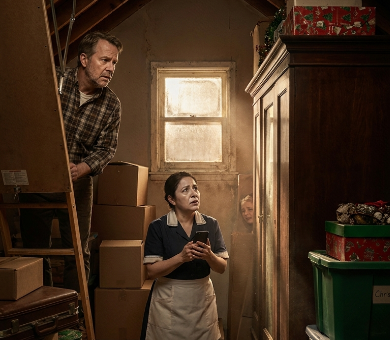
The mop bucket wheels always squeaked in a rhythm that matched my heartbeat. It was a sound I had come to know better than the hum of my own refrigerator at home. For nine years, my weekends began exactly ninety minutes before the final school bell rang on Friday afternoons. While the classrooms of Oakridge Intermediate hummed with the restless, chaotic energy of six hundred kids preparing for their two-day freedom, I pulled the heavy rolling bin into the basement supply closet.
The scent of institutional floor wax and industrial lavender cleaner was my only companion.
In the dim light, I lined up eight plain brown paper bags. Into each one, I placed a fresh turkey sandwich wrapped in foil, a crisp apple, an oatmeal granola bar, and a single grape juice box. I didn’t use district supplies for this. I never would. Every item was bought from my own wages, and over those nine years, the cost had ticked past $6,200. I knew which desks to target during the final recess period: the quiet kids who hovered near the cafeteria doors, the ones whose faces visibly darkened when the weekend was mentioned. I slipped the bags deep into their backpacks while the rooms were empty, acting as an invisible ghost of survival. I did it because I knew what it felt like to have a hollow stomach on a Sunday night.
The routine cracked wide open on a freezing Friday afternoon in mid-November. I was in Room 112, sliding the final bag into the frayed canvas backpack of an eleven-year-old boy named Julian, when the heavy door clicked open. Evelyn Croft, the principal’s senior administrative assistant and the school’s most rigid rule-enforcer, stood in the doorway holding a stack of attendance sheets. Her eyes traveled from my hands to the open backpack, then to the remaining brown paper bags sitting on the teacher’s desk.
“What is that, Maeve?” she demanded, her voice cutting through the quiet room like a serrated knife.
“Just some extra supplies, Evelyn,” I said, my voice steady despite the spike of adrenaline in my chest. “It’s not hurting anyone.”
“It’s unauthorized distribution,” she countered. She didn’t look at the kid, who had ducked his head. She looked only at me, her eyes narrow and cold. “You are not a nurse, and this is not a cafeteria. You need to come with me to the office.”
By Monday morning, a formal, multi-page incident report had been logged with the district superintendent’s office. I was charged with unauthorized food distribution on district property and a breach of biological safety standards. It was a fancy way of saying I had cared about the wrong thing in the wrong place.
By Tuesday morning, I was sitting in the main administrative wing, a sterile environment of polished mahogany and glass walls that felt entirely foreign to my world of mops and utility keys. I sat across from Principal Raymond Thorne and a sharp-eyed representative from District Human Resources. Thorne handled the meeting with a smooth, corporate condescension that made my skin crawl. He didn’t ask why the kids needed the food. He didn’t ask how they were doing. Instead, he lectured me on the severe legal risks of foodborne illnesses, unmonitored allergen exposure, and the absolute necessity of institutional regulation.
“Rules exist for a reason, Maeve,” Thorne said, leaning forward and adjusting his gold cufflink with a practiced flick of his wrist. “If you noticed a systemic need, you should have gone through the proper channels instead of running an unregulated operation out of our classrooms. You’ve left this school district exposed to a catastrophic lawsuit.”
My hands tightened into white-knuckled knots against my denim work trousers. The absolute hypocrisy of his statement broke through my exhaustion. I looked him directly in the eye, ignoring the HR woman who was busy scribbling notes in a thick binder.
“I did go through the channels, Raymond,” I said, my voice low but hard. “Nine years ago, I spent three weeks drafting a proposal for a weekend backpack program. I gave it to you in this exact room. You told me it was a liability.”
Thorne didn’t even blink. His expression remained a mask of smooth, professional denial. “I have absolutely no record of such a proposal, Maeve. The district has always maintained a strict structural ban on such initiatives due to the legal risks involved. We are not a charity. We are an educational facility.”
They placed me on immediate, unpaid administrative suspension pending a formal disciplinary hearing on Thursday. Walking out to my truck in the rain, I felt the weight of my twenty-three years of service pressing down on me. I was fifty-three years old, and I was being treated like a thief for feeding children who had nothing. Sitting in my quiet kitchen that evening, staring at my bank account statements and the tight margins of my retirement plan, I knew I was being set up to be the district’s scapegoat. They wanted to erase me quietly to protect their pristine risk-management records.
I decided I would not go down without a fight. I went down to my basement and pulled out my personal metal filing box. I dug past twenty years of tax returns until my fingers found the crisp, yellowed edges of the document I needed: the original carbon copy of my nine-year-old proposal. But I didn’t stop there. If they were going to use the law as a weapon against me, I decided to see exactly what else the district’s legal and financial records were hiding.
I spent the next forty-eight hours embedded in the online public records archive of the county educational board, tracing every line-item expenditure, state subsidy, and community wellness grant allocated to Oakridge Intermediate over the past decade. My search sharpened when I cross-referenced the dates. My fingers moved across the keyboard until the small hours of the morning, my eyes burning from the screen glare.
I discovered a recurring annual state allocation labeled “Specialized Nutritional Support Services” that had been consistently approved and drawn down by our school’s administrative office every single year for nine consecutive years. The funds were pulled from a state grant meant specifically for low-income student weekend food security. Yet, not a single piece of fruit or loaf of bread had ever entered our cafeteria through those funds. My heart hammered against my ribs as I saw the trail of numbers.
On Thursday afternoon, I walked back into the administrative conference room for the formal hearing. The air was cold, the rain lashing against the high glass windows. Principal Thorne sat flanked by the HR representative, his demeanor clinical and decisive. He looked like a man who was already planning his weekend.
“Maeve,” Thorne started, his tone clipped. “We have reviewed the incident logs. This is your final opportunity to acknowledge your insubordination and sign the separation agreement.”
He slid a document across the polished wood. It was a pre-drafted termination waiver. I didn’t touch it. Instead, I placed the nine-year-old carbon copy of my proposal directly onto the table. There it was: Form 104-B, signed by my hand, and bearing Principal Thorne’s personal office stamp from nine years prior, marked in faded purple ink: DENIED: REJECTED DUE TO DISTRICT LIABILITY CAP.
The room went silent. Thorne’s eyes narrowed, but he didn’t break. “This document is irrelevant, Maeve. All it proves is that you were aware of the district’s policy nine years ago and chose to disregard it for the last decade. That is gross, willful insubordination.”
“It proves you lied,” I said, my voice steady.
“It proves you are a liability,” he shot back. “Sign the waiver, Maeve. It’s the only way you’ll keep a fraction of your pension. If you refuse, we will terminate you for cause, and we will initiate an inquiry into the parents of those eight children. We’ll show the state that your unauthorized ‘charity’ was actually an indicator of neglect in their homes. You’ll be the reason their families are torn apart.”
The threat was calculated to break me. He knew I wouldn’t risk the kids. I looked down at the paper, the pen heavy in my hand. I thought of Julian. I thought of the way he looked at that sandwich like it was gold. I took a slow breath and reached into my tote bag. I didn’t pull out the pen. I pulled out a stack of printouts.
“You really want to talk about liability, Raymond?” I asked.
I laid the state grant ledgers directly over his termination waiver, covering his signature with the evidence of his fraud. I showed them the numbers. Three months after he had officially denied my original proposal over liability concerns, he had taken my exact project description, my data on the eight families, and my operational timeline, and used it to apply for the state’s Specialized Nutritional Support Grant. For nine consecutive years, the district had secretly collected exactly $8,500 annually to fund the very program I was running.
Thorne hadn’t rejected the program because of liability. He had rejected it so he could route the official state funds into a private consulting LLC registered under his brother-in-law’s residential address. He had relied entirely on my secret, self-funded brown paper bags to keep those eight children from complaining of hunger to outside counselors, using my silence to mask a nine-year financial fraud scheme.
The HR representative’s face lost all its color as she scanned the line-item transfers to the private LLC. Her eyes darted from the ledger to Thorne. The room, which had been so sterile and controlled a moment ago, now felt like a trap closing in on him. Thorne’s smooth, arrogant posture collapsed; his jaw tightened, a visible bead of sweat forming at his temple as he looked at the hard, irrefutable trail of his own greed.
“I spent $6,200 of my own money from my janitorial wages to keep those kids from starving because you told me the school couldn’t afford the legal risk,” I said, my voice cutting through the room with steady, absolute precision. “Meanwhile, you were pocketing over $76,000 of state welfare money to pay for your family’s secondary income. I am not signing your waiver. And you are not firing me.”
The power structure in the room inverted completely within ten seconds. The HR representative immediately withdrew the termination paperwork, her legal survival instincts kicking in to protect the district from a federal grant fraud investigation. Thorne was completely paralyzed, realizing that a single call from me would bring the state auditor and the county sheriff to his door before the weekend.
“What do you want?” Thorne whispered, his voice cracking.
“I want the pantry,” I said. “I want an official, board-sanctioned weekend food pantry in the basement. I want it fully funded by the state grant money that has been sitting in your pockets for nine years. And I want to be the program coordinator, with a budget that actually buys food for these children.”
He didn’t argue. He couldn’t. I walked out of that office twenty minutes later with a signed settlement letter in my hand. My record was expunged, my back pay was processed, and the keys to the new pantry were mine.
The following Friday afternoon at precisely 2:30 PM, the shadows of the basement closet were gone. I stood in the bright, freshly painted old home economics room, surrounded by rows of industrial steel shelves stocked with fresh bread, milk vouchers, protein bars, and fresh fruit, all bearing the official purchase stamps of the school district.
Julian walked through the open door, his old backpack slung over one shoulder. He looked nervous, like he was expecting me to be in trouble. I didn’t have to hide a brown paper bag in his locker. Instead, I smiled, reached onto the counter, and handed him a sturdy, high-quality insulated green backpack packed to the brim with weekend meals. He took it openly, his shoulders lifting as the weight of it settled on his back, the room filled with the quiet, unbroken light of the afternoon.
I watched him walk out, his step lighter than I had ever seen it. I looked down at the records on my desk, the ones Thorne would never dare to touch again. I knew the fight wasn’t really over. Men like that don’t just go away. But for the first time in nine years, I wasn’t just a ghost in the hallway. I was the person who finally turned the lights on. I turned back to the shelves and started counting the crates for the next delivery. There was plenty of work left to do.