How My Husband Embezzled Our Family Trust and Left Me With Eleven Dollars and Eighty Cents

The phone screen had a hairline crack right across the digital balance, but the numbers stayed stubbornly bright against the dark glass. Eleven dollars and eighty-two cents. I stood there in the middle of our Naperville kitchen with a plastic bag of carrots half-packed for my school lunch, watching the kitchen wall clock tick past seven-fifteen in the morning while the refrigerator hummed a dull, low note that seemed to vibrate straight up through the floorboards. Richard had left his house key right on the edge of the granite island, resting it on top of a greasy yellow post-it note where he had scribbled a reminder about dry cleaning that we both knew he would never pick up.
He didn’t slam the front door when he walked out. He pulled it shut with that soft, oiled click that expensive hinges make, the sound of a man who was entirely confident that he had just engineered the most efficient exit of his adult life. I remember the exact weight of the air in that room, heavy with the smell of toasted sourdough and stale coffee grounds, and I remember how my thumb kept pressing against the smooth plastic of the cracked screen as if rubbing it hard enough might force the server to refresh and bring back the two million, four hundred and eighteen thousand dollars that had been sitting in our primary long-term account forty-eight hours ago. For nineteen years, every single extra dollar our family managed to scrape together from my high school English salary, Richard corporate bonuses, the inheritance left by my late mother, and the annual cash gifts from my father Arthur had been funneled into that single master portfolio.
It was supposed to pay for Lily and Maya sophomore years at Northwestern, buy us a quiet house by the lake in Wisconsin for our retirement, and serve as an impenetrable financial shield against whatever life decided to throw at us. Instead, Richard had cleared the board in a single electronic wire transfer before the sun was even fully up over the suburban rooftops, leaving me with enough money to buy two gallons of milk and a loaf of bread, and nothing else.
Three months earlier, the first small, jagged pieces of the puzzle had started sliding out of alignment, though I had been too tired from grading freshman essays to look at them properly. Richard started locking his laptop screen the second anyone walked down the second-floor hallway, his shoulders hunching over the keyboard with a jerky, defensive speed that did not match thirty years of corporate desk work.
He started taking phone calls out by the detached garage around midnight, his voice dropping into a flat, rhythmic murmur that stopped the moment the back screen door groaned on its hinges. When I asked him over dinner one Tuesday if he was stressed about the upcoming corporate audit at his logistics firm, he had just laughed, a short, barking sound that didn’t reach his eyes, and told me not to worry my pretty head about corporate balance sheets because that was what he was paid six figures to handle. I let it go because I was tired, because twenty-two years of marriage teaches you to pick your battles until the noise simply becomes part of the background hum of the house, like the way the furnace rattled whenever the temperature dropped below freezing. I trusted him because he was Richard, the boy from Peoria who wore gray wool suits to church and always remembered my mother birthday with a card from local florist.
But while I was sitting at the kitchen table every Sunday night balancing our grocery receipts down to the penny, Richard was meeting with offshore incorporation agents in downtown Chicago and drafting wire instructions that would route every liquid asset we owned into a temporary holding account in the Cayman Islands. He had calculated my weaknesses with the cold precision of an accountant balancing a ledger. He knew I didn’t check the institutional trust portal daily because the statements only arrived in our physical mailbox once a quarter in thick manila envelopes that he usually grabbed off the porch himself. He knew my entire life was wrapped around my classroom, my students, and our twin girls, and he assumed that leaving me with an eleven-dollar balance would act like a lead weight, pinning me to the floor in a daze of panic while he boarded a United flight to Miami and then onward to a new life with a twenty-eight-year-old marketing coordinator named Brittany who liked posting pictures of yacht decks on her Instagram feed.
I sank down onto one of the high-backed oak stools by the island, my knees feeling hollow and waterlogged as the reality of the empty house settled around me. The silence was absolute except for the sound of my own breathing, short and ragged, catching in the back of my throat like a dry autumn leaf. I didn’t cry then. There is a strange kind of numbness that happens when the scale of a betrayal is so massive that your brain simply refuses to process the geometry of it all. You look at a life built over two decades, every birthday party in the backyard, every shared mortgage payment, every late-night hospital run when the girls had the croup, and you realize it was all just a stage set for someone else performance. Richard hadn’t just left me; he had erased me. He had decided that my fifty-year-old face, my teacher salary, and my comfortable domestic routines were liabilities to be liquidated along with the stock portfolio.
I reached out and touched the gold band on my left ring finger, turning it around and around until the metal felt hot against my skin, wondering how many months he had been planning this exact sequence of movements, down to the smug little smile he gave me before stepping over the threshold. The text message he sent me at 7:18 AM was still glowing on the cracked floor tiles where I had dropped the phone. *Thanks for the nineteen years, Diane. Consider this my exit package.* It was so small, so petty, so aggressively casual that it made my stomach turn over in a slow, sickening loop. I stared at the wood grain of the floorboards, trying to calculate how many weeks of substitute teaching it would take to cover the property taxes due in October, when the heavy footsteps of my daughters started creaking down the staircase from the upper landing.
Lily and Maya walked into the kitchen carrying their canvas backpacks over their shoulders, both of them wearing matching gray Northwestern hoodies with the purple N faded slightly at the elbows. They stopped dead right inside the doorway, their eyes darting from my face to the cracked phone on the floor and then to the empty space where Richard boots always sat by the shoe rack. They didn’t scream or drop their books. They had the quiet, hyper-observant stillness of young women who had spent their entire adolescence reading the micro-expressions of two parents whose marriage had been quietly hollowing out from the inside. Lily stepped forward first, her sneakers squeaking softly on the tile, and knelt down beside my chair with her hands resting on my knees. “Mom,” she said, her voice dropping into that steady, low register she used whenever she was trying to calm down a panicked lab partner in organic chemistry. “What happened?
Where’s Dad’s car?” I looked at their bright, intelligent faces, the exact shape of my father eyes looking back at me, and felt a hot wave of shame wash over me because I didn’t even know how to begin explaining that their college educations had just been turned into plane tickets to the Caribbean. “Your father,” I choked out, my voice cracking right down the middle, “he left. He cleaned out the accounts. He took everything, girls. There’s nothing left for tuition or the mortgage.” I expected them to look devastated, to burst into tears or ask how we were going to survive the winter. Instead, Lily and Maya exchanged a long, level look across the kitchen island, a silent conversation passing between them that I had seen a thousand times before when they were plotting some birthday surprise or coordinating their class schedules. Maya didn’t say a word. She dropped her backpack onto the floor with a heavy thud, walked over to the counter where her silver laptop sat half-open, and flipped the lid up with a sharp snap.
“Mom,” Maya said, her voice entirely flat and devoid of any panic whatsoever. “Sit down. Drink some water. Dad didn’t drain the trust. He only drained the secondary dummy account.” My breath caught in my throat like a fishbone, sharp and sudden, and I stared at her across the granite surface as if she had spoken in a foreign language. “The what?” I managed to whisper, my hands gripping the edge of the stool until my knuckles turned the color of chalk. Maya turned the laptop screen toward me, angling the display so I could see the official institutional portal of the Northern Trust Corporation, completely separate from our daily retail bank down on Washington Street. She tapped her phone against the sensor pad to clear a two-factor authentication prompt, and a master balance ledger blinked into existence across the screen in bold, undeniable black font: $2,418,000.00. The entire sum was sitting right there, untouched, fully intact, and completely secured behind a digital wall that Richard corporate keycard couldn’t touch.
I sat frozen in my chair, my heart hammering against my ribs like a trapped bird while my brain tried to reconcile the eleven dollars on my phone with the two point four million dollars glowing on the screen in front of me. “How,” I gasped, my voice shaking so badly I could barely form the syllables. “How is this possible? Your father was the primary administrator on every single family account since nineteen ninety-eight.” Lily stood up from the floor, leaning back against the edge of the sink with her arms crossed over her chest, looking less like a nineteen-year-old sophomore and more like the tax attorney grandfather who had raised her on weekends in his downtown office. “He was, until three months ago,” Lily said quietly.
Three months earlier, the girls had noticed Richard spending entire weekends hunched over his home office desk with his corporate credit card statements spread out like playing cards. They had seen the way he checked his phone under the dinner table, his thumb scrolling through overseas banking apps with a frantic, obsessive rhythm. Being business majors at Northwestern with a grandfather who had spent forty years dismantling fraudulent corporate trusts for the state of Illinois, they didn’t just worry; they investigated. They brought their suspicions directly to my father, Arthur, who still lived in the brick colonial on Hawthorne Lane with his stacks of old law journals and his sharp, cynical view of corporate men who thought they were smarter than the probate courts. My father had run a quiet, unannounced audit of our family trust structures while Richard was away at a regional logistics conference in St. Louis. Because the vast majority of the original trust principal had come from my mother’s estate and my father’s annual cash gifts rather than Richard’s salary, the foundational documents contained an old, dormant protective clause that allowed for emergency restructuring if the primary administrator showed signs of financial negligence or abandonment.
Working late into the night in my father study while I was upstairs sleeping, the girls and my dad had executed a complete legal decoupling of the capital. Two months ago, an official certified mail delivery notice had arrived at our front door while Richard was at a board meeting in Chicago. I had signed for it without looking inside the envelope, assuming it was just another boring municipal tax assessment for the driveway paving. That single piece of paper was the final confirmation of a legal transfer that moved the actual two point four million dollars out of the retail banking system and into an irrevocable dual-signature family trust that required both Lily and Maya signatures before a single penny could be moved anywhere in the world.
To keep Richard from noticing the shift and triggering a premature legal war while he was still nesting in our spare bedroom, my father had left the primary online banking portal connected to a secondary operational account that held only twenty-one thousand dollars of secondary liquid cash from an old dividend payout. The retail bank had updated its user interface three months prior, changing the color-coding of the secondary asset tags from a bright red warning label to a muted gray-blue that looked almost identical to the master trust designation if you were the kind of arrogant man who never bothered to click on the hyperlinked account details. Richard had spent weeks plotting his grand theft, whispering into his phone about offshore accounts and freedom, completely unaware that he was staring at a petty cash drawer. When he executed his secret wire transfer that morning before dawn, he had successfully stolen roughly twenty thousand dollars of secondary cash, convinced to his very core that he was leaving me destitute and broken on the kitchen floor. “He thought he left us with eleven dollars, Mom,” Maya said, her jaw tight and her eyes flashing with a cold, fierce anger that reminded me so much of my father when he was destroying an opposing counsel on cross-examination. “He wanted to leave us with nothing so we couldn’t finish school, and he wanted you to lose the house.
But Grandpa made sure the real money requires dual signatures from both of us before a single cent can be touched by anyone.” I looked from Maya to Lily, and then down at the glowing laptop screen, and the cold panic that had gripped my chest only moments before dissolved into a strange, luminous clarity. The man I had shared a bed with for twenty-two years had tried to toss me out like an old piece of furniture, but the children I had raised had quietly built a concrete bunker around our lives while I wasn’t looking.
“He is at O’Hare right now,” Lily said, glancing down at the silver Rolex watch Richard had given her for her eighteenth birthday, an irony that didn’t escape any of us. “His flight to Miami leaves in two hours, and then he has that connection down to San Jose. He thinks he’s a fugitive billionaire.” I stood up slowly from the stool, smoothing down the front of my cotton skirt with hands that had finally stopped shaking. The exhaustion I had felt five minutes ago was gone, burned away by a cold, steady flame that felt remarkably like power. “Call your grandfather,” I told Maya, walking over to the landline phone mounted on the wall by the pantry. “And call Sarah Jenkins down at the firm on Main Street. Tell her we need an emergency ex-parte asset freeze signed before his plane hits cruising altitude.” By one o’clock that afternoon, I was sitting in Sarah Jenkins high-rise corner office overlooking the autumn trees of downtown Naperville, with my father sitting stiffly in a leather wingback chair beside me and Sarah tapping rapidly on her mechanical keyboard.
When Sarah reviewed the certified trust distribution ledger, the original gift documentation from my mother estate, and the screenshot of Richard taunting text message displayed on my cracked phone, her professional expression hardened into something resembling cold iron. Richard hadn’t just committed marital misconduct; he had executed a textbook case of attempted financial fraud, grand larceny of joint operational funds, and deliberate abandonment under Illinois domestic relations law. “Because he attempted to drain what he genuinely believed was two point four million dollars of marital and trust assets,” Sarah explained, her fingers flying across the keys as she pulled up the emergency court filing templates, “we have immediate grounds for a statewide judicial freeze on all secondary marital assets, his corporate retirement accounts, his annual performance bonuses, and his primary credit lines.”
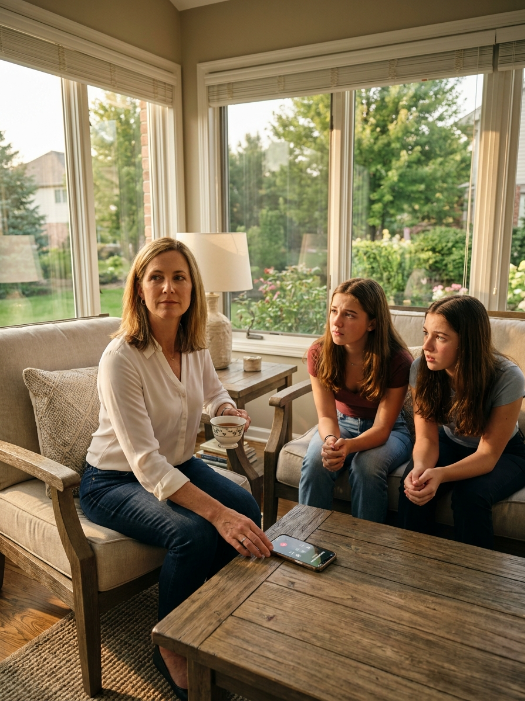
Sarah filed the emergency petition for dissolution of marriage before the clock hit two, walking the papers directly over to the county courthouse where a sympathetic duty judge signed the temporary restraining orders within twenty minutes. Seventy-two hours after Richard walked out of our front door with his leather suitcases, the trap closed so softly he didn’t even hear the latch click until he was standing in an airport terminal three thousand miles away. It was a Thursday afternoon, and I was sitting in the sunroom with Lily and Maya, drinking chamomile tea and listening to the wind rattle the dry oak leaves against the storm windows, when my repaired phone began buzzing on the mahogany coffee table. The caller ID flashed an international roaming prefix out of Central America, followed by Richard personal cell number. I picked the phone up, pressed the speaker button with my thumb, and laid it back down on the wood surface between us. “Diane!” Richard voice exploded through the tiny speaker, raspy, frantic, and completely stripped of the oily corporate charm he usually wore like a second skin.
Background noise echoed heavily behind him, sounding like the chaotic clatter of a crowded resort lobby or an international departure gate. “What the hell did you do? Why are my corporate credit cards declining at the rental desk? Why is my primary checking account locked by a federal flag?” I took a slow sip of my tea, looking across the table at my daughters, who were sitting side-by-side on the sofa with their notebooks open in their laps. “Hello, Richard,” I said, my voice completely level, almost conversational. “How is the weather down south?”
“Don’t play games with me, Diane!” Richard slammed his hand against a hard surface on his end, a sharp metallic crack that made the phone speakers hiss. “I tried to check into the resort in San Jose, and every single card I own was declined by the concierge! The bank manager on the phone says there is an emergency court order freezing my personal lines, and the wire transfer for the initial investment failed because the account balance was essentially zero! Where is the money, Diane? Where is the trust?” I leaned back against the cushions, letting the silence stretch out for three full seconds before I answered him, enjoying the sound of his ragged breathing coming through the wire. “The money is right where it belongs, Richard,” I said plainly. “In an irrevocable trust managed by Lily and Maya. The trust that requires dual signatures from the daughters you tried to leave penniless on a Tuesday morning.” Silence fell over the line so completely that I could hear the hum of the air conditioning unit running in his hotel lobby miles away.
For five long seconds, the only sound was the static of the international connection. “You… you couldn’t have,” Richard stammered, his voice cracking on the vowel like a frightened boy caught stealing from the collection plate. “That was my portfolio. I built those positions over ten years of logistics contracts.” “You built nothing alone,” I replied, my voice dropping into that quiet, steady tone I used to quiet a rowdy classroom of high school seniors. “You tried to steal our daughters’ educational future to fund a second youth with a woman who doesn’t even know your middle name. You thought you left us with eleven dollars and eighty-two cents. But as of an hour ago, a process server delivered formal divorce papers to your corporate headquarters, and a judge has frozen your stock options, your 401k, and your company vehicle to cover attempted financial fraud.”
“Diane, listen to me,” Richard pleaded, his tone shifting instantly from panic into that greasy, bargaining whine I had heard too many times during business disputes. “We can work this out. I can take a cab back to O’Hare right now. I can catch a flight back to Naperville tonight and we can talk about this like adults, ” “Do not ever come back to this house, Richard,” I interrupted, my voice hard as granite. “My lawyer will handle all future communication through the court. Enjoy your flight.” I reached out and tapped the red button on the glass screen, cutting him off in mid-sentence, and watched the call timer fade away to zero. Lily looked up from her notebook, a small, tight smile playing at the corners of her mouth, while Maya simply picked up her highlighter and went back to underlining a paragraph on molecular biology. The legal resolution that followed over the next six months unfolded with the cold, brutal precision of a guillotine blade dropping through dry timber.
Because Richard had documented his intent to steal the entire two point four million dollars through his own text message history and the fraudulent wire initiation logs, the family court judge treated his actions as severe economic waste and intentional marital fraud. The court awarded me sole ownership and full equity of our Naperville home, along with primary control over all remaining secondary marital savings, his corporate retirement accounts, and his remaining stock options to satisfy legal fees and cover the liquid cash he had stolen from our operational account. His young companion abandoned him within three weeks of his accounts being frozen and his credit cards failing at the resort front desk, and his corporate standing at the logistics firm evaporated when the court orders were served directly to his company human resources department on a rainy Tuesday morning.
Lily and Maya completed their sophomore year at Northwestern with straight A’s and top honors, their tuition fully secured by the two million, four hundred and eighteen thousand dollars that remained completely untouched in the dual-signature trust. On a bright, warm Saturday afternoon in August, I stood in our sunroom, looking out through the clean glass at the green lawn and the flower beds I had tended for twenty years while Richard traveled for business. The house was quiet, filled with the soft breeze coming through the open windows and the distant sound of lawnmowers humming down the street. Lily and Maya came downstairs carrying their textbooks, laughing about an upcoming weekend research trip up to the university biological station in Wisconsin, while my father sat in his usual armchair by the bookshelf, sipping black coffee from a chipped ceramic mug and reading the weekend paper. I looked down at the mahogany side table beside my chair.
Lying on the polished wood was a clear acrylic frame holding a copy of the certified dual-signature trust deed, stamped with the official state seal and signed in the firm, clear handwriting of my daughters. For twenty years, I had believed that keeping my family safe meant deferring to my husband, swallowing my doubts, and quietly carrying the burden of a household where my voice was always the lowest in the room. But sitting there in the sunlight, surrounded by my daughters and my father, I knew the truth that had been waiting for me all along. My life hadn’t been destroyed when Richard walked out that front door with his leather suitcases. It had simply been cleared of a man who never deserved the devotion we gave him. I picked up my teacup, smiled at my girls as they walked out the back door toward the garage, and took a slow, quiet sip, completely secure in the unshakeable future we had built together from the ground up.