How I Returned to the Mountain Town That Evicted My Father Twenty Years Ago With a Three Million Dollar Federal Lien

The heavy oak doors of the Pine Ridge municipal hall swung open with a slow, heavy creak that echoed off the high timber rafters, and honestly, the sound had not changed one bit in twenty years. Inside the high-ceilinged room, Mayor Ronald Mercer was standing firmly at the podium in a tailored charcoal wool suit, holding a silver pointer in his right hand like a conductor’s baton while he addressed a packed room of forty local residents who sat rigidly on folding metal chairs.
He was showing off glossy, full-color architectural renderings for a proposed high-end ski resort along the western ridge of the valley, pointing out luxury chalet pads and chairlift alignments with the easy confidence of a man who owned the very dirt beneath everyone’s feet. I was twelve years old the last time I stood in that exact room, clutching the frayed wool of my father’s coat while men in suits told us our lives were over, and the memory of the floorboards pressing against the soles of my sneakers had stayed with me through every single winter since I left these mountains.
Twenty years ago, my father stood in the center of that same aisle, clutching a beat-up leather briefcase against his chest with knuckles that were turning chalk-white. He was suffering from late-stage pulmonary fibrosis that made his breathing short and shallow like a trapped animal’s, his chest heaving under a flannel shirt that smelled permanently of pine rosin and damp cedar sawdust, while Ronald Mercer and the village council laughed openly at him from their elevated dais.
They claimed my father had defaulted on his land taxes, invoked eminent domain under some obscure municipal code, and ordered the county sheriff to forcibly evict us from our ancestral homestead before the first winter snow hit the high timberline. I still remember Mercer leaning forward over the high mahogany rail, his gold signet ring catching the light as he told my father that the Vance family was a line of destitute paupers who would never amount to anything in these mountains, a family of dirt-scratchers who deserved to be tossed out onto the shoulder of Route 9. My father died six months later in a cramped rented trailer thirty miles down the valley, carrying the bitter, choking shame of public exile in his lungs right up until his last rattling breath.
Now, at thirty-two years old, I stood quietly in the back of the chamber wearing a dark tailored suit that cost more than my father earned in half a year, holding a black leather briefcase of my own that felt heavy and solid against my thigh.
I had spent the last decade working as a civil engineer and municipal property developer down in Albany, quietly building the technical resources, the legal backing, and the institutional access necessary to uncover what really happened to our mountain on that cold Tuesday in October. Mercer stopped mid-sentence when he saw me walking slowly down the center aisle, his silver pointer freezing in the air above the rendering board. He was sixty-eight now, his thick hair completely silver, his cheeks red with the prosperous, well-fed flush of a man who had ruled a small Upstate New York mountain town for three decades without ever being challenged by a single soul. He squinted through his wire-rimmed glasses, trying to place the face of the man stepping out of the shadows, and honestly, I let him sweat for a few seconds before I closed the distance between us.
Can I help you, son? Mercer asked, setting his silver pointer down on the lectern with a patronizing, theatrical grin meant to reassure the nervous local shop owners in the front rows.
We are in the middle of an open council presentation, and public comment is strictly reserved for the end of the agenda.
I stopped right at the polished brass railing directly in front of his council desk, keeping my hands resting casually on the top rail so he could see my wedding band and the expensive watch I bought with my first major municipal contract. My name is Kaelen Vance, I said, my voice carrying clean and even across the quiet room without a single tremor of the nervousness I had felt walking through those heavy oak doors. And I am not here for public comment, Mayor Mercer.
A sudden, sharp quiet fell over the entire room, so complete that you could hear the low hum of the fluorescent ceiling lights vibrating against the rafters. A few older residents in the front row turned sharply in their metal chairs, whispering among themselves as they caught the name and stared hard at my jawline, looking for the ghost of the man they had helped drive out twenty years ago. Mercer’s corporate smile stiffened instantly, his lips pulling back into a thin, pale line as his eyes narrowed, a cold flicker of sudden recognition crossing his features before he quickly smoothed his expression back into a mask of dismissive amusement. He adjusted his silk tie with fingers that were just a fraction too stiff, trying to regain the upper hand in front of his constituents.
Kaelen Vance, Mercer said, lowering his voice into that warm, greasy corporate tone meant for the audience behind me. Well, it has been a long time, hasn’t it? I am sorry about your late father, Kaelen, truly, we all felt for you back then. But if you came back here looking to re-open old wounds about your family’s tax default from back in the day, you are simply wasting your time and everybody else’s. That matter was settled legally twenty years ago when the town repossessed the ridge for public infrastructure development.
The town didn’t repossess the ridge, Ronald, I replied, pulling a thick, ribbon-bound legal document from my briefcase and laying it flat with a sharp slap against the mahogany council table right under his nose. And my father never defaulted on a single dollar of his land taxes, not in forty years of owning that timber.
Mercer scoffed, though his right hand twitched noticeably against the edge of his desk, his fingernails digging just a fraction into the polished wood. The property was seized legally for back taxes and placed directly into the municipal development trust under proper county authority, he snapped, his voice losing a bit of its practiced warmth. The paper trail was signed, sealed, and legally closed two decades ago, and no amount of sour grapes from a disgruntled kid is going to change the county registry.
It was closed because you hid the evidence, I said, stepping just an inch closer to the brass rail.
Three months ago, while conducting a deep historical survey of county land records under a federal court subpoena regarding municipal grant fraud, I spent six solid days in the damp, windowless basement of the county historical archive on Pine Street. Inside an unindexed 1904 municipal ledger that had been misfiled behind the old water board maps, I discovered an original brass tax stamp seal tucked into the binding. The stamped numbers on that physical brass seal matched the exact missing tax payment receipts from the year of my family’s eviction, receipts that the county auditor had long claimed never existed. My father had walked right into this building and paid every cent of his annual land assessment directly to the village clerk in cash, but the physical receipts were systematically stripped from the main ledger before the rigged public auction ever took place.
What is that paper? Mercer asked, staring down at the thick document sitting on his desk like it was a venomous snake coiled up beside his paperwork.
That is a certified Federal Land Restitution Order and Master Judicial Receivership, I said, looking right past him at the four council members sitting nervously beside him on the dais. Issued directly by the United States District Court for the Northern District of New York after a federal judge reviewed our forensic audit of the municipal tax rolls.
I turned around slowly to face the gathered room of local residents, including the small-business owners who leased shop space from the village development trust along Main Street, people who had lived here their whole lives. For years, I had carried a bitter, burning resentment toward every single person in this valley, assuming they had all stood by and cheered while my father was dragged off his land like a common criminal. But looking out at their confused, weathered faces in the harsh overhead light, I saw no malice in their eyes, only ordinary people who had trusted their local leaders for decades without ever looking behind the curtain.
Under Section Eight of the federal order, I declared, my voice carrying clear and steady to every corner of the timbered hall, the entire municipal development trust of Pine Ridge is placed under immediate legal receivership. The federal court has calculated the total accrued value of back rent, illegal tax seizures, unpermitted timber extraction, and property damages owed to the Vance Family Trust at exactly three million, two hundred thousand dollars.
Mercer stood up so fast from his high-backed leather chair that the heavy furniture slammed backward into the oak wood paneling with a sharp bang that made several people jump in their seats. You are completely out of your mind! Mercer shouted, his red face darkening to a furious purple as his veins bulged at his temples. You cannot foreclose on a municipal government, you arrogant little punk! This hall, that ridge, and every public lease in this valley belong to the village council under state charter, and no federal judge is going to overturn thirty years of local governance for a dead man’s grudge!
Not anymore, Ronald, I said softly, letting my words drop into the silence like lead weights. As of eight o’clock this morning, I am the court-appointed receiver for all municipal trust assets. And if three million, two hundred thousand dollars is not transferred to the federal court escrow account within seventy-two hours, I hold the legal authority to seize every municipal asset in this town, starting with the very building you are standing in right now.
The council chamber exploded into immediate, deafening chaos the second the words left my mouth, two board members standing up from their chairs and shouting over each other while local shop owners in the audience began demanding answers about their leases. Mercer slammed his heavy oak gavel three times against the wooden block with frantic, jerky motions, his breathing ragged and shallow, his hand shaking so badly he nearly dropped the mallet. Clear the room! Mercer roared at the two uniformed village officers standing near the double doors with their arms crossed. Meeting adjourned! Clear the hall right out into the street right now!
The two officers looked at Mercer, then looked down at the bright blue federal seals stamped across the legal documents lying openly on the council table. Neither officer moved an inch, their boots planted firmly on the linoleum floor. They knew, as well as everyone else in that room, that a federal court receivership order completely superseded any local authority Mercer pretended to hold, and none of them wanted their own badges caught in the crossfire of a federal fraud investigation.
Within twenty minutes, the audience had cleared out into the cold mountain air, leaving only Mercer, his three remaining council members, and the nervous village attorney sitting around the long oak table with me and my own legal counsel. This is nothing more than a cheap shakedown, Kaelen, the village attorney said, adjusting his thick reading glasses as he frantically scanned the pages of the federal subpoena with trembling fingers. Even if there were administrative irregularities in the tax auctions of 2006, and I am not conceding that there were, the statute of limitations on municipal property seizures ran out fifteen years ago under state law.
The statute of limitations does not apply to active, ongoing fraud that has been deliberately concealed through falsified public records, I replied, keeping my tone perfectly measured as I pulled a second thick blue folder from my briefcase and placed it squarely beside the master audit.
Inside that second folder was an Unsealed County Land Registry Master Audit, supported by an original 1904 Land Title Warrant that my legal team had managed to unearth from the state archives in Albany after weeks of digging through probate files. Twenty years ago, I said, keeping my eyes fixed on Mercer, Mayor Mercer informed the public through a formal press release that the Vance ancestral ridge was being acquired by the village under eminent domain to create a public wilderness preserve for the community. But when we subpoenaed the internal bank transfer records of the municipal development trust from the regional depository, we found something very different indeed.
I opened the folder to page fourteen, pointing my finger directly at a series of certified wire transfers dated exactly three weeks after my family was forcibly evicted from our home. The village never held the primary title to begin with, I explained, looking straight at Mercer, who sat completely frozen in his chair like a man carved from stone. The day after my father was thrown off his land, Mayor Mercer filed a quiet title waiver using a forged tax default certificate that bypassed the county board. He then transferred the development rights of the three-hundred-acre Vance ridge to a private shell entity called Ridgeline Development Holdings LLC for the ridiculous sum of sixty-five thousand dollars, a tiny fraction of its actual timber and real estate market value.
Mercer swallowed hard, his throat bobbing as his hands clasped tightly together on the table surface. Ridgeline Holdings was simply a legitimate private partner brought in by the council to manage municipal economic growth during a difficult budget cycle, he muttered, though his voice lacked any conviction.
Ridgeline Holdings was a shell company registered in a dead-end mailbox in Delaware with zero employees and zero commercial assets, I said, flipping to the next page. And page twenty-two of the federal audit shows the primary beneficiary, the sole managing member, and the individual who cleared every single dollar of profit from that sale: Ronald Mercer.
The council member sitting directly to Mercer’s right, an elderly man named Arthur Hayes who had served honorably on the board for fifteen years and ran the hardware store on Main Street, turned his head slowly to look at the mayor with a look of absolute heartbreak. Ronald? Arthur asked, his voice barely a whisper that barely reached across the table. Is that actually true? Did you buy the Vance ridge yourself through a secret shell company while telling us it was for the town?
Mercer didn’t answer him. He stared down at the blue federal seal on the title warrant, his lips pressed into a thin, white line that had lost all its color. For twenty years, Mercer had used his position as council head to keep the land tied up in legal limbo, waiting for the right moment to sell the stolen ridge to an international resort corporation for millions of dollars while collecting municipal management fees from the town he was supposed to be serving. He had ruined my father’s life, destroyed our family name, and left us penniless, all to satisfy his own personal greed and political ambition while pretending to be a pillar of the community.
My client has zero interest in harming the innocent residents or small businesses of Pine Ridge, my attorney stated, addressing the silent, stunned council members. However, the three million, two hundred thousand dollar federal restitution judgment is fully enforceable against the private assets of those who executed the fraud.
I looked at Arthur Hayes and the other council members sitting around the table. My initial impulse when I drove my truck into this valley two days ago had been driven by a cold, burning bitterness that had kept me awake for a decade. I had wanted to foreclose on the entire town, shut down every public office, and make the whole community feel the exact helpless terror my father felt when our belongings were piled on the side of the dirt road in the freezing rain. But sitting in that room, seeing the honest shock on Arthur’s face, I realized that my bitterness was blinding me to the truth. The people of this village hadn’t destroyed my family. Ronald Mercer had manipulated them just as easily as he had targeted us, hiding his paper trail behind fake community projects and small-town charm. Destroying the town wouldn’t bring my father back to life; it would only make me as ruthless and cruel as the man who had stolen our home.
I am giving the council one final choice, I said, leaning over the table toward Mercer. We hold an emergency formal accounting meeting tomorrow morning at nine o’clock sharp in this exact room. You will produce every original vault record from 2006, or federal marshals will execute an immediate asset freeze on every private commercial holding associated with Ridgeline Holdings across the entire state.
Mercer looked up at me then, his eyes filled with a toxic mixture of pure hatred and absolute, suffocating panic. He knew he was completely trapped. The paper trail he had carefully hidden for two decades was laying open on the table between us, and there was no lawyer alive who could talk him out of a federal fraud indictment.
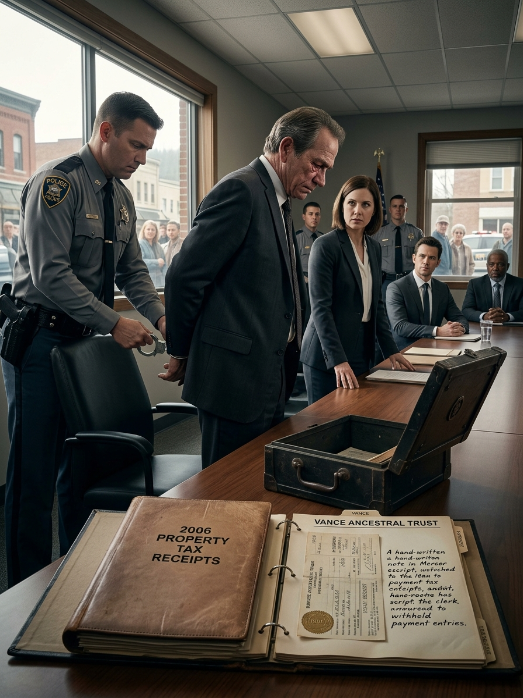
At nine o’clock the following morning, the municipal conference room was lined with three state troopers, two federal court monitors, and a forensic accountant sent directly by the state attorney general’s office to oversee the handover. Ronald Mercer sat at the head of the table, flanked by a high-priced private defense lawyer he must have flown in from Syracuse. He looked ten years older than he had twenty-four hours earlier, his expensive charcoal suit deeply wrinkled, his eyes bloodshot from a sleepless night, and his hands trembling noticeably as he signed page after page of the formal court disclosure documents. In the corner of the room stood an ancient, heavy iron ledger box that had been retrieved two hours prior from the town’s restricted historical vault behind the clerk’s office, its brass latch covered in decades of dust.
The forensic accountant unlocked the iron latch with a small skeleton key, lifted the heavy lid, and pulled out a faded leather binder marked 2006 PROPERTY TAX RECEIPTS. He opened the book slowly to the yellowed tab marked VANCE ANCESTRAL TRUST. Glued securely inside the back sleeve of the ledger were the original physical tax receipts, stamped firmly with the 1904 brass seal, proving beyond a shadow of a doubt that my father had paid his annual land taxes in full six weeks before the eviction order was ever issued. Beside the receipts was a handwritten note in Mercer’s own sloppy handwriting, instructing the former clerk to deliberately withhold the payment entries from the main county ledger to fabricate the default.
The physical evidence of deliberate forgery and public theft is absolute, the state forensic accountant declared, handing the original receipts directly to Officer Davis of the State Police.
Officer Davis walked around the long table and stopped directly behind Mayor Mercer’s chair, his boots clicking hard against the floor. Ronald Mercer, Officer Davis said, pulling his steel handcuffs smoothly from his leather belt. You are under arrest for grand larceny, forgery of official public records, corrupt municipal governance, and federal wire fraud.
Mercer stood up slowly from his chair, his head bowed low toward the floor, offering no physical resistance as the steel cuffs clicked tightly around his wrists with a sharp, final sound. The man who had ruled this mountain town with an iron fist for thirty years was led out through the side doors of the municipal building in complete silence, his defense lawyer trailing nervously behind him with a briefcase.
With the legal fraud officially exposed and the primary conspirator removed from power, my attorney and I sat down with Arthur Hayes and the remaining village council members to execute the final federal restitution settlement terms. Under the terms of the court order, my attorney explained, all personal real estate holdings, commercial properties, and private bank accounts tied to Ronald Mercer and Ridgeline Holdings LLC are seized immediately to satisfy the three million, two hundred thousand dollar judgment.
I stood up from the table and walked over to the large glass window overlooking the town square, where dozens of local residents were standing in small, anxious groups, watching the state police cruisers pull away down Main Street. I am releasing the municipal complex and Main Street business leases from the receivership hold right now, I announced to the remaining council members without turning around. The local store owners will retain their commercial leases without interruption, without lease renegotiation, and without rent increases. The town will not be forced into municipal bankruptcy on my account.
Arthur Hayes looked up at me from his seat, his weathered eyes filled with a profound sense of relief and deep, earned respect. Kaelen, after everything this council did to your father and your family, why on earth are you sparing the town?
Because my father was an honest man who genuinely cared about these mountains, I said, turning back to face them with my hands in my pockets. He didn’t raise me to destroy an entire community just to satisfy a personal grudge. He raised me to protect what belongs to us, not to punish people who were lied to.
I tapped the final document resting quietly on the table surface. The three-hundred-acre Vance ancestral ridge will be returned in full to my family trust, I stated cleanly. And by executive order of the receivership, the entire property will be placed into a permanent, non-transferable public historical trust, named forever in honor of my father, Thomas Vance. No developer will ever build a commercial resort or a luxury chalet on that mountain as long as there is breath in my body.
Arthur signed the final transfer deed with a steady, practiced hand, sliding the completed papers across the polished oak table to me. Your father would be immensely proud of you, Kaelen, Arthur said softly, his voice thick with emotion. The Vance name is fully cleared, once and for all.
Late that afternoon, the dark rain clouds cleared away from the valley, leaving a brilliant, crisp blue sky over the Adirondack peaks that made the snowcaps look like cut glass. I drove my truck up the winding dirt access road that led up the eastern slope of the ridge, stopping right at the crest of the hill where our old wooden family cabin used to stand before it was bulldozed. The original fieldstone chimney was still standing tall against the wind, covered in thick green moss and mountain ivy, surrounded by a ring of towering old-growth pines that had survived the decades.
I stepped out of the truck and walked up to the edge of the stone hearth, taking a deep, cold breath of the clean mountain air that filled my lungs. In my hands, I held a simple wooden frame that I had put together an hour ago at the town carpentry shop. Inside the glass frame was the original, brass-stamped 2006 tax receipt, rescued safely from the town vault, bearing my father’s signature alongside the official paid stamp.
I set the framed receipt resting securely against the center stone of the old fireplace, right where the wooden mantle used to be before the fire took it. Below me, the valley stretched out for miles, quiet and peaceful in the golden late afternoon sun. The town of Pine Ridge sat nestled peacefully along the river, its people safe, its local businesses protected, and the heavy shadow of thirty years of political corruption finally lifted from its streets.
For twenty years, I had carried the heavy, burning weight of childhood shame, believing that my father had died a defeated man who had lost everything to powerful people. But standing on that ridge, looking out over the land that now belonged permanently to our family’s public trust, I realized the absolute truth of it all. My father had never been defeated by anyone. He had simply been betrayed by greedy men whose elaborate lies eventually crumbled under the weight of real evidence and stubborn perseverance.
I reached out and touched the cool rough stone of the chimney, feeling a profound, quiet peace settle over my heart for the first time since I was a twelve-year-old boy standing in that courtroom. I had come back to these mountains not out of malice or petty revenge, but to complete the work my father started before his lungs gave out. His name was fully restored, his memory was cleared, and the mountain he loved so deeply would remain wild and untouched for generations to come.
I turned back toward my truck, leaving the framed receipt shining under the clear mountain sky, knowing my promise to him had finally been kept.