How Finding My Sister’s Ten-Year-Old Returned Letter Exposed a Six Hundred and Fifty Thousand Dollar Forgery

Why do we always look for the most complicated explanation when the simple, ugly truth is sitting right there in front of us on a digital screen or tucked inside a dusty drawer? For ten years, I asked myself that same exhausting question every single time October rolled around and brought back the anniversary of the night Elena walked out of our lives. I was thirty-six when I finally found the envelope, living just ten minutes down the road in our quiet Massachusetts suburb, spending my weeks teaching high school biology and my weekends coming over to help Eleanor, our mother, sort through her endless piles of household bills and property taxes.
Elena had been gone for exactly a decade by then, vanishing into thin air after a screaming match in our kitchen that left the windows rattling and our family completely fractured. Eleanor and our older brother, Marcus, sat me down at the oak kitchen table the very next morning and told me everything I needed to know, or at least everything they wanted me to believe. They said Elena was unstable, greedy, and unbearably selfish, packing her bags in the middle of the night and demanding an immediate cash payout because she refused to put in the hard work required to run Vance Artisanal Bakery. For ten long years, I carried that soul-crushing weight right beneath my ribs like a physical stone, believing deep down that I was simply the weak sister who sat frozen on the stairs and failed to stop the fight. I convinced myself that my complete inability to mediate that argument drove my younger sister away into the dark, and that guilt made me stay close to Eleanor and Marcus, nodding along to their cold, controlling behavior out of sheer, suffocating obligation.
It was a quiet Thursday afternoon in October when the foundation of my entire life finally cracked open behind a stack of old real estate ledgers. I was reaching into the deep back corner of Eleanor’s solid oak desk to pull out an old property tax receipt for the commercial warehouse, and my fingers brushed against something thick and textured wedged tightly behind three blue binders. I pulled it out into the sharp autumn light coming through the window, and my breath caught instantly in my throat because of what was printed across the front in bright red postal ink. It was a yellowed paper envelope stamped with the words refused by addressee and return to sender, bearing a postmark dated November fourteenth, 2016, which was exactly three weeks after Elena packed her bags. My heart started hammering against my ribs like a trapped bird as I carefully slid the unsealed letter from its sleeve, noticing right away that it was written in Elena’s familiar, frantic handwriting on a single yellow legal sheet.
Mom, the letter began, please send my clothes and my college diploma to this P.O. Box in Burlington, Vermont, because I have no money left and nowhere else to go. Marcus changed the security codes on the bakery doors this morning and threatened to call the police on me if I ever stepped foot on the property again, telling me that if I tried to ask for my forty percent equity share, you would both swear to the bank that I embezzled sixty thousand dollars from the flour account. Please, Mom, I built those bread recipes with Dad before he died, so just give me my personal boxes and let me hire a lawyer to settle this fairly.
I stood completely alone in that sunlit office, holding the paper in my hand while my mind struggled to assemble a reality where my mother could keep an unopened letter like that locked in her desk for a decade.
Elena hadn’t run away because she was selfish or unstable, and she certainly hadn’t abandoned us over a petty temper tantrum about minimum wage shifts. She had been deliberately driven out, threatened with fabricated criminal charges, and stripped of everything she owned by the two people who were supposed to protect her, while Eleanor watched me cry tears of pure guilt every single year on Elena’s birthday. I carefully folded the letter, slipped it deep inside the pocket of my gray cardigan, and pushed the desk drawer shut with a quiet click. I didn’t scream or break down right then and there, and I certainly didn’t run out to the back patio where Eleanor and Marcus were sitting together over morning coffee, laughing while they discussed the corporate expansion of the bakery into four new supermarket chains. Instead, I simply walked out to my car, climbed into the driver’s seat, and opened my laptop on the center console with shaking hands.
I had spent ten years running dead-end searches under my sister’s birth name with zero results, but looking at that ten-year-old postmark from Vermont, I finally had a real geographic anchor. Four hours later, digging through public business registries and small commercial food licenses across New England, I found an active filing for a small organic bakery operating out of coastal Maine under our grandmother’s maiden name, Elena Ross.
The morning fog was still hanging heavy and gray over the Maine harbor when I pulled my car to a stop outside a small, weathered brick building with a freshly painted wooden sign that read Harbor Crust Bakery. Through the pristine glass front window, I watched a woman standing at a stainless steel worktable, evenly dusting white flour across a heavy wooden board with practiced, steady movements. She was thirty-five years old now, her dark hair pulled back into a messy knot, wearing a simple flour-dusted apron over a thick gray sweater that looked like it had seen better days. She looked older, leaner, and infinitely stronger than the twenty-five-year-old girl who used to cry in our shared bedroom late at night, but there was no mistaking the sharp curve of her jawline or the way she moved. My hand trembled violently as I pushed the front door open, setting off a small brass bell that chimed overhead and echoed against the low ceiling of the shop.
Elena didn’t look up from her counter right away, calling out in a smooth, professional retail voice that they would be opening in just ten minutes while she continued wiping down the stainless steel. Elena, I said softly, and the sound of my voice seemed to freeze the entire room in place. The damp cloth in her hand stopped moving entirely, and she slowly raised her head, her wide gray eyes locking onto mine across the glass display case with a look of pure disbelief.
For five long seconds, neither of us breathed or moved an inch while the distance of ten years hung heavily in the narrow space between us. Clara, her voice finally came out as a breathless whisper, filled with a sudden, cautious tension that made my stomach twist into a knot. She didn’t drop her cloth and run around the counter to hug me like I desperately wanted her to do, but instead took a slow step backward toward the kitchen door with her jaw clenched tight. Did Marcus send you here to check on me, or are you just playing messenger for Mom again? No, I said, my voice cracking right down the middle as hot tears spilled over my eyelashes and traced down my cheeks. Nobody knows I am here, Elena, and I have spent the last ten years tearing myself apart trying to find you because I thought you hated us. Why would you look for me after all this time, she asked, her tone dropping into a flat, defensive guard that felt like a physical blow.
To tell me that Mom misses her favorite punching bag, or to tell me I ruined the family because I didn’t want to work three shifts for pennies while Marcus bought himself a new boat? No, I said, reaching blindly into my coat pocket and pulling out the yellowed legal paper I had stolen from Eleanor’s desk the day before. I found this behind the tax binders in Mom’s office last Thursday, and I finally know the truth about what happened that night.
Elena stared at the creased yellow paper in my hand, and as her eyes traced the familiar handwriting, a dark, terrible shadow of old pain settled over her features. She kept it, Elena whispered, a bitter, hollow laugh escaping her throat as she shook her head slowly. I spent two hundred dollars of my last three hundred bucks paying a notary public and mailing that certified letter across state lines so someone in that house would see the truth, and she didn’t even have the decency to open the envelope. They told me you demanded cash and walked out because you hated the bakery business, I wept, stepping closer to the glass counter while my boots clicked softly against the wooden floorboards. They told me you called us all pathetic and slammed the door in Mom’s face, and I spent a decade hating myself because I sat on those stairs and didn’t stop you from leaving. Elena looked at me for a long moment, and the hard wall around her expression finally cracked open just enough to let the grief through. She reached out, unlatched the wooden counter gate, and gestured silently for me to follow her back into the small office behind the kitchen where two folding chairs sat beside a tall rack of cooling sourdough loaves.
It wasn’t a fight that drove me out of that house, Clara, Elena said once we sat down, her voice unnervingly steady and quiet in the small room. It was a complete and calculated setup orchestrated by Marcus and backed entirely by Eleanor to steal my legal inheritance. Dad left me a forty percent vested equity share in the bakery trust when he passed away because I had spent three years developing all six of our core commercial artisan loaf recipes from scratch in our basement. By 2016, Marcus wanted to franchise the entire business to a massive regional distributor across New England, but the corporate lawyers required a clean ownership structure before they would release any capital. They needed my forty percent equity signed over to them for a two million dollar business loan, and when I asked for my rightful four-hundred-thousand-dollar valuation buyout based on Dad’s original trust documents, they destroyed my life in a single evening.
Marcus didn’t try to negotiate with me at all, but instead shoved a folder of forged grain invoices in my face and claimed I had been secretly siphoning money from the flour accounts for months. When I told him I was calling an independent auditor first thing in the morning, he grabbed my arm so hard it bruised, dragged me down the back delivery stairs, and threw my suitcases into the gravel alley while Mom stood right there on the landing telling me never to come back.
My stomach turned to solid ice as the entire horrifying picture clicked into place with terrifying clarity. They forced you out so they could keep everything for themselves, I whispered, staring at my hands in my lap. They didn’t just steal my livelihood, Clara, Elena said, opening a heavy blue binder from the filing cabinet beside her desk and sliding it across the table. They filed a fraudulent document with the Norfolk County Probate Court six months after I left, claiming I had executed a voluntary liability release and equity forfeiture. She pointed her finger down at a certified copy of a state-sealed document bearing a neat, fluid cursive signature that read Elena M. Vance in smooth blue ink. That is supposed to be my signature signing away my entire six-hundred-and-fifty-thousand-dollar equity share for zero dollars because of personal debt, but I write my capital E with a sharp print angle like I was taught in middle school.
I know you do, I said immediately, leaning over the paper. I paid a certified forensic handwriting examiner in Portland three months ago to audit the public record, and he issued an official report confirming it is an amateur forgery traced directly from my old high school transcripts. Why didn’t you take this to a judge years ago, I asked, and she gave me a sad, tired smile. Because I was completely alone with zero dollars to my name, building this shop one bag of flour at a time without anyone in that Massachusetts house willing to stand up for the truth.
I reached across the narrow table and grabbed my sister’s flour-dusted hand, squeezing it hard enough to let her know I wasn’t going anywhere this time. You have me now, Elena, I said, and I am going to help you take back every single dollar they stole from your future. For the next three days, I lived a strange, exhausting double life that required nerves of steel and absolute secrecy. I drove back down to Massachusetts on Sunday evening, walking through my front door and pretending that my entire worldview hadn’t just been permanently dismantled by a single piece of yellow paper. I taught my biology classes by day, standing in front of whiteboards and lecturing teenagers on cellular division while my mind was racing miles ahead, planning every single move for the evening hours. Every night while Eleanor was safely occupied at her weekly bridge club and Marcus was tied up at the bakery headquarters across town, I used my spare house key to let myself into my mother’s estate.
As the dutiful daughter who had lived down the road for ten years running errands and managing family logistics, I knew the exact location of every key, password, and metal file box in that house. Inside Eleanor’s heavy home office safe, I found the private corporate financial ledgers for Vance Artisanal Bakery covering the entire decade from 2016 to the present day. Working under the harsh glare of my phone flashlight so I wouldn’t cast shadows through the windows, I scanned every single page of the original restructuring agreements, bank loan applications, and private dividend logs.
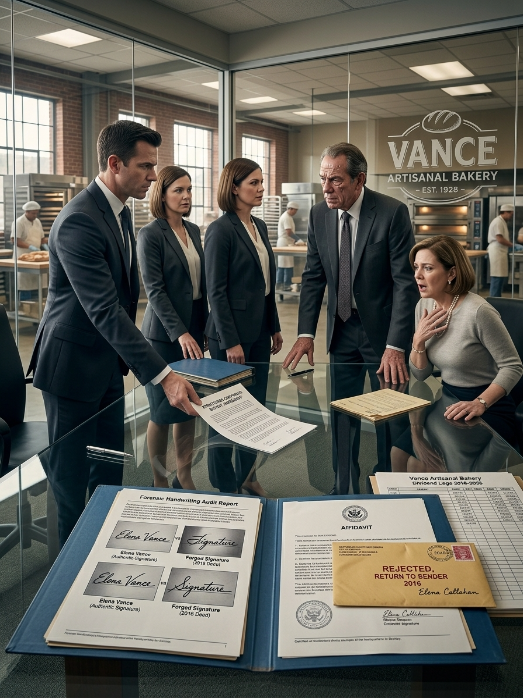
The paper trail was even more staggering and corrupt than Elena had imagined in her worst nightmares, proving that greed had completely hollowed out whatever was left of our family. That six-hundred-and-fifty-thousand-dollar equity share they stole through the forged probate deed had been funneled directly into their personal holding accounts to finance their lavish lifestyle. Over the past ten years, that single stolen block of shares had generated well over one point two million dollars in private dividend payouts for Marcus and Eleanor while they expanded their storefronts across the state. On Thursday morning, I met Elena and her lead corporate attorney, Mr. Callahan, in a quiet glass-walled conference room located high above downtown Boston. We spread the entire collection of evidence across the long mahogany table: the returned certified letter from 2016, the forensic handwriting audit report, my covertly scanned financial ledgers, and a completed civil fraud complaint ready for immediate filing in Norfolk County Superior Court.
This goes far beyond a simple civil dispute over family assets, Mr. Callahan said, adjusting his glasses as he examined the ledger copies under the bright overhead lights. Forging a probate dissolution deed to convert six hundred and fifty thousand dollars in corporate equity constitutes major grand larceny, perjury, and felony wire fraud. If we walk this down to the courthouse steps tomorrow morning, Marcus and Eleanor are looking at very real prison time for corporate racketeering.
I don’t want them sitting in a jail cell, Mr. Callahan, Elena said quietly, her voice entirely devoid of anger as she looked out the window at the morning traffic. I just want my six-hundred-and-fifty-thousand-dollar equity buyout adjusted for a decade of inflation and back dividends, I want my six original recipes legally reassigned to my independent company, and I want them permanently out of my life. Then we schedule the execution meeting for ten o’clock tomorrow morning at their main corporate headquarters in Quincy, I said without hesitation. At precisely ten o’clock on Friday morning, Eleanor and Marcus were sitting behind their polished glass desks in the executive suite of Vance Artisanal Bakery headquarters, deep into a quarterly review. The heavy glass door swung open, and I walked into the room first, followed closely by Elena and Mr. Callahan carrying a thick leather briefcase. Marcus looked up from his leather executive chair with an expression of sharp, annoyed irritation that quickly curdled into profound confusion.
Clara, what on earth is the meaning of this intrusion, Marcus snapped, standing up and towering over the desk. I am in the middle of a vital operational review with Mom, and I have no idea who this stranger is trailing behind you. Then his eyes flicked past my shoulder to the woman standing quietly beside me, and the color drained completely out of his face so fast he dropped his expensive silver pen onto the glass tabletop with a sharp clatter.
Beside him, Eleanor let out a sharp, strangled gasp, her wrinkled hand flying instantly upward to clutch at her heavy pearl necklace as if she were suddenly choking. Elena, Eleanor stammered, her voice shaking violently as she pushed herself up from her chair and stared across the room as if she were seeing a ghost. What are you doing in this building, and Clara, why in God’s name are you standing with her? She is here to collect the debt you incurred when you stole her life’s work ten years ago, Mom, I said, stepping firmly to the front of the desk and dropping the heavy blue legal folder onto the glass with a dull thud. This is completely insane, Marcus shouted, his face turning an angry shade of purple as he slammed his palms down onto the surface. She surrendered her equity voluntarily a decade ago and walked away like the ungrateful child she always was, so take this crazy woman and get out of my office before I have security throw you both onto the street.
Go ahead and call security, Marcus, Elena said smoothly, stepping forward into the light with absolute poise and looking her brother straight in the eye. Call them right now, and while we wait for them to ride the elevator up, your lawyer can walk you through the forensic handwriting audit sitting on Mom’s lap.
Eleanor’s trembling hands opened the folder, revealing the side-by-side photographic analysis comparing Elena’s authentic signature against the amateur forgery filed with the probate court ten years prior. Resting right beside it was the certified affidavit from the state handwriting examiner and a high-resolution scan of the returned 2016 certified letter I had rescued from Eleanor’s desk drawer. You forged her signature on a state probate document, Mr. Callahan said, his tone dry, professional, and entirely lethal as he laid out the dividend logs showing the illegal profits. You converted six hundred and fifty thousand dollars in partnership equity to secure a commercial bank loan under false pretenses, which constitutes felony fraud and grand larceny across multiple state jurisdictions. This is an absolute lie, Marcus spat back, though his forehead was instantly slick with a heavy, nervous sweat as he looked wildly between the documents and his mother. I found the original letter in your bottom desk drawer, Mom, I said, turning my gaze away from my brother and locking eyes with the woman who raised us. You kept her cry for help locked away in a dark drawer while you let me carry the crushing guilt of believing I had ruined our family.
Clara, please, Eleanor wept, her voice breaking into pathetic little pieces as she looked at me with desperate, tear-filled eyes. We did it to save the family business from collapsing during the recession, and I only did what I thought was necessary to protect our collective future.
You didn’t do it to protect anyone, Mom, I said, every single ounce of leftover guilt evaporating into the clean office air. You did it because you cared more about corporate expansion and looking successful than you cared about your own daughter’s survival. Mr. Callahan reached into his briefcase, pulled out a single, binding legal settlement agreement, and placed a heavy silver pen beside it on the glass desk. You have exactly two choices right now, Mr. Vance, the attorney said flatly. Option one is that you and your mother sign this structured corporate buyout agreement right this second, which requires an immediate eight-hundred-and-fifty-thousand-dollar lump-sum transfer to my client covering her equity and back dividends, along with the full legal assignment of her original recipe patents. And what happens if we refuse to sign your little piece of paper, Marcus rasped, his eyes darting frantically toward the door as if he could somehow run away from the math.
Option two is that I walk across the street to the Norfolk County District Attorney’s office within the hour and file a formal criminal indictment for fraud and forgery, leaving the state police to execute their warrants from there. Marcus stared at the paper for a long, silent minute, looking at his mother’s terrified face, then at Elena standing beside me with quiet, unshakeable dignity. There was nowhere left for them to hide, because the paper trail was absolute, the forgery was exposed, and the quiet daughter who had stayed obedient for ten years had finally found her voice. With a shaking, defeated hand, Marcus picked up the silver pen and signed his name at the bottom of the page, while Eleanor followed thirty seconds later with tears smudging the dark ink.
Two weeks after that morning in the corporate office, the crisp autumn sun was shining bright and clear over the rocky coast of Maine. I was sitting comfortably on the wooden porch of Elena’s small house overlooking the harbor, holding a warm mug of herbal tea in my hands while the afternoon tide rolled slowly against the pilings. Below us, the quiet waterfront was dotted with small fishing boats returning from their afternoon runs, and the salty air carried the rich, comforting scent of baking sourdough drifting up from the bakery down the road. The eight-hundred-and-fifty-thousand-dollar wire transfer had successfully cleared Elena’s business account three days prior, and the proprietary recipe rights had been permanently reassigned to protect her independent enterprise forever. I had officially handed in my resignation from the high school teaching position in Massachusetts the very afternoon the settlement funds hit the bank account, packing my books and closing the chapter on my old life.
I sold my suburban condo, loaded my belongings into a rental truck, and moved up to the Maine coast permanently to help Elena manage the expanding operations of Harbor Crust Bakery as her full-time business manager. My mother had tried calling my cell phone six different times over the past week, leaving long, tearful voicemails about family forgiveness and fresh starts, but I had blocked her number without listening to a single word. Marcus had attempted to send a conditional non-disclosure agreement through his corporate lawyers regarding the history of the bakery, but Elena and I had drafted a joint rejection letter and mailed it back within the hour.
We didn’t need their tainted money, and we certainly didn’t need their hollow, manipulative versions of family peace. The back door clicked open behind us, stepping onto the wooden planks as Elena emerged carrying a small wooden tray holding a fresh, warm loaf of golden sourdough and a dish of sweet butter. She set the tray down on the low wooden table between our rocking chairs, cut two thick, steaming slices, and handed one across to me with a quiet smile. I took a slow bite, letting the familiar taste settle over me as the perfectly crisp crust gave way to an inside that was soft, airy, and rich with the exact flavor our father had taught her to cultivate twenty years ago. It really is perfect, Elena, I said softly, looking over at my sister with a deep sense of peace that had been missing from my life for a decade.
Elena leaned back in her chair, wrapping her hands around her tea mug while her gray eyes gazed out toward the open ocean with absolute clarity. The heavy, exhausted shadow that she had carried around like a physical weight for ten years was completely gone, replaced by an unshakeable strength that nobody could ever take away from her again. We finally did it, Clara, she whispered, reaching across the small table to lay her flour-dusted hand over mine. We really did, I replied, watching the gulls dip low over the harbor water as the afternoon light caught the edge of the roof.