How My Business Partner Framed Me for $450,000 And How Ten Years of Ledger Work Brought Him Down

Ten years ago, two city detectives sat across from me in a windowless interview room at the precinct and shoved a stack of printed audit logs across the scarred laminate table, pointing their ballpoint pens directly at a digital signature that matched my administrative user account for three separate wire transfers totaling $450,000. Julian Mercer, my founding partner and the man I had trusted like a brother since our late twenties, had called the police himself, standing right there in the polished glass lobby of our financial district tower with genuine tears shining in his eyes for the local evening news cameras, telling every reporter who would shove a microphone in his face that he was completely heartbroken by my sudden, shocking betrayal.
I was thirty-four years old back then, running on three hours of sleep and wearing a cheap department-store suit that felt like cardboard against my skin, while Julian played the grieving visionary who had just discovered a wolf hiding inside his own sheepfold. We had built Mercer & Vance Financial from a cramped two-desk rental space with mismatched folding chairs and a single rotary telephone into a thriving boutique firm valued at $2.8 million, and while Julian wore the custom charcoal suits, hosted expensive client dinners at steakhouses, and charmed every venture capitalist who walked through our doors, I was the one doing the actual heavy lifting down in the engine room, pulling sixty-hour weeks auditing complex client books, building our internal compliance architecture from scratch, and managing the intricate ledgers that kept the lights on. When the money vanished into a shadow account tucked away in the Cayman Islands, my brain simply refused to process how my private admin access code had been punched in at 11:42 PM from inside our main server room when I had been sitting at home eating leftover casserole with my bedroom window cracked open to the autumn rain.
I did not have twenty thousand dollars to retain a high-priced corporate defense team, and when my court-appointed public defender sat beside me on that orange plastic bench and whispered that a grand jury trial carried a mandatory fifteen-year federal sentence with zero chance of bail, my knees buckled under the weight of a math equation I could not solve. To keep me out of a federal penitentiary, my lawyer negotiated a desperate plea agreement that stripped me of every single share of company equity, forced me into a total personal bankruptcy that wiped out my savings down to the last dollar, and left a fraudulent $450,000 liability debt permanently stamped across my name like a brand on an ox. Julian took absolute, uncontested ownership of the entire firm overnight, swiftly rebranding it Mercer Global and buying out my fifty percent stake for a single nominal dollar under the court-approved emergency restructuring, treating me like a disposable napkin he could crumple and toss into the wastebasket after wiping his mouth.
Former clients who used to invite me to Thanksgiving dinner suddenly stopped taking my phone calls, industry colleagues I had known for a decade actively looked down at the floor whenever they passed me on the downtown pavement, and I packed all my remaining belongings into the grease-stained trunk of my aging sedan, drove ninety miles west out into the flat, endless farm country, and rented a miserable little one-bedroom apartment above an auto repair shop where nobody knew my face, my history, or my ruined name.
The first four years in that dusty flat above the muffler shop were a slow, grinding punishment where the background noise of screeching pneumatic wrenches and the sharp smell of burning transmission fluid became the only rhythm left to my life. I took a modest, low-paying job as a freelance bookkeeper for local grain elevators, family-owned hardware stores, and diners along the highway, keeping my head down, speaking to as few people as possible, and letting the bitter humiliation eat away at the lining of my stomach like acid.
I convinced myself during those endless, quiet evenings that surviving in obscurity was the only sensible path left for a man whose life had been legally erased by a rigged ledger. But the human mind is a strange, stubborn machine, and a professional bookkeeper’s brain does not stay quiet forever no matter how hard you try to starve it of ambition, because numbers always follow rigid, unforgiving physical rules, and digital footings always leave a scar if you know how to look beneath the surface layer of the concrete. The turn came on a damp Tuesday morning in my sixth year of exile when a plain brown envelope arrived at my town post office box with no return address and a crookedly placed postage stamp. Inside was a single yellow sheet of legal pad paper covered in familiar, cramped handwriting, accompanied by a faded printout of an old internal system audit from the autumn of 2015.
The note said: Check the monthly software maintenance fees paid to the unlisted contractor in 2015 because the server timestamp was five hours off local standard time, and even before I finished reading the second sentence, my pulse spiked because I recognized the neat, precise handwriting instantly as belonging to Arthur Pendelton, our firm’s retired head accountant who had kept our books clean for twenty years before Julian forced him into sudden early retirement right after my arrest. Arthur had kept his head down and his mouth shut for years to protect his precious corporate pension, but something inside him had finally cracked, and that single slip of paper was his silent way of throwing a life ring into my dark water.
I dropped my coffee mug right there on the linoleum floor, watching the ceramic shatter into a dozen pieces while my hands shook so badly I could barely unlock the metal firebox where I kept my old offline backups from the firm. I pulled out a dusty external hard drive that had sat untouched at the bottom of the box for six years, plugged it into my battered laptop, and cross-referenced Arthur’s note with my personal server archives from the week before I was pushed out. The glitch was right there in plain sight, glowing against the dark screen like a neon sign in a ghost town, because a five-hour timestamp offset meant the fraudulent ledger entries framing me had not been created in our Chicago office at 11:00 PM as the police reports swore under oath, but were instead routed through a remote server operating in Universal Coordinated Time, cleverly disguised as a routine monthly software maintenance fee paid to an unlisted third-party shell company called Apex Tech Consultants.
I did not scream or punch the wall when I saw it, but instead a cold, heavy focus settled over me, and I spent the next four years quietly pulling every loose thread attached to Apex Tech Consultants during every late-night hour after my local bookkeeping clients went home. I spent my weekends digging through public business filings, state corporate registries, and shell company registries across three different states, tracing the money through a labyrinth of dummy corporations that Julian had set up while I was too busy auditing legitimate client accounts to look over his shoulder. Julian had been extraordinarily careful, but his fatal flaw was his immense, blinding arrogance, because he genuinely believed that I was a broken, spiritless ghost hiding in the farm country who would never have the resources or the stamina to read double-entry ledgers line by line for four solid years.
By early 2026, my paper trail was as thick and solid as a concrete foundation, and with the help of a licensed forensic accounting investigator I hired using five years of my personal grocery savings, I uncovered the final, devastating connection that tied the entire conspiracy together. Apex Tech Consultants was not a software company at all, but a hollow holding company registered quietly in Delaware, and the sole legal signatory listed on their incorporation papers was Bradley Vance, who happened to be Julian’s own brother-in-law. The stolen money had never actually vanished into the Cayman Islands to float away in some international tax haven, but had instead been routed through that offshore stop before coming right back through Apex Tech Consultants under the guise of fake software licensing fees, and finally deposited directly into Julian’s personal private wealth account. He had used our own corporate reserves to pay for the high-end legal representation that kept him clean, buy out my half of a multimillion-dollar firm for a single dollar during my bankruptcy, and finance the lavish downtown penthouse where he now hosted charity galas while I swept floors above an auto shop.
I felt a strange, hollow numbness settle into my chest as I looked over the final bank routing numbers, realizing that the man I had trusted with my professional life had treated my entire existence like an expendable line item on a spreadsheet.
I drove back into the city on a rainy Thursday morning in March, watching the familiar glass skyscrapers rise through the grey drizzle like cold monoliths, and met Arthur Pendelton at a quiet diner three blocks away from the financial district where we used to grab lunch during our early startup days. At seventy-two years old, Arthur looked frail and small inside his oversized wool coat, his hands trembling slightly around his heavy ceramic coffee mug as he stirred in three packets of sugar, but his eyes were still as sharp as a hawk’s. He reached into his leather briefcase and handed me a notarized, fourteen-page sworn affidavit describing in painstaking detail how Julian had called him into his private office in the autumn of 2015 and explicitly instructed him to bypass standard monthly ledger reconciliations, threatening to ruin his accounting license and strip his pension if he ever whispered a word to anyone.
I should have come forward back then, Marcus, Arthur said, his voice cracking slightly as he looked down at the worn Formica tabletop between us. I was terrified of losing my livelihood, and Julian made it very clear what happened to people who asked questions in our building, but what he did to you was an absolute crime, and it sat on my conscience every single day like a lead weight. You came forward when it counted most, Arthur, I told him, laying my hand gently over his trembling knuckles. That is the only thing that matters now.
I spent the next hour assembling everything into a thick black leather dossier, organizing the forensic accounting report, the verified international bank transfer receipts connecting Apex Tech directly to Bradley Vance, Arthur’s signed affidavit, and the unaltered original database files into an ironclad package that left zero room for denial, debate, or legal wrangling. Instead of walking into the district attorney’s office or calling the local precinct to file a public criminal complaint, I decided to handle it face-to-face, walking directly into the gleaming marble lobby of Mercer Global at exactly two o’clock that afternoon without a visitor badge or an appointment. I did not ask the receptionist for permission, but simply leaned over her polished granite counter, gave her my full name, and told her to inform Mr. Mercer that Marcus Vance was waiting down in the lobby for a brief conversation. Three minutes later, her telephone buzzed, her posture went instantly stiff, and she directed me toward the private executive elevator bank leading straight to the forty-second floor, her eyes wide with a mix of confusion and sudden, nervous dread.
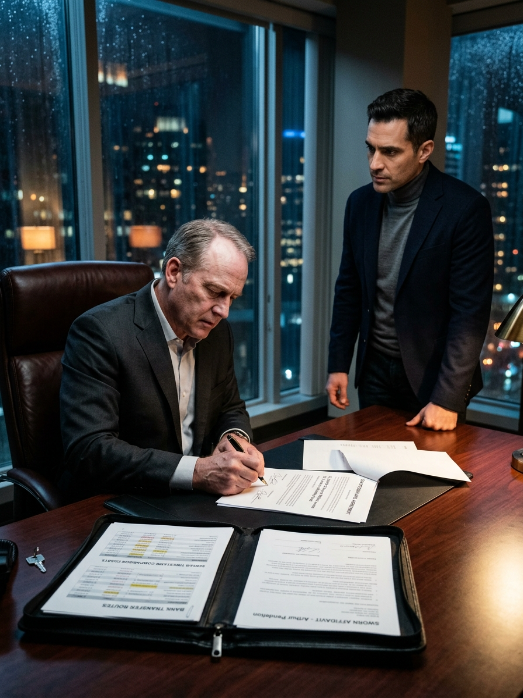
When the heavy brass elevator doors slid open with a soft chime, the entire floor was preternaturally silent, smelling faintly of expensive wool carpet and high-end floor wax, with floor-to-ceiling glass walls overlooking the grey, rain-streaked city skyline and modern bronze sculptures standing sentry along the hallway. Julian was sitting behind a massive dark walnut desk in his corner office, looking a bit older with silver wings at his temples, dressed in a custom charcoal suit that probably cost more than my first car, and he did not bother to stand up as I walked across the threshold, leaning back in his leather chair to project total corporate authority, though I caught the sharp, involuntary twitch in his jaw.
Marcus, Julian said, his voice measured, smooth, and laced with calculated condescension. It has been a long time since we crossed paths. I heard you were doing small-town bookkeeping out in the sticks, pushing papers for farmers and gas stations. What on earth could you possibly want in my office after all these years? I came to return something you dropped ten years ago, I said softly, my voice barely carrying across the empty room. I reached slowly into the deep pocket of my coat, pulled out a small, tarnished silver key on a rusted ring, the original key to our very first two-desk rental office from when we started the company, and placed it quietly in the dead center of his polished walnut desk. Julian glanced down at the key, let out a short, dry, artificial laugh that sounded like dry leaves scraping across concrete, and shook his head.
If this is some pathetic attempt at closure, Marcus, you are ten years too late, because we settled all of this in a court of law, you signed the settlement papers, you took the plea deal, and the firm moved on to bigger and better things. The firm moved on, but the money certainly did not, I said, unzipping my leather briefcase and slamming the thick black dossier down right next to the key with a dull, heavy thud. You routed every single cent through Apex Tech Consultants.
The color drained from Julian’s face so fast and completely that it looked as if someone had pulled a plug in the wall and turned off the lights in the room, his cheeks turning a sickly, chalky grey as his fingers clenched tightly against the armrests of his chair. I have no earthly idea what ridiculous nonsense you are talking about, he stammered, though his voice lacked any real conviction, sounding like a man reading lines from a play he had rehearsed in his nightmares. Apex Tech Consultants, registered quietly in Delaware, I continued, stepping closer to his desk and laying my palms flat against the wood. Legal signatory Bradley Vance, your very own brother-in-law. Between August and October of 2015, four hundred and fifty thousand dollars left our corporate reserve account and went straight to a Cayman shell called Blue Horizon, and three weeks later that exact sum returned as fake software licensing fees to Apex Tech.
You altered the server timestamp logs on our internal database to make it look like I was sitting at my terminal at midnight, but you used our own stolen money to frame me, force my bankruptcy, and steal my half of a 2.8 million dollar business. I flipped open the dossier to the second section, laying out the verified bank transfer routes side-by-side with the server timestamp comparison charts that my forensic accountant had mapped out in brilliant, undeniable detail. Arthur Pendelton signed a sworn affidavit yesterday morning, I added, watching his eyes dart across the pages like a trapped animal. He handed me the duplicate offline database files from the exact week before you wiped the main server clean, and my forensic accountant verified every single penny down to the last fraction of a cent.
Julian stared down at the documents spread across his desk as if they were venomous snakes, refusing to touch them, his rigid corporate posture entirely collapsing as his broad shoulders caved inward and his chin dropped toward his chest. There was no clever argument left to make, no legal loophole to crawl through, and no public relations spin that could erase the brutal, mathematical reality of the numbers staring him in the face. What do you want? Julian asked, his voice dropping to a low, raspy, defeated whisper that barely reached across the room. If you hand this over to the federal prosecutors, it will utterly destroy the firm, the board will strip my title before the end of the week, and I will be sitting in a holding cell by Monday morning. Is that what you came all this way for? Vengeance? Vengeance is messy, Julian, I said, holding his terrified gaze without a shred of triumph or satisfaction in my chest. I am not here to burn the company down or drag you through a humiliating public circus. I am here to correct the record and take care of the people you stepped on to build your little empire.
I pulled a crisp legal document drafted by my attorney out of the front sleeve of the briefcase and slid it across the desk toward his trembling fingers. Here are my terms, I said plainly. First, you will sign a joint legal confession clearing my name completely, vacating the fraudulent liability record, and restoring my standing with the state accounting board. Second, you will step down as Chief Executive Officer within thirty days, citing personal family reasons so the board doesn’t tear itself apart. Third, you will wire two million eight hundred thousand dollars, the full current valuation of the equity you stole from me, into an independent hardship fund managed by a neutral trustee to be distributed among the low-level administrative employees you fired without severance during your 2016 restructuring. Julian stared up at me in absolute, horrified disbelief, his mouth hanging open slightly as his brain tried to process the absurdity of my demand.
You are not keeping a single cent of the money for yourself? he asked, his voice shaking. I built a clean, honest life away from your toxic world, I replied, my voice steady and cold. I do not want your corner office, your fancy title, or your custom-tailored suit. I want my reputation back, and I want the staff members you discarded like trash to finally get what they deserve.
Julian sat in total, suffocating silence for three long, agonizing minutes while the rain drummed a steady, frantic beat against the massive glass windows behind him. He looked out at the sprawling city skyline where he had reigned as a king for a decade, then down at Arthur’s signed affidavit, and finally at the legal agreement waiting for his signature on the desk. He knew with absolute certainty that if I walked out that door and handed the dossier to the federal prosecutor downtown, he was facing multiple felony counts of wire fraud, grand larceny, and perjury that would put him behind bars until he was an old man. With a hand that shook so violently he could barely hold the barrel, Julian pulled an expensive gold fountain pen from his breast pocket and rapidly signed his name on every required line, his signature scratching across the paper like a dying insect.
Two weeks later, a federal judge signed the official court order formally vacating my old judgment, and Mercer Global issued a cold, formal public statement retracting all historical claims against me, clearing my name in full, and restoring my CPA credentials in good standing with the state board. Julian Mercer announced his immediate resignation the following morning, citing personal health reasons, and walked out of the building he had stolen for the very last time. My attorney handed me the certified copy of the court discharge in his quiet office downtown, and when I looked down at the official seal, holding that piece of paper did not trigger a sudden, cinematic burst of joy or a triumphant cheer. Instead, a heavy, freezing weight that I had carried around inside my chest for ten very long years simply melted away into nothingness, leaving an empty, quiet space behind. I did not stay in the city to celebrate at a fancy restaurant or answer phone calls from old acquaintances who suddenly remembered my name and wanted to buy me a drink.
I drove straight back to my small town that afternoon, watching the spring sunlight break through the parting clouds over the open farm fields along the highway. When I unlocked the wooden door to my modest bookkeeping office above the auto repair shop, the familiar, comforting smell of stale paper, fresh coffee, and quiet, honest work welcomed me back home. I sat down at my worn wooden desk, opened the ledger for the local hardware store, and picked up my pen. My name was finally clear, my dignity belonged to me again, and I didn’t need a corporate empire on the forty-second floor to know who I was, because I had my peace, built on a foundation of plain truth that no one could ever take from me again.