How Finding a Photo of My Dead Twin Sister Exposed My Husband’s Six Hundred and Eighty Thousand Dollar Forgery

The notification popped up on my phone screen at 3:15 PM, a harsh blue glare cutting across the stack of archival folders on my wooden desk, and honestly, that was the exact second my entire life split down the middle. It wasn’t a text message from a friend or an update from the county deeds office where I spent my days cataloging centuries of municipal paper trails. It was a physical piece of mail that had somehow slipped through the routine sorting of the local post office and landed right between an electric bill and a glossy trade catalog for acid-free storage boxes.
The envelope was plain manila with no return address, bearing a smudge-inked postmark from Santa Fe dated three days prior. Inside sat a single four-by-six glossy print and a half-sheet of yellowed legal pad paper with eleven words scrawled in cheap blue ballpoint ink: You have twenty-four hours to check the land trust files. I remember turning the photograph over in my hands three separate times, staring at the glossy emulsion as if waiting for the ink to shift or the image to dissolve into something else, something that made sense in the quiet routine of my life in Columbus.
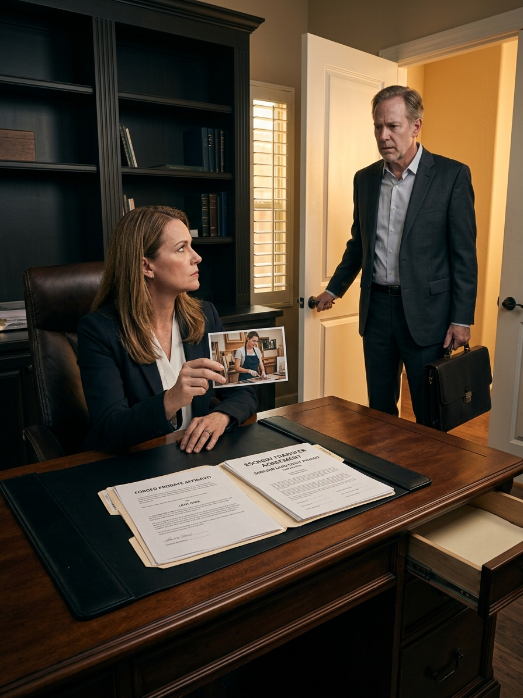
The image showed the interior of an art restoration shop taken from the sidewalk through a large, angled plate-glass window. A woman in a dark charcoal apron stood beside a heavy wooden work table, her head bent down as she worked the tip of a fine-haired brush into the corner of an oil painting propped on an easel.
The overhead fluorescent tubes cast a sharp, cold light across her profile, highlighting the high cheekbones, the straight dark hair caught back in a careless tortoiseshell clip, and the small, slightly curved scar just above her left eyebrow that I had lived with since the summer we turned six and tumbled off the low stone wall behind our elementary school. My breath hitched in my throat, catching somewhere behind my ribs in a hard, dry knot. I sat down heavily on the oak bench in our entryway, the raw pine beneath me feeling suddenly cold through my trousers as I lifted the paper closer to the late afternoon sun cutting through the sidelights. The woman in that frame was me. Yet I had never set foot in New Mexico, let alone walked down a street lined with adobe galleries in Santa Fe. I was thirty-eight years old, an assistant chief archivist who spent her days wearing cotton gloves and inhaling the dry, sweet dust of nineteenth-century probate records, not an artist repairing canvases two thousand miles away.
My identical twin sister, Sarah, was supposed to have been buried in a shallow grave in the high desert outside Taos twenty years ago. When we were eighteen, fresh out of graduation ceremonies and dizzy with the clumsy independence of youth, Sarah packed her gray station wagon and drove west without telling our parents, chasing some vague notion of a bohemian life among the desert galleries. Her car was found abandoned near a dry riverbed three weeks later, doors unlocked, keys dangling from the ignition, and a half-empty travel mug sitting in the console. Six months after that, county searchers pulled a bundle of sun-bleached human remains from the base of a jagged limestone canyon, along with a heavy silver signet ring our grandmother had given Sarah on our sixteenth birthday. The coroner issued a death certificate based on dental charts that matched our childhood orthodontist records, and my parents lowered a heavy bronze casket into our family plot in a cemetery that smelled permanently of mowed clover and damp clay.
My mother never wore color again after that morning, fading out of existence like an old photograph left in a sunny window, and I spent the next two decades carrying the heavy, silent guilt of the twin who stayed behind, studying history and old deeds because I was terrified of losing anything else that had ever belonged to the past.
I brought the photograph millimeters from my eyes, my vision blurring slightly as I focused on the woman’s left hand resting against the edge of the restoration frame. There it was, catching the studio light: the silver signet ring with its worn, shallow-cut family crest, the exact piece of jewelry we were told had been recovered from the canyon rocks beside my sister’s remains. My hands began to shake with a sharp, involuntary tremor that made the paper rattle against my thumb. I reached for my phone on the entryway table and checked the home screen. It was 3:18 PM. My husband, Julian, was downtown at his civil engineering consulting office, buried in blueprints and structural load calculations for the new municipal bridge project. We had been married for eight years, a quiet, orderly match built on shared quiet dinners, predictable Sunday routines, and a shared understanding of what it meant to build a life out of careful planning and mutual respect.
Julian was forty-one, a man who measured his life in load-bearing capacities and contingency funds, someone who never left a drawer unlatched or a debt unpaid. Yet over the past eighteen months, Julian had grown distant in that particular, professional way men do when they are hiding a structural failure in their own lives, working late nights at the firm and taking sudden, unexplained weekend trips out west to inspect remote municipal infrastructure projects in Arizona and New Mexico.
I remembered him standing by our kitchen island six months ago, pouring a cup of black coffee while he told me about his firm’s new expansion into the Southwest market, his voice smooth and entirely devoid of hesitation as he mentioned meetings in Santa Fe and Albuquerque. I got up from the wooden bench, my legs feeling strangely hollow, and walked down the short, carpeted hallway toward Julian’s home office at the back of the house. The room always smelled faintly of dry paper and printer toner, kept meticulously neat with metal racks of rolled blueprints lining one wall and heavy oak filing cabinets standing guard against the far corner. Julian kept his bottom desk drawer locked with a small brass cylinder, explaining years ago that it held sensitive corporate liability documents and private client billing files that required strict confidentiality under his firm’s insurance policies. As an archivist, I knew better than most people that locks are rarely barriers against time or persistence; they are merely temporary pauses designed to keep honest people honest.
I walked into the kitchen, slid open the narrow utensil drawer beside the stove, and pulled out a long, narrow steel spatula with a flexible blade and a heavy-handled flathead screwdriver from the junk drawer under the microwave. My heart was thumping against my ribs like a trapped bird, but my hands remained steady, governed by that cold, flat detachment that comes when you realize the foundation you have been standing on for a decade is nothing more than painted plaster over empty air.
I knelt on the low-pile carpet of Julian’s office, wedging the thin steel blade of the spatula into the hairline gap right above the brass lock cylinder of the bottom drawer. The wood groaned softly under the pressure, a dry, protesting sound that seemed uncomfortably loud in the quiet house, before the internal latch gave way with a sharp, splintering pop. I pulled the heavy drawer outward, sliding it past the metal stops until the interior contents were fully exposed to the gray afternoon light coming through the window. Inside sat neat stacks of quarterly tax filings for Julian’s firm, a thick blue folder labeled Corporate Liabilities, and a heavy accordion file bound tightly with a frayed black elastic band. I lifted the accordion file onto the polished surface of the desk, noticing the small smudge of blue ink on the fabric tab where Julian had written out the address of the property that had belonged to our maternal grandparents: Bear Creek Land Trust, Iron County, Michigan.
My grandparents had established the trust forty years before, setting aside two hundred acres of prime northern timberland and riparian rights to ensure that their descendants would always have a buffer against the world. After my mother passed away three years ago, the trust terms dictated that the property remain dormant until the final dissolution date in 2027 or until all surviving heirs executed a unanimous joint petition for liquidation. The total equity in the land trust sat at six hundred and eighty thousand dollars, an asset I had always imagined as a distant, untouchable mountain cabin surrounded by ancient pines, something sacred we never touched because it belonged to the memory of our family. I untied the black elastic band, letting it snap back against the cardboard tab, and pulled out the top sheaf of papers. The first document was a certified copy of a land trust sale agreement dated two months ago, authorizing the complete liquidation of the acreage and the disbursement of the entire six hundred and eighty thousand dollars in equity. But beneath that paper lay a single sheet of heavy bond paper that made my stomach heave, a sudden, violent wave of nausea rising in my throat that forced me to grip the edge of the desk until my knuckles turned yellow-white.
It was a legal affidavit filed with the Iron County probate court eight months prior, declaring under penalty of perjury that Sarah Vance had been legally dead since the summer of 2006, and that I, Laura Vance, was the sole surviving heir to the entirety of the Bear Creek Land Trust. Stapled to the back of the affidavit was a notarized signature page bearing my full name, authorizing the immediate transfer of the trust proceeds into an escrow account held under the corporate routing number of Vance Engineering Services. I stared at the dark blue ink of my supposed signature, tracing the familiar swoop of the capital ‘L’ and the sharp downward stroke of the ‘V’. It looked nearly identical to my handwriting, the kind of forgery a man could easily produce after eight years of watching me sign birthday cards, grocery lists, and tax returns across the kitchen table. But the date listed beside the signature was November 14th of the previous year, a Tuesday. On November 14th of the previous year, I had been three hundred miles away in downtown Chicago, standing in a windowless hotel ballroom while delivering a three-hour keynote presentation on nineteenth-century municipal water rights at the annual regional archivists conference.
I had never signed that paper. Julian had forged my signature, walking it into a local notary’s office with a forged ID or a bribed accomplice, using my professional absence as an alibi to steal my family’s legacy. I dug deeper into the accordion file, my fingers moving frantically through the remaining documents until I hit a second folder marked Santa Fe Correspondence. Inside lay a thick stack of private investigator reports and billing receipts dating back nearly two full years, detailing surveillance operations conducted on a woman running an art restoration shop on Canyon Road in New Mexico. The investigator’s notes described Sarah’s daily routines, her morning walks, her customer base, and her quiet life under the name Sarah Miller, accompanied by dozens of grainy, telephoto photographs of my sister stepping out of her studio with paint-stained hands and a canvas tucked under her arm. Julian hadn’t stumbled upon Sarah by accident during a bridge inspection trip.
He had spent months hunting her down across state lines, verifying her identity, confirming that she was alive and breathing two thousand miles away, and then he had made a deliberate, calculated choice to keep her existence a secret from me. He knew that if Sarah were officially declared alive, the Bear Creek Land Trust could never be liquidated without her direct knowledge, her signature, and a long, complicated probate proceeding to overturn her twenty-year-old death certificate.
I pulled the blue folder labeled Corporate Liabilities toward me and flipped open the cover. Inside sat three consecutive demand letters from a commercial lender in downtown Columbus, warning that Julian’s engineering firm was facing two hundred and fifteen thousand dollars in immediate debt liability after a major municipal bridge inspection contract in southern Ohio had fallen through due to severe structural calculation errors made by his junior partners. The firm was on the verge of total insolvency, facing forced bankruptcy, the seizure of their commercial assets, and the public humiliation of professional disgrace. Julian hadn’t stolen my family’s land trust to buy a luxury car or fund some mid-life escape; he had looted six hundred and eighty thousand dollars of family timber equity to plug a hole in his failing business balance sheet, covering up his professional failures by effectively murdering my twin sister a second time on a piece of probate paper. He had decided that my sister’s life was worth less than his corporate credit rating, trading her existence for a clean ledger and an extra year of pretending he was a successful businessman.
I sat in Julian’s leather desk chair for ten unbroken minutes, the quiet of the house pressing against my eardrums like deep water while my eyes flicked back and forth between the photograph of Sarah holding her restoration brush and the forged probate affidavit lying beside it on the blotter. The anonymous note had given me twenty-four hours to check the files, which meant whoever sent that manila mailer from Santa Fe knew about the trust liquidation schedule, knew the closing date was set for the following morning, and knew that Julian was about to pull off the final wire transfer before I ever had a chance to look behind the locked door. I checked the escrow transfer schedule stapled to the back of the sales agreement; the final disbursement of the six hundred and eighty thousand dollars was scheduled to clear into Julian’s corporate account at exactly 9:00 AM the next day. I picked up my phone, my fingers cold against the glass, and dialed the public phone number listed on the letterhead of the Canyon Road Fine Art Restoration studio in New Mexico, my thumb hovering over the dial button as if I were about to detonate a charge under my own feet.
The phone rang three times before a woman’s voice answered on the other end, smooth and slightly breathless, carrying the distinct cadence I hadn’t heard across a kitchen table in twenty years. Canyon Road Fine Art Restoration, this is Sarah. The sound hit me like a physical blow to the chest, knocking the air straight out of my lungs and leaving me gasping silently in the quiet office. It was lower than I remembered, rasped slightly by years of turpentine fumes and desert air, but the rhythm of her speech was unmistakably the twin I had wept over in a drafty cemetery plot. Sarah, I managed to croak out, my throat tightening until the words barely made it past my teeth. There was a sharp, jagged silence on the other end of the line, broken only by the faint, hollow clatter of a wooden brush being dropped onto a table. Laura? she whispered, the name stretching out across two decades of grief like a bridge built of old wire. I got the photograph in the mail today, I said, my voice cracking hard on the vowels as tears finally spilled over my lower eyelids and tracked down my cheeks. I’m sitting in Julian’s office right now. I found the land trust files.
Sarah let out a long, ragged exhalation that sounded like someone letting go of a heavy weight after a very long climb. I didn’t know how else to reach you without him stopping it, she said, her voice trembling slightly. Two years ago, your husband walked into my studio out of nowhere. He told me our parents had disowned me completely after I ran away, that you hated my guts for leaving you behind with them, and that the family land trust had been dissolved to pay off our mother’s medical debts years before. He handed me a cashier’s check for five thousand dollars from what he called a hardship fund and told me that if I ever tried to contact you, he would make sure I was prosecuted for insurance fraud related to my old disappearance. But three weeks ago, a probate lawyer from Grand Rapids called my shop trying to verify my old social security number for an estate audit, and I started digging around until I realized Julian had lied to me about every single word. He forged my name, Sarah, I whispered, staring down at the papers spread across the polished oak. He forged an affidavit saying I was the sole heir so he could steal six hundred and eighty thousand dollars to save his engineering firm from bankruptcy.
Stop the transfer, Laura, Sarah said gently, her tone steady and clear across the three thousand miles of copper wire. Please. Just stop him before he cleans out our grandfather’s land. I will, I said, wiping my face with the sleeve of my cardigan. I’m stopping it right now. I hung up the phone without waiting for another word, pulled up the direct contact directory for the chief trust officer at the Grand Rapids bank holding the escrow account, and dialed with a cold, absolute certainty that felt entirely foreign to my usual cautious nature. I identified myself using my full legal name, my mother’s maiden name, my social security number, and my archivist employee ID number, telling the duty officer that the sole-heir affidavit filed under my signature was a complete forgery executed without my knowledge or consent. I instructed them to freeze the Bear Creek Land Trust escrow account immediately, revoke all corporate signing authority previously granted to Vance Engineering Services, and place an administrative hold on any outgoing wire transfers pending a criminal fraud investigation by the state attorney general.
The trust officer listened to the clipped, professional flatness in my voice, asked for my direct callback number, and confirmed within sixty seconds that the six hundred and eighty thousand dollar disbursement had been halted dead in its tracks just sixteen hours before the scheduled morning clearing.
At 5:32 PM, the front door clicked open with the familiar double-click of Julian’s heavy brass-shod heels on the tile entry. He walked down the hallway carrying his leather briefcase in his right hand, humming a cheerful, tuneless melody under his breath as he tossed his car keys into the pottery bowl on the hall console. He stopped dead in the doorway of his office when he saw me sitting behind his desk, the bottom drawer pulled completely out of its runners, and the confidential contents of the land trust file spread out in neat, damning rows across his leather blotter. The relaxed, professional smile vanished from his face in an instant, replaced by a tight, gray look around his mouth that made him look ten years older than his forty-one years. Laura, he said, stepping across the threshold and reaching behind him to click the office door shut with a soft latch. What on earth are you doing in my private files? The six hundred and eighty thousand dollar wire transfer isn’t going through tomorrow morning, Julian, I said, my voice dropping into that cold, level register I usually reserved for damaged manuscript pages. I spoke with the chief trust officer at the bank twenty minutes ago. The account is frozen tight, and your corporate signing authority has been revoked.
Julian took a slow, involuntary step backward, his face draining of color until his skin matched the gray wallpaper behind his left shoulder. Laura, you need to listen to me, he said, his hands coming up in a placating gesture as he took another step toward the desk. My firm was facing total liquidation. We had two hundred and fifteen thousand dollars in emergency debt coming due on the bridge inspection liability, and I was just trying to protect our home, protect our future. I was going to replace the funds in the land trust once the new municipal contracts cleared the winter budget cycle. You found my sister two years ago, I said, standing up slowly from the desk chair and holding up the telephoto surveillance photograph of Sarah standing outside her Santa Fe studio. You let me believe Sarah was dead for twenty years. You let her live three states away thinking her family hated her, all so you could steal her share of six hundred and eighty thousand dollars to cover your own corporate incompetence.
I did it for us, Julian shouted, his voice cracking with sudden, desperate fury as he lunged forward and slammed his palms onto the edge of the mahogany desk. Sarah walked away from this family voluntarily twenty years ago! She didn’t deserve a dime of that land equity! We built our life here, in this house, while she was painting pictures in the desert!
Don’t you dare touch those papers, I said, my voice cutting through his outburst with a sharp, metallic edge that stopped him mid-sentence. My attorney received digital copies of every single document in this file at 4:15 this afternoon, including the forged probate affidavit, the private investigator receipts, and your firm’s bank liability demand letters. If you take one more step toward this desk, I am picking up this phone and calling the county prosecutor directly from speaker mode. Julian froze with his hands hovering over the edge of the blotter, the artificial confidence draining out of his posture until he looked like a man who had finally realized the bridge he was standing on had no pilings beneath it. He knew he was trapped by the very paper trail he had spent two years constructing, caught in a web of his own meticulous record-keeping. I packed two suitcases that evening while Julian sat in total silence in the dark guest room downstairs, staring blankly at the floorboards between his feet.
By 8:00 AM the following morning, my lawyer had filed a formal petition for legal separation and served Julian with an emergency asset-freeze order covering every joint bank account, credit line, and investment portfolio we shared. The bank trustee officially locked Julian out of the Bear Creek Land Trust account forever, ensuring that the timber equity remained safely untouched until Sarah and I could execute a proper, lawful division of our family inheritance.
Julian’s engineering firm entered involuntary receivership three weeks later under the weight of its unpaid debts, and he now faces a criminal inquiry by the state licensing board for corporate fraud, identity theft, and document forgery. I left our suburban home on a crisp Saturday morning, loading my suitcases into the trunk of my sedan without looking back once at the manicured lawn or the front porch where we had spent eight years pretending to have a future. I drove west across the flat, gray highways of Indiana and Illinois, pushing through the long, lonely stretches of the Great Plains and up into the high desert of New Mexico as the autumn air grew sharper and clearer with every hundred miles. When I finally pulled my car up to the small adobe building on Canyon Road in Santa Fe, the late afternoon sun was turning the wooden window frames into ribbons of molten gold. I pushed open the heavy wooden door of the art restoration shop, the brass bell overhead chiming with a light, familiar ring that seemed to echo across twenty years of empty space. The air inside smelled thick and rich with the unmistakable scents of linseed oil, turpentine, and aged pine wood, smelling exactly like the old workshop our grandfather used to keep behind the barn in Michigan.
Sarah was standing near the back work table, holding a small badger-hair varnish brush in her right hand as she looked up from an ornate gilt frame resting on her workbench. She froze when the bell chimed, her eyes locking onto mine across the sunlit floorboards of the studio. We stood three feet apart for a long, unbroken moment, neither of us moving, simply looking into each other’s faces and tracing the identical, curved scar right above our left eyebrows, watching twenty years of silence and artificial grief slowly dissolve into the dust of the desert afternoon. Sarah set her brush down on the wooden table with a soft clatter, took two quick steps forward, and opened her arms wide without a single word. I stepped straight into her embrace, burying my face against her shoulder and holding my twin sister as tightly as I could, finally stepping out of the past and into a life built on absolute, unyielding truth.