How My Mother and I Waited Five Months Past Sixty to Let Arthur’s Forty-Two Million Dollar Biotech Empire Rot From Within

Sixty months. That was the exact countdown running in my head when the first batch of client error logs started pinging our private monitors at 8:52 in the morning on a Tuesday in early 2026. Five years earlier, on a cold Tuesday in November 2021, I had stood right beside my mother, Eleanor Vance, in the glass-and-steel lobby of Vance and Pendelton BioTech, watching four burly security guards in heavy black blazers escort her out of the building she had literally founded and built from scratch with her own sweat and grant money.
She was fifty-eight years old then, holding a single cardboard box containing a heavy glass desk clock that stopped working during the move, a framed photograph of the two of us at the state park when I graduated college, and three empty blue notebook binders with the spines peeling.
Arthur Pendelton stood up on the second-floor glass mezzanine, looking down at us like we were stray dogs he wanted animal control to collect. He was wearing a custom charcoal suit that probably cost more than my first used sedan, holding a small porcelain cup of espresso, and sipping it slow while security hustled my mother toward the revolving glass doors. That morning, Arthur had executed a ruthless, hostile board buyout behind our backs, leveraging a series of altered corporate proxy votes to strip my mother of her executive title, her office, and her life’s work. Within forty-eight hours, he had maintenance workers scrub her name right off the main lobby wall with chemical solvent and refiled our core agricultural filtration patents under his own name as sole inventor.
I was twenty-nine back then, working as her administrative manager and general dogsbody, and my hands were shaking so hard I dropped my car keys right onto the polished terrazzo floor when we got to the parking lot. I wanted to march right back inside and throw a chair through his office window. I wanted to hire a high-priced litigation team that afternoon, burn through our remaining savings, and drag him into open court over the twelve million dollar proprietary patch license that formed the financial backbone of the entire corporate valuation. I was hot-headed and desperate, and every time I thought about the twelve million dollars, my chest felt tight like someone was wrapping piano wire around my ribs.
My mother just sat in the passenger seat of my old Honda Civic, staring quietly out the side window as we drove away from the industrial park and headed out toward the county highway.
She did not cry, and she did not raise her voice once, which honestly unnerved me more than if she had screamed until her throat was raw. When I started ranting about filing an emergency injunction and calling every reporter I knew at the regional business journal, she reached across the center console and set her hand flat and heavy on my forearm. Her palm was warm, and her skin felt dry and steady, completely untouched by the panic that was making my own heart hammer against my ribs.
“Maya, listen to me,” she said, her voice completely even, like she was talking about grocery lists instead of losing a forty-two million dollar company. “Arthur took the corporate name, he took the seats on the board, and he took the patent filings from the filing cabinet. But Arthur is an executive, not a biochemist. He hired corporate lawyers to read my documentation, but he never actually understood the science behind the catalyst.”
“He took your life’s work, Mom,” I said, my voice cracking as I slammed my foot down on the gas when the light turned green. “The company is evaluated at forty-two million dollars right now, and he just walked off with every single dime of it while we are driving away in a car with a rusted muffler.”
“He walked off with a ticking clock,” she replied softly, turning her head to look at me with those sharp blue eyes that missed nothing. “When I designed the core bio-catalyst for the agricultural filtration line six years ago, I knew Arthur was quietly changing the share structures and moving capital behind my back. So I built the compound with a strict, unalterable five-year lifespan. The bio-filter’s catalytic efficiency naturally degrades to zero at exactly sixty months. To keep it functioning past that date, the system requires a proprietary stabilizer update. I kept the secondary stabilizer compound entirely out of the original filing, and I patented it independently under my own private research trust.”
I stared at her in the quiet car, my foot easing off the gas until the car sputtered a little. “Five years?”
“Sixty months,” she confirmed, looking out at the flat cornfields passing us by. “In five years, every single bio-filter unit Arthur has sold across three continents will start failing all at once. He will not be able to fix it, because he does not know how the breakdown works or how to synthesize the replacement chain. We wait, Maya. We build our own small lab, we keep our heads down, and we let his own greed set the trap.”
For the next sixty months, I struggled every single day with her strategic patience, because my biggest flaw has always been my constant, burning impatience. I hated seeing my brilliant mother working out of a damp, rented biochemical research lab in a converted auto body shop on the edge of town, wearing a stained lab coat and washing her own glassware in a plastic basin, while Arthur gave keynote speeches at international agricultural trade shows and took full credit for the bio-filter. I wanted immediate legal combat, but my mother forced me to stay focused on the work, treating the calendar like a slow-acting medicine. We spent those five years quietly running tests, securing our independent patent documentation for the mandatory update compound in a bank safe deposit box, and watching the months tick off the calendar one by one.
By early 2026, the sixty-month mark finally arrived, and the silence in our rented lab felt thick with anticipation. I sat at my metal desk staring at public agricultural tech forums, commercial supply chain error logs, and shipping manifests from around the globe. Right on schedule, the first reports began trickling in from mega-farm conglomerates out in Iowa and the Central Valley of California. Their high-capacity water filtration units were experiencing a sudden, unexplained fifty percent efficiency drop that was turning their irrigation lines into sluggish brown trickles. Within three weeks, the trickling reports turned into a roaring flood that no corporate PR team could plug with press releases. Client error logs from agricultural operations in South America, Eastern Europe, and the American Midwest showed a synchronized drop in catalytic performance across every single system installed back in 2021.
Arthur’s technical teams were in absolute panic mode, working twenty-hour shifts in their gleaming headquarters trying to reverse-engineer a molecule they had never truly understood. They issued public statements claiming it was just a routine maintenance issue caused by local water anomalies, but internal leaks whispered to us by sympathetic former colleagues revealed that their chief engineers had no idea why the core compound was breaking down into a useless sludge. The stock price started sliding downward by two points every day, then four, then ten, as institutional investors realized the company had no technical answer for the global rot.
On the third Thursday of February, Vance and Pendelton BioTech held its annual general shareholder meeting at the grand corporate headquarters auditorium downtown. The company’s market cap was teetering on the edge of a cliff, and major institutional investors were furious, demanding immediate answers for the global system failures that were costing agricultural clients millions in lost crop yields and dead harvests.
My mother stood in our rented lab that morning, wearing a sharp navy suit she had bought four years ago at a department store clearance sale and kept hanging safely in plastic. She picked up a thin leather folder containing the original chemical breakdown logs she had signed prior to her termination, alongside our new, independent laboratory patent documentation for the stabilizer patch that every farmer on earth was suddenly desperate to buy.
“Is everything ready, Maya?” she asked, looking at her reflection in the glass door of our chemical cabinet.
“The board packet is printed and collated,” I said, holding my leather briefcase tight against my chest like a shield. “And I confirmed with the registration desk twenty minutes ago. As minority equity holders under your original founding severance package, we have full legal right of entry to the floor.”
We drove to the corporate headquarters together in my old Honda, parking in the visitor lot right under a massive billboard featuring Arthur’s face advertising the failing filtration units. Walking into that glass building after five years of exile sent a cold pulse right through my chest, but my mother walked with absolute, unbreakable grace. Her chin was up, her steps were measured and calm, and her presence had that quiet, heavy weight of someone who knew she held all the cards.
We walked straight past the security checkpoint, presenting our equity credentials to the desk clerk before anyone could figure out how to stop us or call upstairs. The double doors to the main auditorium were propped wide open, and the room was packed to the gills with over two hundred furious board members, high-priced corporate lawyers, and major shareholders sweating through their collars.
Up at the polished mahogany podium on the stage, Arthur Pendelton was sweating through his tailored shirt, his face flushed a dark, mottled red under the theatrical stage lights. He had a slide deck projected behind him showing vague, meaningless mechanical diagrams, stammering through a rambling explanation about regional water pH levels and unexpected soil contamination in the Mississippi basin.
“We are addressing these minor operational fluctuations with our senior engineering team right now,” Arthur was saying, his voice tight and unnaturally loud over the auditorium microphone. “We expect full system recovery within thirty days, and I assure you our R&D department is, “
“You will not have recovery in thirty days, Arthur,” my mother’s voice rang out clear and firm from the central aisle, cutting right through his excuses like a butcher’s knife. “You will not have it in thirty months. Because you do not understand the molecule.”
The auditorium went instantly dead quiet, the kind of heavy, suffocating silence where you could hear the air conditioning vents humming near the ceiling. Heads turned across every single row of velvet-backed seats as my mother walked down the center aisle, with me right beside her carrying the heavy leather dossier.
Arthur froze completely at the podium, his jaw dropping open before his face twisted into an ugly, dark scowl. “Eleanor? What is the meaning of this interruption? This is a private shareholder meeting for stakeholders only. Security, please escort these people out of the building immediately.”
“I hold four percent of the voting shares, Arthur,” Eleanor said, stopping at the microphone stand right in the middle of the room with her hands resting lightly on the metal stem. “I have every legal right to stand on this floor. And as the sole creator of the agricultural bio-filter, I suggest the board listen very carefully to what I have to say before your forty-two million dollar enterprise loses its entire market valuation by Friday afternoon.”
A senior board member seated right in the front row stood up, knocking his leather portfolio against his chair. “Let her speak, Arthur. We need real answers, and your technical team hasn’t given us a single useful thing in three weeks.”
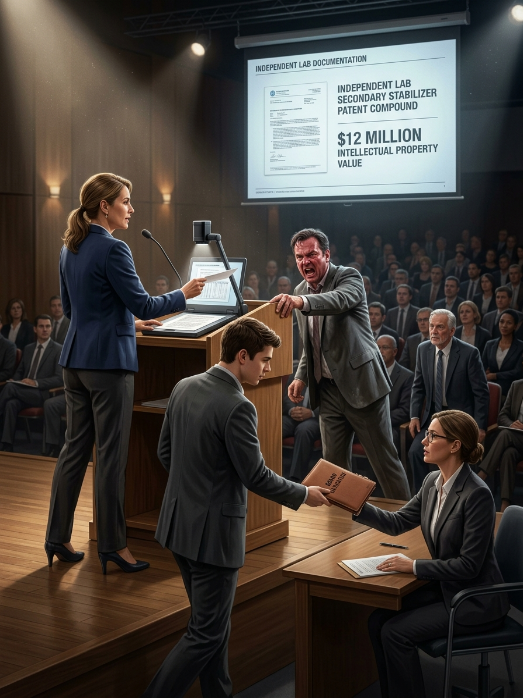
My mother walked up the side steps onto the stage, entirely unbothered by Arthur’s glaring eyes and trembling hands. She placed her original chemical breakdown logs onto the podium screen projector, letting the handwritten notes illuminate the giant screen behind them for everyone to read.
“Five years ago, Arthur scrubbed my name from the patents and claimed sole authorship of the bio-catalyst,” my mother announced to the room, her voice steady, measured, and carrying to every corner of the hall. “What he failed to read in my original laboratory notebooks was the sixty-month catalyst decay rate. The compound was intentionally built to undergo a complete structural degradation after five years of continuous operation. It was designed this way by me to prevent environmental contamination and force a necessary chemical update before the bonds fractured.”
She clicked the remote to the next slide, displaying the verified independent laboratory patent documentation for the mandatory update compound we had registered under our trust.
“This is the secondary stabilizer,” she continued, looking directly at the pale faces of the board members in the front rows. “Without this exact compound, every single filter unit your company has sold across three continents will permanently stall and turn to sludge within the next fourteen days. Arthur cannot replicate it, because I patented the stabilizer compound independently under my own private research trust two years ago. The intellectual property belongs entirely to me, and it is valued at twelve million dollars on the open market.”
Arthur slammed his hand down hard against the wooden lectern, the microphone feedback emitting a sharp, painful squeal that made people wince. “This is extortion! She deliberately sabotaged the corporate technology before she was terminated!”
“I did not sabotage anything, Arthur,” my mother replied calmly, looking him dead in the eye without a trace of anger. “I designed a complete, safe system. You were so blinded by vanity and greed when you stole my patent filings that you published an incomplete formula just to get my name off the lobby wall. You caused this global failure through your own gross negligence and corporate incompetence.”
A low, angry murmur swept through the auditorium like wind through dry grass. The lead board member looked down at the projected documents, then up at Arthur’s sweating face, and finally back at my mother with a look of dawning horror.
“Eleanor,” the board member said, his voice grave and shaking slightly. “What are your terms to deploy the patch?”
I stepped forward on the stage right beside her and handed the formal legal board ultimatum directly to the corporate secretary sitting at the side table.
“My mother will license the proprietary patch to the company immediately,” I stated clearly into the microphone, letting every word hang in the air. “In exchange, the board will execute an immediate vote to remove Arthur Pendelton as Chief Executive Officer for gross misrepresentation and breach of fiduciary duty. Furthermore, Eleanor Vance will be reinstated as Chief Technology Officer and Executive Chairman, with full voting control, and the corporate identity will be formally rebranded back to Vance BioTech Systems to reflect its true origin.”
Arthur looked around the stage, looking desperately for support from the legal team, the board members, or the executives he had spent five years courting with expensive dinners. Not a single person in that room met his eyes. They were all staring at the numbers projected on the screen, knowing their personal investments were about to vanish into thin air if my mother walked out those doors.
The board chairman raised his hand without hesitation. “I move to call an immediate vote on the floor.”
The vote took less than two minutes, and it was unanimous.
Arthur Pendelton was escorted out of the building by the exact same corporate security guards he had used on my mother five years earlier, his cardboard box replaced by a pair of heavy leather briefcases as he kept his head down. Facing massive civil liability for gross misrepresentation to shareholders and hiding critical technical specifications from the board, his career in the biotech industry was completely finished before the sun went down.
The following morning, our independent stabilizer patch was deployed to distribution centers worldwide through our own secure channels. Within forty-eight hours, the client error reports stopped rolling in, system efficiency was restored to one hundred percent across every continent, and the company’s valuation stabilized right back where it belonged.
Two months later, the corporate rebranding was fully finished from top to bottom.
I stood in the main lobby on a bright Tuesday morning holding a paper cup of coffee, watching two local stonemasons complete the final installation above the polished reception desk. They brushed away the last bits of white marble dust with soft horsehair brushes, revealing the deep, chiseled gold lettering mounted permanently into the dark stone wall: Vance BioTech Systems.
My mother walked out of the executive elevator wearing her familiar cotton lab coat over her clothes, carrying a blue notebook binder under her arm. She stopped right beside me, looking up at her name cut cleanly into the marble.
She didn’t boast, and she didn’t celebrate with theatrical speeches or champagne toasts. She simply reached out, patted my shoulder once with her warm hand, and gave me a quiet, knowing smile that made every single hard month worth it.
“Come on, Maya,” she said softly, turning toward the research wing doors. “We have work to do.”
I followed her down the sunlit hallway, stepping into a future built on truth, dignity, and a legacy that could never be erased again.