How My Business Partner Framed Me for $450,000 and How Ten Years of Ledger Work Brought Him Down

The smell of wet asphalt and hot gear oil always drifted up through the floorboards of my one-room apartment whenever Sam downstairs was rebuilding a transmission, a heavy, metallic scent that settled into my clothes and stayed there no matter how many times I washed them. For ten years, that oil smell was the background music to my exile, the steady, grounding backdrop of a life that had been shrunk down to a single hot plate, a narrow cot, and a secondhand oak desk where I spent my evenings checking grain tallies and balancing payroll ledgers for local feed stores.
I used to sit there with a green visor pulled low over my eyes, listening to the muffled clatter of wrenches from the bay beneath me, and wonder if my brain had permanently fused itself to the double-entry columns of numbers that kept my hands busy and my mind from wandering back to the forty-second floor I used to own. Numbers do not care about your reputation, your ruined credit score, or the fact that a jury of people who never met you would have looked at a prosecutor’s ledger and nodded along with the lie. Numbers just sit there on the page, waiting to be balanced, and if something does not add up, it means someone lied somewhere along the line. It took me four years of letting the bitterness curdle in my gut before I realized that bitterness is just a very heavy anchor you drag around behind you while the other guy is sailing the boat you built.
By year five, I stopped hating Julian Mercer and started looking for the math error. Because no matter how clever a crook thinks he is when he writes a script to alter server logs at midnight, he always leaves a trailing comma somewhere in the syntax.
Ten years ago, two city detectives sat across from me in a small interview room and slid a stack of printed audit logs across the scarred metal table, their faces blank and bored like men waiting for their lunch break to start. The digital signature on three wire transfers totaling $450,000 matched my administrative user code down to the last encrypted string, and Julian Mercer had called the police himself, standing in the glass lobby of our office tower with tears shining in his eyes for the local television cameras, telling reporters he was heartbroken by my betrayal. I was thirty-four years old back then, wearing an off-the-rack department store suit that suddenly felt two sizes too big for my shoulders, and I remember staring at the glowing monitor on the detective’s desk as if it were written in ancient Greek.
Julian and I had built Mercer & Vance Financial from a tiny two-desk rental over a dry cleaner’s into an enterprise evaluated at $2.8 million, working sixteen-hour days through the 2008 crash while eating cold pizza off cardboard boxes. I did the heavy operational work, pulling sixty-hour weeks auditing client books, building our compliance structure, and managing internal ledgers until my eyes burned, while Julian wore tailored suits, hosted client dinners at steak houses, and played the visionary public face who everyone wanted to invest with. When the $450,000 in diverted company reserves vanished into an offshore account in the Cayman Islands, I could not explain how my private access code had been used at midnight from inside our server room because I had been home asleep in my own bed three miles away, but I did not have an alibi that could stand up against an automated system log that said otherwise.
I did not have the money for a high-priced corporate defense team who could hire independent digital forensics experts to tear apart a server image, and when my court-appointed lawyer told me the district attorney was pushing for an aggravated larceny charge with a mandatory minimum sentence, my stomach dropped through the floorboards. To avoid a grand jury trial that carried a fifteen-year prison sentence, my public defender negotiated a plea agreement that stripped me of every share of company equity, forced me into personal bankruptcy, and left a fraudulent $450,000 liability record attached to my credit history like an unhealable brand. I remember signing the papers on a scratched formica table in the courthouse basement while fluorescent lights hummed an irritating high-pitched drone overhead, and my hand was shaking so badly I dropped the ballpoint pen twice. Julian took total ownership of the firm the very next morning, rebranded it Mercer Global with a sleek new bronze logo, and bought out my half for a single nominal dollar under the court-approved restructuring, treating me as disposable and wiping ten years of shared sweat away in less time than it takes to cash a paycheck.
Former clients stopped taking my calls before the ink on the court order was even dry, and people I had known for a decade suddenly found very interesting things to look at on the sidewalk when they passed me on the street, crossing over to the other side as if my disgrace were something contagious you could catch just by standing too close. I packed my clothes into trash bags, threw them into the back of my old sedan with a transmission that whined in third gear, and drove ninety miles west to a quiet provincial town where nobody knew my name and nobody cared who Julian Mercer was.
I took a modest job as a freelance bookkeeper for local hardware stores, grain suppliers, and family diners, keeping my head down and my mouth shut while I learned how to live on twelve dollars an hour and a room that smelled like old grease. I lived in that simple one-bedroom apartment above the auto repair shop, keeping my world tiny and silent, refusing to look at financial news sites or let myself wonder how many countries Julian was vacationing in with his new corporate board members. For the first four years, I let the bitter disgrace eat away at me like acid, convincing myself that surviving quietly in isolation was the only sensible path left for a ruined man who had already lost his profession, his savings, and his standing in the world. I would sit by the small window in the evenings watching the rain slick down the windshields of broken-down trucks in Sam’s yard, feeling like I was already half-ghost, a man erased by a stroke of a prosecutor’s pen and a partner’s smooth television smile.
But a bookkeeper’s mind does not stay quiet forever, no matter how much cheap whiskey or self-pity you try to feed it, because numbers always follow rigid physical rules, and digital footings always leave a scar if you know how to look at the original concrete underneath the patch jobs.
The turn came during my sixth year in exile, on a Tuesday morning in late October when the mail carrier dropped off a plain brown envelope at my town post office box with no return address and a crooked postage stamp. Inside was a single sheet of yellow legal pad paper covered in familiar, cramped handwriting, accompanied by a folded printout of an old internal server log from 2015 that had been salvaged from a scrap bin. The note said in block letters: Check the monthly software maintenance fees paid to the unlisted contractor in 2015, because the server timestamp was five hours off local standard time, and nobody checked the GMT conversion before they wrote the script. I recognized the neat, small handwriting instantly even though I had not seen it in years, because it belonged to Arthur Pendelton, our firm’s retired head accountant who had taught me how to reconcile a general ledger when I was twenty-two years old.
Arthur had handled our daily ledger entries until Julian forced him into early retirement right after my forced departure, handing him a modest severance package and a stern warning to keep his mouth shut if he wanted to keep collecting his monthly check. Arthur had stayed quiet for six long years to protect his wife’s medical pension, but something had finally tipped the scales, pushing him to take a risk and drop that envelope into a rural mailbox ninety miles away from the glass towers of Chicago.
I pulled out an offline hard drive I had kept tucked inside a locked metal firebox at the bottom of my closet since the day I was ousted, a dusty relic containing raw backups of our old database from the week before Julian changed the admin passwords. When I cross-referenced Arthur’s note with my personal server backups, the glitch became so obvious I felt sick to my stomach for being too blind to see it six years earlier. A five-hour timestamp offset meant the ledger entries framing me were not created in our Chicago office at 11:00 PM as the police reports claimed during the grand jury proceedings, but were actually routed through a remote server operating in Universal Coordinated Time, disguised as a routine monthly software maintenance fee paid to an unlisted third-party contractor called Apex Tech Consultants. I sat there in the dark apartment above the repair shop while the amber glow of my old ThinkPad screen illuminated the dust motes dancing in the air, realizing that Julian had not just hacked my account from inside the server room, but had used an external remote access protocol that only someone with master root privileges could have authorized during our weekend maintenance windows.
I spent the next four years quietly pulling every loose thread attached to Apex Tech Consultants, treating it like an audit from hell that I had to finish before the sun came up. I worked late into the night after finishing my routine bookkeeping clients for the local hardware stores and diners, tracing public business filings, state registries, and shell company documents across three states through public terminals at the county library and paid online database queries funded by skipping meals. Julian had been careful, but his arrogance was his fatal flaw, because men who steal half a million dollars always assume that once they break someone completely, that person will never have the financial bandwidth or the mental energy to look backward. He assumed I was broken, broke, and silenced forever, living out my days in some dreary little town checking invoices for bags of fertilizer. He never imagined I would spend four years reading double-entry ledgers line by line, comparing state incorporation filings in Delaware with wire routing numbers from international banks until the whole ugly architecture of his lie stood up naked in front of me.
By early 2026, my paper trail was complete down to the last transaction fee, tied together with enough certified documentation to satisfy a federal judge who had seen every trick in the book. Through a licensed forensic accounting investigator named Keller whom I hired using five years of my personal savings, eating canned soup and wearing the same winter coat for four winters, I uncovered the final connection that tied the knot around Julian’s neck. Apex Tech Consultants was nothing more than a shell holding company registered in Delaware with a post office box in Wilmington and zero employees, zero office space, and zero software products to its name. The sole legal signatory for that holding company was Bradley Vance, Julian’s own brother-in-law, a man who worked as a mid-level regional sales rep for an industrial supply company and didn’t know the difference between a balance sheet and a balance beam.
The money had never stayed offshore in the Cayman Islands as the police reports had made it sound during my trial to scare me into a plea. The $450,000 in diverted company reserves had been routed through the offshore account just long enough to wash the serial numbers off, brought back through Apex Tech Consultants under fake software licensing fees, and deposited directly into Julian’s personal wealth management account. He had used our own stolen company funds to pay his high-priced legal fees during the fallout and buy out my half of a $2.8 million firm for a single dollar during my bankruptcy proceeding, laughing all the way to the executive suite while I slept on a cot above Sam’s garage.
I drove back to the city on a rainy Tuesday morning in March, watching the gray skyline rise up through the wet windshield of my sedan like a row of jagged teeth waiting to bite down again. I met Arthur Pendelton at a quiet diner three blocks from the financial district, sitting in a cracked vinyl booth near the back where the smell of burnt coffee and frying bacon hung heavy in the air. At seventy-two, Arthur looked frail, his shoulders stooped inside a worn wool overcoat that looked too big for his frame, but his eyes behind his thick wire-rimmed glasses were as sharp as ever. He handed me a notarized, fourteen-page sworn affidavit describing how Julian had instructed him to bypass standard monthly ledger reconciliations in the autumn of 2015 under threat of immediate termination without benefits. Arthur had quietly saved duplicate, unaltered internal ledger files on a private offline flash drive before Julian wiped the firm’s central database clean during the weekend migration.
“I should have come forward back then, Marcus,” Arthur said, his hands trembling slightly around his heavy ceramic coffee mug as he watched the dark liquid ripple. “I was terrified of losing my pension, and Julian made it very clear what happens to people who ask questions in that office. But what he did to you was wrong, son. It sat on my conscience every single day like a stone in my shoe.”
“You came forward when it counted, Arthur,” I told him, keeping my voice level as I slid the papers into my leather portfolio. “That is what matters now, and nobody is taking your pension away.”
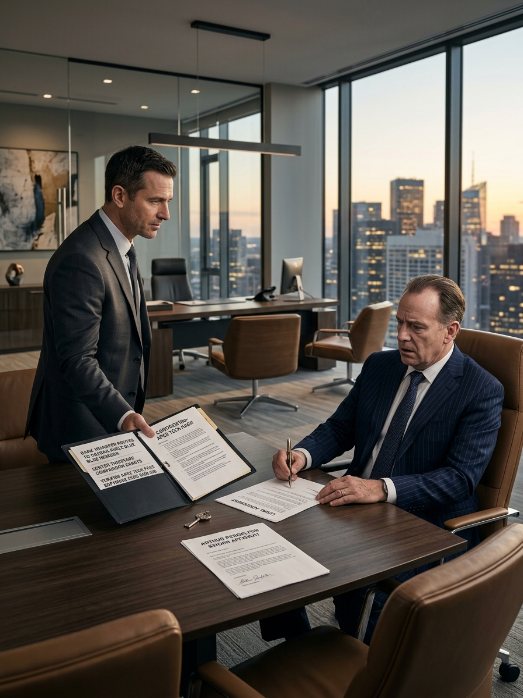
I assembled everything into a thick black leather dossier I had bought at an office supply store down the highway: the forensic accounting report from Keller, verified international bank transfer receipts connecting Apex Tech to Bradley Vance, Arthur’s signed affidavit with its raised notary seal, and the unaltered original ledger files burned onto a gold-backed disc. It was an ironclad, legal-grade paper trail with zero room for plausible deniability, the kind of file that makes corporate defense attorneys tell their high-paying clients to start packing a toothbrush because no amount of spin can talk away hard math. Instead of filing a public lawsuit or calling the district attorney’s office immediately to make a theatrical scene in front of the press, I walked directly into the marble lobby of Mercer Global at two o’clock that afternoon, shaking the rainwater off my umbrella as if I were just another client stopping by to discuss a quarterly return.
I did not ask for a security badge or try to sneak past the front desk like a trespasser running from ghosts. I walked right up to the polished white stone reception counter, looked the young woman behind the screen straight in the eye, and told her my name in a quiet, normal tone. “Tell Mr. Mercer that Marcus Vance is waiting in the lobby to see him.” Three minutes later, her desktop phone rang with a sharp electronic chirp, her posture went stiff as a ramrod as she listened to whoever was on the other end, and she directed me without a word to the private executive elevator leading straight up to the forty-second floor.
When the elevator doors opened with a soft, expensive chime, the floor was silent as a tomb, the kind of quiet that costs ten thousand dollars a month in acoustic ceiling tiles and heavy wool carpets. Glass walls overlooked the gray city skyline through sheets of wind-driven rain, and modern bronze sculptures stood along the hallway like silent sentinels guarding an emperor’s tomb. Julian was sitting behind a massive dark walnut desk in his corner office, looking older with silver threads at his temples, dressed in a custom charcoal suit that probably cost more than my entire first year’s rent above the auto repair shop. He did not get up when I walked through his open door, preferring to lean back in his ergonomic leather chair and try to project total authority, though I caught the slight, nervous twitch in his jaw the second he saw my face.
“Marcus,” Julian said, his voice measured and smooth like radio announcer glass. “It has been a long time since I heard that name around here. I heard you were doing small-town bookkeeping out in the country, helping farmers figure out their tractor payments. What could you possibly want in my office during business hours?”
“I came to return something you dropped ten years ago, Julian,” I said softly, stepping across the thick Persian rug until I stood two feet from his desk.
I reached into my coat pocket, pulled out a small silver key with a worn brass tag stamped with the number twelve, the original key to our very first two-desk office above the dry cleaner’s where we used to eat takeout noodles out of cardboard cartons, and placed it quietly on the polished walnut wood between his pristine leather blotter and his silver pen set.
Julian glanced down at the key, then let out a short, dry laugh that sounded like dry leaves scraping across concrete. “If this is some pathetic attempt at closure, Marcus, you are ten years too late. We settled everything in court. You signed the papers, you took the plea, and the firm moved on to bigger things.”
“The firm moved on, but the money never left the family, did it?” I said, unzipping my leather briefcase and setting the thick black dossier right next to the key with a dull thud that made him blink. “You routed it through Apex Tech Consultants in Delaware.”
The color left Julian’s face so fast it looked as if someone had flicked a light switch behind his skin, leaving him gray and hollowed out under the recessed ceiling lights.
“I have no idea what you are talking about,” he said, though his hands tightened against the armrests of his chair so hard his knuckles turned the color of lard.
“Apex Tech Consultants,” I repeated, keeping my voice completely calm, the way I used to talk to panicked clients when an audit went sideways. “Registered in Delaware under a P.O. box. Legal signatory, Bradley Vance, your own brother-in-law. Between August and October of 2015, $450,000 left our corporate reserve account to a Cayman shell named Blue Horizon. Three weeks later, that exact sum returned as fake software maintenance fees to Apex Tech. You altered the server timestamp logs on our internal database to make it look like my user code did it at midnight. You used our own corporate money to frame me, force my bankruptcy, and take total control of a $2.8 million business while I sat in a holding cell.”
I opened the dossier to the second section, laying out the verified bank transfer routes next to the server timestamp comparison charts that Keller’s investigator had drawn up with red ink connecting every dot.
“Arthur Pendelton signed a sworn affidavit yesterday morning,” I added, watching his eyes dart across the page like trapped insects. “He gave me the duplicate offline database files from the week before you wiped the main server clean. My forensic accountant verified every single penny from the original routing numbers to your personal checking account.”
Julian stared down at the documents as if they were venomous snakes coiled on his desk. He did not touch them, and his rigid posture completely collapsed, his shoulders sinking down toward his chest as he read the names, account numbers, and exact dates that proved his entire empire was built on a foundation of quicksand. There was no argument left to make, no clever public relations spin that could talk away a federal bank routing number matched to his brother-in-law’s signature.
“What do you want?” Julian asked, his voice dropping from its smooth executive cadence to a low, raspy whisper that sounded like sandpaper on wood. “If you hand this file to the federal prosecutors, it will ruin the firm overnight. The board will remove me before the end of the week, and the stock will tank. Is that what you came for? Vengeance for ten years ago?”
“Vengeance is messy, Julian, and it takes up too much room in a small apartment,” I said, looking him dead in the eye without a trace of anger in my voice. “I am not here to burn the company down or watch you do hard time in a federal pen. I am here to correct the record and take care of the people you stepped on on your way up.”
I pulled a single folded legal agreement drafted by my attorney out from the back of the dossier and smoothed it out on the desk in front of him.
“Here are my terms,” I said, pointing a finger at the signature line. “First, you will sign a joint legal confession clearing my name completely, vacating the fraudulent $450,000 liability record, and restoring my standing with the state accounting board with zero reservations. Second, you will step down as Chief Executive Officer within thirty days, citing personal health reasons so the board doesn’t tear the place apart. Third, you will pay $2.8 million, the full current valuation of the equity you stole during my bankruptcy, into an independent hardship fund managed by a neutral trustee for the low-level employees you fired without severance during your 2016 restructuring.”
Julian stared up at me in absolute disbelief, his mouth slightly open as if he thought he had misheard my words over the sound of the rain against the glass. “You are not keeping a single dime of the money for yourself?”
“I built a clean life away from your world while you were busy hiding your dirty books,” I replied, zipping my briefcase shut with a crisp click. “I do not want your corner office, your title, or your custom suit. I want my reputation restored, and I want the staff members you discarded like trash to get what they deserved ten years ago.”
Julian sat in total silence for three long minutes while the city outside hummed through the glass wall. He looked out the floor-to-ceiling window at the gray towers disappearing into the mist, then down at Arthur’s signed affidavit with its blue ink seal, and finally at the legal agreement waiting for his pen. He knew that if this went to a federal courtroom, he was facing wire fraud, grand larceny, and perjury charges that would carry a prison sentence long enough to make sure he never saw the outside of a cell again.
With a hand that shook so badly he dropped his fountain pen the first time he tried to pick it up, Julian pulled a heavy gold Montblanc from his breast pocket and signed his name on every required line with a series of sharp, jagged strokes.
Two weeks later, a federal judge in the district court signed the official court order vacating my old judgment and setting aside the plea agreement on the grounds of newly discovered exculpatory evidence. Mercer Global issued a formal public statement through their corporate communications department retracting all historical claims against me, clearing my name in full, and restoring my CPA credentials in good standing with the state board with an apology tucked into the footer. Julian Mercer announced his immediate resignation the following Monday morning, citing personal reasons as agreed, stepping away from corporate life permanently and leaving the board scrambling to appoint an interim successor. My attorney handed me the certified copy of the court discharge in his wood-paneled office downtown, and holding that piece of paper did not cause a sudden burst of wild excitement or shouting the way I used to imagine it would back when I lived in anger. Instead, a heavy, cold weight that I had carried like a lead vest in my chest for ten years simply melted away into nothingness, leaving me feeling lighter than air.
I did not stay in the city to celebrate at a high-end restaurant or answer calls from old acquaintances who suddenly remembered my name and wanted to buy me a drink to catch up on old times. I drove back to my small town that afternoon while the spring sunlight broke through the parting clouds over the open farm fields along the highway, turning the wet grass a brilliant, electric green. When I unlocked the front door to my modest bookkeeping office above the auto repair shop, the familiar smell of old paper, fresh coffee, and quiet, honest work welcomed me back home like an old friend who had been waiting by the door.
I walked over to my desk, opened the ledger for the local hardware store where I had three weeks of inventory reconciliations waiting to be checked, and picked up my favorite wooden-barreled pen. My name was clear in the state registry. My dignity belonged to me again, earned line by line through ten years of stubborn, unrelenting math. I did not need a corporate empire on the forty-second floor to be whole, because I had my peace, built on a foundation of plain truth that no one could ever take from me again.