How My Husband Tried to Cover His Two Hundred Eighteen Thousand Dollar Theft and Met My ER Brother

The sterile sharpness of rubbing alcohol was the first thing that broke through the haze in my mind. Then came the steady, rhythmic beep of a heart monitor, followed by the harsh glare of fluorescent overhead lights burning through my eyelids. My head throbbed with a slow pulse, but the real pain was in my throat. It was a thick, burning ache that made every swallow feel like pulling broken glass down my esophagus.
“She is starting to move,” a soft voice said nearby.
I forced my eyes open, squinting against the bright white light. Floating directly above me was Ethan’s face.
He was leaning over the metallic side rail of the hospital bed, his expression a carefully practiced portrait of grief and devotion. His jaw trembled slightly, and his eyes were red-rimmed, carrying just enough moisture to convince anyone watching that he was a man consumed by worry. He reached down, taking my numb right hand between both of his, pressing it with gentle tenderness.
“Just lie still, sweetheart,” Ethan said, his voice dripping with soft concern as he turned to the nurse standing at the foot of the bed. “It was a terrible accident. She lost her footing at the top of the basement stairs. I heard the crash from the kitchen and ran down. God, I thought I had lost her.”
He looked back down at me, squeezing my fingers a little tighter. It was a quiet, unspoken warning disguised as affection. He thought I was disoriented. He thought the fall and the concussion had wiped my memory clean. Most of all, he thought he had won.
He had no idea that as the fog in my brain cleared, his true last words to me were still echoing with terrifying clarity in my mind. Three hours earlier, in the silence of our home, he had not been gentle. He had pinned me against the heavy mahogany edge of my desk, his fingers crushing my windpipe until the air in my lungs burned out and my vision dissolved into black specks.
“You never learned when to keep your mouth shut,” he had whispered, his teeth bared and his eyes filled with a cold, desperate rage just before the darkness took me.
Ethan believed he had covered his tracks. He believed that smashing my laptop across the hardwood floor and making a frantic call to nine-one-one would reset the narrative. He was confident that a panicked husband bringing his clumsy wife into the emergency room would be accepted without a second thought.
What Ethan did not realize was that I had spent the last six months preparing for the moment his mask would finally slip. It had started with small things, like a missing bank statement and an unexpected draft on our joint equity line. Over two years, Ethan had systematically drained two hundred eighteen thousand four hundred dollars from our shared retirement and property accounts, quietly moving the money into shell entities registered under an off-shore company. When I started asking questions, his financial theft turned into personal control. He began changing my private health portal logins, canceling my doctor appointments without telling me, and quietly telling our friends that I was becoming forgetful and unstable.
He was setting the stage to take everything from me, including my money, my sanity, and my freedom. I was the daughter of an investigative auditor, and I knew that paper trails were hard to erase.
Every time Ethan transferred money, I saved the transaction confirmation. Every time he left a bruise on my arm or shoulder during one of his quiet rages, I took clear, timestamped photographs. I gathered copies of my original medical records before he could alter them.
I did not keep those files on my computer. I set up an automated script on a secure cloud account. The rule was simple: if my main device was violently disconnected or if I triggered an emergency switch on my phone, the entire encrypted file would automatically send to a single off-site destination. I had routed it directly to the secure terminal of the Chief of Emergency Medicine.
The heavy double doors of the trauma room opened with a soft hiss, and firm footsteps echoed against the floor. Dr. Marcus Vance walked into the room. He was dressed in dark navy scrubs with a stethoscope draped over his shoulders and a tablet held in his hand. Marcus was six years older than me, a man whose entire career was built on evaluating physical trauma and identifying the exact mechanics of injuries. He was also my brother.
Ethan immediately adjusted his posture, stepping away from the bed to project respect. He wiped a hand across his forehead in a display of exhaustion.
“Marcus,” Ethan said, his voice cracking with emotion as he took a step forward, reaching out as if to embrace him. “Thank God you were on duty. It was awful. She fell straight down the wooden stairs. I tried to catch her, but I was too late.”
Marcus did not take a step toward him. He did not offer a hand or acknowledge Ethan’s outstretched arm. His face was completely still.
“Step back from the bed, Ethan,” Marcus said quietly. His voice carried no anger, only the absolute authority of a doctor in his own emergency room.
Ethan paused, a brief flicker of irritation breaking through his tearful face before he quickly smoothed it over. “Marcus, please, I know you are shocked. I am out of my mind with worry too. The paramedic said she has a concussion, but if you could just look at her…”
Marcus walked right past Ethan as if he were not there. He reached the side of my bed and placed two fingers gently against my wrist to feel my pulse. His eyes met mine, holding a look of deep, quiet understanding.
“Can you hear me?” Marcus asked softly.
I nodded once, the small movement sending a sharp spike of pain up the back of my neck. I tried to speak, but only a broken whisper came out.
“Don’t try to talk,” Marcus said gently. He reached down and adjusted the bright examination lamp, positioning the beam directly over my face and neck.
He pulled a small light from his pocket and clicked it on. He gently rolled back my eyelids to examine the whites of my eyes. He was looking for petechiae, which are tiny broken blood vessels caused by a sudden, severe pressure in the neck. Then, with great care, Marcus turned my chin to the left.
Under the harsh glare of the medical lamp, the real story was exposed. There were no scrapes, no jagged cuts, and no impact marks consistent with tumbling down wooden stairs. Instead, stretching clearly across the skin of my throat, were the distinct outlines of human fingers. They were deep purple marks with clear pressure points where his thumbs had locked over my airway.
Ethan stepped closer again, his voice dropping into a tense tone. “Marcus, look, she hit the bottom step against the handrail post. That is where those marks came from. It was a terrible fall.”
Marcus stood up to his full height and turned to face Ethan. There was no warmth or family familiarity in his eyes. There was only the clarity of a doctor who had spent twenty years reading physical injuries.
“A fall down a flight of stairs does not leave uniform strangulation marks across the throat,” Marcus said, his voice echoing off the tile walls. “It does not cause pressure spots in both eyes without a single broken bone in the face. And it certainly does not trigger a financial fraud file that hit my secure hospital computer at eight-fourteen P.M. tonight.”
Ethan froze. The color drained from his face so fast it looked as if he had seen a ghost. “What are you talking about?”
“Five minutes before your call to nine-one-one,” Marcus continued, his tone completely steady, “my system received forty-two documents. Bank transfer receipts showing two hundred eighteen thousand four hundred dollars moved into shell accounts. Photos of prior injuries over six months with location tracking attached. And a signed statement from my sister detailing your explicit threats to her life.”
Ethan’s mouth opened slightly as his posture collapsed. He took an involuntary step back toward the door, his eyes darting toward the hallway. “That is ridiculous. She is sick, Marcus. She has been making things up for months. I told you she was unstable.”
Marcus did not debate him. He did not raise his voice or give Ethan the argument he wanted. Without looking away from Ethan, Marcus reached over to the wall unit, picked up the silver telephone, and dialed the direct line to hospital security and the police officer stationed in the lobby.
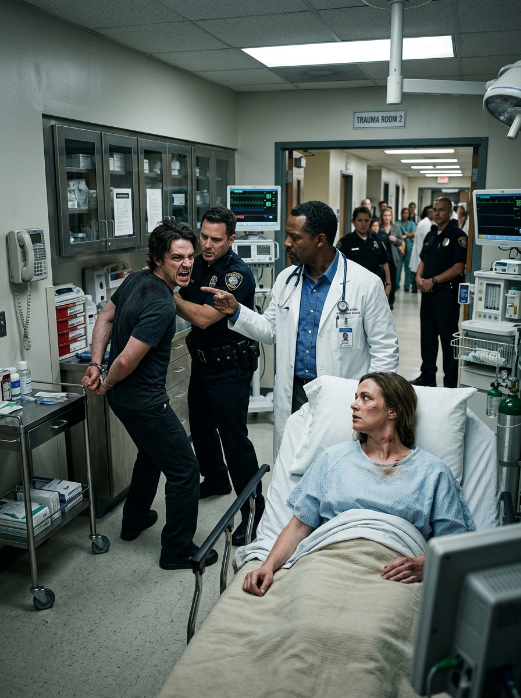
“This is Dr. Vance, Chief of Emergency Medicine,” Marcus said into the receiver. “I have a physical assault patient in Trauma Room Two with evidence of manual strangulation. The suspect is currently in the room. I need hospital security to secure the perimeter, and I need police officers inside this room immediately.”
“Marcus, wait! You are making a huge mistake!” Ethan shouted, his act completely breaking apart into panic. He lunged forward toward the bed, reaching for me as if he could regain control through force. “Tell him! Tell him it was an accident!”
Before his hand could touch my blanket, Marcus shifted his weight and stepped squarely between Ethan and my bed, blocking him completely.
“Touch her again,” Marcus said, “and you will not walk out of this room.”
Footsteps hurried down the hallway. Within seconds, two uniformed hospital security officers came through the door, followed by two police officers.
“He attacked my sister,” Marcus told the officers, pointing directly at Ethan. “He brought her in under a fake story to cover up domestic violence and choking. The physical evidence is clear, and I have the incoming file timestamped prior to her arrival.”
Ethan backed up against the metal cabinets, raising his hands in a fake gesture of innocence. “She fell! Check the stairs! She is trying to ruin me!”
“Sir, turn around and put your hands behind your back,” the lead officer said, taking out his handcuffs.
“You don’t understand! Her brother is biased! He is setting me up!” Ethan yelled, his voice cracking as the officers grabbed his wrists and pinned him against the counter. The heavy click of the handcuffs locking into place echoed through the small room.
As the officers read Ethan his rights and pulled him toward the door, Ethan turned his head back toward me. The mask of the loving husband was entirely gone, replaced by the reality of the man who had tried to erase me.
I looked him straight in the eye. I did not hide behind Marcus, and I did not turn away. I raised my head off the pillow, letting him see that despite the bruises he left, despite the money he stole, and despite his attempt to silence me, I was still here.
“You never learned when to keep your mouth shut,” I whispered, my voice rough and sore, but completely firm.
The officers dragged him out into the hallway, and his shouting faded as the heavy doors closed behind them.
The rest of the night moved with quiet order. The hospital forensic team came in to take clear photographs of my neck, shoulders, and wrists under specialized light. They collected the clothes I wore when I arrived and sealed them in evidence bags.
Before midnight, a detective from the domestic violence unit sat by my bed. I gave a full statement explaining the attack at the house and the systematic theft of two hundred eighteen thousand four hundred dollars from our accounts. With the timestamped files Marcus provided, the detective had everything necessary to establish motive and deliberate harm.
Before sunrise, a judge signed an emergency protective order keeping Ethan away from me and my property. By mid-morning, our bank had processed a legal hold on all associated accounts, freezing the funds in the shell accounts while the police investigation moved forward.
At nine in the morning, the sun was shining bright through the front glass doors of the hospital exit. The fluorescent lights were behind me now. I stood near the exit doors dressed in clean clothes Marcus had brought from home. My throat was still sore, but the heavy weight that had rested on my chest for two long years was gone.
Marcus walked up beside me carrying my discharge papers and two cups of tea. He handed me one and looked at me with a soft smile.
“The police confirmed he is being held without bail until his hearing tomorrow,” Marcus said gently. “With the paper trail and the medical photos, he is not getting out.”
I reached up with my left hand and slipped my fingers under the plastic hospital identification band wrapped around my wrist. I gave a quick, firm tug, snapping the plastic fastener. The band fell into my hand, and I dropped it into the trash bin near the door.
“Thank you, Marcus,” I said, my voice sounding clearer as I spoke.
“You did this yourself,” Marcus replied, nudging my shoulder gently with his. “You gathered the evidence. I just received the file.”
I turned toward the sliding glass doors as they opened, letting in the cool morning air. The sun was rising over the street, casting warm light across the pavement. I took a full, deep breath without pain or fear, and walked out into the morning.