How Finding a Hidden Secondary Phone in Arthur’s Workshop Exposed His Fourteen Year Double Life

The smell of rain-soaked cedar and cold asphalt always stayed in the fibers of my heavy winter coat long after I walked in from the yard, a damp, earthy scent that reminded me of things growing underground. On that Tuesday afternoon, the police officer at my front door brought a different kind of cold into the house. He spoke in the soft, practiced cadence reserved for sudden tragedies, explaining how Arthur’s sedan had hydroplaned across the wet median of State Route 217 into oncoming traffic.
In a single instant, twenty-seven years of marriage dissolved into a routine traffic report, leaving me standing alone in our quiet foyer with my fingers curled around the cold brass door handle. We had built a calm, predictable life together in our suburban home outside Portland where the moss grows thick on the north side of the cedar fences and the neighborhood stays quiet past nine o’clock. Arthur ran an independent management consulting practice that required frequent midweek travel to regional clients across the Pacific Northwest, while I managed acquisitions and cataloging for the local library system downtown. We were the couple that neighbors admired for our low-drama routine, our shared fondness for weekend gardening, and the easy silence we shared over Sunday morning coffee. When I sat on the front row of the chapel four days later, I was numb, consumed by the sudden, overwhelming void of a home that had lost its center of gravity.
The memorial service was nearly winding down to its final blessing when the heavy side door of the chapel opened with a soft click. A woman walked down the center aisle toward the polished mahogany box, her steps deliberate and unhurried. She looked to be in her late thirties, wearing a conservative dark wool coat, her face pale and strained beneath a low-set brim. She did not look at any of the seated guests, her gaze fixed entirely on the casket where Arthur lay dressed in his favorite navy suit. She walked straight up to the wood, reached into her coat pocket with a gloved hand, and placed a single white rose right on the polished lid. As she bent forward, her lips brushed the polished surface, and she whispered four words into the absolute stillness of the room. I will take care of them. A sharp, hot impulse broke right through my fog before I even had time to think about it.
I stood up from the front pew, took two quick steps across the carpet, and caught her firm by the fabric of her sleeve before she could turn toward the side aisle.
Take care of who, I demanded, my voice barely above a whisper, though it cut through the muted murmur of the fading organ music. She froze for a fraction of a second, her shoulder blades stiffening beneath the wool, before she jerked her arm sharply from my grip without once looking me in the eye and slipped out through the double doors into the gray afternoon rain.
That night, unable to force my eyes closed against the silence of the bedroom, I walked out through the back patio to Arthur’s detached garage workshop. The heavy oak door had a way of sticking during the damp autumn months, giving off a dry, protesting groan every time it opened or shut.
The scent of sawed cedar and machine oil still hung heavy in the air, exactly as it had every evening for over two decades. I had no specific plan; I simply wanted to stand in the space where he spent his long hours building custom bookshelves and repairing antique chairs, wanting to feel close to something he had touched before everything went wrong. On the bottom shelf of his heavy steel toolbox, tucked neatly beneath a rusted set of socket wrenches and a box of galvanized nails, my fingers caught the edge of an unfamiliar black velvet pouch that had no business being there. Inside was a secondary cell phone, fully charged and left on silent with the screen dark against the velvet lining. I pressed the home button, and fourteen years of text records unspooled in a relentless, glowing stream across the tiny screen.
There were thousands of messages detailing doctor appointments, school drop-offs, grocery lists, and casual, daily affection that made my stomach turn over. Photos loaded in steady streams from years I thought I knew by heart: three children growing up in a house I had never seen, a middle school boy with Arthur’s chin, a younger girl with ribbons in her hair, and a toddler taking steps across a hardwood floor. The most recent photo showed Arthur holding a birthday cake with four lit candles, smiling that familiar, crinkled-eye smile I had loved for half a lifetime. The timestamp on that image was from eight months ago, precisely during the four days I thought he was in Seattle attending our annual wedding anniversary trip to Hawaii, which he had allegedly canceled at the last minute due to an urgent client emergency at a regional lumber mill. I sat down hard on the cold concrete floor of the workshop and did the simple, brutal math in my head.
He had conceived that youngest child during the week of our twenty-third wedding anniversary while I was busy packing his favorite woolen sweaters into his suitcase for a trip he never took. Tucked right behind the phone case was a folded legal document, crisp and official: a deed for a residential property in a leafy neighborhood of Portland, purchased in 2016 for $890,000 cash. The legal owners were listed as Chloe Vance and a corporate entity named Apex Northwest LLC, a name I had seen on Arthur’s Schedule C tax filings for years, which I had always assumed was merely his primary consulting trade name and nothing more.
My hands were surprisingly steady as I scrolled down to the contact list on the hidden phone, finding only one single number saved under the simple name Chloe. I tapped the call button without letting myself hesitate, pressing the receiver to my ear while the garage hummed with the distant sound of traffic on the highway. It rang once, twice, three times.
Arthur, Chloe’s voice came through the speaker, high and frantic, tumbling over itself. Where have you been? The news said… She cut herself off mid-sentence, catching her breath as a sudden realization hit her. Who is this?
This is Eleanor, I said, keeping my tone entirely level, every syllable measured against the pounding in my chest. Arthur’s wife.
A long, suffocating silence stretched over the line, broken only by the distant hum of long-distance static. When Chloe finally spoke, her voice lacked the sharp edge of anger; it was thick with confusion and genuine, gut-wrenching fear. He told me you were dead, she whispered, her breath catching in her throat. He told me you were a terminally ill recluse. He said you were so mentally fragile and sick that leaving you would kill you, but that you lived entirely in a private care facility downtown and hadn’t recognized anyone in years.
The absurdity of the lie landed with the weight of an iron plate right on my chest. For fourteen years, Arthur had constructed a master illusion that served both sides of his double life with chilling precision. To me, he was the hard-working, traveling consultant dedicated to our peaceful suburban routine and our quiet life together. To Chloe, he was the devoted partner trapped in a tragic, noble duty to a dying, non-functional ex-wife who couldn’t be abandoned without triggering a fatal medical decline.
I am not sick, I said clearly, looking out at the workbench where his hand tools sat in their foam cutouts. I work full-time at the public library. We have been married for twenty-seven years, and he came home to me every single weekend without fail.
On the other end of the line, I heard the sharp, sudden sound of Chloe breaking down into ragged, breathless weeping, the phone clattering against a wooden surface before she picked it back up to sob into the receiver.
The next morning, I did not spend my time crying or staring at the walls of the kitchen. I called Marcus, a trust and estate attorney who had handled my parents’ probate years earlier when the farm was settled. We met at his office downtown at nine in the morning, the rain still beating a steady rhythm against the tall library windows overlooking the courthouse square. I laid the hidden phone, the $890,000 Portland property deed, and our joint tax returns out on his polished walnut desk in neat, orderly piles. Marcus spent twenty full minutes cross-referencing Arthur’s business filings with our joint bank records before he looked up at me over his reading glasses with a hard, flat line to his mouth.
Arthur was routing money systematically, Marcus noted, tapping his pen against a ledger sheet. He set up Apex Northwest LLC to receive his primary consulting retainers from the timber companies. Instead of bringing those funds home to your joint account to pay down the mortgage, he funneled over $800,000 of marital earnings over the last eight years into a secondary account to cover the mortgage, private school tuition, and living expenses for the Portland address.
Is that legal, I asked, watching the reflection of the gray sky in the polished wood of his desk.
It’s marital waste of the highest order, Marcus replied firmly. You cannot use joint marital assets to purchase real estate or support a secondary household without your spouse’s knowledge or written consent. Because the Portland deed includes his LLC, that asset is tied directly to his probate estate. We can freeze all corporate assets immediately through the probate court before anyone tries to liquidate them.
Two days later, I drove my sedan across the bridge into Portland, finding the address listed on the deed tucked onto a quiet, leafy residential street lined with tall maple trees dropping golden leaves. The house was a modern, two-story craftsman with clean cedar siding and a neat boxwood hedge along the front walk. I walked up the paved path, pressed the brass doorbell button, and waited while the chime echoed through the interior.
When Chloe opened the front door, the heavy red rims around her eyes told me instantly that she had not slept a single minute since our late-night phone call. Behind her in the narrow hallway, I saw a framed photograph hanging on the wall: Arthur smiling broadly on a sunny beach, his arms wrapped around three young children who looked nothing like ghosts.
Eleanor, she said, her fingers clutching the edge of the screen door so hard her knuckles were bone-white.
May I come in, I asked quietly.
She stepped aside without a single word, her shoulders slumped beneath a gray cardigan. We sat across from each other at her bright kitchen table while her children were away at school and daycare. For two hours, we placed our lives side by side like two mismatched maps of a territory neither of us had chosen to explore. I showed her our joint tax returns stamped by the IRS, photographs of our home in the suburbs, and airline receipts from vacations Arthur had claimed were solo business trips to regional boardrooms. She showed me her calendar entries, thousands of text threads spanning back over a decade, and the legal closing papers for the craftsman house.
Arthur had told her that every single dollar for the house and their living expenses came from a family trust left by his parents in Ohio. He had convinced her to remain a stay-at-home mother, keeping her entirely dependent on the monthly wire transfers from Apex Northwest LLC while managing every detail of their financial life. He had kept her isolated from the broader community, convincing her that any public appearance with him near my side of town could lead to a messy media scandal that would ruin his consulting business and cut off her family’s support entirely.
He built a cage for both of us, I told her, looking across the table at the woman who had unknowingly shared my husband for half a generation. Except he used my earned library wages and our joint marital money to build yours brick by brick.
What happens now, Chloe asked, her voice trembling as she looked down at her hands. The bank… the mortgage… the kids’ school?
My attorney is freezing the LLC accounts today, I said calmly. The law recognizes my absolute right to recover diverted marital funds. The house will have to be dealt with through the probate court as part of the estate settlement. I am not here to punish your children, Chloe, because none of this is their fault. But I am not going to finance Arthur’s lie for one day longer, nor am I going to surrender my own financial security for a life I knew nothing about.
Over the next six weeks, Marcus filed formal probate motions in county court, citing fraudulent asset concealment and breach of fiduciary duty within the marriage. Because Arthur had improperly transferred community property into his shell company to pay the mortgage and down payment on the Portland residence, the judge placed a temporary legal lien on the entire property. Facing the harsh reality of an asset clawback and a frozen bank account, Chloe engaged her own legal counsel within days, and we entered into weeks of tense out-of-court negotiations. In the end, a settlement was reached: the Portland craftsman house would be put on the market immediately, with the marital estate recovering the initial $890,000 capital diversion, while the remaining equity from the sale was placed into a restricted educational trust exclusively managed for the three children.
Arthur’s polished reputation among his corporate clients, golf partners, and our extended family vanished completely as the probate filings became public record in the county gazette. The carefully curated narrative of the dedicated professional and loving husband dissolved under the cold, unforgiving light of bank ledgers and property deeds. Friends who had initially offered tearful sympathy calls went stone cold once they understood the scale and duration of his deceit. I watched people I had known for decades struggle to find words when I ran into them in the grocery aisle, but I didn’t need their nervous comfort or their pity. The truth was harsh and bruising, but it was solid ground beneath my feet at last. For fourteen years, I had lived inside a fiction, but every step I was taking now was anchored in cold, undeniable facts that no one could argue away.
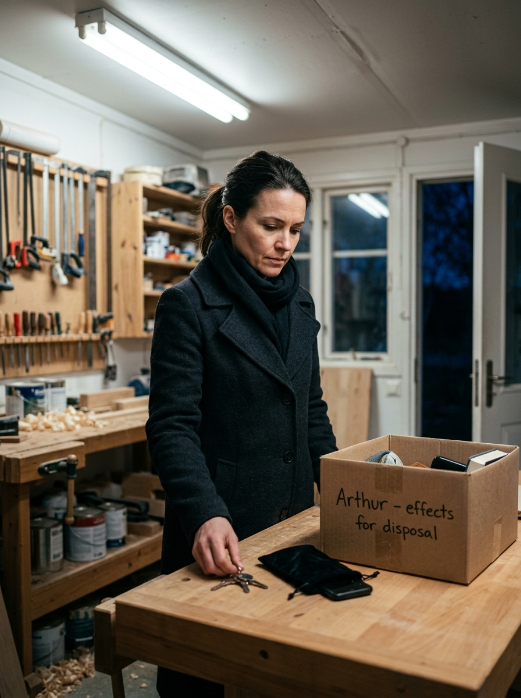
On a quiet Saturday evening in late autumn, the light fading fast behind the bare branches of the oak trees, I walked out to Arthur’s workshop one last time. The estate settlement papers were fully signed, the bank accounts were permanently separated, and my own independent future was secure under my own name. I picked up the black velvet pouch from the dusty workbench, pulled out the secondary phone one final time, and held the power button down until the screen went completely black for good. I dropped the dead phone into a cardboard box of his personal effects that the thrift truck was scheduled to pick up on Monday morning. Then, I took my own heavy set of house keys out of my coat pocket, placed them firmly in the center of the clean, swept wooden workbench where he used to plane his cedar boards, and turned off the overhead fluorescent lights. I locked the heavy garage door behind me with a solid, metallic click that echoed across the empty driveway. I walked out into the cool, clear night air, stepping forward into a life that was finally, completely my own, leaving the silence behind me like an old coat I didn’t need anymore.