The Twelve Dollar Balance: How My Twin Daughters Outsmarted Their Father’s $180,000 Flight to Europe

The green ledger book had a small grease stain on the bottom right corner of page forty-two, right where my thumb used to rest while I added up the columns every single Friday night after the double shift at the supply warehouse ended. I kept that book in the bottom of my cedar chest under three winter blankets because looking at it felt like touching something fragile that might crumble into grey dust if I pressed too hard. Eighteen years of ledger entries, written out in my own neat, slightly cramped hand, charting every fifty-dollar birthday check from my mother, every performance bonus from the logistics yard, and every extra hour I scraped together by staying late when the night crew called in sick.
It was never just a record of numbers to me. It was the physical proof that my twin daughters, Emma and Chloe, were going to step onto a college campus without owing a single red cent to a bank, that they wouldn’t start their adult lives with the heavy anchor of student loans dragging them under before they even learned how to swim in the deep end. I didn’t think about the hours back then because the book gave me a destination, and when you have a destination, your feet just keep moving even when your joints ache and the coffee tastes like old tin.
That was the life I built while Richard was busy building something else entirely behind my back, though I didn’t let myself see the cracks until the cedar chest was already empty. Richard was a man who measured his life in leather-bound planners and crisp white shirts that always smelled faintly of expensive cedarwood and dry cleaner chemicals, the kind of person who walked into a room and somehow made the furniture look slightly cheaper just by standing near it.
We had been married for twenty-two years, which is a long time to spend convincing yourself that a closed door is just a closed door and not a room full of secrets. I remember the exact Tuesday morning the illusion tore right down the middle because the digital clock on my microwave blinked 7:42 in a harsh amber glare that made my eyes water. The house had that heavy, dead kind of quiet that only settles in when someone has packed their bags in the dark and slipped out the side door without letting the hinges groan. I had logged into our joint online portal to pay Emma’s first semester bill at the state university, expecting to see the solid, comforting block of numbers we had guarded like a national treasure for nearly two decades.
Instead, the screen read twelve dollars and zero cents, sitting there like a small, mocking punctuation mark at the end of eighteen years of my life.
I sat frozen at my desk for a long time, my fingers resting on the plastic keys of the keyboard while the hum of the old refrigerator in the kitchen sounded abnormally loud, like a chainsaw cutting through dry pine. My hands started that familiar, frustrating tremble that usually only hit me after a sixteen-hour double shift, but this time it wasn’t exhaustion making my bones shake. I clicked through the transaction ledger with a mouse that felt slippery under my damp palm, watching the digital trail open up like a fresh cut. Four days earlier, a single wire transfer had moved one hundred seventy-nine thousand, nine hundred and eighty-eight dollars out of the college savings account and into an overseas holding routing number that didn’t have our last name attached to it anywhere. The digital signature on the transfer was Richard’s, stamped with his secure employee token at 2:14 in the morning while I was sound asleep three feet away in our bed.
I didn’t scream, and I didn’t cry right then, because my brain had simply stopped processing anything beyond the stark, white light of the monitor. I stood up so fast my knee caught the edge of the oak desk, sending a sharp pain shooting up my leg, but I barely felt it as I walked down the narrow hallway to our master bedroom. His heavy leather duffel bags were gone from the top shelf of the closet, along with his winter coats, his passport holder, and the silver-framed photograph of himself from his company’s annual banquet in Chicago. On his nightstand, held down by a heavy brass paperweight shaped like a mallard duck, lay a single sheet of hotel stationery with three printed sentences that looked like they had been typed by a machine rather than written by a man I had shared a life with. He told me he was leaving for Europe, that our marriage had been dead in his chest for years, and that he was already on his way to start a new chapter in London with Julianna, a twenty-eight-year-old marketing coordinator from the downtown office who probably didn’t know the first thing about working a double shift in a cold warehouse.
I picked up the paper, and the ink felt cold under my thumb, completely devoid of any human warmth or hesitation. I sat down on the edge of the unmade bed, clutching the hotel stationery so hard my knuckles turned the color of skim milk, while the reality of the upcoming semester began to press down on my chest like a wet wool blanket. Emma was scheduled to move into her dorm in twenty-one days to study computer science, and Chloe was registered for the financial systems track right down the hall in the business building. We had spent the previous Sunday evening checking off packing lists and folding flannel sheets, talking about desk lamps and extension cords, believing we were standing on the threshold of their bright, secure future. And now there was twelve dollars left in the bank, and Richard was probably sitting in the comfortable leather seat of an outbound airliner, drinking complimentary ginger ale and spending our daughters’ future on a woman young enough to be his niece.
Half an hour later, I was sitting flat on the hardwood floor of the kitchen with my back against the lower cabinets, staring at the printed transaction statement clutched in my lap when the back door swung open with its familiar, cheerful squeak. Emma and Chloe walked in carrying brown paper grocery bags from the local market, their arms loaded with fresh fruit and cartons of oat milk for their morning coffee routines. They stopped dead in their tracks the second they saw me sitting there among the stray crumbs and the morning sunbeams, their faces dropping from casual laughter into sharp, immediate concern. Chloe dropped her keys on the small wooden table near the door, the metal ring hitting the surface with a loud, ringing clatter that made my teeth ache. They didn’t ask me what was wrong with polite hesitation; they moved toward me like two experienced nurses responding to a code red in a busy hallway, dropping their bags right where they stood.
“Mom?” Emma asked, her voice dropping an octave as she knelt down beside me on the cold floor and reached for my shoulder. “What happened? Did something happen with Grandma?”
“It’s gone,” I whispered, the words scraping against my throat like dry sandpaper because I couldn’t find enough air to push them out properly. “Your father left. He took everything out of the savings. The college fund is gone down to twelve dollars. I didn’t protect it, and I failed you both, and I am so sorry.”
I braced myself for the kind of breakdown I had just put myself through, expecting them to start screaming, or crying, or throwing things the way young adults do when the ground suddenly drops out from under their feet. I waited for the panic to fill the kitchen, for the sound of shattering glass or hysterical weeping that would match the jagged tear in my own chest. Instead, Emma and Chloe looked at each other across my bowed head, a strange, utterly silent communication passing between them in the space of a single heartbeat. It wasn’t the look of devastated children; it was the look of two professional analysts who had just found the exact anomaly they had been hunting for in a massive stack of corrupted data. Emma stood up slowly, pulled out one of the heavy oak kitchen chairs, and sat down right in front of me with her knees pressed together and her hands resting flat on her denim thighs.
“Mom, stop crying right now,” Emma said, her voice entirely too calm, too steady for a nineteen-year-old girl whose entire life savings had just vanished into the digital ether. “The money isn’t gone. Dad didn’t get away with it.”
I stared at her through my wet lashes, feeling a cold numbness spread through my fingers because my brain refused to connect her words with the stark reality of the bank ledger sitting on my knee. “Emma, I am looking at the statement right this second,” I said, my voice rising into a cracked, desperate treble. “He wired nearly one hundred and eighty thousand dollars out four days ago. He is probably landing in Heathrow right now with that girl.”
Chloe didn’t argue with me, and she didn’t try to offer me false comfort or pat my hand the way a sympathetic friend would do. She reached into her canvas backpack, pulled out her slim silver laptop, and set it down on the kitchen table right above my head with a decisive click of the magnetic latch. “Mom, Dad has never been nearly as clever as he likes to think he is,” Chloe said, her fingers already flying across the keyboard with the practiced speed of someone who spent half her life writing algorithms in her bedroom. “And he completely forgot who raised us, and more importantly, he forgot how that account was actually structured from day one.”
She brought up a secure browser window, entered a complex series of authentication codes, and turned the screen toward my face so I could read the crisp, glowing text. Two months earlier, right around the time the girls turned eighteen and graduated from high school with honors, they had enrolled in early summer enrichment courses at the university downtown. Around that exact same window, Chloe had started noticing small, jarring discrepancies in how Richard behaved around the house, like the way he would suddenly stop talking when she walked into the living room with her laundry basket. She caught him taking hushed phone calls out by the oversized garbage bins in the driveway late at night, his voice dropping into low, hurried murmurs whenever the screen door creaked. Because they were both deeply invested in cybersecurity coursework and fiercely protective of the household stability they had watched me sacrifice for, the twin sisters started paying quiet attention to the digital footprint running through our home network.
They found deleted emails on the shared household printer log between Richard and Julianna, containing detailed itineraries for flights to London, hotel reservations in Mayfair, and timelines for liquidating our domestic holdings. But the most important discovery wasn’t the romance or the betrayal; it was the legal technicality that Richard had apparently forgotten or never fully understood in the first place. That savings account had been opened eighteen years ago by my own mother as a joint custodial savings account in my name and his, created explicitly for the benefit of the two girls as beneficiaries. The moment Emma and Chloe reached their eighteenth birthdays, the legal framework of the account shifted automatically under state banking regulations, granting them full rights as adult co-owners on the file alongside me. Richard still treated the account like his own personal piggy bank because his name was on the initial paperwork, but legally, he was just one of several primary signatories sharing space with two young women who were already studying systems architecture and financial controls.
Without saying a single word to Richard or me, because they knew I would have panicked and tried to talk them out of making waves, the girls took decisive action during their second week of summer break. They walked into the local brick-and-mortar branch of our bank with their birth certificates, their student IDs, and a printed copy of the original trust formation papers from my mother’s estate. Working with a student legal advisor from the university’s campus clinic who specialized in consumer protection, they updated the account’s security protocols right there at the manager’s desk. They instituted a mandatory dual-authorization requirement for any outbound electronic transfer exceeding five thousand dollars, meaning any large movement of funds required digital verification from two separate primary account holders before the clearinghouse would release the capital. If an unverified attempt was made by a single party without the secondary sign-off, the system was programmed not to reject it instantly, which would have tipped off the person trying to move the money, but rather to trigger a sophisticated internal fraud containment protocol.
“When Dad initiated that wire four days ago,” Chloe explained, her finger tapping the edge of the laptop screen where a green verification checkmark glowed in the corner, “he thought he was executing a clean transfer to his private international holding account in London. But he didn’t read the fine print on the banking app’s security update notification that we pushed through our admin portal. The moment his request hit the clearinghouse without a secondary signature from me or Emma, the system intercepted it quietly.”
“The routing software put a temporary administrative hold on the outbound wire to his destination account,” Emma added, leaning in close so I could see the cascading lines of encrypted data scrolling down the monitor. “It flagged his personal profile for suspicious international activity, locked his ability to open new lines of credit through our banking network, and automatically routed the entire principal sum of one hundred and eighty thousand dollars straight into a newly created private trust account registered solely under your name and your Social Security number.”
I stared at the screen, my breath catching in my throat as I read the numbers displayed in bold black type under a brand-new routing number that belonged to me and me alone. Resting right there in the digital ledger was the full sum of one hundred and eighty thousand dollars, intact, protected, and completely out of Richard’s reach.
“The twelve dollars left in the old account was just the minimum balance required by the system to keep the main line open without throwing a red error flag,” Chloe added with a small, cold smile that looked terrifyingly like my own when I was dealing with a difficult supplier at the warehouse. “If the automated system had closed his account completely right away, he would have received an immediate text alert while he was still packing his bags in the master closet. We needed him to believe he had successfully stolen our future until he was already thousands of miles away across the ocean.”
For the next forty-eight hours, the three of us moved through the house with a strange, quiet precision, like people working on a delicate machine in a silent room. I signed the new trust documents at the dining room table under the guidance of a sharp family law attorney recommended by the university clinic, formally establishing myself as the sole trustee for my daughters’ educational funds. We filed emergency separation papers that very afternoon, placing a strict legal freeze on our suburban house, our vehicles, and our remaining personal assets before Richard could try to leverage anything else from a hotel room across the Atlantic. I didn’t feel angry anymore; the shock had worn off, leaving behind a cold, clear space in my mind where every decision felt as obvious and necessary as shutting off a water main during a pipe burst.
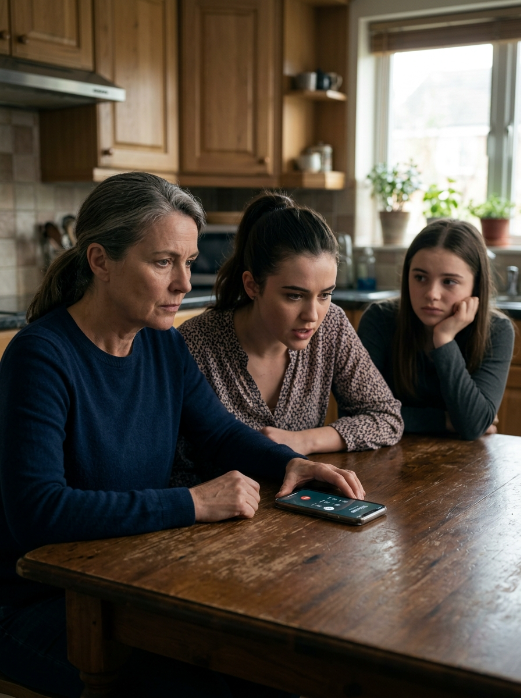
On Thursday afternoon, the sun was casting long, pale stripes across the kitchen linoleum when my cell phone vibrated against the wooden surface with a sharp, insistent buzz. The caller ID flashed Richard’s name, accompanied by the international country code for the United Kingdom, glowing in bright white letters against the dark screen. I looked at Emma and Chloe, and without saying a word, I picked up the phone, placed it right in the center of the kitchen table, and tapped the speaker icon with my index finger.
“Martha?!” Richard’s voice exploded out of the small speaker with such force that it startled me, sounding frantic and thin, distorted by the poor satellite connection. In the background, I could hear the loud, hollow, echoey chime of airport terminal announcements and the indistinct roar of a crowded European railway station. “What the hell is going on with our bank cards?! Why is every single line of credit I own returning an error code?!”
I took a slow, deep breath, tasting the stale air of the kitchen, and kept my voice completely level, flat, and devoid of any warmth. “Hello, Richard.”
“My cards just got declined at the front desk of the hotel in London,” he yelled, his voice cracking with a sudden, ugly panic that didn’t sound anything like the calm, collected man who used to lecture me about household budgeting over breakfast. “The room deposit bounced! We are sitting here at the station trying to book a train down to Paris, and the ticket agent says all my accounts are frozen under an active fraud investigation! Where is the money?! Where is the one hundred and eighty thousand dollars?!”
In the background behind him, I could hear Julianna’s voice, sharp and stressed, complaining about the weight of their matching leather luggage and demanding to know what was taking him so long to fix the problem.
“The one hundred and eighty thousand dollars was never yours to take, Richard,” I said, my tone as steady as an old stone wall.
“I transferred it legally! It showed as pending on my app before we boarded!” he screamed, his words tumbling over each other in a desperate rush. “Where is it? What did you do with it?!”
Emma leaned down toward the microphone of the phone, her voice carrying that cold, surgical precision that made her straight-A grades in computer science look like child’s play. “It’s in Mom’s trust account, Dad. You tried to steal our college money, so Chloe and I redirected it the exact second you clicked send on your phone. You’ve been traveling on temporary, pending credit lines for three days, and as of an hour ago, those lines are fully closed.”
The line went completely dead quiet for five full seconds, save for the faint hiss of static and the distant clatter of train wheels on steel tracks somewhere in London.
“You… you can’t do that,” Richard stammered, the arrogance evaporating from his voice instantly, leaving behind the sound of a small, frightened man trapped in a place he didn’t understand. “That’s my money! I’m standing in a foreign train station with two bags and no working cards! Martha, tell them to release my funds right now! Julianna and I have nowhere to sleep tonight!”
“You’ll have to figure that out on your own,” I said softly, looking at the two young women sitting across from me who had saved everything I spent eighteen years building. “Your key doesn’t work on the locks here anymore, your name is off every account we own, and my lawyer will be serving your employer with legal documents by tomorrow morning. Don’t call this number again.”
I reached out and tapped the red button on the screen, cutting off the sound of his voice before he could say another word, and the kitchen returned to that deep, steady silence that felt like peace.
Three weeks later, the morning sun was bright and warm against the white curtains of the kitchen window, filling the room with the rich, dark smell of fresh-brewed coffee and toasted bread. On the center of the wooden table lay two official enrollment confirmation packets from the university for Emma and Chloe, their crisp white pages stamped paid in full for their entire freshman year. Right beside the packets sat the small, dented metal box where I had kept every paper savings receipt, deposit slip, and bank ledger stub since the day Emma was born. I picked up the final tuition receipt, slid it neatly into the bottom of the metal box alongside the old green ledger book, and pressed the metal latch down until it clicked shut with a satisfying, permanent sound. Richard was still somewhere out there in Europe, dealing with massive banking overdraft fees, canceled credit profiles, and the deeply embarrassing task of asking his corporate office for an emergency advance just to buy a coach-class ticket back home to face a very unfriendly divorce lawyer.
I looked across the table at my daughters, who were sitting together over two ceramic mugs of tea, pointing at a campus map and arguing good-naturedly about who had to make the long walk across the quad for their early morning computer lab. I sat down beside them, picked up my own cup, and took a slow, warm sip while the morning light settled over us all, knowing for the first time in twenty-two years that we were going to be just fine.