How My Family Ordered Me to Sit by the Coat Rack and Met the Judge Who Ruled My Tax Appeal

The morning coffee pot on my kitchen counter had finished its slow, wet sputter about ten minutes before the phone started vibrating against the wood. It was 1:30 in the morning, which is the exact hour when nobody calls you with good news unless they have won the lottery or someone is lying in a ditch. I was sitting at my wooden kitchen table under the harsh glare of a single overhead bulb, surrounded by six yellow legal pads and a half-eaten sleeve of saltine crackers, trying to trace out the procedural posture of a municipal zoning dispute that was set for oral argument the next afternoon before a three-judge panel in Richmond.
My eyes felt like someone had rubbed them with coarse sandpaper, and my left shoulder had that familiar, burning knot that comes from holding a fountain pen too tightly for twelve hours straight. My father’s face popped up on the screen, his contact photo taken at my brother’s last birthday dinner where he was wearing a blazer that cost more than my first used sedan. I stared at the screen for three long beats, watching the little green dot blink, before my thumb finally dragged across the glass to accept the call. No retired corporate executive calls his thirty-four-year-old appellate attorney daughter in the middle of the night to ask about her health or her caseload.
“Tomorrow night, you can join your brother’s fiancée’s family for dinner,” my father said, his voice a tight, irritated whisper that sounded like he was standing in a dark hallway trying not to wake the neighbors. “But keep your mouth shut.” I leaned back in my wooden chair, letting out a long, slow breath that rattled the loose papers at the edge of the desk, and rubbed my thumb over the bridge of my nose where the indentation from my reading glasses always left a red mark. “Why, Dad?” I asked, my voice flat and tired from a sixteen-hour workday that had begun before dawn.
Before he could answer, my mother’s voice came sharp and thin through the speaker in the background, cutting in like a pair of freshly sharpened kitchen shears. “Her dad is a circuit court judge, don’t embarrass us like you always do,” she hissed, her words clipping together with that familiar, stinging condescension that had been the soundtrack of my entire childhood. “Got it,” I said quietly, and tapped the red button before they could add another item to the list of my lifelong failures. I didn’t bother arguing with them because argument requires an audience that is willing to listen, and my parents had closed that door somewhere around the time I turned twenty-two and decided I wanted to read briefs instead of attending country club mixers. I was thirty-four years old, and I had spent the last seven years working long, grinding hours as an appellate attorney in a downtown firm where nobody cared about your last name if your legal reasoning had a hole in it.
I handled complex municipal motions, regulatory disputes, and administrative appeals that required wading through thousands of pages of zoning codes and tax statutes while my peers were out at cocktail lounges. But to my parents, my work was just an unglamorous desk job they barely understood and never cared to ask about, something like a glorified secretary who happened to have a diploma framed on the wall. My brother Julian was thirty-one, wore three-thousand-dollar suits paid for on corporate credit cards that my parents secretly guaranteed, and bounced from one failed real estate partnership to another on my father’s savings. To them, Julian was the rising executive, the charismatic young lion of Richmond real estate, and I was the quiet, invisible daughter who didn’t fit into their high-society aspirations or their country club photo albums.
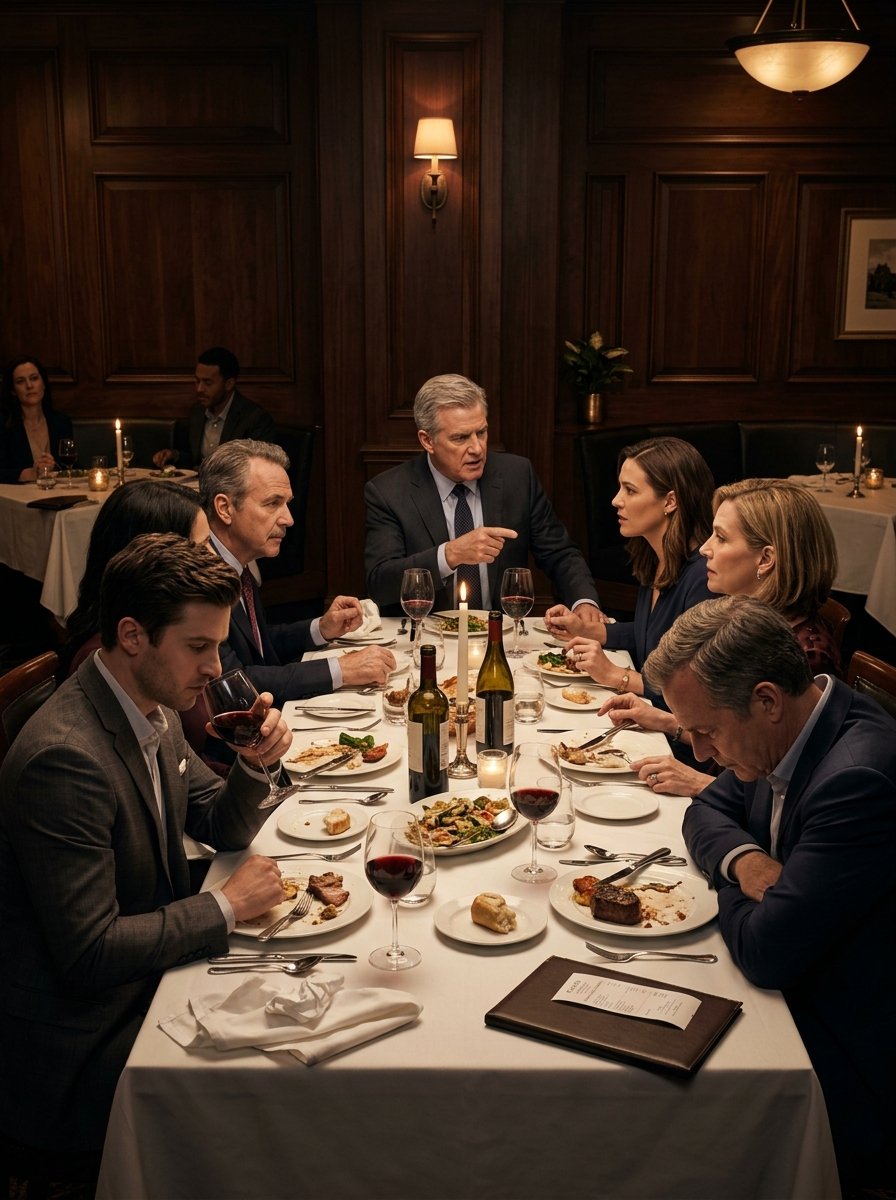
The next evening, I arrived at LEMAITRE, an expensive steakhouse downtown where the valet stands out front look like they belong in a movie and the plates cost more than my weekly grocery budget.
I wore a plain navy blazer and tailored trousers, the exact same outfit I wore to the clerk’s office that morning, with my hair pulled back into a simple clip that required no maintenance. My mother met me near the host stand before I even had a chance to look at the menu, her eyes immediately scanning my outfit with clear, undisguised disapproval as if I had shown up in overalls and muddy boots. She grabbed my elbow firmly with her manicured fingers, her nails pinching right through my sleeve, and steered me away from the main dining room toward a long private dining table tucked away in the shadowy back corner near the service station. “You sit down here next to the coat rack,” she whispered fiercely into my ear, her breath smelling of expensive mints and pure panic. “Judge Vance is sitting up at the top next to Julian and Clara, and we don’t need you opening your mouth about anything.
Just eat your food, smile, and let Julian do the talking because he’s trying to secure a commercial land investment through Clara’s uncle.” Her fingers dug a little deeper into my arm before she finally let go, smoothing down her silk blouse as if my very presence had somehow contaminated her evening. “Understood, Mom,” I said in a low, deadpan voice, taking my seat at the absolute bottom of the table without making a scene, right where the heavy wooden coat stand cast a long shadow over my water glass.
At the far end of the room, sitting beneath a pair of modern brass sconces that gave his hair a silvery halo, sat Judge Arthur Vance, a broad-shouldered man with thick grey hair and sharp, deliberate eyes that missed nothing in a room. Across the state legal community, Judge Vance was known as a ruthless, sharp-minded jurist who didn’t tolerate fluff, posturing, or unprepared counsel in his courtroom; lawyers who walked into his chambers without knowing every footnote of their case law usually walked out twenty minutes later with their motions denied and their pride thoroughly shredded. For the first hour, I kept my promise to my parents because keeping my mouth shut was the easiest way to survive an evening with them. I stayed quiet, ate my ribeye steak which was cooked a little too well for my taste, drank my ice water, and watched my family put on an embarrassing, toe-curling performance that made my teeth ache.
Julian spent forty-five minutes bragging about his proposed retail development on the north side of town, dropping legal terms like zoning exemptions and tax increments with the casual confidence of someone who had learned everything he knew from reading the back of a cereal box. He made sweeping, completely inaccurate statements about municipal variance procedures and local tax credits, gesturing wildly with his steak knife while bread crumbs scattered across the white linen tablecloth. Every time Julian spoke, I saw Judge Vance’s jaw tighten slightly and his eyes narrow, though the judge was far too polite to interrupt his daughter’s future in-laws in the middle of a private celebration dinner. My father laughed at Julian’s jokes louder than anyone else in the room, throwing his head back and slapping the table with a theatrical heartiness that made the silver cutlery rattle against the china. My mother kept chiming in every few minutes, dropping deliberate hints about Julian’s sharp business mind and his uncanny ability to spot undervalued commercial land before the big developers even smelled the blood in the water.
Whenever the conversation drifted down our end of the table, my mother would quickly interject to change the subject, steering all attention right back to Julian like a circus ringmaster keeping the spotlight on the dancing bear.
Near the end of the meal, when the dessert plates had been cleared away and the coffee cups were filling up with dark, bitter steam, Judge Vance stood up slowly from his chair, lifting his heavy crystal wine glass by the stem to deliver a formal toast to his daughter Clara and my brother Julian. The room grew still, the low hum of conversation dying down as everyone turned their attention toward the head of the table where the judge stood like an immovable pillar. “I’d like to say a few words about family, trust, and the future,” Judge Vance began, his deep, resonant voice filling the private room with an effortless authority that commanded absolute silence. He turned to glance down at my parents with a polite, measured nod, then looked toward Julian and Clara with a softening expression that suggested he genuinely loved his daughter. Then, as his eyes swept slowly down the length of the long table, moving past the water pitchers and the bread baskets toward the shadowy corner near the coat rack, he stopped cold.
The judge froze mid-sentence, his lips parting slightly as if he had just recognized a ghost sitting among the winter coats. His wine glass stayed hovering in mid-air, the red liquid inside perfectly still against the crystal rim. His eyes locked directly onto me, widening just a fraction before his brow knitted together in a sudden, intense wave of recognition.
The room fell completely silent, the kind of heavy, suffocating quiet where you can hear the ice cubes melting in the water glasses three seats away. My mother’s hand darted across the table to grab her linen napkin, her knuckles turning bone-white as she shot me a furious, panicked glare from fifteen feet away, her eyes screaming what did you do without making a sound. Judge Vance slowly set his wine glass down on the white tablecloth with a tiny, distinct click that sounded like a hammer hitting an anvil. He excused himself from his daughter’s side with a brief, murmured word, pushing his chair back against the hardwood floor and beginning to walk down the full length of the private dining room. His heavy leather shoes made a steady, deliberate rhythm against the floorboards, and his eyes never left my face, locking onto me with the terrifying intensity of a predator spotting movement in the tall grass.
My father half-stood from his chair, his face flushing a pale, nervous red that clashed horribly with his expensive jacket, looking like a man about to watch his house burn down. “Judge Vance, please, if my daughter is in your way or sitting in the wrong place, we can have her move right now, she didn’t mean to cause any trouble,” my father stammered, his voice climbing an octave in his desperation to appease a man he viewed as royalty. Judge Vance didn’t even look at my father, didn’t break his stride, and didn’t offer a single polite nod in his direction. He walked straight past my trembling parents, ignoring them as if they were nothing more than pieces of mahogany furniture, and stopped right in front of my chair at the foot of the table near the coat closet.
A genuine look of total surprise and immediate professional respect crossed the judge’s face, replacing the stern judicial mask he had worn all evening like a fresh coat of paint. “Hello,” Judge Vance said, his voice crisp and clear enough for every person in the private room to hear every single syllable. “I certainly didn’t expect to see you here tonight. What is your connection to this family?” I offered a calm, polite smile that didn’t reach my eyes, stood up slowly from my chair, and extended my right hand over the edge of the table toward him. “Good evening, Judge Vance, I’m Julian’s sister, and these are my parents sitting right over there,” I said, my voice completely steady and level, carrying none of the trembling panic that was currently paralyzing the rest of the table. Judge Vance took my hand and shook it firmly, his grip strong and dry, before he slowly turned his head to look back at my father and mother who were sitting frozen in their chairs with their mouths slightly open like stranded fish. “Julian’s sister?” Judge Vance asked, looking back down at me with genuine wonder in his eyes, his eyebrows lifting high up on his forehead. “You didn’t mention your full name when we met in court, counselor.
Julian, you never mentioned that your sister was the senior associate who argued the municipal trust appeal in my court three months ago.” My father blinked hard, his hands resting flat and trembling on the white tablecloth as if he had just been struck across the face with a wet trout. “The… the what?” my father managed to whisper, his voice cracking on the final word.
Judge Vance turned his broad shoulders toward the middle of the table, addressing my entire family and Clara’s parents with the professional cadence of a man delivering a bench ruling from on high. “Three months ago, this attorney stood in my courtroom against a team of six senior partners from a major corporate firm out of Washington who thought they could walk all over local counsel,” Judge Vance announced, his voice ringing with absolute admiration. “She presented one of the most precise, brilliantly structured oral arguments I have heard on the bench in fifteen years of service. She didn’t use notes, she didn’t stumble on a single statute, and she dismantled their entire administrative preemption defense in twelve minutes flat. She saved her client over four million dollars in illegal municipal tax assessments that the city had tried to bury in backroom appropriations. My colleagues and I still reference her written briefs in our judicial chambers as a masterclass in appellate advocacy.” The private room was entirely motionless, the air thick with a heavy, humiliating silence that felt heavier than lead.
The only sound in the entire restaurant was the faint, mocking clunk of cutlery coming from the main dining room outside through the closed mahogany doors. My mother looked as if every drop of air had been sucked straight out of her lungs by a vacuum, her chest barely moving beneath her silk blouse. Julian sat fixed in his chair like a statue, his cheeks burning a deep, angry dark red, his lips parted without making a sound, staring down at his half-eaten dessert as if it held the secrets of the universe. Clara looked at me with open, unadulterated shock, while her mother slowly leaned forward on her elbows across the table, suddenly looking very interested in who I was and why my family had tried to shove me into the corner near the coats.
“She’s… well, she’s just a local corporate lawyer working behind the scenes,” my mother stammered, trying desperately to salvage some shred of her dignity, her voice high and trembling with desperate falseness. “We always tell her not to brag about her desk job because pride comes before the fall…” “Brag?” Judge Vance let out a short, genuine laugh that echoed off the private dining room walls, shaking his head slowly as if my mother had just told a particularly absurd joke. “Ma’am, with a mind like hers, she doesn’t need to brag because her work speaks louder than a room full of politicians. She is easily one of the sharpest appellate litigators in this circuit, and I would take her briefs over half the senior partners in the state bar association any day of the week.” He turned back to face me directly, his tone shifting from public proclamation to warm, personal professional courtesy that left no room for doubt. “I hope to see you in my court again next month on the Henderson petition, counselor, because your brief on that administrative standing issue was absolute perfection.” “Thank you, Your Honor,” I said softly, keeping my posture straight as a ramrod and my tone entirely composed, letting the words hang in the air like clean linen. “I appreciate your kind words.”
For the rest of the evening, the entire social dynamic at the table completely collapsed under the weight of the truth. Judge Vance returned to his seat at the head of the table, but the conversation never went back to Julian’s commercial development plans, his retail projections, or his three-thousand-dollar suits. Whenever Julian tried to interrupt the silence with another grand, sweeping speech about real estate investment opportunities, Clara’s mother would politely brush him aside with a wave of her hand and turn down the table toward me to ask about actual municipal law. “Tell us about that tax appeal,” Clara’s mother asked, looking across the table with real, hungry curiosity as she leaned on her elbows. “How long did it actually take you to prepare a case that complex against six high-priced Washington lawyers?” I answered her questions simply and directly, explaining the legal procedural steps without bragging, without embellishing, and without throwing anything in Julian’s face.
I didn’t raise my voice, I didn’t gloat, and I didn’t look at my parents once. I just answered every question with the natural, unshakeable confidence of someone who actually knew what she was doing every single day of the week. Every time my mother tried to step in to steer the focus back to Julian’s business ideas or his upcoming wedding plans, Judge Vance would firmly pivot the topic right back to my legal practice and the upcoming appellate docket. My father sat in complete, crushed silence, staring down at his empty plate like a man attending his own funeral, unable to meet my eyes for the remainder of the meal. Julian barely touched his dinner after that, staring at his half-empty wine glass as if he wanted nothing more than to melt right through the floorboards and disappear into the restaurant’s basement. When the check finally arrived in a heavy leather folder, Julian reached for it automatically out of sheer habit with a shaky, trembling hand, but Clara’s father quietly took it first, pushing it past my brother without a word and settling the bill himself while giving me a respectful, acknowledging nod across the room.
As the dinner party began gathering their coats and scarves from the back racks, my father pulled me into the narrow hallway near the coat closet, away from the rest of the group where the shadows were deep and quiet. His hands were trembling slightly as he reached out to touch my forearm, his fingers digging in with a desperate, pathetic need to fix what had just been broken beyond repair. “Why didn’t you tell us?” my father whispered, his voice shaking with a sudden, panicked need to regain control of his narrative. “Why didn’t you ever tell us you were arguing cases like that in front of Judge Vance and winning against big-firm lawyers? We had no idea you were working at that level.” I looked my father straight in the eyes, holding his gaze without blinking, watching the old man crumble right there under the dim hallway lights.
I didn’t feel angry anymore, and I didn’t feel the bitter, burning resentment that had kept me awake during countless late nights at my desk. For the first time in my entire life, I felt completely free from needing his approval, his recognition, or his permission to exist. “Because, Dad,” I said in a calm, clear voice that didn’t waver once, “you called me at one in the morning to tell me to keep my mouth shut.”
My father opened his mouth to say something in defense, but no words came out of his throat, just a dry, pathetic little rasp of air. He just stood there under the flickering hallway lights, looking at me like he was seeing his own daughter for the very first time, realizing that the person he had ordered to sit by the coat rack was the only reason his family name had any remaining respect in that room. I reached up and adjusted the lapels of my plain navy blazer, picked up my leather briefcase from the coat rack shelf where it had been hiding all evening, and stepped past him without waiting for an answer. I walked out through the heavy glass doors of LEMAITRE into the cool, crisp night air of downtown Richmond, taking a deep breath of the autumn wind that smelled of distant rain and asphalt. I could hear my mother calling my name from the lobby behind me, her voice high and anxious and entirely stripped of its usual authority, but I didn’t turn around to look.
I walked down the quiet sidewalk to my car, placed my briefcase carefully on the passenger seat, and unlocked the driver’s side door with a steady hand. Sitting behind the wheel, I looked at my reflection in the rearview mirror under the amber glow of the streetlamp, seeing not the invisible daughter who sat by the coat rack, but the attorney who owned her own courtroom. I didn’t feel the need to argue, explain, or demand an apology from anyone ever again. I started the engine, pulled out into the empty night traffic, and drove home in the quiet, beautiful silence.