How Finding an 80-Pound Oak Cabinet in Our Trash Cans Cost Helen Her Marriage and Custody

The notification popped up on my phone screen at 8:42 PM while I was standing in our quiet hallway in Oakhill, five days after coming back from a grinding work trip to Cleveland. My fingers were still stiff from the steering wheel, and my suitcase was sitting right by the front door where I had dropped it ten minutes earlier. I had expected to hear running footsteps and little giggles the second I pulled into the driveway, but the house had that terrible, dead kind of quiet that only settles in when someone is hiding.
There was only a raspy, shaking whisper coming from behind the half-open door of Gracie’s bedroom at the end of the hall. I didn’t want to look at the screen, but my thumb hit it anyway because Evelyn’s text attachment sat there waiting like a live wire.
“Dad… my back hurts a lot, but Mom said that if I told you, I would destroy the family.”
The words hit my ribs like a blunt stone. I dropped my heavy canvas bag by the coat rack and pushed the door open with two fingers, my heart already hammering against my breastbone.
“Gracie?” I stepped into the dim room, squinting through the shadows. “Sweetheart, what’s wrong?”
My eight-year-old daughter was sitting right on the very edge of her mattress, hugging a gray stuffed rabbit so tight her small knuckles were stark white. Her hair was tangled into bird’s nests, her eyes were red and swollen from hours of silent crying, and she was breathing in shallow, careful gasps that made her little shoulders hitch.
She looked so tiny, trying to curl herself into a ball in the middle of the bed to take up as little space as humanly possible.
“Mom said it was my fault,” Gracie whispered, her voice cracking into a high, pitiful squeak. “She said I made her do it, and if you found out, you’d be so mad at both of us that you’d leave and never come back.”
A wave of cold dread washed over my chest and made my stomach turn over. I rushed across the room and dropped hard onto my knees beside her mattress, not caring about the dust on the rug.
“What was your fault, Gracie? Did you get hurt while I was gone?”
“It hurts right here,” she whimpered, her small hand trembling as she pointed toward her lower spine. “I can’t bend over. Mom told me to stay in bed and not to move around when you got home so you wouldn’t notice.”
When I gently touched her lower back over her thin cotton pajamas, she winced and let out a sharp gasp that cut right through me. I carefully pulled the fabric up just an inch, and what I saw made my blood run hot. A massive, deep purple and angry reddish-yellow bruise ran across her lower back in a thick, ugly band. It wasn’t a little playground scrape or a minor bump from a toy. It was a severe, deep-tissue trauma spreading across her small frame like an ink stain.
Before I could ask another question, I heard the front door click open down the hall with a familiar, brisk sound.
Helen walked into the house carrying a plastic grocery bag from the local market. My wife looked perfectly composed, her blonde hair tucked neatly behind her ears, wearing her expensive beige wool coat like she had just come from an easy afternoon out.
But the second she stepped past the foyer and saw the light spilling out of Gracie’s doorway, her face tightened into a hard, defensive line.
“Sawyer! You’re home early,” Helen said, her tone suddenly shifting into a high, bright chirp that didn’t reach her eyes. She walked straight past me toward the kitchen island, setting the plastic bag down with a sharp clatter. “I just ran to the store to get some vanilla ice cream for Gracie. Poor thing has been feeling a bit under the weather. She had a silly little slip on the rug in the living room two nights ago while I was making dinner. You know how clumsy she gets when she’s tired.”
I stepped out of the bedroom and into the hallway, shutting Gracie’s door most of the way to keep her from hearing our voices rise.
“She’s covered in severe bruises, Helen,” I said, keeping my voice low and level, though my hands were shaking. “She can barely sit upright without crying. And she told me you warned her not to say a word to me.”
Helen’s bright smile vanished instantly, replaced by a cold, irritated frown that I knew too well. “Oh, don’t start, Sawyer. Don’t come home after five days away and start dramatic accusations. She slipped on a throw rug. I gave her some children’s ibuprofen and put her to bed. She’s making a huge deal out of it because she wants attention. You know how dramatic kids can be.”
“She isn’t dramatic,” I said, taking a step toward her. “She’s terrified.”
“She’s fine!” Helen snapped, her voice sharpening into a bitter edge. “I am her mother, Sawyer. I took care of it. She just needs rest, not you hovering over her making her think she’s dying.”
I didn’t waste another second arguing with her. Reasoning with Helen when she was backed into a corner was like talking to a brick wall. I turned back into Gracie’s room, grabbed a warm fleece blanket from her chair, and carefully wrapped it around her shivering shoulders.
“What are you doing?” Helen demanded, standing in the doorway with her arms crossed over her chest. “Where do you think you’re taking her?”
“I’m taking her to the emergency room,” I said, lifting Gracie into my arms as gently as I possibly could. Gracie buried her face in my shoulder, letting out a small whimper as the motion jostled her bruised back.
“Are you insane?” Helen’s voice cracked, a flicker of real panic showing through her manufactured anger. “It’s nearly nine o’clock at night! You’re going to drag her out to a hospital over a bump on the rug? You’re making me look like a horrible parent!”
“Move out of the doorway, Helen,” I said.
She stared at me for three long seconds, her teeth clenched so hard her jaw muscles twitched, before stepping aside with a huff. “Fine. Go spend six hours in a waiting room to prove a point. You’ll see I was right.”
I carried Gracie to my SUV, buckled her carefully into the backseat with her favorite pillow, and drove straight to Saint Jude Community Hospital through the quiet Oakhill streets.
The ER waiting room was relatively quiet for a weeknight. Because of Gracie’s age and the visible severe bruising across her lower back, the triage nurse took one look at her intake form and sent us back to an exam room within twenty minutes. Dr. Aris Thorne, an attending pediatrician with graying hair and a calm, methodical demeanor, came in to evaluate her a few minutes later.
He examined her back, touching the swollen tissue with light, professional fingers while Gracie gripped my hand so hard her knuckles turned white. After sending her for quick X-rays and a scan to check her spine, Dr. Thorne walked back into the room holding a clipboard with her results.
“Mr. Owens,” Dr. Thorne said quietly, leaning against the counter. “The good news is that her spine is intact. There are no fractures or broken bones. But this is a very serious deep-tissue contusion and severe lumbar muscle strain. This level of tissue impact did not come from slipping on a carpeted floor.”
“What could cause this?” I asked, my heart hammering against my ribs like a trapped bird.
“This is consistent with a heavy, solid object crushing against her or dropping directly on her,” Dr. Thorne explained, his eyes fixed steadily on mine. “Something with significant weight and a wide surface area. Furthermore, looking at the color and the tissue swelling, this trauma is at least forty-eight hours old. Why wasn’t this child brought in when it happened?”
“My wife told me she fell while I was out of town,” I said, the words heavy and metallic in my mouth. “I just got home an hour ago.”
Dr. Thorne nodded slowly, his expression darkening. “Because of the severity of the injury and the delay in seeking medical care, hospital policy requires me to file an official clinical trauma report. I’m printing the discharge papers and the formal medical evaluation for you now. She needs rest, cold compresses, and strict supervision for the next week.”
I sat on the edge of the examination table holding the official hospital report in my hands. The paper clearly documented the horrifying truth: deep crushing trauma caused by a heavy object, left completely untreated for two full days while her mother told her to stay quiet.
When I finally drove Gracie home at 11:15 PM, she was fast asleep in the back seat, completely exhausted from the long exam and the pain. I pulled into our driveway, killed the engine, and stepped out to gather her from the car without waking her.
As I unbuckled her, a porch light clicked on next door with a sharp snap.
Our neighbor, Mrs. Evelyn Vance, was standing by her front steps wrapped in a thick wool shawl. Evelyn was a seventy-two-year-old retired middle school principal who kept a sharp eye on everything that happened on our street. Seeing my headlights cut through the dark, she walked down her driveway toward my car with a purposeful stride.
“Sawyer?” Evelyn called out softly, her voice carrying across the gravel. “Is Gracie alright? I saw you leave in such a hurry earlier tonight.”
“We just got back from the ER, Evelyn,” I said, keeping my voice low so I wouldn’t wake the sleeping child in my arms. “Helen told me she slipped on a rug two days ago, but the doctor said a heavy object crushed her back. I don’t know what really happened while I was in Cleveland.”
Evelyn stopped dead in her tracks. Her face hardened into a grim line, her lips pressing together tightly. She looked toward my darkened house, then back at my face in the dim glow of the dashboard lights.
“Sawyer,” Evelyn said, her voice dropping to an urgent, raspy whisper. “Two nights ago, around two in the morning, I heard a terrible, loud scraping noise coming from your driveway. It woke my dog right up. I was worried someone was trying to break into your garage, so I pulled up my security camera feed on my phone.”
She reached into the pocket of her sweater, pulled out her smartphone, and tapped the screen a couple of times.
“My camera covers my side yard and looks right over your driveway,” Evelyn said, turning the glowing screen toward me so I could see the playback. “Look at this timestamp. Tuesday night. 2:15 AM.”
I took the phone from Evelyn’s hand, my fingers cold against the glass. The video clip was crisp and clear under the bright LED floodlights mounted above her garage.
On the small screen, I watched my wife, Helen.
She was wearing her old gray sweatpants and heavy leather work gloves, struggling to drag massive, splintered pieces of dark wood out through our side garage door. I watched her haul broad oak planks, shattered glass shelves, and crushed side panels across the concrete pavement, shoving them down into the bottom of our large black city trash bins at the end of the driveway.
It was our unanchored, eighty-pound solid oak antique display cabinet.
It was an old family heirloom that Helen’s mother had given her years ago. Before I left for my business trip to Cleveland five days earlier, I had explicitly told Helen not to touch it or move it out of the hallway until I got home so we could bolt the heavy mounting brackets securely into the wall studs. It was top-heavy, tall, and dangerously unstable on uneven flooring.
The video showed Helen sweeping up tiny shards of glass off the driveway at two in the morning, her face slick with sweat under the harsh floodlights, hastily pushing the heavy bins to the curb hours before the Wednesday morning garbage truck arrived.
The entire picture assembled itself in my mind with terrible, sickening clarity.
While I was away on business, Helen had tried to move the unanchored cabinet herself without waiting for me. It had tipped over, crashing down onto the hardwood floor and catching eight-year-old Gracie underneath its heavy wooden frame as the child tried to run out of the way.
Instead of calling 911, instead of taking our screaming, injured daughter to the hospital, Helen had panicked about her own negligence and what people would say. She had lifted the heavy frame off our child, dragged the broken wood out to the garage in the dead of night, and spent hours hiding the evidence before the garbage collectors could see it. Then, to protect her pride and hide what she’d done, she had spent two days gaslighting an eight-year-old girl into lying in bed in agony, convincing her that she would destroy the family if she told her father the truth.
“Evelyn,” I said, my voice cold and hollow as the phone screen went dark in my hand. “Can you email this clip to me right now?”
“It’s already in your inbox, Sawyer,” Evelyn said gently, placing a warm hand on my forearm. “I saved the file the exact moment I saw it happen. You take care of that little girl.”
“Thank you,” I whispered.
I carefully lifted Gracie out of the car, carrying her into the quiet, dark house. I carried her down the hallway, laid her gently on her bed, and pulled the covers over her shoulders. She stirred slightly, hugging her gray stuffed rabbit closer to her chest, but didn’t wake up.
I closed her bedroom door softly, walked into the living room, and sat down at the heavy dining table.
Helen was sitting on the sofa, scrolling through her phone with a ceramic mug of herbal tea in her hand. She looked up at me with an irritated frown, setting her mug down on the glass coffee table with a sharp clink.
“Well?” Helen asked, crossing her legs and leaning back against the cushions. “Did the emergency room doctors tell you the exact same thing I did? That you completely overreacted over a minor bump?”
I didn’t answer her right away. I reached into my coat pocket, pulled out the printed hospital discharge paper detailing the severe crushing trauma, and laid it flat on the glass table between us.
Then, I unlocked my phone, opened the video file Evelyn had sent me, and set the screen down right next to the hospital report. The video began playing on a loop, showing Helen dragging the splintered oak cabinet to the trash bins at two in the morning under the harsh glare of the neighbor’s floodlights.
Helen looked down at the white paper. Then her eyes shifted slowly to the glowing phone screen.
All the color drained out of her face until she looked like chalk. Her lips parted, but no sound came out of her throat. She stared in horror at the video loop of herself sweeping up shattered glass in the dark while her injured child lay suffering inside.
“Sawyer… I… I can explain,” she stammered, her voice suddenly thin and trembling as the reality crashed down on her.
“The doctor documented severe impact contusions from a heavy falling object,” I said, my voice completely devoid of anger, flat and steady like iron. “You moved the oak cabinet after I specifically warned you it wasn’t secured. It fell on our daughter. And instead of taking her to an emergency room, you let her lie in bed in agony for two days while you chopped up the cabinet and hid the pieces in the trash.”
“It was an accident!” Helen stood up abruptly from the sofa, her hands shaking as she reached out toward me across the table. “I was trying to move it into the dining room before you got back! Gracie was running around the hallway, she distracted me, she bumped right into the side of it, “
“Stop,” I said, raising one hand to cut her off. “Do not blame an eight-year-old child for your own reckless mistake. You let her suffer for forty-eight hours just to save your own skin.”
“I gave her medicine! I monitored her!” Helen cried out, tears finally breaking in her eyes as her composure completely crumbled into a ragged mess. “☀️I knew she didn’t have any broken bones! I knew she was fine! If I took her to the hospital, they would have called child services on me! They would have blamed me for everything! I was trying to keep this family together!”
“No,” I said, looking her dead in the eye without blinking. “You were trying to keep yourself out of trouble. You told our daughter that if she told me she was hurting, she would destroy this family. You made an eight-year-old child carry the burden of your mistake.”
Helen took a step back, her legs hitting the edge of the kitchen counter as her knees went weak. “Sawyer, please. We can get through this together. We’ll go to counseling. I made a terrible mistake, I panicked, I wasn’t thinking clearly, “
“You were thinking clearly enough to drag an eighty-pound cabinet out to the curb at two in the morning,” I said, standing up from the chair. “You were thinking clearly enough to lie straight to my face the second I walked through the front door tonight.”
“What are you going to do?” she asked, her voice cracking with pure fear as she looked at my face. “You’re going to destroy our marriage over a mistake?”
“You destroyed it the moment you decided your pride was more important than Gracie’s health,” I said.
I picked up my phone and the official medical report from the table.
“I’ve already spoken with the hospital social worker before we left Saint Jude,” I told her quietly. “The clinical report has been filed with the county. Tomorrow morning, at eight o’clock, I am meeting with a family law attorney. I am filing for emergency temporary full custody of Gracie and exclusive use of this house.”
Helen stared at me, shock completely overtaking her features. “You’re kicking me out of my own house?”
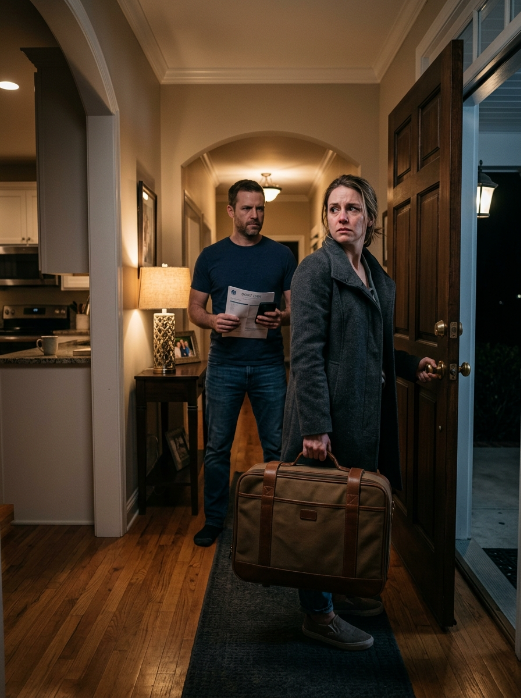
“I am protecting my daughter,” I said, standing firm between her and the hallway leading to Gracie’s bedroom. “I’ve already set your suitcase by the front door. I packed a week’s worth of your clothes while you were sitting here drinking tea. You can stay at your sister’s house across town tonight.”
“Sawyer, you can’t do this!” Helen stepped forward, her voice rising to a shrill scream that echoed off the walls. “You can’t just throw me out like trash!”
“If you don’t take your bag and walk out that door right now,” I said, keeping my voice dead steady and low, “I will call the police right this second, hand them this medical report and Evelyn’s video footage, and file a formal report for child neglect and failure to seek medical care.”
Helen froze in her tracks. She looked at my face, searching for any sign of hesitation, any opening for manipulation. But she found absolute nothing. She knew the crushing weight of the evidence sitting in my hand, and she knew I meant every single word.
She swallowed hard, her mouth trembling violently. Without saying another word, she walked over to the front entry, grabbed her wool coat and her packed suitcase from the floor, and pulled the heavy door open.
She turned around one last time, looking at me with a bitter mixture of hatred and embarrassment.
“You’re making a huge mistake,” she whispered, her voice shaking.
“Get out, Helen,” I said.
She stepped out onto the porch into the cold night air, and I shut the heavy wooden door behind her, clicking the deadbolt securely into place with a sharp metallic thud. I stood in the quiet foyer for a long time, listening to the sound of her car starting in the driveway and pulling away down the street until the tires faded into nothing.
The house was completely silent.
I walked back down the dark hallway and opened the door to Gracie’s bedroom. The warm, soft glow of her nightlight filled the room, casting gentle shadows across the walls.
Gracie was awake, her large brown eyes watching me nervously from the edge of the pillow.
“Dad?” she asked, her voice small and delicate. “Is Mom mad at me?”
I walked over to her bed, sat down softly on the edge of the mattress, and reached out to hold her small hand. Her fingers were warm, and she held onto my hand with all the strength she had left.
“No, sweetheart,” I said, leaning down to kiss her forehead gently. “Mom is gone for a while. You didn’t do anything wrong. You didn’t destroy anything at all.”
“Are you going to leave me too?” she whispered, a stray tear slipping down her flushed cheek.
“I am never leaving you, Gracie,” I said, looking straight into her eyes so she could see the complete, absolute truth in my face. “Not ever. You were very brave tonight. From now on, you never have to be afraid to tell me when you’re hurt. Nobody is ever going to tell you to keep quiet again.”
Gracie let out a long, shuddering breath, the tension in her small frame finally melting away into the mattress. She pulled her gray stuffed rabbit up under her chin, adjusted her position without wincing from the pain, and closed her eyes.
Within minutes, her breathing slowed into a deep, peaceful sleep.
I stayed sitting on the edge of her bed in the dark room, holding her small hand while the clock on the nightstand ticked toward midnight. Outside, the neighborhood was completely still. I looked at my daughter’s resting face, knowing that the road ahead of us would be long, full of legal battles, difficult conversations, and hard adjustments. But as I sat there watching her breathe softly without pain, I knew the house was finally safe.