How My Daughter’s Words About a Smelly Backpack Led Me to 412 Maple Street and Saved Mark

Forty-eight hours. That was the exact span of time that sat between my daughter Chloe coming home from the elementary school spring fair with a strange, flat comment about her classmate and the moment Deputy Miller finally kicked the lock clean out of the frame at 412 Maple Street. I have turned those forty-eight hours over in my head a thousand times while sitting at my kitchen table with a cup of cold chicory, trying to figure out how people can live three doors down from a quiet tragedy and never once smell the rot coming through the floorboards until it is almost too late to pull anyone back from the edge.
It started on a Tuesday afternoon in early May, though the weather felt more like July, the kind of heavy, buzzing heat that makes the tar on the elementary school parking lot go soft under your shoes. I was standing near the raffle booth helping Mrs. Gable sort through stacks of donated paper plates and plastic cutlery when Chloe came running across the grass with her brown ponytail whipping against the collar of her yellow shirt. She grabbed my apron strings, pulled me down toward her level, and whispered something that made my face go hot with embarrassment.
“Mom, Sophie smells like food dying,” she said, her little fingers digging into the cotton of my apron.
My first instinct, and I am not proud of this, was to shut her down right there before anyone else near the cake walk heard her. We live in a town where everybody knows everybody’s business, and the last thing I wanted was for my eight-year-old to sound like she was picking on a motherless child whose family had fallen on hard times after the mill closed down.
Sophie was in Chloe’s third-grade class, a quiet, skinny little thing who had been wearing the same oversized navy cardigan since the first frost of November, her clothes always smelling faintly of something old and damp, like a basement that had taken on water during the spring thaw.
“Chloe, hush,” I hissed, looking around fast to see if any of the other mothers were listening. “We do not talk about our classmates like that. Sophie has a lot on her plate.”
I thought she was just being a typical kid noticing someone who didn’t fit the neat little picture of our suburban PTA meetings. Her mother had passed away two years prior from a sudden lung infection that took her in less than a week, and her father, a man named Mark who used to run the drill press down at the foundry, had been struggling to keep his head above water with odd jobs and bad knees ever since.
The teachers at the school were always whispering about how rough Sophie looked lately, her socks sliding down into her sneakers and her hair unbrushed, but everyone just figured it was the usual sort of neglect you get when a broken-down widower tries to raise a little girl all by himself without any female relatives around to show him how to braid hair or match socks.
I pulled Chloe behind the canvas flap of the popcorn stand where the air smelled sweet and greasy, kneeling down until my eyes were level with hers so I could give her a proper scolding about manners and compassion.
“Look at me,” I said, keeping my voice low and firm. “Pointing at someone’s clothes or how they look is cruel. Sophie doesn’t have a mother at home to help her get dressed in the morning. You need to be kind, not judgmental.”
Chloe didn’t look down at the grass the way she usually did when she knew she was in trouble.
Instead, she locked her eyes right onto mine, her small jaw set in a way that made me realize she wasn’t being mean at all, she was trying to tell me something she didn’t have the big words for yet.
“I am not talking about her clothes, Mom,” Chloe whispered, her voice dropping down until I had to lean in close to catch the words over the sound of the portable generator chugging behind the hot dog roller. “Dirt from the playground just smells like dirt after it rains. Sophie doesn’t smell like playground dirt. She smells like our deep freezer downstairs when the power went out for four days last summer and Dad had to haul the black garbage bags out to the curb because everything went black and sour inside.”
The noise of the school fair seemed to drop out around me, like someone had reached over and turned the volume knob on a radio down to zero. The kids screaming near the bounce house, the tinny country music coming from the loudspeaker, the chatter of the women folding raffle tickets all muffled into a thick, buzzing static that made my ears ring.
“What are you talking about?” I asked, my voice suddenly sounding very thin in my own head.
“At lunchtime, she wouldn’t put her backpack in her cubby,” Chloe whispered, her fingers twisting nervously into the hem of her t-shirt. “She kept it on her lap under the table the whole time. When she unzipped it to pull out a crumpled paper napkin, I saw inside. She had a juice box that was blown up big and round like a balloon, and a plastic bag full of dark brown apples and something squishy and black. She tried to take a bite of a piece of bread, but it had green fuzz all over the corner. I told her not to eat it, and she started crying. She told me if I told Ms. Henderson, the police would come and take her dad away.”
My stomach turned over, a cold, heavy drop that felt like falling off the porch in the dark. I sat right back down on the dry grass, the heat leaving my face all at once and the blood rushing into my boots.
“How long has she been bringing that bag?” I asked, my hands starting to shake against my knees.
“A few days,” Chloe said, her lower lip trembling. “She told me she has to bring the food home because her dad is resting and he can’t go to the grocery store.”
I stood up, holding Chloe’s hand so tight she squeezed back and made a little sound of pain. I looked across the wide expanse of the school lawn toward the wooden bleachers near the back fence. Sophie was standing completely alone by the chain-link, holding a faded navy-blue backpack against her stomach with both arms like it was a shield against the rest of the world. The other children were running past her in packs, kicking up dust and giving her a wide, unconscious arc. Two mothers standing near the sign-in sheet were glancing over at her, their noses slightly wrinkled, whispering behind their paper cups of punch. They thought they were looking at a neglected kid with poor hygiene. They thought it was just the natural consequence of a widower who didn’t know how to run a washing machine.
I didn’t wait for the raffle winners to be announced. I walked straight across the grass toward Sophie, keeping my face smooth and neutral so I wouldn’t scare her off. As I got within five feet of where she stood, the smell hit me like a physical blow. It wasn’t unwashed hair or old sweat or even the musty odor of a dusty coat. It was the sour, heavy, suffocating stench of warm, spoiled dairy and rotting fruit, trapped inside heavy nylon and leaking slowly through the rusted teeth of the zipper every time she shifted her weight.
“Hi, Sophie,” I said gently, keeping my voice as soft as I could manage.
She jumped like she had been touched by a live wire, her shoulders shooting straight up to her ears, and pulled the backpack even tighter against her ribs until the straps cut into her forearms.
“Hi, Mrs. Miller,” she mumbled, staring hard at the scuffed toes of her sneakers.
“It is awfully hot out here today, isn’t it?” I said, crouching down so I wasn’t towering over her. “Chloe and I were just heading over to get some lemonade and a couple of hot dogs from the grill. Would you like to come sit with us for a while?”
Sophie swallowed hard, her little throat bobbing under the collar of her oversized sweater, and I could see the dark, purple-gray hollows under her eyes that no amount of sleep could fix. She looked exhausted in a way an eight-year-old child should never have to know.
“I can’t,” she whispered, her voice cracking slightly. “I don’t have any ticket money for the booth.”
“My treat,” I said, standing back up and offering her my hand. “Come on. The line is moving fast.”
We walked over to the wooden picnic tables behind the gymnasium where the shade was deep and cool. I bought three hot dogs, two cold bottles of water, and a bag of salted potato chips, keeping my movements deliberate and easy so she wouldn’t feel cornered. Sophie didn’t eat like a kid at a party who was just having fun. She ate with a wild, silent speed, tearing into the meat without chewing properly, her eyes darting back and forth across the yard like she was expecting someone to walk up at any second and snatch the paper plate right out from under her fingers.
While the girls sat together side by side on the bench, I walked quickly over to the chain-link fence where Ms. Henderson was standing with a clipboard and a whistle around her neck, organizing the second-grade relay teams.
“Ms. Henderson, I need to talk to you for just a second,” I said, cutting right through her cheerful greeting.
The teacher turned around, her face settling into that polite, tired mask educators wear toward the end of a long school week. “Oh, hi Sarah. Isn’t it a wonderful turn-out today? The weather really cooperated.”
“Have you noticed anything unusual about Sophie this week?” I asked, lowering my voice so the parents standing nearby wouldn’t catch the edge in my tone.
Ms. Henderson’s polite smile faded into a tight, defensive line. She let out a long breath and tapped her clipboard against her thigh. “Sarah, we are well aware that Sophie’s home life is difficult since her mother passed. Her father has limited income, and we know her clothes haven’t been clean lately. The smell in the classroom has been… well, it’s been noticeable since Tuesday. I actually sent a written notice home in her folder on Wednesday reminding her father about basic home hygiene standards and clothing care.”
“A note?” I stared at her, feeling a cold spike of anger hit the back of my throat. “Did you call him on the telephone?”
“I tried calling his cell phone yesterday morning,” Ms. Henderson said defensively, her chin coming up a fraction of an inch. “It went straight to an automated message saying the service was temporarily unavailable. Look, we have to be careful about making assumptions before we start calling social services or making a fuss. Some families in this town just live a bit roughly, and we don’t want to overstep.”
“It’s not bad hygiene, Ms. Henderson,” I said, stepping closer and lowering my voice until it was almost a hiss. “Her phone is off, she is carrying a backpack full of black, rotting food straight out of her kitchen refrigerator, and she told Chloe she can’t tell anyone because she’s scared the state will take her dad away. The smell isn’t her clothes. The smell is coming from inside her house.”
Ms. Henderson went dead pale, the red flush from the May sun draining out of her cheeks until she looked like she had taken chalk to her skin. She dropped her whistle against her chest where it clinked softly against her metal clipboard clip. “What do you mean, her house?”
“I’m going over there right now,” I said, turning on my heel. “You can either give me the address from her student file right this second or you can call a welfare check into the sheriff’s office yourself, but I am not letting that little girl carry that bag back to an empty house another minute.”
Ms. Henderson didn’t give me the address directly out of some misguided sense of school privacy protocol, but she didn’t have to. She pulled her personal cell phone out of her pocket, dialed the county sheriff’s non-emergency line right in front of me with trembling fingers, and gave them the address listed on Sophie’s emergency card: 412 Maple Street, a small frame house out on the northern edge of town near the abandoned lumber mill where the weeds grew tall against the rusted cyclone fences.
“The deputy is on his way,” Ms. Henderson said, her hand shaking as she pressed the red end call button. “Sarah, please wait for them. Don’t go inside by yourself.”
“I’m taking the girls in my car,” I said, already walking fast toward the parking lot where my blue SUV sat baking in the sun. “Sophie is not sitting on a police cruiser bumper while they sort this out.”
Five minutes later, I had Chloe and Sophie buckled safely into the back seat. I reached into my purse and handed Sophie a fresh bottle of cold water and a pretzel rod I had packed for the fair. She took them without a word, holding the cold plastic bottle flat against her cheek like she was burning up with a fever.
As I drove the three miles out toward Maple Street, my eyes kept flicking to the rearview mirror. Sophie sat as stiff as a board, her small hands clutching the plastic water bottle, staring fixedly out the side window as the suburban houses gave way to overgrown lots and rusting agricultural equipment.
“Sophie,” I said, keeping my voice as gentle as a lullaby. “We’re going to stop by your house for just a minute to check on your dad. Is that okay with you?”
Sophie froze completely. The pretzel rod stopped an inch from her mouth, and her little face crumpled inward like wet paper. Tears started leaking silently down her dusty cheeks, cutting clean little tracks through the grime on her skin.
“Please don’t get him in trouble,” she sobbed, her whole body shaking against the restraint of the seatbelt. “He didn’t mean to. He fell down.”
“When did he fall down, sweetie?” I asked, my grip tightening on the steering wheel until the leather groaned under my palms and my knuckles turned the color of lard.
“Before the weekend,” she whispered, burying her face in her small hands and crying into her palms. “He was fixing the boards on the back porch steps because they were rotting out. I heard a big bang and he screamed real loud. He couldn’t stand up after that. He had to crawl inside the kitchen on his elbows. He told me his back popped.”
My heart hammered against my ribs like a trapped bird beating its wings in a dark box. “Why didn’t he call someone for help, Sophie?”
“His phone was on the kitchen counter,” she whimpered. “He couldn’t reach up high enough to grab it. He tried to pull the cord of the wall phone down, but he couldn’t reach that either. He told me to be a big girl and bring him water from the bathroom tap in the plastic pitcher.”
“What about the lights, Sophie? What about the food?”
“The lights went dark three days ago,” she said, her voice dropping down to a raspy, dry whisper that tore at my chest. “The big box in the kitchen stopped humming and got warm inside. Everything got soft and smelled dirty. Dad told me not to open the refrigerator door anymore because the bad air made him cough real hard, but I was so hungry, Mrs. Miller. I took things out and put them in my bag so I could eat at school when nobody was looking. I tried to bring him some bread, but it had green fuzz on it and he wouldn’t eat it. He just keeps sleeping on the floor.”
I hit the gas pedal hard. We blew past the old grain elevator and took the turn onto Maple Street with tires squealing against the loose gravel.
The house at 412 was a small, white story-and-a-half with peeling paint that hung in gray curls and an overgrown front lawn where dandelions had gone to seed. The blinds were pulled down tight in every single window, giving the place a blind, dead look. Taped securely to the front screen door was a bright yellow notice from the municipal electric company, a formal shut-off warning dated four days back.
I pulled my SUV right into the dirt driveway just as a county sheriff’s cruiser turned in behind me, kicking up a cloud of white dust that settled over my hood. Deputy Miller, a steady, middle-aged guy I knew from our Wednesday night potlucks at the Methodist church, stepped out of his vehicle and adjusted his belt with a heavy sigh.
“Sarah?” he called out, walking toward my window with a deeply confused frown on his face. “What’s going on out here? Dispatch said you called in a welfare check from the school fair.”
“Mark is inside this house,” I said, opening my door and stepping down into the dust. “He fell last week. His back is broken or seriously injured, the power has been cut off for days, and he’s been lying on the kitchen floor without medical attention while his eight-year-old daughter tried to keep him alive with water from a plastic pitcher.”
Deputy Miller’s face hardened instantly, every trace of small-town friendliness vanishing into official police procedure. He didn’t ask any more questions. He moved past me with long strides and went straight up the warped wooden steps of the front porch.
He pounded heavy knuckles against the frame of the screen door. “Mark! It’s Deputy Miller! Mark, can you hear me in there?”
Nothing answered him. Only the heavy, hollow silence of a house that had been sealed up against the heat and the world.
“I’m kicking the door,” the deputy said over his shoulder, looking back at me with a grim set to his mouth. “Keep the kids in the back of the car. Do not let them look.”
He planted his heavy boot right beside the cheap brass lock, and on the second violent kick, the wooden jamb splintered with a dry crack that sounded like a gunshot.
A wave of heat and stink burst out through the opening, a thick, humid wall of stagnant air carrying the unmistakable, heavy smell of rot, unwashed skin, spoiled milk, and human misery. Even from where I stood near the bumper of my SUV, the stench was strong enough to make my stomach heave.
Deputy Miller pulled his flashlight from his belt, covered the lower half of his face with his forearm, and stepped across the threshold into the dark. “Mark!” he shouted into the gloom.
I stayed planted near my car, keeping my back deliberately turned toward the house so Chloe and Sophie couldn’t crane their necks through the open windows. Seconds dragged on like lead weights. I could hear the deputy’s heavy boots moving across uncarpeted floorboards, the sharp rap of his flashlight hitting furniture, and then his urgent voice calling into the shoulder radio clipped to his shirt.
“Dispatch, I need an EMS unit out here at 412 Maple Street right away. Priority one transport. Male subject down, conscious but non-responsive, severe dehydration and suspected spinal injury.”
Ten minutes later, the narrow dirt road was filled with the flashing red and blue strobes of an ambulance backing down the drive, its heavy diesel engine idling with a deep, vibrating rattle that shook the loose gravel. Paramedics hurried up the steps carrying a folding aluminum stretcher, a rigid backboard, and bulky orange medical bags.
Deputy Miller came back down the front steps a moment later, pulling off his blue latex gloves and tossing them toward his cruiser. His forehead was slick with sweat, and his expression was gray.
“How is he?” I asked, stepping forward so the girls wouldn’t catch the worst of it.
“He’s in terrible shape, Sarah,” Deputy Miller said softly, keeping his voice down. “He was lying on the floor in the back bedroom near the hallway. He hasn’t been able to move from the waist down since the fall. He’d been pulling himself across the floor using just his arms to reach a plastic bowl of tap water the little girl left beside him. He’s running a high fever, looks like severe pressure ulcers on his lower back, and he’s completely dehydrated. If that child hadn’t been hauling water to him from the bathroom, he wouldn’t have lasted another twenty-four hours.”
“Is he conscious?”
“Barely,” Miller said, shaking his head. “When we put the neck brace on him, he grabbed my sleeve and asked if Sophie was okay. He was crying because he thought she was going to get taken away by the state.”
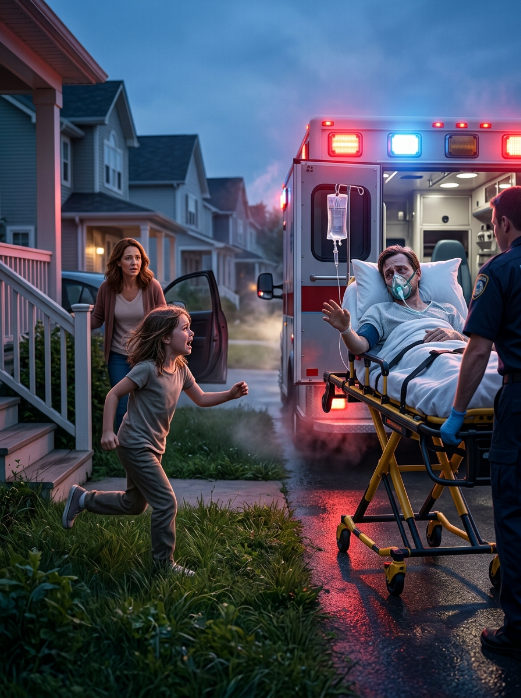
I turned and looked back at my vehicle. Sophie was sitting in the back seat, her face pressed flat against the cool glass, watching the paramedics carry a heavy, covered stretcher down the front porch steps. Mark was strapped securely under a white thermal blanket, an IV bag hooked up to a metal pole above his head, and a clear oxygen mask covering his nose and mouth.
As they rolled him toward the back doors of the ambulance, his head turned slightly toward the car. His eyes were deeply sunken, dark circles hollowed into his face like bruises, but he was searching for her.
“Sophie,” I called out, opening the car door and holding out my hand. “Come on out here for a second, sweetie.”
She scrambled out of the seat and ran to the edge of the patchy lawn, her sneakers crunching in the dirt. The lead paramedic paused for a second, lowering the stretcher slightly so Mark could see her through the open doors.
Mark raised one weak, trembling hand an inch off the canvas board. His voice came through the oxygen mask like a low, wet rasp that barely carried over the engine.
“I’m sorry, baby,” he whispered, tears running sideways into his graying hair. “I tried… I tried to get up.”
“It’s okay, Daddy!” Sophie cried, her small voice breaking into a ragged sob. “The lady bought us hot dogs! The lady fixed it!”
The paramedics loaded Mark into the back of the rig, slammed the heavy metal doors shut, and pulled away down the gravel road with their lights flashing against the afternoon trees.
Within twenty minutes, a representative from Child Protective Services, a woman with tight hair named Mrs. Vance, arrived in a gray sedan. She sat on the wooden porch steps with a black leather notepad while Deputy Miller finished writing up his formal incident report against the side of his cruiser.
“Under normal circumstances,” Mrs. Vance told me, looking over at Sophie who was sitting quietly on the hood of my car holding Chloe’s hand, “we would place a child in an emergency foster home while the parent is hospitalized and the living conditions here are investigated by the county.”
“She is not going to a shelter,” I said flatly, crossing my arms over my chest. “She has been through enough trauma to last three lifetimes in the last four days alone. I am a mother. We have a spare room, a clean bed, and a full pantry. Let her stay with us until Mark is out of danger at the hospital.”
Mrs. Vance looked at me appraisingly, then looked over at Deputy Miller. Miller gave her a slow, definitive nod. “Sarah’s a good woman, and her husband is a deacon down at the church. I’ll vouch for her placement.”
Mrs. Vance took down my driver’s license number, inspected the back of my SUV, and had me sign a temporary ninety-two-hour emergency placement form right there on the dusty hood of my car.
That evening, after two long, hot baths, a fresh set of clothes borrowed from my niece, and a huge bowl of chicken noodle soup at our kitchen table, Sophie looked like a different person. We took her old navy backpack, walked it straight out to the heavy plastic trash can in the garage, and dropped it into the bottom where it belonged. Under the warm light of our kitchen chandelier, cleaned up and wearing a soft pink sweater that smelled like laundry detergent instead of rot, Sophie didn’t look like the strange, neglected child the mothers at the fair had whispered about. She just looked like a small, tired girl who had been carrying the weight of the whole world on her eight-year-old shoulders.
Mark stayed in the county hospital for three solid weeks while the doctors worked to repair two fractured vertebrae in his lower back that had pinched his spinal nerve and caused temporary paralysis, compounded by a severe systemic infection from the floor burns. The surgeon told me later that another two days without antibiotics and fluids would have taken his life just as surely as the fall itself.
While he was recovering, our town did what it should have done months before the accident happened.
We didn’t let the state take Sophie away. I kept her at my house for the entire month, packing two lunches every morning and sending both girls off to school together on the yellow bus. The school board held an emergency meeting on a Tuesday night and changed their student welfare policies, making it mandatory for teachers to conduct an immediate direct home check if a child shows sudden signs of physical neglect or missing utilities, rather than just sending written notes home in folders that never get opened.
A local contractor who went to our church repaired the rotting back porch steps at Mark’s house for free. The congregation raised $4,200 to pay off his back electric bills, restock his kitchen cabinets with fresh food, and buy him a brand-new refrigerator to replace the old one that had died in the heat.
When Mark was finally discharged in a temporary wheelchair to start six months of physical therapy, I drove Sophie home to meet him on a bright Tuesday afternoon.
The front yard had been mowed down to a neat, clean green. The yellow shut-off notice was gone from the screen door. The front jamb had been planed and repaired, and the house smelled faintly of pine cleaner and fresh air from windows that had been pushed wide open to the breeze.
Mark was sitting in an armchair in the living room with a blue quilt over his knees. He looked thin, and his face was lined with gray, but the color had come back into his cheeks. When Sophie ran through the front door and threw her arms around his neck, he held her so tight his knuckles turned white, burying his face in her hair and weeping silently without any pride left to hold him back.
I stayed out on the front porch for a few minutes to give them their privacy, watching the afternoon sun filter through the oak trees in the yard.
Before I left to walk back down the drive, Mark called me over to the open doorway. He reached out and took my hand in his, his grip still rough and calloused from years of machine work.
“Sarah,” he said, his voice thick with unspoken emotion. “I don’t even know how to begin to thank you for all of this. You saved my life. And more than that, you saved my little girl.”
“Don’t thank me, Mark,” I said softly, looking back at Chloe, who was standing in the doorway holding a box of fresh juice boxes we’d brought over for the pantry. “Thank Chloe. She was the one who actually listened to what Sophie was trying to say when nobody else wanted to hear it.”
Now, every single morning when the yellow school bus stops at the corner of Maple Street, I watch from my kitchen window while I stir my coffee.
Sophie comes down the porch steps, clean and bright in a new yellow coat that fits her shoulders just right, carrying a red lunchbox in her hand. When she gets to the gravel stop, she climbs up the green steps and sits right beside Chloe on the long bench.
I watch the bus pull away down the road, and I thank God for the small, strange things children notice when the rest of us are too busy to pay attention.