How My Uncles Handed Me a Broken Clock and Met Grandfather’s Hidden Land Trust

The red dust on my grandfather’s gravel drive had barely settled before my Uncle Dale shoved a taped-up cardboard box against my chest and told me to get the junk off his property. We were standing outside the old mountain cabin near Knoxville where Granddad Earl had lived for eighty-four years, managing ninety acres of pine and oak ridges with a quiet hand that nobody else in the family ever understood. Dale had already stripped the keys to the Ford pickup out of the kitchen bowl before the funeral home transport had even cleared the county line, and Uncle Wayne was sitting on the tailgate with a legal pad, tallying up the tools in the shed like he was liquidating a bankrupt hardware store.
I was thirty-two then, working as a junior project analyst down in Charlotte, and I had driven three and a half hours through the mountains just to help carry things to the curb because my mother asked me to, not because Dale or Wayne wanted my face around. They always treated me like a visitor who didn’t know which end of a shovel to grab, a city boy who sat on the porch listening to stories about watershed management instead of sweating over hay bales. When Dale shoved that heavy clock into my arms, the mahogany veneer on the back was peeling off in dry, gray strips, and the pendulum hung sideways inside the glass like a broken limb. Dale leaned his forearms against the truck bed and spat into the weeds. You always were Earl’s favorite project, Chris, he said, his voice grating against the quiet mountain air. You want a piece of him, take the clock.
The mechanism seized up three years ago and it weighs fifty pounds of dead wood. It would not fetch five dollars at a Saturday morning tag sale in town. Wayne did not look up from his clipboard where he was writing down the serial number of Granddad’s old chain saw. Just take it and get out of our hair, Chris, Wayne muttered, not even bothering to look me in the eye. Granddad kept that heavy thing around like it was made of solid gold, but it hasn’t chimed since the winter of twenty-one. It is just dead weight. I did not argue with them because arguing with Dale and Wayne was like trying to stop a freight train with a pocketknife. I carried the heavy box out to my sedan, set it carefully on the floor behind the front passenger seat so the rotting wood would not stain the cloth, and drove back down the interstate to Charlotte with ninety dollars of gas in the tank and a hollow feeling in my chest that had nothing to do with the clock.
For two full years, that broken mantel clock sat on the top shelf of my bookshelf in my small apartment, gathering a thin layer of city dust while the rest of my life moved forward in spreadsheets and quarterly reports. I told myself Granddad had simply let go at the end because living alone on a ninety-acre ridge takes a toll on an eighty-four-year-old man, and the constant pressure from my uncles must have worn him down until he stopped fighting them. I remembered how he used to walk those timber trails every single morning at six o’clock, his boots crunching on the frost-heaved dirt, stopping to check the growth rings on the white oaks he had planted back when my mother was still a little girl in pigtailed dresses. He was a deliberate man who measured his words the way he measured board feet, never wasting a sound. I figured Dale and Wayne had simply outlasted him, wearing him down until he signed over his checking accounts and handed them the keys to his truck without a fuss.
That assumption held up in my head until a rainy Saturday morning in November when I finally bought a brass cleaning kit and a small set of jeweler’s screwdrivers from the hardware store down the street, intending to scrape off the peeling veneer and turn the old housing into a small liquor cabinet or a bookshelf decoration. I lifted the heavy thing down from the shelf, cleared a spot on my kitchen counter, and laid it flat on its face across a folded dish towel. The air in my apartment smelled faintly of old cedar and damp wool every time I moved it, a smell that always brought back the porch of the Knoxville cabin and the sound of cicadas in the high maples. When I angled my gooseneck desk lamp directly over the back panel, I noticed something that made my thumb pause against the brass corner bracket. The four small screws holding the lower access panel in place were not old iron-oxide screws like the rest of the hardware on the case.
They were bright, clean, brass machine screws with sharp, unblemished cross-slots that gleamed under the halogen bulb like they had been screwed in yesterday afternoon. The wood surrounding them was scarred and darkened by forty years of woodsmoke and stove oil, but the slots in the screw heads were pristine, showing fresh brass where a modern screwdriver had turned them with firm, deliberate pressure. Someone had been inside this sealed compartment long after the clock stopped keeping time. Someone who knew exactly what they were doing and wanted to make sure nobody else ever looked.
My fingers were slightly cold as I picked up the small Phillips-head bit from my plastic kit and fitted it into the first screw head. It turned with a smooth, silent rotation, backing out without the gritty screech of aged metal that I expected from an eighty-year-old piece of furniture. When all four screws were lying on the tile counter, I used the tip of a butter knife to pry up the edge of the lower wooden panel, which gave way with a soft suction sound as old glue finally let go. It was a false bottom, carefully cut from a scrap piece of quarter-sawn white oak that had been planed down in Granddad’s own workshop with a hand plane, leaving those distinct, rhythmic rippled marks across the grain that I had watched him carve a hundred times when I was ten years old. Underneath that false floor lay a narrow, shallow recess carved into the heavy pine base of the housing, perfectly sized to keep things away from the gears and the pendulum spring.
Resting inside that hidden compartment was a flat bundle wrapped tightly in heavy black oilcloth and secured with several rounds of yellow electrical tape that still smelled fresh and sticky. I peeled the tape back with my thumbnail, the rubbery squeak sounding loud in the quiet apartment, and pulled out three folded sheets of thick parchment paper stamped with the official raised seal of the Knox County Register of Deeds. Along with the deeds came a black leather pocket ledger with its spine cracked down the middle and a handwritten letter folded once across the center, written in Granddad Earl’s sharp, slanted fountain pen ink that never quite faded. I unfolded the top legal document first, my eyes scanning the dense blocks of formal legal language until I hit the words that made my breath catch in my throat. It was a recorded land trust agreement and a general warranty deed for the entire ninety-acre ridge outside Knoxville, executed, witnessed, and legally recorded three months before Granddad passed away.
It did not belong to the estate. It did not belong to Dale, and it did not belong to Wayne. Granddad had conveyed the entire ninety acres into an irrevocable conservation land trust, naming me as the sole managing trustee and direct legal owner upon his death, with strict covenants forbidding any commercial timber harvesting, subdivision, or development for ninety-nine years.
I picked up the handwritten letter next, my thumb tracing the familiar slant of his letters against the cream-colored paper. Chris, the letter began, if you are reading this, you took the clock home like I knew you would. Your uncles think with their pocketbooks and their boots, and they measure everything by what it can fetch at a scrap yard. When my knee gave out three years ago, Dale came up here with a timber scout from Chattanooga, talking about clear-cutting the north slope for fast paper money while my back was turned. They thought I was too old to stop them, so I stopped winding this mantel clock the day after that timber scout walked my property line. I let it sit dead on the shelf so Dale and Wayne would mark it down as worthless junk and hand it straight to you without opening the back. The ridge is yours now, Chris, and you have the legal power to keep the chainsaws off those trees.
Don’t let them strip the hill. Attached to the back of the deed was a small white business card for Mr. Thomas Vance, an attorney whose office sat on Main Street in downtown Knoxville, right across from the stone courthouse steps. My stomach dropped as I opened the black leather pocket ledger and turned to the final pages. The entries were written in Granddad’s neat, sharp accounting hand, noting every gallon of fuel, every repaired fence post, and finally, a transcript of a conversation he had overheard in his own kitchen just weeks before his death. Uncle Dale had already approached a commercial logging outfit from over the ridge, offering them an unrecorded, cash-under-the-table contract to clear-cut the ninety-acre property for a hundred and twenty thousand dollars in hand-delivered cash, splitting the take between himself and Wayne before the probate court even opened the estate files. I sat at my kitchen table in Charlotte for nearly twenty minutes, staring at the bright brass screws and the raised county seal, realizing that my uncles had stripped Granddad’s checking account, taken his truck, and dismissed his life because they were too arrogant to look inside something they had already labeled as trash.
My phone rang two days later while I was sitting at my desk trying to figure out how to take a three-hour drive back to Tennessee without losing my job over an emergency absence. It was my cousin Sarah, Dale’s youngest daughter, who had always stayed on the sidelines of the family squabbles because she was studying nursing down in Chattanooga. Her voice was thin and shaking so badly I could hardly make out the words over the static of her cell phone connection. Chris, you need to call someone or come up here right now, she whispered, her breath coming in short hitches like she was hiding behind a barn door. Dad and Uncle Wayne brought a whole crew up to the ridge about an hour ago. There are three logging trucks, a big yellow skidder, and six men with chainsaws already unloading by the lower pasture gate. Dad told everyone he has the sole power of attorney and that he sold the timber rights fair and square this morning.
They are starting on the north slope first, right where Granddad planted those white pines back in sixty-four. I did not call Uncle Dale. I did not send a text message to warn him or ask him what he thought he was doing. I simply opened my briefcase, slid the oilcloth bundle and the deeds inside next to my laptop, grabbed my car keys off the kitchen counter, and drove straight down I-40 toward Knoxville with the windows rolled up and the radio off so I could hear the hum of the tires against the concrete. By eleven o’clock that morning, I was sitting across a mahogany desk from Mr. Thomas Vance in his second-floor office near the courthouse square. Mr. Vance was seventy-one years old, wore silver-rimmed wire spectacles that slipped down the bridge of his nose every time he looked up, and had represented my grandfather through three separate property disputes and a boundary line lawsuit back in the nineties.
He adjusted his glasses, pulled the oilcloth bundle from my briefcase, and spent twenty minutes reading every line of the recorded trust agreement before bringing up the Knox County property registry on his computer screen with a slow, deliberate click of his mouse.
Earl came to see me right after your Uncle Dale tried to force that fraudulent power of attorney document on him at the hospital, Mr. Vance said, leaning back in his leather chair and folding his hands across his stomach. Your grandfather knew exactly what his boys were planning the minute his health started failing. He paid the legal fees out of a separate cash account they didn’t know existed, and we made sure this conservation trust was fully recorded with the county clerk before the stroke hit him. The land was legally transferred to you two years ago, Chris. The total valuation of the acreage is sitting at four hundred and fifty thousand dollars on paper, but the timber rights are locked tight under a perpetual conservation covenant. Nobody, not Dale, not Wayne, and not a judge in this county, can touch a single tree without your explicit written consent as the sole managing trustee.
Mr. Vance stood up, walked over to a heavy gray filing cabinet in the corner of the room, and printed out three certified copies of the registered deed along with a formal cease-and-desist injunction notice stamped with the seal of the chancery court. Your uncle’s timber contract for one hundred and twenty thousand dollars in cash is completely null and void, Vance said, picking up his suit coat from the back of his chair and reaching for his car keys. In fact, it crosses the line straight into commercial fraud and criminal trespass. Let’s go take a drive up the ridge and see what they’re tearing down. We arrived at the family property just before two in the afternoon, turning off the state highway onto the gravel track that wound up through the lower cedar trees. The quiet mountain air, usually filled with the sound of wind through the pines and the distant call of blue jays, was completely ruined by the roaring, high-pitched whine of two professional chainsaws and the heavy, rattling diesel thrum of a yellow track skidder tearing up the earth along the access road.
Two large white pine trees, straight-grained and forty feet tall, had already been felled near the old entrance gate, their green boughs crushed flat against the weeds where the skidder had dragged them out of the way.
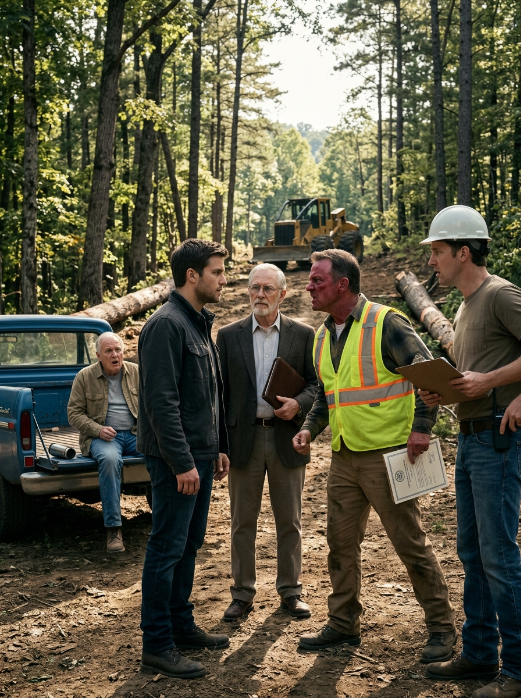
Uncle Dale was standing near the edge of the clearing wearing a high-visibility yellow vest over his flannel shirt, waving his arms to direct the logging foreman, a broad-shouldered man in a red hard hat who was holding a clipboard under his arm. Uncle Wayne was sitting on the tailgate of Granddad’s old Ford F-250, drinking black coffee from an insulated thermos and watching the crew drop a third pine with a sharp, cracking snap that echoed off the ridge. When Mr. Vance’s sedan pulled up to the edge of the clearing and stopped right behind Dale’s truck, Dale spat onto the gravel, wiped his mouth with the back of his work glove, and walked over with a smug grin stretching across his face. Well, look who finally decided to show up for a family visit, Dale called out, raising his voice to cut through the noise of the idling engines.
You are about three hours too late to stop anything, Chris. We are clearing out the south lot before the rain hits tonight, and the timber buyer has already wired our deposit. You might as well turn that little city car around before you get dust all over the fenders. I stepped out of the passenger side of the sedan, keeping my feet steady on the loose gravel, and looked him straight in the eye without flinching. You need to signal the crew to shut down those saws right now, Dale, I said, my voice sounding flat and quiet against the roar of the diesel engine. Dale let out a short, barking laugh, shaking his head as he looked over at the foreman in the red hard hat. You hear that, Mike? The boy thinks he’s running the farm now that the old man is gone. Listen to me, Chris, this land belonged to my father, and Wayne and I are his rightful heirs.
We are taking care of business the way it should have been done years ago. You take your sedan back to your desk job in Charlotte and let the men do their work. Mr. Vance stepped out from behind the car door, his white hair catching the afternoon sun, and pulled the certified county records from his leather folder with slow, deliberate movements. He didn’t raise his voice either, but his tone had that cold, sharp authority that only fifty years of practicing law in small-town courtrooms can buy. My name is Thomas Vance, representing Chris as the sole legal owner and managing trustee of this ninety-acre property, Vance said, holding the papers out toward the foreman. This land was placed into a perpetual conservation trust prior to Earl’s passing. The deed was legally recorded with Knox County two years ago, and Chris holds absolute title to every square foot of timber on this ridge.
Mr. Dale logging this land is committing illegal trespass, conversion of assets, and commercial fraud.
The logging foreman stopped walking, his hand hovering over his clipboard as he looked down at the raised county seal and the bright blue ribbons attached to the legal documents. He looked over at Dale, his expression hardening instantly from casual indifference to cold anger. Dale, what the hell is this? the foreman demanded, stepping back from him. You told us you had sole power of attorney and owned the timber rights outright with zero encumbrances on the title. You signed a binding timber warranty statement this morning. He’s lying, Dale shouted, his face turning a dark, bruised red as he lunged forward toward Mr. Vance with his fists clenched at his sides. Earl was out of his mind at the end of his life! He didn’t leave nothing to this city boy! All Chris got was that piece of junk clock off the mantel! The deed was hidden inside the frame of that exact clock, Uncle Dale, I said, taking two steps forward so he had to look at me instead of the lawyer.
Granddad put brand-new brass screws in the back panel three weeks before he died because he knew you’d steal everything else in his house, and he knew you’d hand that silent clock straight to me thinking it was worthless. Wayne dropped his thermos onto the truck bed with a loud metallic clatter, his mouth hanging open as he stared from me to the county paperwork in the lawyer’s hand. The foreman immediately grabbed the portable radio off his belt, pressed the call button twice, and yelled into the speaker at the top of his lungs. Shut ’em down! Kill the saws right now! Load the gear and pull the skidder back to the road! The roaring whine of the chainsaws died away across the mountain slope within ten seconds, leaving behind a strange, heavy silence broken only by the whistling of the wind through the remaining pines and the clicking of hot exhaust pipes cooling down in the weeds.
The timber company packed their heavy machinery onto the flatbed trailers and hauled everything off the ridge before five o’clock that evening, leaving behind deep mud ruts and the two fallen pines lying awkwardly across the brush. Because Uncle Dale had signed an unrecorded warranty agreement claiming full ownership that he did not possess, the logging outfit served him with an immediate breach-of-contract notice and slapped him with a fifteen-thousand-dollar penalty fee for mobilization and equipment transport costs before they pulled their trucks off the property. Dale stood by his truck with his hands jammed deep into his pockets as the last flatbed rolled down the gravel lane and disappeared around the lower bend, his face set in a mask of bitter hatred that didn’t need any words to explain it. He and Wayne got into Granddad’s old Ford without looking at us, slammed the doors hard enough to rattle the side mirrors, and drove away down the mountain without speaking another syllable.
We haven’t exchanged a single word or a single glance since that afternoon on the ridge, and the family name feels smaller than it used to, but the trees are still standing. I spent the next three days in Knoxville working alongside Mr. Vance to finalize the permanent boundaries of the Earl Conservation Trust, ensuring that the ninety acres are fully protected under Tennessee state law so that no commercial developer or disgruntled relative can ever touch those woods again. I drove back to Charlotte on Tuesday evening, the interstate smooth beneath my tires as the sun dipped below the western ridge and painted the sky in shades of bruised purple and gray.
My apartment was quiet when I unlocked the front door and stepped inside, the air smelling of the city dust that always settled on the windowsills after a few days away. I walked over to the kitchen island, picked up the small precision screwdriver I had left on the tile counter, and carried the mahogany mantel clock into the living room where I set it upright on the sturdy wooden shelf above my desk. I adjusted the inner escapement wheel, replaced the heavy brass weights on their chains, and reached out with my index finger to give the tarnished brass pendulum a gentle, measured push to the left. The clock gave a small, rhythmic tick, caught the mechanical beat on the rebound, and began to swing steadily back and forth with a dry, reliable sound that filled the room. A moment later, the internal hammer struck six times against the coiled wire gong, clear and deep, rolling out into the quiet space like a bell across a mountain valley. I sat down at my desk, pulled my laptop toward me, and listened to the slow, steady tick keeping time in the dark room, knowing that Granddad had known exactly what he was doing when he let the clock run down to save the mountain from the saws.