How Cleaning Out My Dead Neighbor’s Freezer and Backyard Revealed Forty-Seven Missing Children and My Own Name

“We can’t just leave her porch to the demo crews,” I told my brother-in-law over the phone while the rain tapped against the kitchen window with that dull, rhythmic thud that always made my shoulders tighten up.
I knew you’d call me a fool for spending $187,000 on an eighty-two-year-old dead woman’s house with no family and no will, but Clara Vance had lived next door to me for fourteen years, and fourteen years leaves a mark on a man whether he wants it there or not.
I’m the one who shoveled the heavy wet drift off the end of her driveway every January so the county plow wouldn’t pile it three feet high against her cedar gate, and she’s the one who brought over a warm plate of lemon-drenched pound cake when my truck transmission dropped out in the middle of the street back in nineteen-ninety-eight. When the county coroner hauled her out on a Tuesday morning with nobody following the black van, it felt like an insult to the quiet way she kept her yard swept clean of maple leaves every autumn.
The county put the two-story craftsman house on the courthouse steps with a minimum bid that barely covered the back taxes, and I cleared out my savings account down to $1,412.30 to make sure no out-of-state developer with a slick suit and a stack of demolition permits got their hands on those old floorboards.
The title clerk handed me the brass key ring with a dry paper-cut smile and told me the estate was officially clear, no heirs, no debts, lock, stock, and barrel mine.
Two weeks after the deed was recorded in my name at the county annex, I walked over the threshold with a box cutter, two rolls of heavy-duty contractor bags, and a pair of yellow rubber gloves that smelled faintly of old bleach. The air inside had that flat, heavy stillness of a place where nobody had opened a window since the first frost, smelling faintly of dried lavender sachets and old paper tucked away in dark closets. I started in the kitchen because it was the heart of the house, a place where Clara used to stand at the porcelain sink peeling potatoes with a paring knife that was worn down to a sharp silver sliver from thirty years of sharpening.
The counters were wiped down to bare wood, the cupboards lined with clean butcher paper held in place by yellowing Scotch tape, and every spice jar arranged in alphabetical order by a hand that must have been steady as a rock before the arthritis finally knotted her knuckles. When I pulled open the top door of the heavy upright white freezer in the utility pantry to turn off the compressor and let it thaw out, my thumb brushed against something stiff and square tucked right behind the wire shelf basket.
Stacked in neat, precise columns alongside small frozen plastic containers of vegetable soup were white paper envelopes, frozen hard and stiff like cedar shingles in January. I reached in with my rubber glove and pulled one out, the frost flaking off the heavy-stock security paper onto my sleeve. Written across the front in Clara’s sharp, delicate cursive was a single date from twenty-three years ago, accompanied by a small black number marked with an indelible grease pencil: #1.
I stood there in the quiet kitchen with the hum of the compressor dying down in my ears, staring at the little number while the damp chill from the freezer bit right through the thick rubber of my glove. The entire top shelf was packed tight with them, wedged in between bags of frozen garden peas and a stale loaf of Pepperidge Farm bread that had probably been in there since the Reagan administration.
I pulled them out one by one, counting out loud in the cold, dim room just to hear a human voice bounce off the clean tile walls. There were forty-itude seven identical envelopes in total, forty-seven heavy security packs wedged into every corner of that white metal box like bricks in a dry-laid wall. Each one was numbered sequentially from one up to forty-seven with the same precise ink. Each one bore a date spanning a timeline that stretched back over two decades, right up to six months before Clara passed away in her sleep with her old chenille bedspread pulled up to her chin.
My fingers were stiff from the cold air pouring out of the compartment, but the back of my neck was sweating as I used my pocketknife to slice through the yellowed tape of envelope #1. Inside was a thick stack of hundred-dollar bills bound with a dry rubber band that snapped the second I touched it: exactly $5,000 in cash, the bills crisp and smelling faintly of old bank vaults. Beneath the currency lay a single Polaroid photograph, the edges curling just slightly from twenty years of sub-zero storage.
It was a headshot of a little boy, no older than four, wearing a red windbreaker, looking straight into the lens with serious, dark eyes that didn’t look like they belonged to a child who had ever laughed at a cartoon. I laid it on the clean counter and reached for the second one, my heart hitting a slow, heavy rhythm against my ribs like a hammer striking an old oak stump.
$5,000 cash. A photograph of a little girl, maybe three years old, with yellow hair ties holding back wisps of fine brown hair.
The third envelope. $5,000 cash. A Polaroid of a toddler sitting on a cracked vinyl kitchen chair with his tiny fists balled up in his lap.
Every single envelope contained the exact same thing: five thousand dollars in hundred-dollar bills and a photograph of a young child, ages ranging strictly between three and six years old, their faces frozen in time on fading square film. Forty-seven envelopes. Forty-seven different children looking out at me from the shadows of a dead woman’s pantry.
My hands started shaking so violently I dropped the stack onto the butcher-block counter, the heavy bills scattering across the surface like dry leaves in a gust of wind. The total cash alone was sitting at nearly a quarter million dollars in plain sight, but it was the faces in those photographs, silent and innocent, that made the room spin until the white cabinets seemed to tilt sideways.
I backed away from the counter, pulled out my phone with a thumb that wouldn’t stop twitching, and dialed the local precinct’s non-emergency line before my common sense could talk me out of it.
Detective Miller arrived forty minutes later in an unmarked sedan that leaked a little dark oil onto Clara’s clean gravel drive. He was a broad-shouldered man in his late forties with tired eyes that looked like they hadn’t seen a full night’s sleep since the county built the bypass, and he had a slow, methodical way of walking that showed he wasn’t going to let anyone rush him through his day. He stood in Clara’s small kitchen, looking down at the forty-seven stacks of cash and the grid of children’s faces I had carefully lined up across the table in rows of ten, like soldiers waiting for an inspection that wasn’t ever going to come.
“Did she have extended family?” Miller asked, leaning over the table, his rubber-gloved fingers hovering an inch above the photo of the small boy in the oversized wool sweater. “Grandchildren? Great-nieces? Maybe she was keeping trust money for her sister or something.”
“She had no children,” I said, my voice sounding thin and dry in my own ears. “Detective, I lived next door to Clara for fourteen years, and I’m telling you she never had a soul cross that front threshold except the mailman and the propane guy. I brought her groceries when she broke her ankle on the ice. I walked her mail up to her porch when it rained. She had no husband, no kids, no visitors. She was entirely alone.”
Miller stared at me for a long moment, his jaw working a piece of mint gum from one side of his mouth to the other, then reached out and picked up five of the photographs with two fingers. “Let me take these back to the station. I’ll run them through the national database just to see if anything lights up in the system. Sometimes old ladies keep strange things for people who asked them to, but this is a hell of a lot of cash for a retired legal secretary.”
He left with five of the photos tucked into his inside jacket pocket, his car door slamming with a dull, heavy thud that rattled the old windowpanes in Clara’s front room. I stayed in the house, sitting at Clara’s kitchen table in the dimming afternoon light while the shadows stretched long across the linoleum, unable to leave the remaining forty-two pictures alone in the dark house.
Three hours later, Miller’s cruiser pulled back into the driveway without turning on its headlights, crunching quietly over the fine gravel. He did not walk up to the house with his usual measured pace; he almost ran, his heavy boots clattering against the cedar boards of the front porch before he pushed through the back door without knocking. His face was the color of skim milk, and his jaw was set so hard his cheek muscles looked like knots under his skin.
“We got hits,” Miller said, his voice clipped and urgent like a man reading off a casualty list during a shift change at the mill. “I ran the first five photos through the National Center for Missing and Exploited Children database. All five matched open cold cases from across four states. Missing children cases spanning twenty-three years.”
Cold air seemed to rush out of the walls, smelling of old cedar and damp earth even though the windows were latched tight. My stomach dropped into a bottomless void where the floorboards should have been.
“Clara…” I whispered, looking down at the neat rows of smiling toddlers who didn’t know what was coming for them. “Was she… was she taking them?”
“We don’t know yet,” Miller said, reaching for his portable radio to call for state police backup and a forensics team out of the county seat. “We need to search every inch of this house before somebody tries to burn it down or clear it out.”
As Miller stepped back onto the back porch to make his call into the night air, I turned back to the upright freezer to check if we had missed anything tucked away in the back corners of the frosted compartment where the light didn’t reach.
Tucked flat against the very top ceiling of the freezer chest, hidden behind a frost-covered metal lip that blocked the view from the front, was a forty-eighth envelope.
It was not numbered. It was not sealed with yellow tape. Written across the front in clear, unfaltering cursive that hadn’t trembled once was my own name: Arthur Vance.
My pulse hammered in my ears like a piston in a rusted cylinder as I pulled it down. Clara knew I was the only neighbor who had talked to her about the house over the years, and she knew I would be the one standing in her kitchen with a box cutter when she was finally gone.
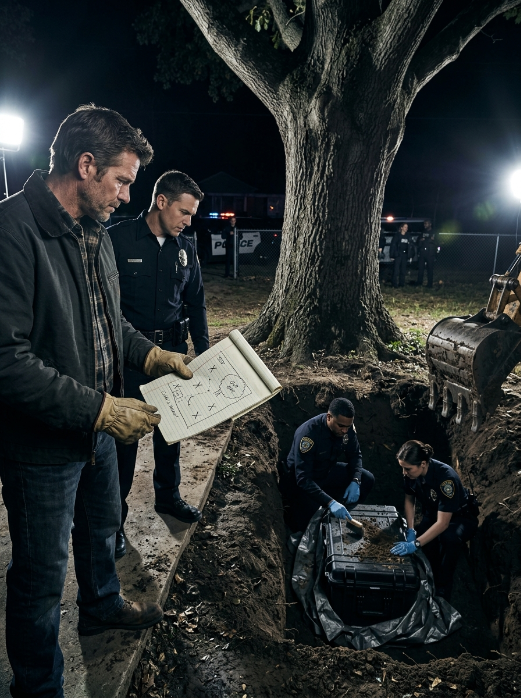
Inside envelope #48, there was no cash and no Polaroid of a child. There was a single sheet of lined notepad paper folded in half three times, and a carefully drawn map of the three-quarter-acre backyard behind the craftsman house, drafted in blue ballpoint pen with notes written in the margins. The map showed the old white oak tree, the perennial flower beds along the fence line, and the rusted chain-link gate. Dotted across the lawn were six distinct, heavy ink X’s marked with precise measurements from the back corners of the foundation.
I unfolded the letter on the counter under the buzzing fluorescent light. Clara’s handwriting was steady, precise, and entirely devoid of any sign of fear or old age.
“If you are reading this, my long watch is finished, and the house is yours,” the letter began. “I chose you because I knew you were a person of quiet order and deep kindness, someone who would not hide what you found, nor allow it to be buried by greed or convenience. I know what the police are thinking right now. They think I was a monster. They think I stole those sweet souls from their mothers. I did not take them. I saved them.”
My hand started shaking so badly the paper rattled against the formica.
“Twenty-three years ago, I discovered that the private adoption broker I worked for as a legal secretary was running an off-grid trafficking ring right out of the county records office,” the letter continued in that same sharp hand. “They staged disappearances, wiped birth records, and sold children to high-paying illegal transfers across the state line. The law enforcement in our county at that time was compromised, tied directly into the brokerage’s payroll through silent partnerships. I couldn’t go to them because they would have buried me in a pine box before I reached the county line. So I began my own war. For twenty-three years, I used every cent of my savings, every pension check, and every secret payment I could squeeze out of that system to intercept those transfers before the papers were filed. I bought those forty-seven children out of the ring before they could disappear into dark places where nobody would ever find them.
I placed every single one of them into safe, vetted, off-grid open-adoption families across the country where they were loved like their own. The $5,000 in each freezer envelope was set aside as emergency setup funds for their true identity restoration, money meant to help them when the truth finally came to light. The photos in the freezer are who they were when I saved them from the broker’s back room. Start digging where the six X’s are in the backyard. What you’ll find there is their true names, and the living truth that will bring them home.”
“Miller!” I shouted, dropping the letter onto the table and rushing to the back porch where he was still talking low into his radio. “Cancel the forensics unit for the house! Tell them to bring backhoes and ground-penetrating radar instead!”
By midnight, powerful halogen floodlights illuminated Clara’s backyard, casting long, stark shadows across the wet grass like prison yard towers. Local police cruisers, state investigators, and federal agents filled the narrow gravel drive, their dark uniforms stark against the bright glare of the lights. I stood by the edge of the patio, holding Clara’s letter in my gloved hands alongside Detective Miller, who hadn’t said a single word since he read the second paragraph of the note.
The first excavator bucket bit into the dark earth near the base of the old white oak, the exact location of the first X on Clara’s hand-drawn map.
Four feet down in the damp clay, the heavy metal teeth struck something hard and hollow with a dull, metallic thong that echoed across the quiet neighborhood.
Officers jumped into the open trench with square-nosed shovels, brushing away the dark soil with quick, nervous strokes until they uncovered a heavy-duty, commercial-grade waterproof fire-chest, sealed tight with silicone grease and wrapped in several layers of industrial plastic tarps.
One by one, over the next four hours while the dew soaked through my work boots, the excavation crew unearthed all six chests from the designated coordinates in the yard, lining them up along the grass like small coffins waiting for a service.
Inside the brightly lit kitchen, surrounded by federal agents and cold-case detectives who looked like they hadn’t slept since the administration changed, Miller unlatched the heavy brass clasps of the first chest.
Inside was not tragic evidence of harm or forgotten bones, but an immaculate, airtight archive of human life preserved in plastic sleeves and manila folders.
The chest was lined with organized ledger books, legal files, DNA reference swabs preserved in airtight glass vials, original state birth certificates stamped with gold seals, and detailed location logs written in Clara’s neat hand. Every single envelope from the freezer corresponded directly to a master file in the buried chests.
File #1 matched envelope #1 down to the last digit. It contained the boy’s real birth name, his original parents’ names from a small town two counties over, the hospital where he was born before the records were scrubbed, the identities of the trafficking brokers who had taken him from his crib, and the exact names, addresses, and contact numbers of the loving adoptive couple Clara had placed him with twenty-three years ago when he was just a baby in a red windbreaker.
File after file, chest after chest, revealed the same meticulous detail. Forty-seven complete paper trails. Forty-seven biological identities preserved against the dark. Forty-seven safe, protected placements that had grown up without knowing the woman who bought their safety with grocery money and winter coats.
Clara had not just saved forty-seven children from a black-market network; she had kept an unbroken, ironclad chain of evidence that proved where every single one of them was today, down to their school report cards and dental records.
“She kept them safe,” Miller breathed, staring down at a modern color photograph attached to File #1 showing the boy, now a twenty-seven-year-old high school history teacher in Ohio with a wife and a baby of his own. “She didn’t just hide them. She tracked them as they grew up year after year like a ghost watching over a nursery. Every single one of these kids is alive and walking around.”
The investigation swept forward with the precision of a clockwork machine over the next six months, while the local paper tried to make sense of why the old lady next door had a quarter million dollars in her freezer and a paper trail buried under her hydrangeas. State and federal task forces used Clara’s buried archive to systematically dismantle the remnants of the old trafficking ring, bringing legal accountability to the aging brokers and corrupt officials who had profited from stolen lives decades earlier before they could slip away into retirement.
More importantly, the process of restoration began with the quiet dignity of a church service.
Because of Clara’s irrefutable records, DNA profiles, and preserved emergency funds, federal family advocates were able to delicately contact all forty-seven now-grown adults with proof of where they came from. They brought answers to forty-seven biological families who had spent decades staring at empty bedrooms during the holidays, praying for a miracle they thought would never come while the years slipped away.
The house remained mine by deed and by right. The county cleared the property tax liens, the temporary floodlights were packed away into state vans, and the deep trenches in the garden were backfilled with fresh, rich topsoil that smelled of rain and new grass.
On a warm morning in early May, nearly a year after I first unlocked the front door with my box cutter, I stood at the edge of the backyard where the white oak was just starting to push out its first tiny green buds. The turned earth was green again, covered in a thick carpet of fresh grass and blooming wild clover that bees were humming over in the morning sun.
A sedan pulled into the gravel driveway behind the house, its tires crunching softly against the stones.
I turned to see a woman in her late fifties step out of the passenger side, her hands trembling as she looked up at the cedar porch where Clara used to sit with her knitting. Beside her walked a twenty-six-year-old woman with yellow hair ties holding back her dark hair: the very same girl from Polaroid #2, looking around the yard with eyes that took in every blade of grass.
They held a thick manila folder containing Clara’s records against their chests, their gaze scanning the peaceful garden where the truth had been kept safe in the cold dark ground while the world went on around them.
I stepped back toward the shadow of the porch, leaving them alone in the quiet yard under the morning light, holding Clara’s handwritten ledger close to my own ribs as the first reunited family walked across the grass to say thank you to the woman who had brought them home.