How My Husband Told Everyone I Was Losing My Mind and Met My Grandfather’s Irrevocable Trust

My grandfather always told me that a man who builds his house on borrowed sand will spend the rest of his life watching the tide come in. He said it back when I was twelve, sitting on the dusty porch of his hardware store in Spartanburg while he wiped the grease off his knuckles with an oily rag, and I didn’t understand a single word of it. I thought building meant pouring concrete and swinging hammers, the heavy physical work of the world that my uncles did until their backs gave out before they turned fifty.
Andrew loved quoting my grandfather during our first few years together, back when he was driving a rusted Ford pickup with a dented tailgate and wearing work boots that smelled permanently of wet clay and diesel fuel. He would lean against the kitchen counter, toss his keys into the ceramic bowl with a metallic clatter, and tell me that Thomas Vance was the only self-made man in this entire county worth a damn. He didn’t know that my grandfather had actually owned the bank that held the mortgage on the land where Andrew’s first subdivision went up, because I never told him the full measure of what was waiting in the quiet legal entities my family left behind. When you love someone at twenty-eight, you don’t hand them a ledger and say here is the ledger; you hand them your faith and hope they know how to carry it without dropping it.
Andrew carried it for six years like it was a heavy crown, building Vance Development from a two-man desk in a rented storage unit into a fifty-million-dollar commercial enterprise with glass-front offices downtown and his face glossy on the cover of the regional business journal. He started wearing custom charcoal suits from that tailor down in Atlanta, the ones with the subtle blue pinstripe and the silk lining that cost more than my first secondhand Honda Civic. He stopped bringing home the grease and started bringing home the dry, sterile smell of expensive cologne and corporate boardrooms where nobody raised their voice above a polite murmur. I stayed right where I had always been, tending the hydrangeas along the flagstone path, keeping the books balanced through Vanguard Crest, and making sure the property taxes were paid quarterly from the irrevocable trust my grandfather established back in nineteen-eighty-four. I watched him grow taller in his own estimation, saw the way his shoulders squared off when people recognized him at the country club, and I let him have every bit of it because his pride was the engine that kept the company moving forward.
But pride is a thin sort of plaster, and when the weather changes, it cracks right down the middle before you even notice the dampness coming through the wall.
Twelve years of building a life together, and it all started coming apart over a ceramic mug of dark coffee on a Tuesday morning in October. The mug didn’t just break when it hit the floor; it exploded into sharp, heavy pieces across the white tile, sending dark liquid splashing against the baseboards. I didn’t drop it. Andrew pushed my elbow as he walked past me toward the refrigerator, his shoulder hitting mine hard enough to send the hot ceramic flying through the air. “Look at you,” he said, not even turning around as he pulled out a carton of whole milk with a casual flick of his wrist. “You can’t even hold a cup of coffee at eight o’clock in the morning.
Your hands are shaking again, Clara.” I looked down at my hands, resting flat against my thighs, completely still. “You bumped into me, Andrew,” I said, my voice barely above a whisper because my throat felt tight and dry. He turned, holding the milk carton, and gave me that slow, sad shake of his head that he had been perfecting over the last six months like an actor preparing for a tragic role. It was the face of a deeply patient husband dealing with a wife who was slowly losing her grip on reality. “I was two feet away from you,” he said softly, making sure his voice stayed low and gentle, the exact tone he used when our neighbors or his corporate friends were visiting. “This is what I’m talking about. You’re forgetting where you are in the room. You’re losing your balance. I’m worried about you, Clara. Everyone is.” He didn’t offer to help me pick up the glass.
He walked right over the scattered shards, his leather dress shoes making a loud, clean clicking noise against the tile, and walked out to the flagstone patio. Through the tall glass doors, I watched him sit down at the teak table, pull out his phone, and slide his thumb across the screen with a light, easy movement that showed no sign of the concern he claimed was breaking his heart. I stayed on my knees in the kitchen, carefully pulling the larger pieces of glass out of the dark puddle with my bare fingers. My hands weren’t shaking at all. But my heart was hammering against my ribs so hard I could feel the pulse in my teeth.
Eighteen months before that morning, Brenda had arrived at one of Andrew’s site openings wearing a tailored emerald dress and carrying a leather portfolio that looked like it belonged to an architect rather than an interior decorator. Brenda was thirty-two, sharp-eyed, and possessed an uncanny ability to compliment Andrew on things he hadn’t actually accomplished, like the structural engineering of a cantilevered roofline he had only approved after his lead contractor threatened to quit. Within six months, she was designing all of Vance Development’s model units and billing our corporate accounts through an independent LLC with a P.O. box in Greenville. Within a year, she was showing up at our evening dinners, sitting on the patio, and talking about corporate expansion while looking right past me as if I were just another piece of patio furniture that came with the deed. I wasn’t stupid. I saw the late-night text messages glowing against his bedside table while he slept, and I saw the corporate expense reports showing four-hundred-dollar dinners in downtown restaurants on nights Andrew claimed he was inspecting job sites in the county.
When I finally confronted Andrew in our living room three months ago, standing by the stone fireplace where my grandfather’s portrait used to hang before Andrew had it moved to the attic, he didn’t apologize. He didn’t deny a single word of it. He just looked at me with cold, flat eyes that had none of the warmth I married twenty-four years ago. “Who do you think anyone is going to believe, Clara?” he asked, his voice dropping into that smooth, dangerous register he used when closing a bad land deal. “A man running a fifty-million-dollar company, or a fifty-four-year-old woman who can’t even remember where she left her car keys?” That was when the subtle campaign started, the slow poison designed to make me doubt my own reflection in the hallway mirror. He began moving my reading glasses from the nightstand and putting them in the pantry behind the flour canister, then pretending to help me find them while shaking his head with that patient, sorrowful sigh.
He told our friends at church that I was suffering from early-onset memory issues, dropping little hints over Sunday potluck about how hard it was to watch someone you love slowly drift away. He called my sister in Ohio three times in one week and expressed deep concern about my emotional stability, making sure she knew I was starting to imagine things that never happened. And then came the financial paperwork, laid out on the kitchen island like a trap he expected me to walk right into without looking at the floor.
Two weeks ago, Andrew brought home a thick, blue-bound folder and dropped it onto the granite countertop while I was making tea in the copper kettle my grandmother gave me. “It’s a restructuring agreement,” he said, sliding a silver pen across the stone toward my hand. “Since you’ve been feeling overwhelmed lately, I’m taking over the full administration of the family assets and the house. It consolidates everything under my primary corporate signature so you don’t have to worry about the tax filings or the property bills anymore.” I looked down at the document, the pages smelling faintly of fresh toner and expensive paper. Tucked inside thirty pages of dense corporate language was a clause surrendering all claims to Vanguard Crest and transferring the property deed of our four-thousand-square-foot home directly to his personal holding company, Vance Holdings LLC. He was offering me a flat payout of fifty thousand dollars and a monthly living allowance that he could revoke at any time if my behavior became uncooperative. “I need time to read this,” I told him, keeping my fingers wrapped around the warm handle of the kettle. “You don’t need to read it, Clara,” he said, his voice dropping into that fake, soothing tone that made my skin crawl. “You won’t understand the tax terms anyway.
Just sign it. It’s for your own protection before things get worse for you.” I didn’t sign it. I tucked the folder into my leather tote bag, waited until Andrew left for a site meeting the next morning at seven-thirty, and drove straight down to Arthur Sterling’s office in the city. Arthur was seventy-one now, with white hair, sharp blue eyes, and a legal practice that had handled my grandfather’s affairs since the Carter administration. He sat behind his heavy oak desk, put on his gold-rimmed glasses, and read through the agreement Andrew had tried to force on me with the methodical slowness of a man examining a bad foundation. When he reached the signature page, Arthur let out a long, quiet breath and set the papers down on the green blotter. “Your husband is either remarkably stupid or incredibly desperate, Clara,” Arthur said, tapping his fountain pen against the corner of the desk. “He has no legal standing to transfer these assets.
But more importantly, while reviewing your file to prepare for this meeting, my forensic accounting team found something else.” Arthur pulled out a thick ledger sheet covered in red and black ink that made my stomach turn over. “For the past six months, Andrew has been quietly redirecting corporate lines of credit from Vance Development into a private offshore account in the Cayman Islands. He’s transferred just under seven hundred and fifty thousand dollars.” Arthur looked me dead in the eye. “And three days ago, he filed a preliminary request with First National Bank to take out a two-million-dollar equity mortgage against this house.”
My stomach turned over like I had stepped off a high ledge into empty air. “He can’t do that. The house belongs to the trust.” “He submitted a forged corporate resolution claiming Vanguard Crest had dissolved and transferred its rights to him,” Arthur said smoothly. “The bank hasn’t approved it yet because they called my office to verify the corporate seals this morning. Andrew doesn’t know they called me.” Arthur leaned back in his leather chair, tapping his pen against the blotter. “You have two choices, Clara. You can let me file a quiet injunction and sit down with him in a conference room to settle this privately. Or, we can let him proceed with the annual board dinner he is hosting at your home tonight.” I looked out Arthur’s window at the city skyline, watching a flock of pigeons wheel past the brick facade of the courthouse. I thought about the mug breaking on the tile this morning.
I thought about the way he told my sister I was losing my mind. I thought about Brenda sitting on my patio, drinking my wine, while Andrew smiled at her as if she were the one who had given him everything. “What happens at the board dinner tonight?” I asked softly, my fingers tracing the scarred wood of the windowsill. Arthur smiled a small, grim smile that didn’t reach his eyes. “Tonight, Andrew has invited his four primary investors, his head of lending from First National, and his inner executive circle to celebrate what he thinks is a new ten-million-dollar land buyout. He intends to showcase his control.” “Let him host the dinner,” I said.
By six o’clock that evening, the house was buzzing with the nervous energy of high-end catering staff moving silver platters and crystal glassware across the mahogany dining room table. Andrew came down the stairs at six-thirty, looking immaculate in a tailored charcoal suit with a silk pocket square that matched his blue tie. He was adjusting his cufflinks when he spotted me standing near the entryway, wearing a simple navy dress I had owned for five years and a pair of sensible flat shoes. He stopped, looking me up and down with obvious disapproval that he didn’t even bother to mask. “Is that what you’re wearing? Brenda is coming tonight to help present the interior concepts for the new plaza. She’s dressed appropriately. You look like you’re going to a PTA meeting.” “It’s comfortable, Andrew,” I said quietly, keeping my hands folded in front of me. “It looks cheap,” he snapped under his breath, stepping close to me so the caterers wouldn’t hear through the swinging kitchen door. “Listen to me very carefully. Tonight is critical for the company. Keep the wine poured, don’t talk about your health, and if anyone asks about the property management, just smile and let me answer. Do not embarrass me.” “I won’t embarrass you, Andrew,” I said.
At seven o’clock, the guests began to arrive in a steady stream of luxury sedans pulling up our gravel drive. There were eight people in total: the senior vice president of commercial lending from First National, three major private equity partners, two corporate directors, Brenda, and Andrew. Brenda arrived wearing a striking emerald gown that was entirely too formal for a private residential dinner, but she carried herself as if she were already the mistress of the estate. She barely acknowledged me when I opened the front door, tossing her silk coat onto the bench near the entry and walking straight to Andrew, placing a hand lightly on his forearm with a familiar, proprietorial touch. “Everything looks divine, Andrew,” she cooed, her voice carrying easily into the high-ceilinged living room. “We’re going to impress the bank beyond words tonight.” Throughout the meal, Andrew was in rare form, holding court at the head of the long mahogany table with a glass of expensive Cabernet in his hand.
He talked at length about his vision for Vance Development, his grand plans for the new commercial park, and how he had single-handedly built his empire from the ground up through sheer willpower and financial genius. “It’s all about risk management and vision,” Andrew announced, raising his glass toward the bank executive, a sharp-eyed man named Frank Henderson. “A lot of guys in this business get soft. They rely on old money or safe loans. But when you build something with your own bare hands, every brick belongs to you.” Frank Henderson took a sip of his wine, nodding politely while cutting into his prime rib. “Speaking of ownership, Andrew, our legal department sent over a quick flag on that equity line request for the estate here. They said there was a small verification delay with the holding trust.” Andrew’s hand paused for a fraction of a second on his glass, but his smile didn’t slip an inch. “Oh, that’s just a routine administrative cleanup, Frank.
Vanguard Crest is an old entity my wife’s family had a minor stake in years ago. It’s completely dormant now. My team is finalizing the official corporate merger papers as we speak. Clara doesn’t handle any of those details anymore, as you know.” He cast a quick, pitying glance toward my end of the table. “Clara’s focus these days is just staying comfortable and resting.” Brenda let out a small, quiet laugh into her linen napkin, and two of the junior directors joined in with polite chuckles.
The dining room went slightly quiet after that, two of the board members shifting uncomfortably in their seats and looking down at their plates. They had all heard Andrew’s quiet comments over the past few months about my declining health, and the awkwardness in the room was thick enough to choke on. “In fact,” Andrew continued, leaning forward, emboldened by the silence, “we’re planning to streamline all our corporate operations by the end of this month. Full consolidation under my singular authority. It’s the only way to ensure the company’s growth without unnecessary domestic distractions.” I set my cloth napkin down on the table next to my plate, the white linen crisp and neatly folded along the edge. “Andrew,” I said, my voice clear and completely steady, cutting through the low hum of the room like a knife. He frowned, his eyes narrowing as he glared at me from the head of the long table. “Clara, please.
Frank and I are talking business. Why don’t you see if the caterers have the dessert ready?” “I don’t think dessert will be necessary tonight, Andrew,” I said. Before he could answer, before he could bark another order or give his friends that sad, knowing look about my mental state, the sharp chime of the front doorbell echoed through the high ceilings of the foyer. Andrew’s brow furrowed in annoyance, his face flushing red. “Who the hell is that at eight-thirty at night?” “I’ll get it,” I said, rising smoothly from my chair.
I walked to the front door, unlocked the heavy oak panel, and opened it wide to the cool autumn air. Arthur Sterling stood on the porch, wrapped in a dark wool overcoat, holding a worn leather briefcase under his arm. Standing right beside him was a uniformed county deputy sheriff with his badge catching the porch light, and a process server holding a thick stack of certified legal documents tied with red twine. “Good evening, Clara,” Arthur said quietly, stepping across the threshold. “Are we on schedule?” “Perfect timing, Arthur,” I replied, standing aside. “Come in.” The heavy footsteps of the three men echoed loudly against the hardwood floor of the entryway as I led them directly down the hall toward the formal dining hall.
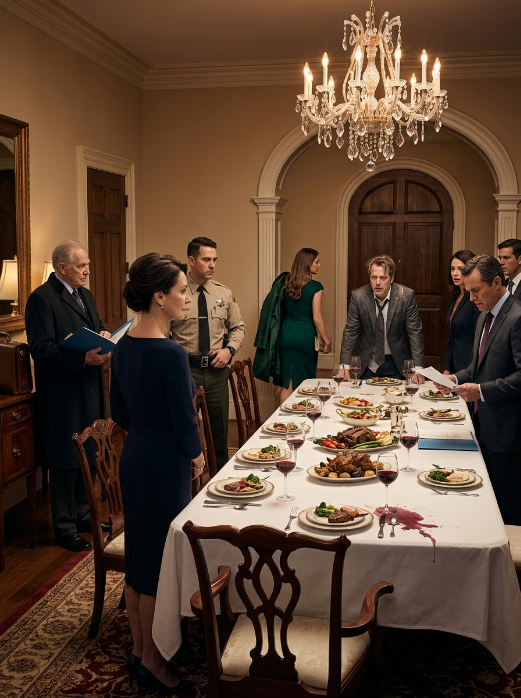
The entire room went dead silent the moment Arthur stepped through the double archway. Andrew stopped midway through taking another sip of his wine, his glass hovering near his lips, his eyes wide with sudden, unadulterated terror as he saw Arthur and the deputy step into the light of the crystal chandelier. “What is the meaning of this?” Andrew said, slamming his glass down onto the table so hard Cabernet splashed across the white tablecloth and stained the linen. “Arthur? What are you doing in my home? And why is there a police officer in my dining room?” “It isn’t your home, Andrew,” Arthur said, his voice completely calm, echoing with decades of quiet legal authority. He set his briefcase on the edge of the sideboard, clicked the brass latches open with two sharp metallic snaps, and pulled out a stack of blue-bound folders. Brenda stood up from her chair, her emerald dress rustling loudly against the mahogany. “This is completely inappropriate!
We are in the middle of a private executive dinner!” “Sit down, miss,” the deputy said, his voice flat and unyielding, his hand resting casually near his duty belt. Brenda blinked, her face flushing bright red, and slowly sat back down without another word. Andrew stood up, his face turning an unhealthy shade of dark red as he gripped the edge of the table. “Clara, what did you do? Did you call Arthur here to make a scene? I told you, your legal confusion is something we handle privately! Get them out of here before I call my security team!” “Your security team has already been notified of the change in property access and has stood down,” Arthur informed him mildly. He pulled three documents from the top folder and handed them directly to Frank Henderson, the bank executive sitting near the center. “Frank,” Arthur said, “I am Arthur Sterling, lead counsel for the Clara Vance Irrevocable Trust and sole registered legal representative for Vanguard Crest.
I understand Mr. Vance here applied for a two-million-dollar equity mortgage against this property using a forged corporate resolution.” Frank Henderson’s eyes went wide. He looked down at the papers Arthur had handed him, his fingers tightening on the heavy bond paper. “Forged?” “He’s lying!” Andrew shouted, his voice cracking as he lunged forward, grabbing the edge of the dining table with white knuckles. ” adultos! I built Vanguard Crest! I run Vance Development! Clara is my wife, she has no operational authority! She doesn’t even have full mental capacity right now!”
“Mr. Vance,” Arthur said, pulling a certified document with a thick red state seal from his briefcase and laying it directly in front of Andrew’s plate. “This is the original trust indenture established forty years ago by Thomas Vance. This trust owns ninety-eight percent of the voting shares of Vanguard Crest, which in turn owns the land, the corporate charters, the equipment leases, and the deed to this six-acre residential estate.” Arthur turned to face the board members and investors sitting around the table in stunned silence. “For twelve years, Mrs. Vance allowed her husband to act as executive manager. However, at three o’clock this afternoon, under Clause 14 of the master charter, Clara Vance executed a full Revocation of Executive Authority. Andrew Vance was formally removed as Chief Executive Officer of Vance Development and managing director of Vanguard Crest.” The room seemed to lose all air. One of the private equity partners swallowed hard, looking from Andrew to the official documents spread out across the expensive silverware. “Furthermore,” Arthur continued, “we have filed a formal freeze on all corporate lines of credit following the discovery of seven hundred and fifty thousand dollars in unauthorized transfers to an offshore account in the Caymans over the last six months.” Andrew’s face drained of color so fast he looked almost gray under the bright chandelier light.
He staggered back an inch, his knuckles white as he gripped the mahogany. He turned his head frantically, looking across the table at Frank Henderson. “Frank… Frank, listen to me, it’s an internal accounting error,” Andrew stammered, his confident executive voice completely gone, replaced by a desperate, high-pitched whine. “We can clear this up tomorrow morning! Arthur is her grandfather’s old friend, they’re trying to ambush me!” “It’s not an accounting error, Andrew,” I said, stepping up to the side of the table, looking him straight in the eyes without flinching. “I spoke with the bank auditors at two o’clock today. The Cayman account was opened in your name and Brenda’s.”
Every eye in the room instantly snapped to Brenda like iron filings to a magnet. Brenda froze where she sat. Her lips parted, her face turning chalk-white. She looked at Andrew, then at the deputy, then at the bank executive who was currently staring at her with undisguised disgust. “Andrew…” Brenda whispered, her voice trembling violently. “What is she talking about? You told me that account was a legal tax shelter for our consultancy fees!” “Shut up, Brenda!” Andrew hissed, turning on her with raw panic clawing at his throat. “Don’t you tell me to shut up!” Brenda snapped, her composure completely shattering into pieces. She grabbed her designer clutch from the table, standing up so fast her chair screeched against the hardwood floor as she backed away from Andrew as if he carried a contagious disease. “You told me you owned this company! You told me she was living off your money and didn’t have a cent to her name!” “I do own it!
I built it!” Andrew yelled, his voice echoing off the high plaster ceilings. “You built nothing, Andrew,” I said. My voice wasn’t loud. I didn’t raise it once. But the quiet certainty in my words stopped him cold in his tracks. “You rode on my grandfather’s foundation for twelve years. You thought because I stayed quiet, I was weak. You thought because I let you hold the microphone, you owned the stage.” Arthur pulled a final document from his folder and handed it to the deputy. “Mr. Vance,” the deputy said, stepping forward with his notebook out. “As of three o’clock today, an immediate Revocation of Occupancy was served for this address. The property belongs strictly to the Clara Vance Irrevocable Trust. You are officially trespassing on these premises.” Andrew blinked, staring at the deputy as if he couldn’t process the simple English words. “Trespassing? This is my house! My clothes are upstairs!
My cars are in the garage!” “The vehicles are registered corporate assets of Vanguard Crest and their keys have been impounded,” Arthur noted mildly. “As for your personal clothing, you have fifteen minutes to gather what can fit into two suitcases under the deputy’s supervision. Everything else will remain on site pending formal property division through the courts.”
Andrew looked around the long mahogany table. He looked at his board members, who were already standing up, pulling their phones out of their pockets, and avoiding his gaze completely as they headed for the side exit. He looked at Frank Henderson, who was folding Arthur’s legal documents into his coat pocket with a cold, hard expression that meant Vance Development would never see another dollar of commercial credit in this state as long as he lived. He looked at Brenda, who had already pulled her silk coat over her dress and was hurrying toward the front door without looking back at him once. “Brenda, wait!” Andrew called out, his voice cracking with desperation. She didn’t even pause. The heavy front door clicked shut behind her with a definitive, hollow snap. Andrew stood alone at the head of the long table, surrounded by half-eaten plates of prime rib, overflowing wine glasses, and legal papers that stripped him of every single thing he had spent twelve years pretending he owned.
He turned to me, the arrogance completely gone, the fake soothing tone he had used to gaslight me for months wiped away as if it had never existed. He looked small, trembling, and entirely defeated. “Clara…” he whispered, taking a slow, shaky step toward me, reaching out a hand with his palms upturned. “Clara, please… we can talk about this. We’re married. Twelve years! You can’t just throw me out on the street in front of everyone. Please… just give me a few days to fix this. We can go to counseling. We can work it out.” I looked at him, and for the first time in months, I felt no fear, no doubt, and no hesitation. I felt the absolute, unshakable weight of my own dignity returning to my bones. “You told me this morning that I was losing my mind, Andrew,” I said softly, my hands resting at my sides. “But my mind is completely clear.
And my house is clean.” I turned my back on him and looked at the deputy standing by the sideboard. “Please escort him upstairs to get his clothes.”
It took twenty minutes for Andrew to clear his things from the master suite. He came down the stairs carrying two canvas duffel bags, his tailored charcoal suit jacket unbuttoned, his silk tie loosened at his neck, looking like a man who had just survived a shipwreck only to realize he was stranded on a barren rock. He didn’t look at the caterers who were silently packing away the unused silver platters and crystal glassware into heavy plastic crates. He didn’t look at Arthur, who was methodically closing his leather briefcase and snapping the brass latches shut. When he reached the front entryway, he paused near the heavy oak door, holding his bags, waiting for me to say something, a final insult, an angry word, anything that would give him a foothold to argue one last time. I just stood near the hallway archway, my hands relaxed at my sides, watching him with a strange, distant clarity. The deputy opened the heavy front door, letting in a rush of cool October air from the porch. Andrew stepped out into the dark night, his leather shoes clicking against the stone steps for the last time, and walked down the long gravel driveway toward the main road where a yellow taxi was waiting with its headlights cutting through the dark.
The house grew quiet once the car’s taillights disappeared around the bend in the road. The caterers finished their work, apologized quietly for the strange scene, and left through the side service door without making a sound. Arthur stayed behind for a few minutes, sitting at the kitchen island, sipping a cup of hot black tea while he reviewed the final lock-out confirmation orders with his assistant over his cell phone. At ten o’clock, Arthur packed his briefcase, buttoned his wool coat, and walked with me to the front porch under the amber glow of the carriage lamps. “The bank has already frozen his credit lines, Clara,” Arthur said, wrapping his coat tight against his chest against the chill in the air. “And the sheriff’s office will have a unit patrol the front gate for the next forty-eight hours just to make sure he doesn’t try to return for his golf clubs or anything foolish.
You are completely safe here.” “Thank you, Arthur,” I said, leaning against the wooden pillar. “For everything.” “Your grandfather knew what kind of man Andrew was when you first introduced him, Clara,” Arthur said softly, looking at me with a warm, gentle smile that crinkled the corners of his eyes. “Thomas didn’t lock those assets up to keep you from living your life. He locked them up so that when you were ready to stand on your own two feet, the ground beneath you would never give way.”
After Arthur’s car drove down the drive and the red lights faded into the trees, I walked back inside and locked the heavy front door with two turns of the deadbolt. I walked through the quiet, spacious rooms of the estate, listening to the old floorboards settle under my feet. I went into the kitchen, where the broken glass from the morning was long gone, the white tile clean and smooth and undisturbed. I went into the formal dining room, pulled the long linen tablecloth off the mahogany table, and carried it down to the laundry room to be washed. Then I went up to my bedroom, opened the wide balcony doors all the way, and let the cool, clear night air fill the room. I sat down at the small mahogany writing desk near the window, pulled a blank leather-bound notebook from the drawer, and picked up a heavy fountain pen. For twelve years, my name had been buried behind corporate titles, executive decisions, and another man’s vanity. Tonight, the quiet was mine. The house was mine. My life was mine. I set the metal nib to the paper and wrote down the first line of my new life, completely undisturbed.