How My Sister’s Ex Tried to Steal Her Catering Equity and Met an Old Paramedic Report

The notification light on Clara’s phone flashed three times against the mahogany surface of the desk at exactly 4:14 in the morning, a small, stubborn pulse of blue that I could see from the doorway of the guest room where I had been sleeping on a lumpy pull-out sofa for three weeks. I had driven down from Redding the moment she called me to say Jason had filed the emergency papers to lock her out of the commercial kitchen on 4th Street.
My sister didn’t move. She was sitting in her old velvet armchair with a wool blanket pulled up to her chin, staring at the baseboard heater like it was about to speak to her. She looked smaller than she had at Christmas, her shoulders pulled inward like she was trying to occupy half as much space in the world as she used to, and her left hand was tucked deep inside the opposite sleeve of her sweater, clutching her forearm the way she had every single day since the night of the warehouse stairs.
I didn’t want to interfere at first because Clara had always been the proud one, the sister who built Miller Catering Design from two folding tables and a borrowed commercial oven while the rest of us were still figuring out our utility bills. But when I walked into her house that Tuesday and found four empty boxes of paracetamol on the kitchen counter and a legal notice taped to the refrigerator door demanding she hand over her controlling shares for one dollar to settle back-spousal maintenance claims, I unpacked my duffel bag and put my car keys on the entry table.
Jason had spent four years building a cage out of other people’s sympathy, and he had done it so quietly that even Clara’s business partners thought she was the one who lost her grip after that bad fall behind the venue. He would tell venue managers at high-end weddings that Clara was having another one of her dizzy spells, lowering his voice into that rich, warm baritone that made every auntie in the room want to pat his arm and tell him what a saint he was for managing a wife who couldn’t keep her balance on a flat floor.
The air inside the county family court waiting room smelled like floor wax and old paper when we got there twenty minutes before docket call on Thursday morning. I sat beside Clara on the hard oak bench, keeping my knees pressed together and my handbag clutched between my boots so she wouldn’t see how badly my knuckles were shaking.
Across the gray linoleum, Jason was holding court near the water cooler in a tailored charcoal suit that probably cost more than my first car, adjusting his silk tie with one hand while he laughed at something the young marketing coordinator said. Madison was twenty-six, with short dark hair cut into a sharp bob and a beige sheath dress that looked like it belonged in a real estate brochure rather than a family court hallway, tapping her nail against an iPad screen and nodding every time Jason opened his mouth.
Daniel, the attorney Clara hired after selling her grandmother’s silver ring set to pay the retainer, sat on her other side with his leather briefcase balanced across his knees. He didn’t look at Jason once. He was turning the thin, yellowed pages of a folder that looked like it had been pulled from an industrial filing cabinet in the basement of the municipal building at midnight.
“He wants the whole thing, Clara,” Daniel said, keeping his voice down so it wouldn’t carry past the radiator against the far wall. “The current settlement draft asks for your full surrender of controlling equity in the catering design firm. In exchange, he agrees to waive his back-spousal maintenance claims.”
“Back-spousal claims,” Clara repeated, her voice dry and thin like dead leaves scraping across concrete. “He is suing me for $120,000 in support while trying to strip my $450,000 in equity.”
“He claims your mental instability over the past four years caused severe operational losses,” Daniel said calmly, his pen moving in small circles in the margin of a financial sheet. “His filing includes written statements from three venue managers claiming you were unreliable during the summer bookings. He has three separate affidavits swearing you fell down twice at the Oakridge Estate tasting event alone.”
Clara looked down at her lap. Her fingers tightened inside her sleeves until I could see the fabric stretch white across her knuckles. That was Jason’s favorite word in every text message he sent me after the accident, too. Unstable. Fragile. Overwhelmed. He had told me on the phone three days after she came home from the hospital that Clara was just not built for the stress of commercial scaling, that her equilibrium had been permanently scrambled by the concussion, and that he was taking over the signature authority on the line of credit just to keep the bank from calling our notes. He had said it with such heavy, exhausted sincerity that I had actually apologized to him for being short with him on the phone.
I remember the night of that inventory review four years ago as clearly as if it were happening behind my eyelids right now, even though I was two hours away in Redding when my phone rang at 11:42 PM with Jason telling me Clara had taken a bad spill in the dark. We were supposed to meet for Sunday dinner the following weekend, and she had been so excited about the new walk-in freezer they were installing behind the main warehouse on Industrial Way. She had worked sixteen-hour days for six months straight, living on black coffee and saltines, because she refused to take a venture loan that would give some board of directors the right to change her menus. That was the night she found out Jason had already signed over twenty percent of the subsidiary voting rights to his college roommate’s holding company without telling her.
She had confronted him on the concrete landing behind the loading dock while the delivery trucks were idling out on the tarmac. I know how Clara gets when she is cornered about her work, she doesn’t yell, she just gets very quiet and starts reciting figures like a ledger until the other person feels small. And Jason didn’t like feeling small in front of his crew.
When the primary ambulance crew arrived that night, Jason was already kneeling beside her on the gravel with his hand pressed against her collarbone, telling the young medic that she had been dizzy all afternoon from skipping lunch and must have missed the top step in the shadows. When the police officer came into the cubicle at St. Jude’s with a small plastic notebook, Jason stayed right beside her pillow, his hand heavy on her good shoulder, whispering how lucky she was that he had been downstairs doing inventory checks when she tumbled. And when Clara tried to lift her head from the starch-smelling pillow to tell the officer that Jason had given her a hard shove to the upper chest that sent her tumbling down those nine concrete steps, Jason leaned down until his mouth was almost touching her ear and told her that if she said one word about a push, he would have her committed to the county psychiatric ward before morning, and she would lose every square foot of the kitchen before the ink on the corporate dissolution papers was dry.
She was twenty-eight, bruised from her ribs to her knees, and terrified that the business she had built while Jason was still working part-time at a car dealership would be handed over to his friends in a bankruptcy auction. She kept her mouth shut. She signed the insurance release forms with her right hand while her left arm was pinned inside a heavy fiberglass cast. And for four years, I watched my sister turn into a ghost in her own house, apologizing for dropping spoons, wearing long sleeves in July to hide the long white scar that ran from her wrist to her elbow where the titanium plate held her bones together, and letting Jason manage every dollar that came through the front door.
Now, sitting on that wooden bench in the municipal court building, Jason caught me looking at him over Clara’s shoulder. He didn’t look away or look ashamed. He just smiled that small, easy smirk that he used whenever he knew he had the votes, and walked over to our row with Madison following two steps behind like an extra piece of luggage.
“Clara,” Jason said, stopping right in front of our bench with his hands tucked into the pockets of his charcoal trousers. “We have fifteen minutes before Judge Miller calls us in. Save yourself the embarrassment of a public record. Sign the transfer papers. That four hundred and fifty thousand dollar valuation is a fiction anyway based on the damage you did to our brand during the summer tasting season.”
“The valuation was verified by an independent court-appointed accountant, Jason,” Daniel said without looking up from his legal pad.
“An accountant who doesn’t see the daily operational reality,” Jason replied smoothly, shifting his weight to his back foot. “Clara knows the truth. She hasn’t been right since the accident four years ago. The court isn’t going to award operational control to an officer who can’t hold a clipboard without her fingers shaking.” He lowered his voice just enough to make it personal, looking down at my sister with that awful, practiced pity. “You don’t want your medical history dragged out in open court, Clara. You know how fragile you get under questioning.”
I didn’t wait for Clara to answer. I started to stand up, my boots making a sharp scrape against the floor wax, but Clara caught the edge of my coat sleeve with her good hand and pulled me back down so hard the leather creaked.
“I am not waiving my equity, Jason,” Clara said, her voice small but steady, rising up through the hollow hallway like a wire pulled taut. “And I am not paying you $120,000 for a lie you’ve been telling since the night you pushed me.”
Jason chuckled, a short, dry sound that had no humor in it, and shook his head before turning back toward his attorney who was standing by the double doors. “Have it your way. But when the judge reads the incident reports from four years ago, don’t say I didn’t try to keep this private.”
He walked away toward the water cooler, his leather soles clicking against the floor. Daniel slowly closed the thick Manila folder he had been holding, tapped the corner against his knee once, and looked between Clara and me.
“Are you ready?” Daniel asked, his voice dropping into that low, flat register lawyers use when they know they are about to turn a key in a very old lock.
“Is the file complete?” Clara asked him, her eyes fixed on the gray wood of the courtroom door.
Daniel reached into his briefcase and pulled out a small, heavy white flash drive that looked like it had been dropped in a toolbox, along with three pages of stiff, yellowed paper clipped together with a rusted metal staple.
“I found something in the archive logs late last night, Clara,” Daniel whispered, leaning in so close his shoulder touched mine. “Something Jason’s legal team missed when they scrubbed the local precinct files for their initial motion.”
Daniel opened the folder again and pointed to a faded carbon copy tucked behind our formal financial disclosures from four years ago.
“When Jason called 911 that night,” Daniel murmured, his thumb resting on the bottom margin of the yellow sheet, “he thought he controlled the narrative from the first five minutes. The primary ambulance crew arrived from station twelve, took his statement while you were semiconscious on the gravel, and filed the standard accidental fall report. That is the report Jason’s attorney attached to his petition to prove your long-term instability.”
“I remember,” Clara said, her teeth set so hard her jaw muscles stood out like walnuts under her skin. “The doctor at the intake desk just nodded along with whatever Jason said about my dizziness.”
“Right,” Daniel said. “But what Jason didn’t realize is that the county dispatch had a secondary unit code logged that same minute because the primary rig was delayed by six minutes at the freight train crossing on 9th Street. A backup paramedic unit was sent out from the north station. The senior paramedic on that secondary rig was a man named Arthur Vance.”
I stared at the name on the page. Arthur Vance. The ink was old and slightly smeared where someone had spilled coffee on the bottom corner back when the county still used manual carbon logs.
“Arthur Vance didn’t write the main hospital transfer summary,” Daniel continued, his finger tracing a line of small, neat handwriting in the margin. “He was on site for only ten minutes while they were sorting out the stretcher transfer. But while the primary paramedics were loading you into the back of the first rig, Vance walked down the concrete stairwell to check the scene for loose gravel or oil slicks. He saw the blood smear on the sixth step, the pattern of the impact on your left arm where the railing bolt had caught your sleeve, and he heard Jason talking to you through the open doors before they slammed them shut.”
“What did he hear?” I asked, my own breath catching in my throat like I’d swallowed a dry bone.
“Vance noted in his supplemental log that the husband was leaning over the patient, speaking in a harsh, low whisper, commanding the patient to keep her mouth shut about the stairs if she wanted to see her business again,” Daniel said. “Vance flagged the dispatch as a suspicious domestic incident and logged an internal safety report with the county sheriff’s department. He also recorded the scene audio on his shoulder radio, which was linked to the county’s automatic digital logging system before the shift ended.”
I sat frozen on the wooden bench, the smell of floor wax suddenly turning sour in my nose. “Why didn’t the police follow up back then?”
“Because you signed the accidental injury waiver at the hospital three hours later under Jason’s supervision,” Daniel explained, flipping the page to reveal a certified digital fingerprint from the sheriff’s office dated four days ago. “The police closed the active file without reviewing the secondary dispatch attachments because the primary report was marked ‘cleared-accidental’ by the first officer on the scene. The secondary report sat in the county emergency management backup servers for four years. Unread. Unredacted. Until I ran a cross-index search on all 911 calls originating from that address between midnight and 2:00 AM.”
Daniel laid the white flash drive on top of the Manila folder like it was a heavy stone. “I spent four hours with Arthur Vance last night at his house out past the river,” Daniel said softly. “He retired two years ago from the county service, but he remembers that night because he nearly wrote a formal complaint about the way Jason was screaming at you while you were bleeding onto the gurney. He signed an emergency affidavit confirming his original notes, and we obtained the archived body-cam audio from the secondary unit dispatch log through an emergency subpoena signed by Judge Miller’s clerk at midnight.”
Before I could answer, the heavy double doors of the courtroom swung open with a dry metallic click. A bailiff stepped out into the corridor, adjusted his belt, and announced in a loud, echoing voice that rattled the glass in the transoms, “In the matter of Miller versus Miller. Department 4 is now in session.”
Jason immediately straightened his charcoal coat, gave Madison a short, confident nod that looked like he was greeting a board member, and walked briskly through the double doors without looking back. He looked back over his shoulder at Clara once just before the door swung shut, a small, dismissive smile playing on his lips, completely convinced he was walking into a room that would hand him everything my sister had spent fifteen years building on her knees.
Clara stood up slowly. For four years, I had watched her keep her heavy wool coat buttoned up to her chin whenever she was around Jason or any of our old business associates, wearing long sleeves even in the middle of July to hide the deep, jagged white surgical scar that ran from her wrist to her elbow where the surgeons had put in a titanium plate to rebuild her forearm after the bone came through the skin.
She reached up with her right hand, unbuttoned her dark coat, and folded it neatly over my arm, standing there in a simple slate-gray blouse that showed the sharp lines of her collarbones.
“Let’s go,” she told Daniel.
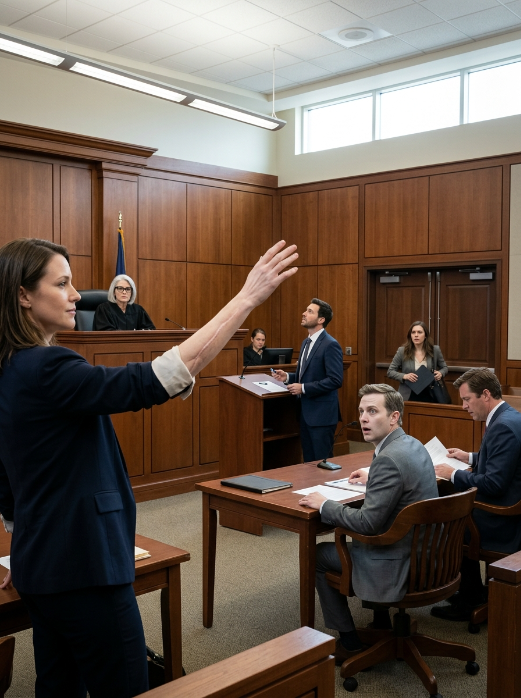
The courtroom was vast, bright, and cold. High oak paneling lined the walls, and the overhead fluorescent tubes buzzed with a dull, steady hum that made my teeth ache. Judge Miller, a stern woman in her late sixties with sharp silver hair cut straight across her forehead and heavy wire-rimmed glasses, sat behind the elevated mahogany bench, reviewing the motion papers in front of her with a yellow highlighter.
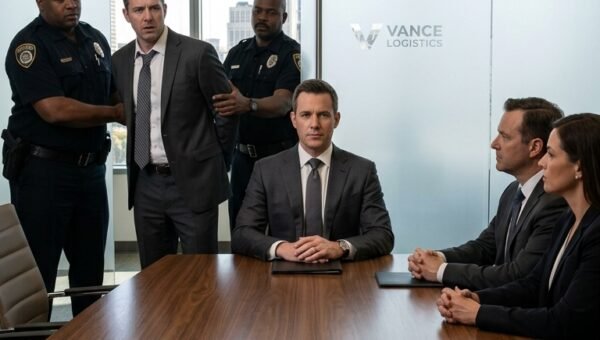
Jason and his attorney, a tall man named Vance Sterling who wore a tie with little gold ducks on it, sat at the petitioner’s table on the right. Madison sat in the first row of gallery seats directly behind Jason, her legal pad resting open on her knees, her pen poised and ready to take notes on the destruction of my sister’s life. Daniel and I took our seats at the respondent’s table on the left, the air between us smelling faintly of old paper and Daniel’s peppermint lozenges.
“We are here on petitioner’s motion for emergency asset allocation and temporary spousal support,” Judge Miller began, her voice crisp, dry, and efficiency-driven like she was reading a grocery list at the end of a long shift. “Petitioner is requesting full voting control of Miller Catering Design, LLC, and an order directing respondent to pay $120,000 in retroactive spousal maintenance based on alleged financial mismanagement and personal incapacity.”
Jason’s attorney stood up immediately, buttoning his jacket with a smooth, practiced flick of his wrist. “Your Honor, my client has carried this enterprise alone for four years. Mrs. Miller suffered a severe traumatic accident four years ago, a fall down concrete stairs due to her own documented physical instability. Since that time, her mental condition has deteriorated. She has been absent, unstable, and a liability to our high-profile catering clients. We have attached medical records and client statements showing her inability to perform her daily duties. We are simply asking for full corporate control so Mr. Miller can save the firm’s $450,000 equity value from total collapse.”
Judge Miller leaned forward, looking over the top of her glasses down at our table. “Mr. Daniel, how does your client respond? The documentation provided by the petitioner paints a concerning picture of operational paralysis.”
Daniel stood up calmly. He did not raise his voice or gesture toward the other side of the room. He reached into his briefcase, pulled out three bound copies of Arthur Vance’s certified affidavit, and laid them on the edge of the mahogany table.
“Your Honor, the entire premise of the petitioner’s argument rests on a manufactured narrative of my client’s so-called instability,” Daniel said. “They rely on a four-year-old emergency room report to prove she is physically and mentally unfit. But that report was curated by Mr. Miller while my client was suffering from severe physical trauma and under the direct verbal coercion of her husband.”
Jason sneered quietly at the petitioner’s table, leaning over to whisper something in his lawyer’s ear that made Sterling wave his hand dismissively toward the ceiling. “Your Honor, this is an attempt to litigate a settled medical history from four years ago without a single new expert witness.”
“It is not settled, Your Honor,” Daniel said firmly, his voice cutting across the lawyer’s complaint like a knife through soft bread. “Last night, we uncovered the secondary emergency response records from the county emergency log on the night of November 14th. We have an affidavit from retired Paramedic Arthur Vance, along with the preserved, unredacted body-cam audio from the secondary unit that arrived on scene while the primary transport was still loading.”
Jason stopped whispering to his lawyer. His whole body went entirely still, the way a rabbit freezes in the tall grass when it hears a shadow move overhead.
“What does this secondary record contain, Mr. Daniel?” Judge Miller asked, her eyes narrowing behind her heavy glasses until they looked like dark stones.
“It contains contemporaneous physical observations confirming that my client’s injuries were consistent with a violent physical assault, not an accidental slip,” Daniel said. “And it contains clear, uncoerced audio of Mr. Jason Miller threatening his wife while she lay injured on the cold concrete, warning her that if she reported the assault, he would use his legal control to strip her of her corporate equity and brand her as insane before the police could finish their paperwork.”
“That is an outrageous, unsubstantiated slander!” Sterling shouted, half-rising from his chair and knocking his leather folder against the table leg.
“Quiet, Counsel,” Judge Miller snapped, her gavel hitting the wooden block with a sharp, dry crack that made Madison jump in the front row. She looked back down at Daniel. “Do you have the audio log verified by the county Sheriff’s department under standard chain of custody?”
“I do, Your Honor,” Daniel said, his hand resting on the small white flash drive. “We have submitted the certified county digital record under file index 409-B. With the court’s permission, I would like to play thirty seconds of the scene recording from the secondary paramedic’s body microphone.”
Judge Miller gave a short, curt nod to her clerk. Daniel walked over to the podium, plugged the flash drive into the court media box, and pressed the small silver button on his desktop controller.
The courtroom speakers crackled with static for two long seconds, followed by the distant, heavy sound of rain hitting a metal roof and an idle ambulance engine coughing in the background. Then, a sharp, recognizable voice cut through the quiet courtroom like glass breaking on a tile floor.
“You shut your mouth, Clara,” Jason’s voice blasted through the overhead speakers, cold, sharp, and dripping with a cruel, venomous certainty that made the hairs on the back of my arms stand up. “You tell the cop you slipped on the top step. If you say one word about a push, I will tell everyone in this city you belong in a ward. You won’t get a dime of the firm’s equity. You’ll leave with nothing. Do you hear me? Nod your head!”
A high, breathless gasp followed on the recording, my sister’s voice from four years ago, weeping through broken ribs while the rain came down on the loading dock, followed by Jason’s voice again, smooth as oil: “That’s a good girl. Now hold still while I call the cop over.”
The audio cut off with a sharp electronic click.
The silence in the courtroom was absolute. Nobody coughed, nobody shuffled their papers, and the fluorescent lights seemed to hum a little louder against the high ceiling.
Clara stood up slowly from her chair. She didn’t say a single word to the judge or to the lawyers. She just raised her left arm, pulled back the cuff of her slate-gray blouse until the fabric was tight against her elbow, and held her bare arm out toward the mahogany bench, exposing the thick, white nine-inch surgical scar that ran like a railroad track along her bone where the metal plate lived.
Jason turned slowly in his chair to look at her, his neck stiff like he hadn’t turned his head in years. The color had completely drained from his face, leaving him a dirty, grayish white under the office lights. His mouth opened slightly, but no sound came out except for a dry click of his tongue against his teeth. Behind him, in the front row of the gallery, Madison stared at the back of Jason’s head in absolute horror, her mouth slightly parted. She slowly closed her iPad, tucked it into the side pocket of her leather purse, stood up quietly without looking at anyone, and walked out the heavy rear doors of the courtroom without a backward glance.
Judge Miller sat in complete, motionless silence for five long seconds. Her face was set like granite, the lines around her mouth deep and hard. When she finally spoke, her voice was quiet, icy, and lethal.
“Mr. Sterling,” Judge Miller said, staring directly past the lawyer down at Jason’s white face. “You have thirty seconds to explain why I shouldn’t immediately hold your client in summary contempt and refer this entire file to the District Attorney’s office for criminal intimidation, perjury, and corporate fraud.”
Sterling looked at Jason, then down at his papers, his hands visibly shaking as he tried to stack his legal briefs into a neat pile. “Your Honor… we… we request a brief recess to consult with our client regarding these new disclosures.”
“Request denied,” Judge Miller said firmly, her hand dropping onto the wooden block without hitting it. She picked up her heavy black pen and began writing rapidly on her official order sheet, the scratching of the nib the only sound in the room. “The petitioner’s motion for emergency asset control and back-spousal maintenance is denied with prejudice. I am issuing an immediate temporary injunction freezing all corporate accounts of Miller Catering Design, LLC, pending a complete court-ordered forensic financial audit by an independent state accountant.”
She looked up, her eyes hard as nails. “Furthermore, I am stripping Mr. Miller of all sole signature authority on company accounts and appointing an independent receiver to oversee daily operations effective immediately. Mr. Miller will vacate the corporate offices on Industrial Way by 5:00 PM today. The clerk is instructed to transmit the audio file and Paramedic Vance’s affidavit directly to the County Prosecutor for immediate grand jury consideration.”
She brought her gavel down once, short and hard. “We are adjourned.”
Two hours later, we walked out the front glass doors of the courthouse into the bright Redding afternoon sun. The air was fresh and cold, crisp against our faces after hours of stale basement air.
Jason was standing near the bottom of the wide marble steps, surrounded by his legal team who were already packing their bags into a black sedan. He looked smaller somehow, his sharp charcoal suit wrinkled across the shoulders, his silk tie pulled loose at the collar like he’d been running. He saw Clara coming down the steps and started to walk toward her, his hands raised in a desperate, pleading gesture that looked pathetic in the broad daylight.
“Clara, wait,” he said, his voice stripped of all its smooth executive confidence, sounding like a frightened boy in a schoolyard. “We can talk about this. We built that company together from nothing. You know I was just trying to protect the business assets back then… I was under so much stress with the supplier loans…”
Clara didn’t stop walking. She didn’t even slow down her pace. She walked right past him, her leather heels clicking firmly against the marble steps, her chin held high and her shoulders square under the autumn sun. She didn’t offer a single word of argument, anger, or explanation. He didn’t exist to her anymore, not as an enemy and not even as a memory worth the breath to curse him.
That evening, I sat in the bright, sunny corner of Clara’s home office while she unpacked a fresh box of legal files on her wooden desk. The room was quiet, filled only with the soft amber light of the late afternoon sun streaming through the clean windows that she hadn’t opened in years. On the center of the desk lay the official receivership papers and the corporate governance documents for the re-established enterprise: Clara Miller Design & Catering.
Her left arm still throbbed with a tiny, familiar ache where the titanium plate sat against the bone whenever the weather turned damp, but for the first time in four years, the heavy, dark weight in her chest was gone. The white scar on her arm was no longer a secret mark of shame or a daily reminder of her weakness. It was simply proof that she had stayed when she should have run, and that the truth always waits in the dark until someone turns on the light.
She picked up her fountain pen, signed her name firmly across the final ownership line in dark blue ink, and laid the pen down on the clean white desk.