How a Little Girl With Four Dollars and Sixty-Three Cents Exposed Marcus Vance and Met My Irrevocable Terms

I ran the south side of Milwaukee for twenty-four years, and nobody came up to me on the street unless they were looking for work or terrified out of their wits. You do not survive three decades of asphalt politics, turf wars, and dockside protection without building a reputation that precedes you by a block or two. People knew the charcoal coat. They knew the four heavy guys who drove the black suburbans six feet behind my left shoulder. They knew that if my name came up in a conversation, you kept your voice down and your eyes fixed on the pavement.
But on a freezing Tuesday morning outside the Fondy Farmers Market, when the wind off Lake Michigan was sharp enough to split wood, a little girl broke every rule I had ever laid down.
She was six, maybe seven years old, wearing a thin pink coat with a missing button at the throat and sneakers that had seen better winters. She walked straight past Mateo and the rest of the crew like they were just parking meters, reached right into her pocket, and held out a fistful of cold copper and silver. She opened her small palm right under my nose, and I looked down at it. There was a quarter, eight dimes, three nickels, and forty-eight pennies. Exactly $4.63. The metal looked gray against her skin, freezing cold from the wind that smelled of wet asphalt and old snow. I did not move. I just stood there with my hands in my pockets, letting the silence stretch out between us while the market vendors shouted about potatoes and onions behind us.
My mommy needs formula for the twins, and she cannot get up, the girl said, looking straight up at me with pale grey eyes that did not blink once. My dad said if I gave this to the big man in the charcoal coat at ten o’clock, you would help us.
Mateo took half a step forward to guide her back behind the line where people usually stayed when they wanted to talk to me, but I raised two fingers without looking at him. My territory operated under strict, unyielding rules. I collected dues, I settled disputes before they reached the blood-on-the-pavement stage, and I kept the neighborhood clean of the cheap garbage that poisoned the kids in the schoolyards. But my cardinal rule, the one written in iron across my own conscience after the night I lost everything, was that children were completely off-limits. You do not touch them, you do not use them, and you certainly do not send them into my yard with pocket change.
What is your name, sweetheart? I asked, dropping right down to one knee on the slushy concrete, letting the cold seep straight through the wool of my trousers.
Sophie, she said, her voice small and flat like a worn record. She dropped the coins one by one into my leather glove, and the metal felt heavier than it had any right to be. My dad died last month. But he told me before he died that if Mommy got too sick, I had to find you right here at ten o’clock.
A cold knot formed right behind my ribs, the kind of physical warning you only get after living through enough gunfights to know when the air is turning sour. A dead man sending a child to my precise location at ten in the morning on a Tuesday with loose change was not some strange coincidence born of a mother’s desperation.
It was a message, or a move on a chessboard I could not see yet, and someone was trying to use my own history as a lever against me. I stood up slowly, brushing the grit off my knees, and looked straight at Mateo. Get the car around front.
We followed Sophie three blocks down to a decayed brick apartment complex on 14th Street where the paint was peeling off the window frames in long, scabby curls. The hallway smelled of damp plaster, stale cooking oil, and scorched wiring that had been buzzing behind the lathe since the Eisenhower administration. When I kicked open the unlocked door to apartment 3B with the heel of my boot, I did not need to see much to know how the story went. Clara Carter was lying on a stained mattress shoved into the corner of the small, bare living room. She was shivering under a gray wool blanket that looked like it had been salvaged from a freight car, her skin slick with sweat, her breathing shallow and raspy like a dry pump. In a plastic laundry basket modified into a crib nearby, two five-month-old infants were crying weakly from hunger, their little faces red and pinched.
There was no food in the cupboards, no milk in the small, unplugged refrigerator, and the radiators were stone cold to the touch. Get my doctor here now, I ordered Mateo, my voice dropping an octave as I pulled my own wool scarf off and tossed it over the back of a splintered kitchen chair. And bring food, milk, and heat units from the warehouse. We need portable heaters before the water pipes burst in the walls.
While Mateo ran down the stairs to make the calls on his encrypted radio, I looked around the room, taking in the small details that told the real story of the place. Clara was barely conscious, mumbling something about her fever and her babies between dry, rattling coughs that shook her whole frame. I sat Sophie down on a wooden kitchen chair that was missing one caster and pulled my heavy coat around her shoulders to keep the draft from the leaky window off her skin.
Sophie, I asked softly, sitting back down on my heels in front of her so she had to look at me instead of the empty room, when did your father tell you to come find me?
The night before he went away, she whispered, staring hard at the floorboards where a knot in the pine looked like a dead eye. He said he was going to sleep for a long time, but if Mommy could not wake up, I had to take the money from the blue jar and bring it to the man in the charcoal coat by the big cabbage trucks.
Ten minutes later, Dr. Evans arrived with two of our private nurses carrying heavy aluminum cases of medicine and oxygen tanks up the stairs three at a time. Evans examined Clara on the mattress, checking her pulse at the throat before pulling out a stethoscope with hands that had patched up half the East Side over the years. Severe pneumonia, Evans told me quietly, standing up and wiping his glasses on his sleeve. Another twelve hours without intravenous fluids and heavy antibiotics and she would have suffered respiratory failure. The kids are dehydrated, but we can fix that at the estate.
As the nurses went to work lifting Clara onto a collapsible stretcher, Mateo pulled me out into the dark hallway where the naked bulb flickered in the draft. His face was pale under the dim light, the old scar across his left cheek standing out white and sharp.
Boss, I ran the family name the second the kid mentioned it, Mateo whispered, keeping his voice down so the nurses wouldn’t hear through the thin door. The mother is Clara Carter. The father was Marcus Vance.
The name hit me like a physical blow to the stomach, the kind of heavy, breathless impact that leaves you searching for the floor. Marcus Vance was a mid-level money handler who used to work for Victor Rossi over on the north side, a quiet, slick operator who handled the digital ledger work for the numbers rackets. Three weeks ago, Rossi’s main warehouse in the industrial district got hit by an unknown crew, and the word on the street was that Vance had double-crossed Rossi, walked out with five million dollars in unwashed drug money, and died when his getaway car caught fire and burned to the frame in a ravine near Lake Michigan.
Rossi thinks Vance burned in that car with the five million, Mateo said, shaking his head slowly. He believes the cash went up in smoke, but he has been tearing the county apart looking for any sign that Vance stashed a portion of it somewhere before he went up in flames.
I looked through the cracked doorway at little Sophie, who was sitting quietly on the floor while Dr. Evans handed her a paper cup of warm sweet tea. Why would Marcus Vance, a man supposedly burned to ashes a month ago, tell his six-year-old daughter to find me at a specific market corner at ten in the morning with $4.63?
I walked back into the small apartment to secure Clara’s personal belongings so we could move her and the kids to my secured safehouse estate in Elm Grove where nobody would find them without an army. I picked up a plastic nightstand drawer to gather her identity papers, hospital cards, and some old mail to establish residency.
That was when I noticed a small orange plastic prescription bottle lying underneath a pile of past-due utility bills on the bottom shelf.
I picked it up slowly, turning it over in my gloved hand to read the small white label printed by the pharmacy on Holton Street. The prescription was for heavy pain management made out to Marcus Vance. The fill date printed on the sticker was February 10th. Today was February 14th.
I stared at the prescription bottle in my hand for a long time while the radiator in the corner finally gave a loud, metallic clank as the heat started to reach it. Marcus Vance’s car had allegedly burned in that ravine on January 14th, four weeks before a pharmacist handed him a bottle of pills across a counter three miles from here. A man declared dead four weeks ago does not pick up a fresh prescription for back pain at a local strip-mall pharmacy on a Thursday afternoon.
I pulled open the top drawer of the cheap dresser and searched through the rest of the papers with fingers that felt suddenly stiff and cold. Tucked inside the pages of a worn black leather Bible with gold leaf on the edges, I found a glossy 4x 6 photograph printed on heavy cardstock. It showed Marcus Vance sitting in an armchair with a red throw blanket over his knees, drinking coffee out of a white mug, holding up that morning’s Milwaukee Journal Sentinel from three days ago so the date was clearly visible to anyone looking. On the back, in sloppy, hurried handwriting, was a note addressed to Clara: *Nearly ready. Hold out a little longer.*
The reality of the situation hit me with brutal, sickening clarity, the kind of realization that makes you want to put your fist through a wall. Marcus Vance had not died in that flaming wreck on the county road. He had faked his death, staged the crash using some poor bastard’s stolen car and a body that wouldn’t talk, and vanished into the fog with Victor Rossi’s five million dollars. But he knew Rossi would search every state in the union for him until he saw proof or found a body that matched the dental records. More importantly, Vance knew Rossi’s enforcers were starting to keep tabs on Clara and the kids, waiting in unmarked cars down the street to see if Vance would try to contact them or slip back for his family.
Vance knew my personal history down to the last detail. He knew I had lost my own nine-year-old daughter to a stray bullet during a dock war twenty years ago. He knew I had sworn an oath on her grave never to let another child suffer in this city if I had the breath to stop it.
The coward had deliberately abandoned his sick wife and three starving children in a freezing apartment, handed his six-year-old daughter four dollars and sixty-three cents, and sent her straight to me like a piece of living bait. He knew that the moment I took Sophie and Clara under my wing, Victor Rossi would see it as a direct, undeniable challenge. Rossi would assume I was hiding Vance in my cellar or splitting the five million dollars with him down at the docks.
Vance had turned me and my entire organization into his unwitting human shield. He was using my men to fight his private war with Rossi while he sat in some warm motel room waiting to slip across the Canadian border with five million dollars in cash stuffed into the trunk of a rented sedan.
My cell phone rang in my breast pocket with a short, sharp vibration on an unlisted line known to fewer than five people in North America.
I answered without saying a word, keeping my eyes fixed on the small photograph of Vance holding the newspaper.
Andrew, a smooth, nervous voice came through the speaker with that slight catch in the breath that always comes before a coward tries to explain himself. I see you picked up my family. I knew you wouldn’t let them freeze.
Marcus, I said, my voice dropping down to an icy tone that made Mateo look up from the doorway.
Don’t sound so angry, Andrew, Vance chuckled, though the sound was thin and ragged like dry grass in the wind. I knew you were a man of honor. I knew you couldn’t turn down a child in need when she put her trust in you. Right now, Rossi’s scouts are watching that apartment block on 14th Street. They saw your suburbans pull up ten minutes ago. In about one hour, Rossi is going to send a heavy strike team to your Elm Grove estate thinking you’ve got his five million dollars stashed in the library.
You put your own blood in the line of fire just to buy yourself a head start, I said softly, feeling the blood hum behind my ears.
I gave them a chance, Vance snapped, dropping his polite tone and letting the selfish panic show through. Rossi was going to kill them eventually just to send a message to the streets! By bringing you into it, I bought them permanent protection. You have the men, the guns, and the walls to beat Rossi back. While you and Rossi tear each other apart tonight, I’m crossing the border into Ontario. Take care of Clara and the kids, Andrew. You’re better suited for the father role anyway.
The call went dead with a sharp click, leaving the hum of the cell tower in my ear.
I looked at Mateo, who was standing by the window with his hand resting naturally on the grip of his sidearm, waiting for the word.
Boss? Mateo asked, his eyes narrow and dark. What are the orders for tonight?
Call the secondary security detail and the heavy transport trucks, I said, my voice hard and clear like dropping stones into a bucket. Move Clara and the babies to the secure compound in the north woods under heavy guard. Do not take them anywhere near Elm Grove.
And Elm Grove? Mateo asked, shifting his weight.
Elm Grove is where Rossi thinks we are waiting for him with his money, I said, pulling my gloves back on. We are going to intercept Rossi’s strike team before they even reach the iron gates. And then we are going to find Marcus Vance before he reaches the interstate highway.
By eight o’clock that evening, a light, wet snow was falling across the county, sticking to the windshields and turning the backroads into dark ribbons of black ice. Victor Rossi sent six of his top enforcers in two black SUVs, driving south toward my Elm Grove property down a quiet, unlit gravel lane off Capitol Drive. They expected to launch a surprise attack on my house under the cover of the storm, believing I was harboring Vance and his stolen millions behind my brick walls.
Instead, they drove straight into a trap that had been set before the snow even started to fall.
Three of my heavy commercial delivery trucks blocked the narrow road completely, boxing Rossi’s vehicles in from the front and back so they had nowhere to turn except the steep drainage ditches. Before Rossi’s men could even unlatch their doors or draw their weapons, twenty of my operators stepped out from the pine treeline on both sides, their heavy industrial floodlights blinding the drivers through the tinted glass.
I walked up to the lead SUV through the falling snow and knocked twice on the driver’s window with the metal ring on my right hand. The driver, Rossi’s chief lieutenant, rolled the glass down an inch, his face pale and sweating despite the freezing air coming off the fields.
Tell Victor that Marcus Vance is alive and well, I told him, throwing the glossy photograph of Vance holding the recent newspaper through the crack onto his lap. Tell him Vance stole his five million, faked his own funeral, and tried to set us against each other so he could escape into Canada without a tail. I have no interest in Rossi’s money, and Rossi has no business operating in my territory. If he wants Vance, he can look for him on the road north, but he stays out of my county.
The lieutenant stared down at the photograph in the beam of a flashlight, then looked up at my armed men surrounding his vehicle with their weapons resting easy in their hands. Where is Vance right now?
He belongs to me first, I said flatly, leaning down until he could see the cold anger in my eyes. If Rossi brings another armed crew across my border, I will destroy his entire operation piece by piece until there is nothing left to tax. Turn around and get out of my sight.
Rossi’s men backed their vehicles out of the lane one by one and retreated north toward the city without another word. The threat to my territory was finished before it even started, leaving only the sound of the wet snow hitting the pine needles.
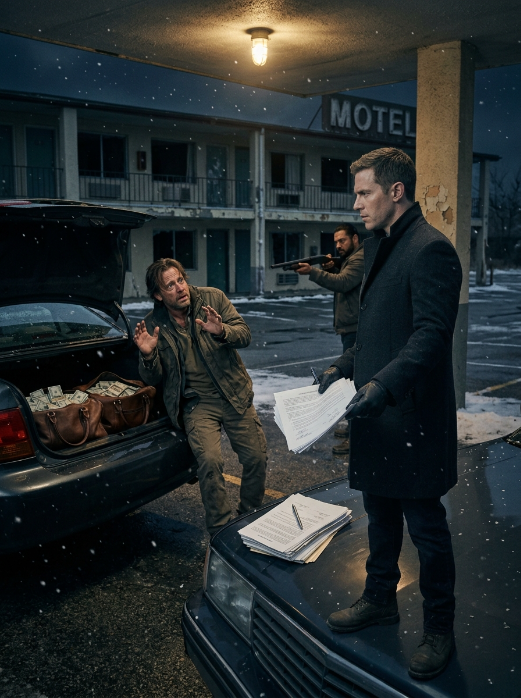
An hour later, my tracking team located Marcus Vance at a run-down motel near the interstate highway outside Kenosha where the neon sign flickered through the sleet. He was parked in the second-to-last stall, frantic, packing two large leather duffel bags stuffed tight with bricks of hundred-dollar bills into the trunk of a rented gray sedan with Illinois plates.
When I walked into the yellow light of the motel parking lot with Mateo two steps behind me, Vance froze with a stack of cash in his hand. He made a sudden, stupid move toward his waistband where he had tucked a small automatic pistol, but Mateo stepped out from behind a concrete pillar and leveled a twelve-gauge shotgun straight at his chest. Vance dropped his hands instantly, his fingers trembling violently as the money scattered across the wet asphalt.
Andrew! Vance gasped, backing up until his shoulders hit the edge of his trunk lid. Look, we can split it right now! Two point five million for you, two point five for me! You saved my family, you kept Rossi off my back, we can both walk away rich!
Shut your mouth, I said.
I stepped close to him, pulled a thick sheaf of legal documents and a metal clipboard from beneath my coat, and threw them hard onto the hood of his rented car. A stainless steel pen rolled across the cold metal and stopped right against the windshield wiper.
What is this supposed to be? Vance stuttered, his eyes darting between my face and the barrel of Mateo’s gun.
That is a complete, irrevocable surrender of all parental rights, I said, my voice so quiet he had to lean in to catch the words over the sound of the highway. You are legally declaring yourself unfit, abandoning all legal claims to Sophie and the twins, and granting sole custody to Clara. You are also signing over every asset, account, and vehicle listed in your name anywhere in this state.
You can’t do this to me, Vance whimpered, his face twisting as the panic finally took hold of him. They’re my kids! You can’t just take them away!
You used your six-year-old daughter as target practice in a turf war, I said, my voice carrying an edge that made him flinch back against the car. You left her with four dollars and sixty-three cents while you sat on five million dollars in stolen cash in a cheap motel. You are not a father. You are a disease, and I am cleaning the floor.
If I don’t sign these papers? he whispered, looking like he might throw up on the fender.
I looked down at my watch and let the seconds tick away in the cold air. If you don’t sign, I call Victor Rossi and give him your exact room number and your license plate number. I give you thirty seconds to decide whether you want to talk to Rossi or talk to my lawyer.
Vance grabbed the heavy pen with shaking, clumsy hands. He didn’t read a single line. He just scribbled his name on every marked line, initialed the legal waivers where Mateo pointed, and dropped the pen onto the cold hood like it was burning his fingers.
Now take your stolen money and get out of Wisconsin before the hour is up, I told him, stepping back into the shadow of the overhang. If you ever set foot in this state again, or if you ever attempt to contact Clara or those children by phone, letter, or messenger, I will not call Rossi. I will handle you myself.
Vance scrambled into his rental car like a dog, slammed the door, hit the gas with the tires spinning on the ice, and sped away into the darkness toward the state line, leaving a cloud of gray exhaust hanging in the sleet.
Three months later, the spring sun was finally breaking through the winter gray over Milwaukee, warming the brickwork and turning the dirty snow into rushing gutters of water. Clara Carter had fully recovered from her illness under the care of Dr. Evans and our private nurses. With the legal papers signed and Vance permanently erased from their lives, my legal team helped her secure a clean, safe, three-bedroom home in a quiet suburban neighborhood out past Wauwatosa where the yards were big and the schools were safe. The twins were healthy, laughing, and growing fast, and Clara had even started working part-time as an administrator at a local children’s health clinic that my organization funded quietly behind the scenes.
She knew who I was, and she knew what I did for a living on the south side. But she also knew that as long as I breathed, no harm would ever touch her family again, and that was all the accounting that mattered.
One quiet afternoon when the office was empty and the sun was hitting the tall library windows just right, I sat at my dark oak desk in the corner of the study. The house was peaceful, the kind of quiet you only earn after twenty years of making sure the right people stayed in their place.
I pulled open the top drawer of my desk, reaching past the ledger books and the heavy brass letter opener. Inside sat a small, custom-made velvet box lined with dark red silk that I had ordered special from a craftsman down on Brady Street.
I lifted the brass clasp and opened the lid. Resting against the dark silk were the exact coins from that freezing morning in February: one quarter, eight dimes, three nickels, and forty-eight pennies.
$4.63.
It was the most expensive fee I had ever accepted in thirty years on the street. It didn’t buy protection, or power, or a square mile of asphalt territory. It bought a future for three innocent kids who had been handed to me by a coward who thought money was the only thing worth dying for.
I closed the velvet box with a soft click, placed it securely in the corner of the drawer, and locked it away.