How My Son Tricked Me Into Signing Away My Retirement and Met My Courthouse Records

I got it wrong right from the start because I trusted the ink on the page instead of the way his thumb kept rubbing the edge of his coffee cup. When Arthur called me on that Tuesday evening in late September, his voice had that same slick, practiced rhythm he used down at the real estate board when he was trying to push a bad parcel onto some out-of-town buyer. He told me he was looking over my taxes while doing some general restructuring for the office, and he noticed my mortgage rate was sitting at six point eight percent.
He said he could run a streamline through his brokerage and drop me down to four point two without me having to leave the kitchen. At sixty-two, working forty hours a week as an administrative assistant at the grain elevator in Oelwein, saving four hundred dollars a month sounded like a gift dropped straight from heaven. My husband Arthur Sr. had passed away four years earlier, leaving behind our modest three-bedroom ranch and an annuity that brought in just enough to cover property taxes and home insurance, so every dollar felt like iron. I told him it sounded wonderful, set my tea cup down on the counter, and thanked him for taking the time to think about his old man. He laughed that short, breathy laugh of his and told me it would take him twenty minutes max to process the whole thing.
When he came over that Sunday, he brought a box of cinnamon rolls from the bakery downtown and a thick manila folder stuffed with agency forms already tabbed out with bright yellow sticky flags.
He laid them across my dining table, pointing with his silver pen to the signature lines near the bottom of each page. He told me to just sign near the tabs because he had already filled in all the legal descriptions, the parcel numbers, and the income verification stuff from the tax returns I had sent him the month before. It saved me from having to read eighty pages of standard disclosures, or so he said. I picked up the pen, but I paused at the third document because it listed my retirement annuity account at Prudential, and I wanted to know why a house mortgage needed to touch my late husband’s savings. Arthur didn’t look up from his phone screen, but his thumb paused for a second before he kept scrolling through his text messages. He told me it was just standard asset verification, that the lender needed proof I had liquid reserves in case of an emergency, and that they wouldn’t touch a single dime of the principal.
He sounded so calm, so relaxed, that I felt foolish for even asking him a question. Arthur had been a licensed mortgage broker for nine years, he wore tailored suits, he drove a clean Buick LaCrosse, and he constantly talked about protecting his clients’ wealth, so I figured I was just being an ignorant old man who didn’t understand modern banking. I signed where the yellow tabs pointed, drank coffee with him for an hour, and hugged him goodbye at the front door while he told me the mobile notary would be in touch soon.
Two weeks later, a quiet young man named Jason came by at six in the evening with a briefcase full of papers, flipping rapidly through the pages and pointing to signature lines without explaining anything about what I was signing. I signed my name a dozen times, trusting that every sheet was part of the same mortgage lowering process Arthur had explained over cinnamon rolls.
Before Jason packed his briefcase, he handed me a single yellow carbon copy of the closing disclosure summary and wished me a good evening, and I put the document folder in my desk drawer feeling a deep sense of relief. With my monthly house payment dropping, I could finally start setting aside a little extra for repairs on the back porch roof where the cedar shakes had been curling up toward the sky since the big windstorm back in May. A month later, in early November, I received my monthly paper statement from Prudential, the custodian holding my late husband’s annuity, and I opened it at the kitchen counter over my morning oatmeal. The account was supposed to hold $142,000, generating a modest monthly dividend check of $450 that went straight into my checking account to cover my quarterly taxes and basic groceries. I opened the envelope, pulled out the single sheet of paper, and stopped breathing for a second because the principal balance listed at the top was not $142,000 at all, but rather $57,340.
Below the summary line was a transaction record dated three weeks prior showing a direct account disbursement of $84,660 categorized as an authorized custodial collateral transfer and third-party commercial security loan. My hand began to shake so hard that the paper rattled against the formica counter, and I sat down on the nearest kitchen chair, staring at the numbers until they blurred together into a gray smudge. More than half of my life savings, money my husband had worked thirty years on the loading docks to secure for my protection, was completely gone from the core balance without my knowledge or consent. I immediately picked up my phone and called Prudential’s customer service line, and after ten minutes of automated prompts and holding music, a customer representative named Sarah came on the line. She told me she was looking at the file notes and that on October fourteenth, their office had received a signed secondary collateral agreement and a power of attorney authorization executing an equity-backed commercial line drawdown against my account principal.
I told her I never signed a power of attorney and that I never authorized anyone to take eighty-four thousand dollars out of my annuity, but she told me the documentation was submitted directly through Harrington Financial Services with the primary broker on record listed as Arthur Miller. My own flesh and blood, the boy I raised in this very house, had used my mortgage refinance as a cover to strip my retirement clean for his own business deals.
I hung up the phone, sat alone in the quiet kitchen, and looked at the empty spot across the table where my son had sat eating pastries three weeks ago. My heart was pounding, but beneath the shock, a cold, sharp clarity began to settle over me like winter frost on the windowpane, and I knew I wasn’t going to let him sweep this under the rug with another slick explanation. I picked up my car keys from the hook by the back door, walked out to my car, and drove straight to Arthur’s office in downtown Oelwein. His firm occupied a bright, glass-fronted suite on the second floor of a renovated brick building near the old square. When I walked through the heavy glass doors, the receptionist looked up with a polite smile, but I walked right past her desk and pushed open the heavy mahogany door to Arthur’s private office without knocking.
Arthur was sitting behind his wide oak desk, talking on a headset while staring at two large computer screens, but when he saw me standing there in my work jacket, his smile froze and he quickly tapped his headset to end the call. He asked me what I was doing there, standing up and smoothing his tie like he was greeting an angry client instead of his own father, and asked if everything was okay at home. I took the Prudential statement out of my purse and laid it flat on his desk, right over his keyboard, and told him to explain what he had done to my account.
Arthur looked down at the paper, and for a fraction of a second, his eyes widened with panic, but he recovered instantly and let out a soft, patronizing sigh before walking around his desk. He tried to place a comforting hand on my shoulder, but I took a step back, out of his reach, and told him to keep his hands to himself. He told me to calm down in his smooth, professional voice, saying it wasn’t what it looked like and that I didn’t need to worry about that statement because it was all part of the bigger picture. I told him eighty-four thousand six hundred and sixty dollars was transferred out of my annuity and that it said he used my account as collateral for a commercial loan after lying to me about the mortgage papers. Arthur rubbed the back of his neck, looking around the room as if trying to find the easiest way to explain something to a simple-minded old man.
He told me his brokerage firm was expanding into a commercial development project on the north side of town and that they needed an eighty-four thousand dollar liquid reserve bond deposited in an escrow account to lock in the construction financing. He told me the bank needed hard collateral, not just company projections, and that he used my account for a temporary signature backing because he didn’t want to liquidate his own investment accounts during a market dip.
I asked him what would happen if the project failed and what would happen to my money if his construction loan didn’t clear the underwriting board, but Arthur just scoffed and waved his hand dismissively through the air. He told me it wasn’t going to fail because it was a prime retail location with three signed anchor tenants, and that he was a senior partner who knew how the market works. I snapped at him then, telling him it wasn’t his business decision to make with money your mother and I scraped together over a lifetime, and that my husband worked thirty years so I wouldn’t end up on the street. Arthur’s face turned red, and he asked me why I was making such a huge scene out of a technicality when he had just lowered my house payment by four hundred dollars a month. He told me he was out there building real wealth for this family while I sat in that house worrying about every nickel, and that I should be trusting him instead of coming down to his office like a crazy person.
I told him he lied to my face, put yellow flags on legal papers, and had me sign away my security while eating my pastries, but he just crossed his arms and told me the paperwork was signed, notarized, and filed with the state banking board so I just needed to let the ninety days run out. I looked at my son, his expensive shoes, his tailored suit, and his complete lack of remorse, and realized he didn’t see me as his father anymore, but rather as a soft, trusting target who wouldn’t fight back.
I told him I was going home now, and as I walked toward the door, he called after me not to do something stupid because if I started making noise with Prudential or his partners, I would freeze the entire development project. I didn’t answer him, I just walked out of the suite, down the stairs, and into the afternoon cold without looking back once. The next morning, I didn’t go into work at the grain elevator, but instead drove down to the county courthouse and requested copies of every filing submitted under my name and Arthur’s brokerage firm over the past three months. I sat in a quiet corner of the record office with a yellow highlighter, going through forty pages of real estate filings until I found the second piece of the puzzle that made my stomach turn. Arthur hadn’t just used my annuity as secondary collateral for his firm’s commercial deal, but to qualify for the escrow release threshold, he had signed my name as a personal guarantor on a $210,000 short-term bridge loan, putting a secondary lien directly against my house.
If his commercial project defaulted, the lender had the legal right not only to keep the eighty-four thousand from my annuity, but to initiate foreclosure proceedings on my home to recover the rest of what he owed. My hands didn’t shake this time because the shock was completely gone, replaced by a cold, firm determination that I learned back when I worked the night shift at the old mill.
At two o’clock that afternoon, I met with Thomas Vance, a senior consumer fraud and real estate attorney whose office was two blocks from the courthouse in a brick building with white trim. Mr. Vance was a quiet man in his sixties with sharp eyes who listened without interrupting as I laid out the timeline, the Prudential statements, the property records, and the notary signatures across his desk. He picked up page twelve of the bridge loan packet and asked me if I signed that specific page granting power of attorney for commercial guarantee, and I told him I signed the stack Arthur brought home under the yellow sticky tabs. Mr. Vance pulled a magnifying glass from his desk drawer, examined the signature line, and then checked the notary seal page signed by Jason, the mobile notary. He noted that the notary stamp listed a registration number from two counties away and that the signature was dated October twelfth at two in the afternoon, which happened to be a Tuesday when I was working my full shift at the grain elevator with timecards to prove it.
Mr. Vance set his pen down on the blotter and told me my son didn’t just misrepresent the loan terms, but had a mobile notary pre-stamp documents outside my presence to satisfy the bank’s closing deadline. He told me that moved the whole mess out of a family disagreement and directly into financial fraud and forgery.
I asked him what my options were, and he told us we could file an emergency injunction with the state Department of Financial Institutions and serve a formal notice of fraud to both Prudential and the bridge loan lender. He explained that would immediately freeze the escrow account holding my money and halt the lien registration on my home, but warned me that the state regulatory board would open an investigation into Arthur’s broker license and the lender would pull their funding. I thought about Arthur’s arrogance, his threats in the office, and the casual way he had gambled my entire life’s survival for his own greed, and told Mr. Vance to file the papers immediately. Forty-eight hours later, the legal notices were served, and the reaction was just as explosive as Mr. Vance had predicted when he signed the complaint forms. By Friday afternoon, the commercial lender froze the escrow account and issued an emergency freeze on the bridge loan due to material misrepresentation in the application paperwork.
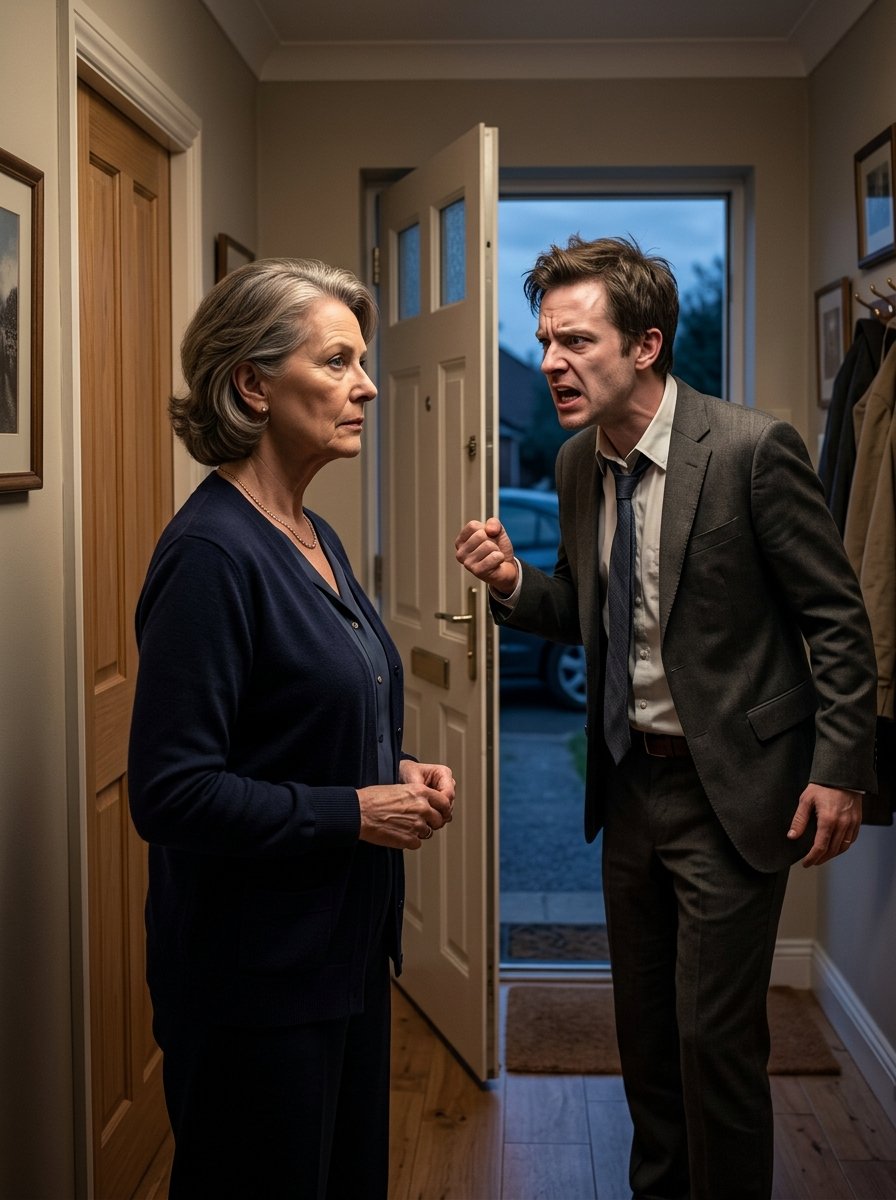
Because the funding fell through, Arthur’s commercial development deal collapsed before the closing deadline, triggering heavy financial penalties from his investment partners and bringing down his entire house of cards. At six o’clock that evening, my front door bell began ringing frantically, and when I opened it, I found Arthur standing on my porch with messy hair, a loose tie, and a face pale with absolute fury.
He yelled at me, asking if I was happy now that the bank pulled the financing and the whole development project was dead on arrival. He pushed past me into the entryway, shouting that his partners pulled their capital and that the state licensing board sent an investigator to his office two hours ago. I stood my ground in the hallway and told him he brought this on himself by forging documents and risking everything I owned. He threw his hands in the air and shouted that he was going to pay me back in ninety days, and that all I had to do was sit still and keep my mouth shut. He told me his reputation in this city was destroyed, his firm was facing a formal review, and he could lose his broker’s license, asking me if that was really what I wanted to do to my own son.
I told him he risked my home and the money his mother and I worked for, and that he lied to my face in my own kitchen. He pleaded with us being family, saying you don’t call lawyers and state investigators on your own blood, and that I could have talked to him again before doing something so drastic. I reminded him that I did talk to him in his office, and he told me it was just a business decision and that I was making a scene over a technicality.
He told me he didn’t have the money to pay the contract penalties now, and that if the board revoked his license, he would lose everything he had built over the past decade. I told him he would have to figure out how to rebuild his life, just like I would have had to do if his deal failed and the bank took my roof out from under me. I told him to get out of my house, and he stared at me for a long, heavy moment, waiting for me to soften or apologize, but I didn’t move an inch. He turned around, slammed the front door behind him so hard the porch light rattled in its socket, and drove away into the dusk without looking back. The formal proceedings took six grueling months to resolve with Mr. Vance handling the communications, and the state financial regulators completed their investigation into Arthur’s brokerage practices with undeniable evidence of improper document execution.
The bridge loan was officially rescinded, stripping the secondary lien off my property title completely, and Prudential processed the court-ordered restoration of my funds, returning the full $84,660 balance back to my retirement annuity along with retroactive dividend payments. Arthur’s brokerage firm disbanded under the weight of the investigation, he received a two-year suspension of his mortgage broker license, and he was ordered to pay administrative fines to the state board. To cover his legal costs and mounting debts, he had to sell his Buick and move out of his downtown condo into a small rental apartment on the other side of the county.
We haven’t spoken since the night he stood in my hallway and yelled at me about his commercial project going under. My daughter Sarah, who lives down in Des Moines, stood by my decision after I sent her copies of the court filings and showed her what her brother had tried to pull behind our backs. She came up for a visit last month, and for the first time in a very long time, the house felt quiet, safe, and truly mine from the foundation to the rafters. It is early spring now, and the winter snow has finally melted off the lawn, leaving behind clean dirt and the first green shoots of hostas along the front walkway where my wife used to plant her garden. Yesterday afternoon, a local contractor finished installing new asphalt shingles on my roof, fixing the leaks that had worried me through three winters of heavy ice dams.
I paid for the work using a small portion of my restored annuity dividend, writing a check from my own checkbook right here at the kitchen table without asking anyone for permission or help. When the contractor packed up his truck and drove down the gravel drive, I walked outside into the cool afternoon air and stood by the mailbox, looking up at the house. The new dark gray shingles looked sturdy, neat, and secure against the grey spring sky, holding fast against the wind just like they were built to do. I reached into my pocket, pulled out my house key, and turned it over in my hand, feeling the familiar worn brass edges that had opened this door for thirty-four years. The house was modest, quiet, and completely mine, built on honest work and protected by my own two hands, and I unlocked the front door, walked inside, and shut it firmly behind me.